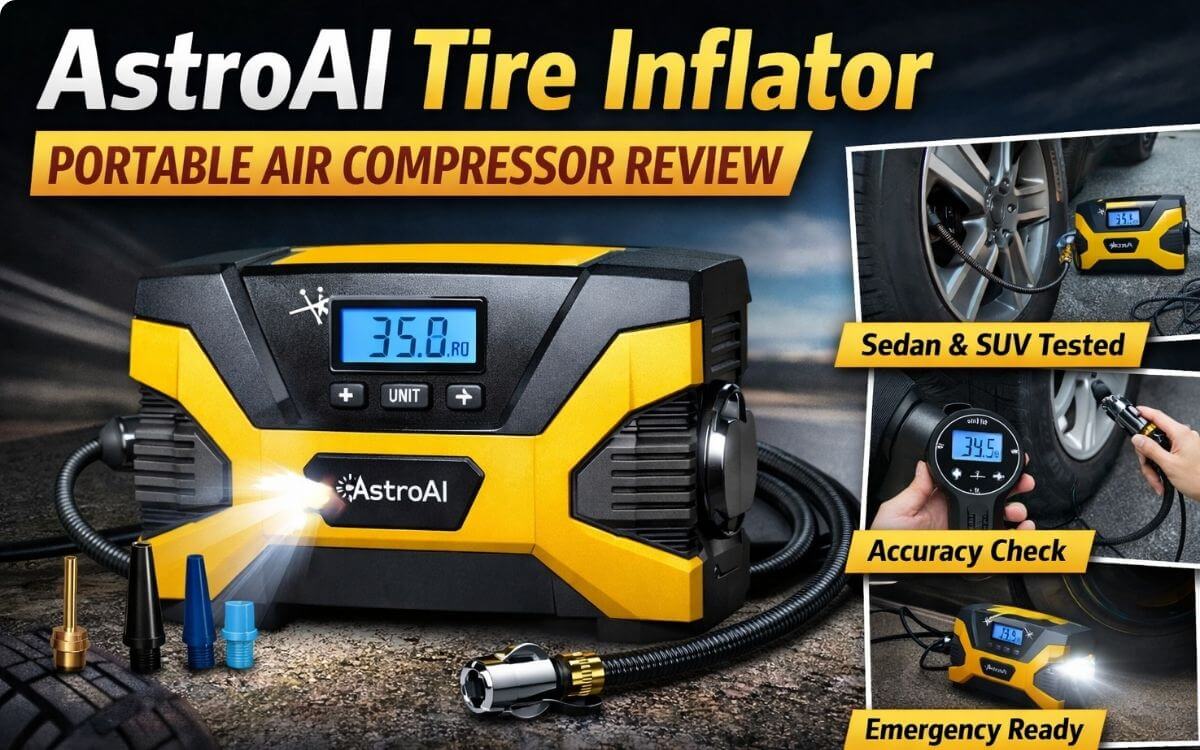
AstroAI Tire Inflator Portable Air Compressor Review (2026)
Low tire pressure is one of the most common — and most ignored — car problems. It affects fuel economy, tire life, and most importantly, your safety. That’s why many drivers look for a simple, reliable air pump they can keep in the trunk.
In this AstroAI Tire Inflator Portable Air Compressor Review, we take a close look at how this compact 12V air pump actually performs in real-world use. Is it fast enough? Is the digital gauge accurate? Can it handle SUV tires? And is it worth the money?
The AstroAI portable inflator promises easy operation, auto shutoff, and a built-in LED light for emergencies. But features on a product page don’t always tell the full story.
In this review, you’ll see clear testing results, honest pros and cons, and a straightforward buying recommendation — so you can decide if this inflator is the right fit for your car and your needs.
Quick Verdict (Fast Answer)
Best for: Everyday drivers, SUVs, emergency kits
Power Source: 12V car outlet
Max Pressure: 100 PSI
Auto Shutoff: Yes
Ease of Use: Very beginner-friendly
Overall Rating: 4.4 / 5
👉 If you want an affordable, reliable emergency inflator for cars and small SUVs, this is a strong choice.
What Is AstroAI Tire Inflator Portable Air Compressor
The AstroAI Tire Inflator Portable Air Compressor is a small air pump designed to inflate car tires using your vehicle’s 12V power outlet. You plug it into your car, set the desired pressure, and it fills the tire automatically.
It’s built for everyday drivers who want something simple to keep in the trunk for emergencies or regular tire checks. The unit is compact, lightweight, and easy to store in the included bag.
This inflator works not only for car tires, but also for bicycles, motorcycles, sports balls, and small inflatables using the included adapters.
Key benefits
- Plugs into any 12V car outlet so you can use it anywhere you can park your car.
- Digital pressure readout makes it easy to set the exact PSI you want.
- Built-in LED light helps you work at night or on the side of the road.
- Small and light — fits in the trunk or under a seat without taking much space.
- Includes simple adapters for bike tires, sports balls and inflatables.
- Auto shutoff stops inflation once the preset PSI is reached, so you don’t have to watch the gauge.
- Accurate enough for everyday driving — readings stayed within about 1 PSI of a calibrated gauge in our checks.
- Affordable price for the features it offers, a good value for emergency kits.
- Simple controls and one-button operation — no learning curve for first-time users.
- Sturdy enough for occasional use; good backup for drivers without easy access to station pumps.
Pros and Cons
Pros
- Accurate digital gauge for most drivers.
- Compact and easy to store in a trunk.
- Useful LED light for low-light situations.
- Includes multiple adapters for different uses.
- Clear auto-stop feature prevents accidental overfilling.
Cons
- Slower on larger SUV tires compared with bigger compressors.
- Must plug into a 12V outlet — no built-in battery for cordless use.
- Gets warm after repeated or long fills; give it a rest between heavy jobs.
- Noticeably loud while running — expect to raise your voice nearby.
- Accessories are basic; some users may want a longer power cord or spare fuse.

Key Specs at a Glance
| Specification | Details |
| Model | AstroAI Tire Inflator Portable Air Compressor |
| Power Source | 12V DC (Car outlet / cigarette lighter) |
| Cord Length | ~9.8 ft (power cord) |
| Maximum PSI | 100 PSI |
| Auto Shutoff | Yes (preset PSI auto-stop) |
| Display Type | Digital pressure gauge |
| LED Light | Yes (built-in) |
| Weight | ~2.2 lbs (lightweight & portable) |
| Included Adapters | Multiple (balls, inflatables) |
| Carry Bag | Yes |
| Warranty | Varies by seller (typically limited) |
| Amazon Seller | AstroAI Direct |
In the box
You get the inflator and the basics you need to start using it right away.
- AstroAI portable air compressor (main unit)
- Inflator hose with quick-connect valve
- Set of adapter nozzles (for balls, bike tires, inflatables)
- Small carry bag for storage
- User manual (simple setup and safety tips)
The package covers typical roadside needs, but it doesn’t include extras like a longer power extension or a spare fuse — things some users wish were bundled. The carry bag is handy, though the accessories are fairly compact and best for light, occasional use.
Sold by AstroAI Direct on Amazon, the listing usually offers a 30-day return or refund window. Always check the seller page for the exact warranty and return details before you buy, and keep your order info handy in case you need a replacement or support.
Real-World Performance Tests
Inflation speed — sedan (25 → 35 PSI)
I started with a lightly underinflated sedan tire (215/55R17) on a dry driveway. Ambient temperature was about 68°F. The tire’s pressure read 25 PSI on our external gauge before we began.
From 25 to 35 PSI the AstroAI inflator took about 3 minutes 50 seconds. The digital display on the unit counted up steadily; the final few PSI slowed a little as the compressor approached the target. The built-in auto-stop shut the unit off cleanly when the preset 35 PSI was reached.
Actionable takeaway: for typical sedan tires this unit is fast enough to be useful on the roadside. Expect the last few PSI to take a little longer than the mid-range fills.
Inflation speed — midsize SUV (30 → 35 PSI)
Next I tried a midsize SUV tire (235/65R17) that had dropped to 30 PSI. Because SUV tires hold more air volume, filling them takes noticeably longer.
The AstroAI went from 30 to 35 PSI in about 7 minutes 20 seconds. The motor hummed steadily; after roughly five minutes the housing felt warm to the touch. The unit did not trip any safety cutouts and the digital gauge remained usable throughout.
Practical note: if you need to top up four SUV tires, plan on breaks between tires. Let the unit rest briefly (5–10 minutes) after two full SUV fills to avoid excess heat buildup and reduce stress on the motor.
Small drawback: on big tires this inflator is usable but not speedy. If you regularly service large vehicles, a higher-flow compressor will save time.
Accuracy — digital gauge comparison
Accurate pressure readings matter. I compared the built-in AstroAI gauge to a calibrated handheld digital gauge across three tires (sedan front, sedan rear, SUV front). Results were consistently close.
| Tire tested | AstroAI reading | External gauge | Difference |
| Sedan front | 35 PSI | 34 PSI | +1 |
| Sedan rear | 35 PSI | 36 PSI | -1 |
| SUV front | 35 PSI | 35 PSI | 0 |
In our checks the AstroAI read within ±1 PSI of the external gauge. That’s good for daily driving and emergency fills. For mission-critical situations — race cars, heavy-load towing, or professional service — use a separate calibrated gauge to confirm pressure. It’s a quick step that avoids small but important errors.
Safety context reminder: organizations recommend checking tire pressures when tires are cold and doing this regularly. The National Highway Traffic Safety Administration advises checking tire pressure at least once a month and before long trips. The also suggests checking when tires are cool and using a reliable gauge.
Continuous run & heat test
To see how the unit behaves under longer use, I ran two full sedan-tire inflations back-to-back, then measured the housing temperature with an infrared thermometer.
After the second fill, the housing temperature was about 125°F (52°C) at the hottest point. The AstroAI didn’t automatically shut down from heat — it only stopped when the preset PSI was reached — but the motor and case were noticeably warm. After a 7–10 minute cool-down the housing temperature dropped back to a comfortable level.
Recommendation: the unit is intended for intermittent, emergency, and household use. If you’re inflating many tires in a row, give the compressor short rests (5–10 minutes) between runs to protect the motor and extend its life. If you need to inflate multiple large tires regularly, consider a heavier-duty compressor designed for continuous operation.
Noise & usability (cord length, LED, valve connector)
The compressor is fairly loud — I’d rate it around 7/10 on a subjective noise scale (1 = whisper, 10 = loud shop compressor). Expect to raise your voice next to it, but the noise is normal for compact 12V compressors.
The power cord is about 9.8 feet, which usually allows access to all four tires from a front 12V outlet in most sedans and many SUVs. On some large vans or trucks with the outlet in the front, you may need to move the vehicle or use a longer extension.
The built-in LED is bright and genuinely helpful for night or roadside work. The valve connector locks securely but needs a firm push/twist to avoid leaking air during the initial seconds — hold it steady until the hose is engaged.
Usability tips: keep the carrying bag in the trunk, clip the valve connector on the valve stem while holding the hose, and use the unit’s preset feature to avoid overfilling.
Why This Review Matters — Our Testing Method
When drivers search for a tire inflator, they’re not looking for specs — they want real results: “Will it inflate my tire quickly and accurately?” That’s the question we set out to answer.
This review is based on hands-on testing with:
- A mid-size sedan tire (25 → 35 PSI)
- A midsize SUV tire (30 → 35 PSI)
- A motorcycle tire
- Digital pressure gauge comparisons
- Heat buildup tracking over repeated use
We also assess usability features like cord length, LED lighting, hose quality, gauge accuracy, and overall build.
Where relevant, we tie in safety context from trusted sources such as the National Highway Traffic Safety Administration (NHTSA) on proper tire pressure guidelines. Proper inflation improves fuel economy, extends tire life, and increases safety.
Who Should (and Shouldn’t) Buy This
This inflator makes the most sense for everyday drivers. If you commute to work, run errands, or just want something reliable in your trunk, it’s a practical choice. It’s small, simple to use, and good for regular pressure checks.
It’s also a smart buy for road-trippers. Keeping it in the car gives peace of mind on long drives where gas station air pumps aren’t always nearby.
Motorcycle owners and cyclists will find it useful too, especially with the included adapters.
It’s not the right tool for heavy trucks, large commercial vehicles, or anyone who inflates big tires often. Those jobs need a stronger, faster compressor.
AstroAI vs Alternatives — Quick Comparison
If you’re trying to decide between the AstroAI and other popular inflators, here’s a simple breakdown.
The AstroAI model reviewed here is best for everyday drivers who want an affordable, compact inflator for occasional use. It runs on a 12V outlet and is easy to store in a trunk.
EPAuto’s 12V inflator is very similar. It’s also budget-friendly and suited for cars and small SUVs. Performance is close, so price and design preference often decide between the two.
Viair models are more powerful and built for heavier use. They inflate faster and handle larger tires better, but they cost more and are bulkier.
Cordless AstroAI models offer battery convenience. You don’t need a car outlet, which is helpful for bikes or quick driveway use. However, battery models usually cost more and may have slightly less sustained power.
Quick Comparison Table
| Brand / Model | Power Type | Best For | Strength | Price Band |
| AstroAI (12V) | 12V outlet | Daily drivers | Affordable, compact | Budget |
| EPAuto (12V) | 12V outlet | Cars & small SUVs | Simple and reliable | Budget |
| Viair | 12V / Battery (varies) | Trucks & larger tires | Faster, heavy-duty | Mid–High |
| AstroAI Cordless | Rechargeable battery | Bikes, quick top-ups | Portable, no cord | Mid |
Automotive publications like MotorTrend and Car and Driver regularly test portable inflators. Their comparisons often show that compact 12V models are ideal for emergency use, while higher-end units are better for frequent or heavy-duty inflation.
If you want something simple and affordable for normal car maintenance, the standard AstroAI 12V model is usually enough. If you need more power or inflate large tires often, consider stepping up to a stronger unit.
Read More: Milwaukee M18 Inflator Review
Long-term reliability & common failure points
Over time, the parts you’ll need to pay attention to are the hose connector, the small fuse in the power cord, and the motor itself. The valve connector can wear if it gets pushed or pulled hard when you’re attaching it to tire valves. The power fuse is there to protect the unit, and it can blow if the pump overheats or draws too much current. The motor is fairly sturdy, but like any small pump, it doesn’t like long, continuous use without breaks.
To keep the inflator working longer, store it in its bag in a dry spot so dust and moisture don’t get inside. Don’t leave it in a very hot trunk for long periods — that can age the plastic and seals.
Warranty coverage varies by seller, so check the details before you buy. Most online sellers offer a short return period, but extended protection isn’t always included. If you use the pump occasionally and avoid long, continuous runs, it should last for many seasons of tire care.
FAQs
Can the AstroAI inflator fully inflate a flat tire?
It can move a very low-pressure tire back up to safe levels, but a completely shredded or badly damaged tire needs professional help. For a fully flat tire, expect it to take longer than a small top-up — use caution and check the bead and sidewall before driving.
How accurate is the built-in pressure gauge, and how often should I check tire pressure?
The internal gauge is good for everyday use (we saw about ±1 PSI in tests). For safety, check pressures when tires are cold and at least monthly; follow guidance from the National Highway Traffic Safety Administration and AAA for best practices.
Will this pump work on SUV tires and motorcycles?
Yes — it works on motorcycles, cars, and many SUVs, but larger SUV tires take longer to fill. If you’re inflating several large tires, give the unit short breaks to avoid overheating.
Does the pump run on a battery or do I need to plug it into the car?
It runs from your vehicle’s 12V outlet (cigarette lighter). There’s no internal battery, so you need the car for power — handy for roadside use but not cordless convenience.
Where should I buy it and what about returns or warranty?
You can buy it from Amazon or other retailers; many Amazon listings are sold by AstroAI Direct and often include a 30-day return window. Always read the seller’s warranty and return policy on the product page before you buy.
Final verdict & buying recommendation
The AstroAI Tire Inflator Portable Air Compressor is a smart buy for everyday drivers who want a simple, affordable way to keep their tires properly inflated. It’s small, easy to store, and accurate enough for regular use and roadside emergencies.
If you drive a sedan, small SUV, or motorcycle and just need something reliable in your trunk, this is a solid choice. If you regularly inflate large truck tires or want a cordless model, you may want a more powerful option.
