Motorcycle Tire Load Rating Chart
Last updated on March 1st, 2026
Choosing the wrong tire load rating is one of those small mistakes that can quickly become a big, dangerous problem — overheating, tread separation, or a sudden blowout can happen when a tire is asked to carry more than it’s rated for. That’s why getting this right matters every time you replace tires.
Below you’ll find a clear motorcycle tire load rating chart (load index 20–99) to make choosing easier. The load index is the number stamped on the tire that tells you how much weight that tire can safely carry at its rated pressure.
This guide walks you through how to read the chart, how to calculate the load rating you actually need for your bike, and practical safety tips. You’ll also learn why tire pressure changes carrying capacity and how load index and speed rating work together. Read these steps before your next tire purchase — a few minutes of checking now can prevent a costly or dangerous mistake later.
Motorcycle Tire Load Rating Chart (Load Index 20 → 99)
| Load Index | Weight Capacity (kg) | Weight Capacity (lbs) |
| 20 | 80 | 176 |
| 21 | 82.5 | 182 |
| 22 | 85 | 187 |
| 23 | 87.5 | 193 |
| 24 | 90 | 198 |
| 25 | 92.5 | 204 |
| 26 | 95 | 209 |
| 27 | 97.5 | 215 |
| 28 | 100 | 220 |
| 29 | 103 | 227 |
| 30 | 106 | 234 |
| 31 | 109 | 240 |
| 32 | 112 | 247 |
| 33 | 115 | 254 |
| 34 | 118 | 260 |
| 35 | 121 | 267 |
| 36 | 125 | 276 |
| 37 | 128 | 282 |
| 38 | 132 | 291 |
| 39 | 136 | 300 |
| 40 | 140 | 309 |
| 41 | 145 | 320 |
| 42 | 150 | 331 |
| 43 | 155 | 342 |
| 44 | 160 | 353 |
| 45 | 165 | 364 |
| 46 | 170 | 375 |
| 47 | 175 | 386 |
| 48 | 180 | 397 |
| 49 | 185 | 408 |
| 50 | 190 | 419 |
| 51 | 195 | 430 |
| 52 | 200 | 441 |
| 53 | 206 | 454 |
| 54 | 212 | 467 |
| 55 | 218 | 481 |
| 56 | 224 | 494 |
| 57 | 230 | 507 |
| 58 | 236 | 520 |
| 59 | 243 | 536 |
| 60 | 250 | 551 |
| 61 | 257 | 567 |
| 62 | 265 | 584 |
| 63 | 272 | 600 |
| 64 | 280 | 617 |
| 65 | 290 | 639 |
| 66 | 300 | 661 |
| 67 | 307 | 677 |
| 68 | 315 | 694 |
| 69 | 325 | 717 |
| 70 | 335 | 739 |
| 71 | 345 | 761 |
| 72 | 355 | 783 |
| 73 | 365 | 805 |
| 74 | 375 | 827 |
| 75 | 387 | 853 |
| 76 | 400 | 882 |
| 77 | 412 | 908 |
| 78 | 425 | 937 |
| 79 | 437 | 963 |
| 80 | 450 | 992 |
| 81 | 462 | 1019 |
| 82 | 475 | 1047 |
| 83 | 487 | 1074 |
| 84 | 500 | 1102 |
| 85 | 515 | 1135 |
| 86 | 530 | 1168 |
| 87 | 545 | 1202 |
| 88 | 560 | 1235 |
| 89 | 580 | 1279 |
| 90 | 600 | 1323 |
| 91 | 615 | 1356 |
| 92 | 630 | 1389 |
| 93 | 650 | 1433 |
| 94 | 670 | 1477 |
| 95 | 690 | 1521 |
| 96 | 710 | 1565 |
| 97 | 730 | 1609 |
| 98 | 750 | 1653 |
| 99 | 775 | 1709 |
What Tire Load Rating Numbers Mean
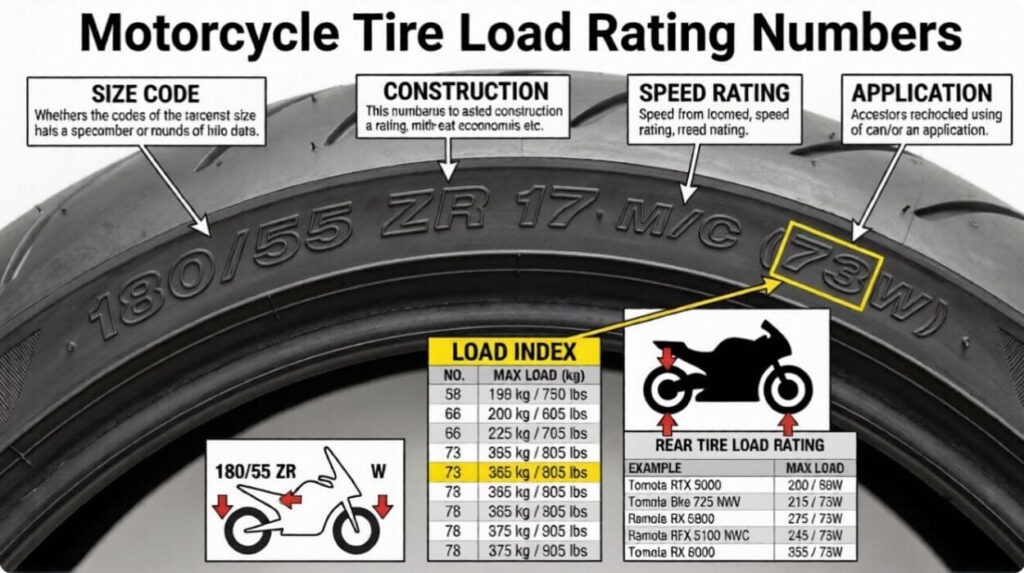
What the numbers mean: The load index is a simple code that tells you how much weight one tire can safely carry. It isn’t the weight itself — it’s a number you look up in a standard table to find the actual kilos or pounds. Think of it as a label that points to a weight value.
Where to find the number on a tire: Look at the tire’s sidewall — the raised writing around the edge. The load index usually sits beside the tire size information. For example, after the size you might see a two-digit number like 58 or 73, often followed by a letter. That two-digit number is the load index.
How the load index works: Each load index number matches a fixed weight in kilograms and pounds set by industry tables. You don’t calculate it by math; you read the number and check the chart to see the exact capacity per tyre. Those capacities assume the tyre is inflated correctly and in normal conditions.
Difference between load index and speed rating: The load index is about weight. The speed rating is a letter (A, H, V, W, etc.) that shows the tyre’s tested maximum safe speed. They’re different measurements but usually written together on the sidewall — number then letter. One tells you how much weight the tyre can hold, the other how fast it can safely go.
How to Read the Chart Correctly
Reading the load chart is easier than it seems. Start by finding the load index number on your tire’s sidewall — it’s usually a two-digit number right after the size. That’s your key to the chart.
Next, look up that number in the load rating chart. The chart will show the exact weight the tire can safely carry in kilograms and pounds. This is the maximum weight for one tire, so keep that in mind when calculating for your bike.
Finally, compare that weight with the total weight of your bike, yourself, any passenger, and luggage. Make sure each tire’s load capacity meets or exceeds that per-tire weight. If it doesn’t, you’ll need a tire with a higher load index.
A small tip: even if a tire meets the minimum requirement, adding a small safety margin is smart. Overloading a tire can reduce grip, cause uneven wear, and increase the risk of a blowout.
How to calculate the load rating you actually need
Start with the bike’s GVWR — that’s the maximum total weight the motorcycle is built to carry. You’ll find it on the frame/swingarm label or in the owner’s manual.
Add up everything you’ll carry: the motorcycle’s weight, the rider, any passenger, fuel, gear and luggage. That total is the real load you must plan for. The Motorcycle Industry Council’s tire guide uses this same method in its load calculator.
Don’t assume the weight splits 50/50 between front and rear. Bikes usually put more weight on the rear — especially with a passenger or luggage — so size the rear tire for the heavier share. Tools and guides recommend using the axle or manufacturer split when you can.
Once you have the total and an estimated front/rear split, calculate the load on each tire. Example: total 300 kg with a 40/60 split = 120 kg on the front, 180 kg on the rear. Use that per-tire weight to pick a load index from a standard chart.
Quick examples (simple numbers to show the math):
Sport bike: bike + rider + gear = 295 kg. Assume a 43/57 split → front ≈ 127 kg, rear ≈ 168 kg.
Look up those per-tire values on the load-index chart and choose the next index that equals or exceeds each number.
Touring bike (with passenger): bike + rider + passenger + luggage = 550 kg. Assume 40/60 split → front 220 kg, rear 330 kg.
Pick tires whose load index covers at least 220 kg for the front and 330 kg for the rear.
ADV bike (with luggage): total ≈ 360 kg, assume 35/65 split → front 126 kg, rear 234 kg.
Again, match those per-tire numbers to the load-index chart.
A quick safety note: always meet or exceed the manufacturer’s minimum load index and any axle or GAWR (axle) limits listed in the manual. Don’t downgrade to a lower index even if the tire “fits.”
If you want, I can run the numbers for your exact bike, rider weight, and luggage and tell you the minimum per-tire loads to look up on the chart.
Minimum vs Recommended Load Rating
Not all tires with the minimum load rating are safe for every situation. The minimum rating only tells you the lightest load a tire can carry. If you add a passenger, luggage, or go on a long trip, that minimum might not be enough. Using a tire at its exact limit can make it feel stiff or reduce grip in corners.
Choosing a recommended or higher load rating gives extra safety and a more comfortable ride. It doesn’t harm your bike, though higher-rated tires can feel slightly firmer and may weigh a little more.
Here’s a simple guide:
| Type | When to Use |
| Minimum | Light solo riding |
| Recommended | Daily riding |
| Higher rating | Touring or heavy load |
In short, always consider your actual riding situation. A tire that’s just at the minimum works for quick solo trips, but most riders are safer sticking with the recommended or slightly higher rating.
Common Mistakes Riders Make When Using Load Charts
Many riders make simple mistakes that can put them at risk, even if they’re checking load charts. One common error is ignoring the weight of a passenger or extra gear. A tire that’s fine for just the rider may be overloaded once someone else hops on.
Another mistake is choosing tires only by size. Two tires can be the same width and diameter but have very different load ratings. Assuming they’re the same can lead to under-rated tires on your bike.
Some riders also forget that tire pressure affects load capacity. Even a tire with the correct load rating can fail if it’s underinflated. Low pressure reduces the weight a tire can safely carry and can cause uneven wear or overheating.
Being careful with these details — considering passengers, gear, tire rating, and pressure — helps your tires last longer and keeps your ride safe.
Why Tire Load Ratings Matter for Safety
Tire load ratings are more than just numbers—they directly affect your safety on the road. Using a tire with the correct rating helps prevent blowouts, which can happen when a tire is overloaded and overheats.
The right load rating also improves handling. Tires that are under or over their ideal load can feel unpredictable in corners or at higher speeds. Properly rated tires wear more evenly, which extends their life and saves money in the long run.
Finally, correct load ratings help maintain braking stability. Overloaded tires can increase stopping distance and reduce traction, especially in wet or emergency situations. Choosing tires that match your actual weight keeps your bike safer and more responsive.
How Tire Pressure Affects Load Capacity
Tire pressure and load capacity go hand in hand. A tire is designed to carry its rated weight only when it’s inflated to the recommended pressure. If the pressure is too low, the tire can’t support as much weight, which increases the risk of overheating, uneven wear, and even blowouts.
Keeping your tires at the correct pressure ensures they perform as expected and last longer. Here’s a quick reference to show how pressure affects load capacity:
| Tire Pressure | Load Capacity |
| Recommended PSI | Full rated capacity |
| Slightly below | Reduced capacity, softer ride |
| Significantly low | Risk of failure, uneven wear |
Checking pressure regularly is simple and can prevent problems before they happen. Even a small drop in PSI can make a noticeable difference in how much weight your tires can safely handle.
Motorcycle Tire Load Index vs Speed Rating — how they work together
Tire markings show two different limits: how much weight a tire can carry (load index) and how fast it can safely go (speed rating). You need both to pick a tire that’s safe for your bike and riding style.
Speed rating letters:
- H — good for typical highway speeds (about 210 km/h / 130 mph).
- V — higher (about 240 km/h / 149 mph).
- W — even higher (about 270 km/h / 168 mph).
- ZR — used for very high-speed tires (historically meant above 149 mph; often paired with a W or higher).
Tires with higher speed ratings are built to resist more heat. That matters because heat is the main enemy of tire structure and performance.
At very high speeds, heat and flex can reduce a tire’s actual weight capacity. In simple terms: a tire might carry its rated load at normal speeds but carry less when pushed hard and hot. That’s why matching both ratings matters.
Always match or exceed the bike maker’s original (OEM) load index and speed rating. Using a tire with a higher speed rating or load index is usually safe; using one below the OEM spec is risky.
| Topic | What it means | Quick takeaway |
| Load index | Number that tells weight capacity per tire | Pick a tire with load index ≥ OEM requirement |
| Speed rating | Letter that shows safe sustained speed / heat resistance | Higher letter = better heat handling at speed |
| How they interact | High speed raises heat and can lower real load capacity | Always meet/exceed both ratings for your riding use |
Quick Reference Chart for Popular Motorcycle Types
Here’s a simple quick reference chart to give you a general idea of common load index ranges. These are typical values, not exact requirements. Always check your owner’s manual for your specific model.
| Motorcycle Type | Typical Rear Load Index | Typical Front Load Index |
| Sportbike | 73–77 | 55–58 |
| Cruiser | 71–79 | 55–60 |
| Touring | 77–84 | 60–66 |
| Adventure (ADV) | 69–80 | 54–60 |
| Dual Sport | 60–70 | 47–54 |
| Lightweight / 300cc Class | 62–70 | 50–54 |
| Maxi-Scooter | 70–84 | 55–60 |
Rear tires usually carry more weight, especially on touring bikes and when riding with a passenger or luggage. That’s why the rear load index is often higher than the front.
Use this chart as a starting point, not a final answer. The correct load index always depends on your exact motorcycle and how you use it.
Read More: Motorcycle Tire Conversion Chart
FAQ
Can I use a tire with a higher load rating?
Yes. Using a tire with a higher load rating is safe and often a good idea, especially if you carry passengers or luggage. The only minor trade-off is that higher-rated tires can feel slightly stiffer and may weigh a bit more, but this is usually not noticeable for most riders.
What happens if the load rating is too low?
If a tire’s load rating is too low for your bike and weight, it can overheat, wear unevenly, or even fail while riding. This increases the risk of blowouts, reduced handling, and longer stopping distances.
Is the load index per tire or total?
The load index is per tire. You need to make sure each tire can support the portion of the total weight that it carries. For most motorcycles, divide the total loaded weight by two to find the required per-tire load.
Does speed rating affect load capacity?
Not directly. The speed rating tells you the maximum safe speed for the tire. However, at very high speeds, a tire carrying close to its maximum load can heat up faster, which effectively reduces its safe carrying capacity. Always check both load index and speed rating for your riding conditions.
Final Thoughts — Choosing the Right Tire Safely
A tire load rating chart is more than just numbers — it’s a key tool for keeping your ride safe. Using it correctly helps you pick tires that can handle your bike, your weight, and any passengers or luggage without risk.
Always check your motorcycle’s owner manual before buying new tires. The manual often lists the exact load index and pressure your bike needs, which ensures you stay within safe limits.
Remember, safety should always come before price. A slightly more expensive tire with the correct load rating is far better than a cheaper one that can’t handle your weight. Properly rated tires protect you, improve handling, and give you peace of mind on every ride.
