Run Flat Tires (Ultimate Guide 2026)
You’re driving at night and suddenly your tire loses pressure… What now?
There’s no safe place to stop, and changing a tire in the dark doesn’t feel like a good option.
This is exactly the kind of situation run flat tires are designed for. They let you keep driving for a short distance, giving you time to reach a safer place instead of stopping right away.
In this guide, you’ll learn how run flat tires actually work, their real pros and cons, how much they cost over time, and whether they’re the right choice for your driving needs.
In simple terms, run flat tires are built to keep supporting your car even after losing air, so you can continue driving for a limited distance instead of stopping immediately.
What Are Run Flat Tires?
Run flat tires are designed to keep working even after they lose air pressure. In a regular tire, a puncture usually means you have to stop immediately. With a run flat tire, you can keep driving for a short distance—enough to reach a repair shop safely.
Most run flat tires can handle around 50–80 km at reduced speed after a puncture. This gives you time and control, instead of dealing with a sudden roadside emergency.
Types of Run Flat Tires
There are two main types of run flat tires.
Self-Supporting Run Flat Tires
This is the most common type. The tire has stronger sidewalls than a regular tire, so it can hold the car’s weight even when air pressure drops.
If the tire gets punctured, the stiff sidewalls help it stay upright for a short distance. That is why many cars with run-flat tires do not need a spare tire in the trunk.
Support Ring System Tires
This type uses a strong ring or insert inside the tire. If the tire loses air, the ring supports the car and keeps the wheel from sitting directly on the road.
This design is less common, but it works well in some special vehicles. It is more complicated than the self-supporting style and is usually not found on everyday passenger cars.
How They Differ from Regular Tires
The biggest difference is what happens after a puncture.
With a regular tire, you usually have to stop right away to avoid damage or losing control. With a run flat tire, you can keep driving for a while, which makes things much safer in busy traffic or at night.
However, there’s a trade-off. Run flat tires tend to feel a bit firmer on the road. You might notice a slightly rougher ride compared to regular tires, especially on uneven roads. They also cost more to replace, which is something to keep in mind.
Why Modern Cars Are Using Them
Many newer cars, especially premium models, come with run flat tires from the factory. There are a few reasons for this.
First, safety. Drivers don’t have to stop immediately in risky situations like highways or dark areas.
Second, convenience. Since you can drive after a puncture, many cars don’t include a spare tire anymore. This saves space and reduces vehicle weight.
But it’s not perfect for everyone. In areas with rough roads or limited tire services, some drivers still prefer regular tires because they’re easier and cheaper to deal with.
How Run Flat Tires Work
Run flat tires are built to handle a loss of air without collapsing right away. The key difference is in the sidewalls—the outer edges of the tire.
These sidewalls are much stronger and thicker than those on regular tires. They don’t rely only on air pressure to hold the car up. Instead, they can carry the weight of the vehicle on their own for a short time.
When everything is normal, the tire works like any other tire. Air pressure supports the load, and the sidewalls stay firm but flexible.
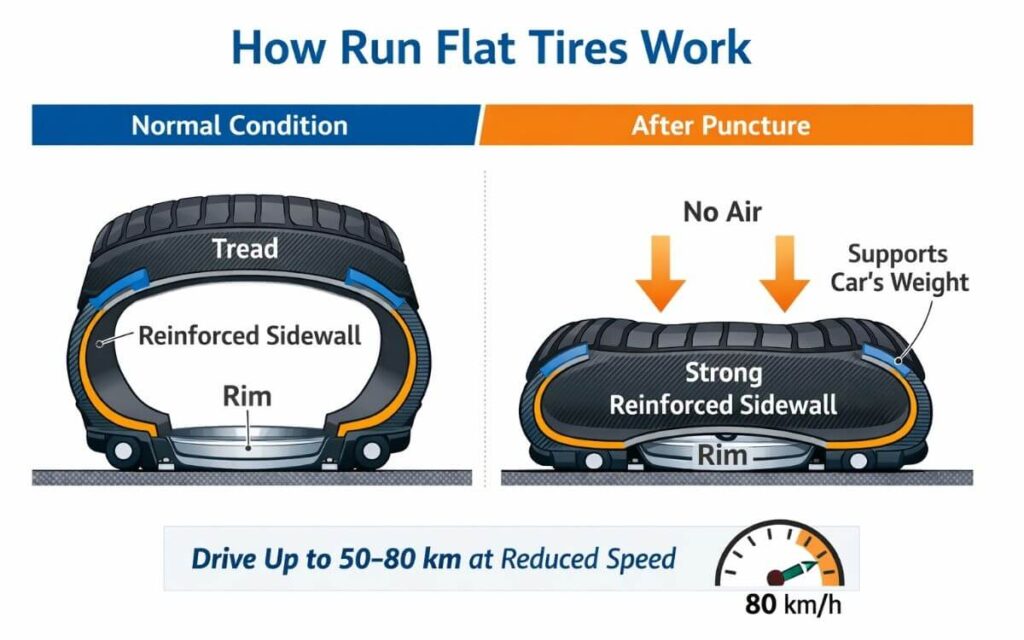
The real difference shows up when there’s a puncture.
If a sharp object causes a leak, the air slowly or quickly escapes. In a regular tire, this would cause the tire to flatten and make driving unsafe almost immediately.
With a run flat tire, the reinforced sidewalls take over. They hold the shape of the tire and keep it from folding under the car. This allows you to keep driving without losing full control.
At first, you might not even feel a big change. But after a short distance, the ride usually becomes firmer and a bit rough. That’s a sign the tire is no longer supported by air.
Most cars with run flat tires also have a tire pressure warning system. This alerts you as soon as the pressure drops, so you know something is wrong even if the car still feels stable.
There are limits you need to respect.
- You can usually drive about 50 to 80 kilometers after a puncture
- Your speed should stay under 80 km/h
These limits are not flexible. Pushing beyond them can damage the tire completely and may even affect the wheel.
One thing to keep in mind is that driving on a run flat tire after a puncture puts extra stress on it. Even if it still looks fine from the outside, internal damage can happen. That’s why many of these tires need to be replaced rather than repaired.
In short, run flat tires don’t prevent punctures. They just give you time and control to deal with the situation safely instead of stopping immediately in a risky spot.
Real-World Scenario: What Happens After a Puncture?
Imagine you’re driving and your tire gets punctured.
With a run flat tire, you usually won’t hear a loud noise or feel a sudden drop.
The tire starts losing pressure, but it doesn’t collapse. The car keeps moving in a stable way, especially at first.
Within a few seconds or minutes, a warning light shows up on your dashboard. This is your first clear sign that something is wrong.
At this stage, the car may still feel normal. Steering and braking won’t change much right away, which can be a bit misleading. It’s easy to think everything is fine—but it’s not.
What you should do next is simple.
Slow down gently. Don’t brake hard or make sharp turns.
Start looking for a safe place to stop or a nearby repair shop.
You can keep driving for a short distance, but this is not the time to continue your trip like nothing happened. The goal is to reach safety, not your final destination.
Here’s what you should avoid:
- Don’t keep driving at high speed
- Don’t ignore the warning light
- Don’t drive longer than necessary
Pushing the tire too far can cause permanent damage. In many cases, that means you’ll have to replace it instead of repairing it.
The tire becomes unsafe when you go beyond its limits—either by driving too fast or too far. You may start to feel the ride getting rougher, and handling can slowly get worse.
If you notice vibrations, reduced control, or the car pulling to one side, it’s a sign you need to stop as soon as possible.
Run flat tires give you extra time, not unlimited freedom. Using that time wisely is what keeps you safe.
Advantages of Run Flat Tires (Real-Life Benefits)
Safety: No Sudden Roadside Stop
One of the biggest benefits is safety. If a tire loses air, you don’t have to stop immediately in a risky spot.
Instead of pulling over on a busy highway or a narrow road, you can keep driving to a safer place. This is especially helpful in areas with heavy traffic or poor lighting.
A small downside is that some drivers feel too confident and delay stopping. It’s still important to act quickly and not push the limits.
Control: Better Stability After a Blowout
With regular tires, a sudden blowout can make the car hard to control. The vehicle may pull to one side or feel unstable.
Run flat tires stay more stable because their structure holds up even without air. Steering and balance remain more predictable, especially at moderate speeds.
This doesn’t mean perfect control, though. You still need to slow down and drive carefully.
Convenience: No Spare Tire Needed
Run flat tires removes the need to change a tire on the roadside. You don’t have to deal with tools, lifting the car, or getting your hands dirty.
For many drivers, this is a huge relief—especially in bad weather or unfamiliar areas.
The trade-off is that if the tire is badly damaged, you’ll likely need a full replacement instead of a quick repair.
Space Saving in the Vehicle
Since there’s no need for a spare tire, car manufacturers use that extra space for other things.
This can mean more room in the trunk or a slightly lighter vehicle, which may help with fuel efficiency.
For everyday use, it simply means more usable storage space.
Disadvantages of Run Flat Tires
Rougher Ride Comfort
Run flat tires are built with stronger sidewalls, and that stiffness can be felt on the road.
You may notice a firmer, slightly harsher ride—especially on rough or uneven roads. Small bumps and potholes can feel more noticeable compared to regular tires.
For some drivers, this isn’t a big deal. But if comfort matters to you, it can become tiring over long drives.
Higher Cost (Purchase + Replacement)
Run flat tires are usually more expensive than regular tires.
The upfront price is higher, and replacement costs can also add up over time. In many cases, you don’t have cheaper options available like you do with standard tires.
This makes them less appealing for drivers trying to manage a tight budget.
Limited Repairability
One of the biggest drawbacks is that many run flat tires cannot be repaired after a puncture.
Even if the damage looks small, internal damage may already be done. For safety reasons, most shops recommend replacing the tire instead of fixing it.
This means a simple nail puncture can turn into a full replacement cost.
Shorter Lifespan (In Some Cases)
Some drivers report that run flat tires wear out faster than regular tires.
This can depend on driving style and road conditions. Rough roads, frequent braking, and heat can all reduce their lifespan.
Not every driver experiences this, but it’s something to keep in mind.
Limited Availability in Some Regions
Run flat tires are not as widely available as regular tires, especially outside major cities.
If you need a replacement quickly, you might have fewer choices or longer waiting times. In some areas, finding the exact size or brand can be difficult.
This can be frustrating when you’re in a hurry or far from larger service centers.
Run-Flat Tires and Vehicle Performance: What to Expect
Steering Feel
Run-flat tires often feel a little firmer on the road. That is because their sidewalls are built stronger than regular tires.
In everyday driving, this can make steering feel more direct. Some drivers like that. Others feel the car is less smooth, especially on rough roads.
Ride Comfort
Comfort is where many people notice the biggest difference.
Run-flat tires can make bumps, potholes, and uneven roads feel more noticeable inside the car. The ride is not usually harsh enough to be a deal-breaker, but it is less soft than with regular tires.
If you drive mostly on smooth roads, you may not mind much. On broken roads, the difference is easier to feel.
Braking and Stability
Run-flat tires are designed to stay stable when air pressure drops, and that can help the car feel more controlled in an emergency.
Under normal driving, braking should still feel familiar. The main benefit shows up if a tire loses pressure and you need to keep the car steady for a short distance.
That said, they are not magic. If the tire is damaged badly or driven too far after losing air, performance drops quickly.
Noise on the Road
Some drivers notice a little more road noise with run-flat tires.
This does not happen in every car, but the stiffer build can make them sound less quiet than regular tires. On smooth highways, it may not matter much. On rough roads, it can be easier to notice.
Fuel Economy and Weight
Run-flat tires can be slightly heavier than regular tires.
In real driving, that may have a small effect on fuel use, although it is usually not a major difference. The bigger change is often the loss of the spare tire, which can help save space in the car.
What This Means for Daily Driving
For most drivers, run-flat tires feel normal in everyday use, with a few trade-offs.
They offer extra peace of mind, but the ride is usually firmer and a little less comfortable. If you care more about safety and convenience, that trade may be worth it. If you want the softest and quietest ride, regular tires usually feel better.
Run Flat Tires vs Regular Tires (Comparison Table)
| Feature | Run Flat Tires | Regular Tires |
| Driving after a puncture | Can continue driving for a short distance (usually 50–80 km) | Must stop immediately |
| Safety in emergencies | Higher – reduces risk of sudden roadside stops | Lower – requires immediate action |
| Ride comfort | Slightly stiffer, less smooth on rough roads | More comfortable and softer ride |
| Cost (purchase) | More expensive | More affordable |
| Cost (replacement) | Higher, fewer cheaper options | Lower, more options available |
| Repairability | Limited – often needs replacement | Easy to repair in many cases |
| Availability | Limited in some areas | Widely available everywhere |
| Spare tire needed | Not required in most cases | Usually required |
| Weight & space | Saves space (no spare tire) | Takes up space for spare tire |
| Performance after damage | Stays stable for a short distance | Can become unstable quickly |
| Best for | Safety-focused, city & highway drivers | Comfort-focused, budget-conscious drivers |
Cost Breakdown (Full Ownership Cost)
Purchase Price Comparison
Run flat tires usually cost more than regular tires right from the start.
That higher price comes from the stronger structure inside the tire and the extra engineering needed to make it work after a puncture.
For many drivers, the difference is noticeable when buying a full set. Even if the gap is only moderate on one tire, it adds up quickly across four tires.
Replacement Cost
Replacement is where the cost can really climb.
If a run flat tire is damaged badly, it often cannot be repaired, so you may need a full replacement instead of a simple patch.
That means one puncture can turn into a bigger bill than expected. With regular tires, the same problem might be cheaper to fix.
Hidden Costs to Keep in Mind
The first hidden cost is limited repair.
Because many run flat tires cannot be safely repaired, you may replace them more often than you would with standard tires.
Another cost is alignment sensitivity.
If your wheels are not properly aligned, the tires can wear unevenly. Since run flat tires are more expensive, uneven wear becomes a bigger financial problem.
There is also the issue of availability.
If you need a replacement quickly, finding the exact tire may take time, especially outside major cities.
Long-Term Cost Analysis
When you look at the full picture, run flat tires can cost more over time even if they save you trouble during a flat.
You are paying for safety, convenience, and the ability to keep driving after a puncture. But that convenience often comes with a higher purchase price and less flexibility when it comes to repairs.
For drivers who do a lot of city or highway driving, that trade-off may feel worth it. For others, especially those watching their budget, regular tires may make more sense.
Are They Worth the Price?
For some drivers, yes. If safety and convenience matter more than comfort and cost, run flat tires can be a smart choice.
If you want lower running costs, easier repairs, and a smoother ride, regular tires may be the better value.
Vehicle Compatibility (Who Uses Them?)
Run flat tires are most commonly found on newer, higher-end cars. Brands like BMW, Mercedes-Benz, and Lexus often install them as standard from the factory.
If you own one of these cars, there’s a good chance it came with run flat tires instead of a spare.
Why Manufacturers Prefer Them
Car makers use run flat tires mainly for safety and design reasons.
They allow drivers to keep moving after a puncture, which reduces the risk of stopping in dangerous places. This is a big selling point for premium vehicles.
They also save space. Without a spare tire, manufacturers can use that extra room for storage or reduce the overall weight of the car.
TPMS Requirement (Important)
Run flat tires depend on a system called TPMS, which stands for Tire Pressure Monitoring System.
This system alerts you when a tire loses air. Since run flat tires don’t always look flat, this warning is very important.
Most modern cars already have TPMS built in. If your car doesn’t, using run flat tires can be risky because you might not notice a problem right away.
Can You Install Them on Any Car?
Technically, run flat tires can be installed on many cars—but that doesn’t mean they’re always a good fit.
Your car should have TPMS, and the suspension should be able to handle the stiffer ride. Some vehicles are not designed for that, which can affect comfort and performance.
Also, once you switch to run flat tires, you’ll need to stick with the correct size and type. Mixing them with regular tires is generally not recommended.
For many drivers, it’s best to follow what the car manufacturer originally designed for the vehicle.
Performance in Different Driving Conditions
Run flat tires can behave differently depending on where and how you drive. In some situations, they feel very useful. In others, the trade-offs become more noticeable.
City Driving
In city traffic, run flat tires can be helpful because you are usually closer to a repair shop. If a tire loses air, you may still have time to get somewhere safe without stopping in the middle of traffic.
The downside is that city roads often have bumps, broken pavement, and speed breakers. Because run flat tires have stiffer sidewalls, those small road defects can feel more noticeable.
Highway Driving
Run flat tires make a lot of sense on highways. A puncture at high speed can be dangerous, and these tires give you time to leave the road safely instead of stopping right away.
That extra distance can reduce panic and help you reach a safer place. For long-distance drivers, this is one of the biggest reasons people choose them.
Poor Road Conditions
On rough roads, run flat tires are a mixed bag. They can still get you moving after a puncture, which is useful if help is far away.
But the same strong sidewalls that help with safety can also make the ride feel harsher. If the road is full of potholes or broken patches, you may feel more shake and impact than you would with regular tires.
Potholes
Potholes can be hard on any tire, but run flat tires may feel less forgiving. They do not absorb bumps as softly, so the ride can feel firmer.
If you drive often on pothole-filled roads, this is something worth thinking about before choosing them.
Rough Roads
On rough or uneven roads, the tire may feel stiff and less comfortable. It still does the job, but not always in the smoothest way.
For some drivers, the added safety is worth it. For others, the extra firmness gets tiring over time.
Extreme Weather
Heat
Hot weather can put extra stress on tires, especially when roads are long and temperatures are high. Run flat tires can handle everyday heat, but like any tire, they still need proper air pressure and regular checks.
If pressure is low or the tire is already damaged, heat can make the problem worse faster.
Rain
In rainy weather, run flat tires can be useful because they reduce the need to stop on a wet roadside after a puncture.
Still, wet roads require careful driving. If you lose pressure, do not keep driving too fast, even if the car still feels stable. Slower, careful driving matters more in rain.
Maintenance & Care Tips
Run flat tires still need regular care. They are tougher than normal tires, but they are not “set it and forget it” tires. A little attention helps them last longer and perform better.
- Check tire pressure often: Run flat tires can keep moving after a puncture, but that does not mean they can be driven on with low pressure all the time. Check pressure at least once a month and before long trips. Correct pressure helps with safety, comfort, and tire life.
- Keep the wheels aligned: If your alignment is off, the tires can wear unevenly and faster than they should. You may also notice the car pulling slightly to one side. If that happens, have the alignment checked sooner rather than later.
- Rotate the tires on schedule: Moving the tires around from time to time helps them wear more evenly. Many drivers do this every 8,000 to 10,000 km, but your car manual should be the final guide. Skipping rotation can shorten tire life.
- Watch for signs of damage: Look for cracks, cuts, bulges, or uneven wear. If a tire feels shaky, noisy, or the car starts handling differently, do not ignore it. Run flat tires can hide internal damage, so even small problems matter.
Taking care of them does not take much time, but it can save you from bigger problems later.
Can Run Flat Tires Be Repaired?
This is one of the most common questions, and the answer is not always simple.
Most tire manufacturers are cautious when it comes to repairing run flat tires. In many cases, they recommend replacing the tire after a puncture, even if the damage looks small from the outside.
The reason is hidden damage. When a run flat tire is driven without air, the inside structure can weaken. You may not see it, but it can affect safety later.
When Repair Might Be Possible
In some situations, a repair can be done—but these cases are limited.
If the puncture is small, located in the center of the tread (not the side), and the tire was not driven far without air, a professional may consider repairing it.
Even then, the tire needs a full inspection from the inside. Not every shop is willing to do this, and some will still recommend replacement to stay on the safe side.
When Replacement Is Required
In many real-world cases, replacement is the only safe option.
If the tire was driven for a long distance after losing pressure, or if the damage is on the sidewall, it cannot be safely repaired.
Also, if there are signs of internal wear, heat damage, or structural weakness, the tire should not be reused.
Safety Warning
It’s tempting to save money by repairing a run flat tire, but this is not something to take lightly.
A weak or damaged tire can fail without warning, especially at higher speeds. What looks like a small issue can turn into a serious safety risk.
If you’re unsure, it’s always better to choose safety over cost. A proper inspection by a trusted professional is the safest way to decide.
Alternatives to Run Flat Tires
Run flat tires are not the only option. Many drivers choose other types based on comfort, cost, and driving style.
Regular Tires + Spare
This is the most common setup and what most cars use.
Regular tires usually give a smoother ride and cost less to buy and replace. If you get a puncture, you can repair the tire in many cases, which saves money.
The downside is clear—you have to stop and change the tire if something goes wrong. That can be inconvenient or unsafe in certain situations.
Touring Tires (Comfort-Focused)
Touring tires are designed for comfort and quiet driving.
They absorb bumps better and feel smoother on rough roads. If you mostly drive in the city or take long trips, this can make a big difference in how relaxed the drive feels.
The trade-off is that they don’t offer the same level of emergency support as run flat tires. A puncture means you’ll still need to stop and deal with it.
All-Season Tires (Balanced Option)
All-season tires are built to handle a bit of everything.
They work well in dry, wet, and light winter conditions. For many drivers, they offer a good balance between comfort, grip, and cost.
Like regular tires, they don’t let you keep driving after a puncture, but they are practical for everyday use.
Which Option Is Best for You?
The right choice depends on how and where you drive.
- If safety and convenience are your top priorities → run flat tires make sense
- If you want comfort and lower costs → regular or touring tires are better
- If you want one tire for mixed conditions → all-season tires are a solid choice
If you often drive on rough roads or long rural routes, having regular tires with a spare can be more practical.
In the end, there’s no single “best” option. It comes down to what matters more to you—comfort, cost, or peace of mind.
Real Driver Experiences
When drivers talk about run flat tires, the same two themes come up again and again: safety and convenience on the positive side, and comfort and cost on the negative side.
Many people like the peace of mind. If a tire loses air, they can keep driving for a short distance instead of stopping in a risky place. That matters a lot on highways, at night, or in bad weather.
The other thing drivers appreciate is not having to deal with an immediate tire change. There is no need to pull over and fight with tools on the roadside if the tire goes flat.
But the complaints are just as common. A lot of drivers say the ride feels firmer than they expected, especially on rough roads. Others are surprised by how much more they spend when it is time to replace them.
What Most Drivers Regret
The most common regret is not understanding the full cost before buying them.
Some drivers expect a small upgrade in safety and are fine with that. Then they realize the tires are more expensive to replace, and a simple puncture may mean buying a new tire instead of repairing the old one.
Another regret is comfort. People who switch from regular tires sometimes notice the difference right away and wish they had tried both options before making the change.
What They Love After Switching
Drivers who stay with run flat tires usually value one thing above all else: less stress after a puncture.
They like knowing they have time to get off the road safely instead of being stuck on the shoulder or waiting for help in an unsafe spot. For many people, that peace of mind is worth the trade-off.
They also like convenience. No spare tire to worry about, no urgent roadside change, and less hassle in situations where stopping would be difficult or dangerous.
In the end, most drivers do not describe run flat tires as perfect. They describe them as useful. The people who like them most are usually the ones who care more about safety and convenience than a soft ride or the lowest possible cost.
Who Should Buy Run Flat Tires?
Run flat tires make the most sense for drivers who care about safety and convenience in everyday situations.
If you spend a lot of time on highways or busy roads, they can give you extra confidence. You don’t have to stop immediately in risky places if something goes wrong.
They’re also a good fit for people who don’t want to deal with changing a tire. If you prefer a simple, stress-free solution, this can be a strong reason to choose them.
City drivers can benefit too. In heavy traffic, avoiding a roadside stop can make a big difference.
In short, they work best for drivers who are willing to pay a bit more for peace of mind and ease of use.
When You Should Avoid Run Flat Tires
Run flat tires are not the best choice for everyone.
If you care a lot about ride comfort, you may not enjoy how they feel on rough roads. The stiffer design can make daily driving less smooth.
They’re also not ideal if you’re trying to keep costs low. Both buying and replacing them can be expensive over time.
If you often drive in areas with poor road conditions or limited tire shops, regular tires can be more practical. It’s easier to repair or replace them when needed.
For long trips in remote areas, having a spare tire can feel more reliable than depending on limited driving distance after a puncture.
In the end, if comfort, flexibility, and lower cost matter more to you, regular tires are usually the better option.
Future of Run Flat Tire Technology
Run flat tires are likely to keep improving, especially in the areas drivers care about most: comfort, price, and everyday usability.
One of the biggest changes people hope for is a smoother ride. Early run flat tires often felt stiff, but newer designs are moving in a better direction. Tire makers are trying to keep the safety benefits while making them feel more like regular tires on rough roads.
Cost is another area that may improve over time. As more vehicles use run flat tires, production can become more efficient. That may help bring prices down slowly, even if they still stay higher than regular tires for now.
Run flat tires may also become more common in electric vehicles. EVs are often built with less space for a spare tire, and they benefit from tires that support safety and efficiency. Since EVs are also heavier than many gas cars, tire design matters even more.
That said, run flat tires still face the same basic challenge: they need to balance safety with comfort. If tire makers can solve that better, more drivers may be willing to choose them.
Final Verdict: Are Run Flat Tires Worth It?
For some drivers, yes. For others, no.
Run flat tires are worth it if safety and convenience matter more to you than comfort and cost. They are especially useful if you drive on highways, in busy traffic, or in places where stopping for a tire change would feel unsafe.
They also make sense if you want less hassle. You do not have to deal with a spare tire right away, which can be a real advantage in bad weather, at night, or in unfamiliar areas.
But they are not the best choice for everyone. If you want a softer ride, lower tire costs, and easier repairs, regular tires are usually the better option.
My simple recommendation is this: choose run flat tires if peace of mind is your top priority. Choose regular tires if comfort and saving money matter more.
FAQs
How long can you drive on a run-flat tire?
Most run flat tires let you drive about 50–80 km after losing air. You should also keep your speed below around 80 km/h.
This is meant to get you to a safe place or repair shop—not to continue your full journey.
Are run-flat tires safe?
Yes, they are designed with safety in mind. They help you stay in control and avoid sudden roadside stops after a puncture.
However, they are only safe if used correctly. Ignoring warning signs or driving too far can make them unsafe.
Can they be repaired?
Sometimes, but not always.
If the damage is small and the tire wasn’t driven far without air, a repair might be possible. But in many cases, replacement is recommended to stay safe.
Do they wear out faster?
They can, depending on how and where you drive.
Rough roads, poor alignment, and hot conditions can cause faster wear. Some drivers notice this more than others.
Can I replace run-flat tires with regular tires?
Yes, you can switch to regular tires.
But you should make sure your car setup still works well without run flats. Also, you may need to carry a spare tire or have a backup plan in case of a puncture.
Do I still need a spare tire?
Most cars with run flat tires do not come with a spare.
That’s because you can drive a short distance after a puncture. Still, some drivers prefer carrying a spare for extra peace of mind, especially on long trips or in remote areas.
