Tire Circumference Chart: Complete Guide
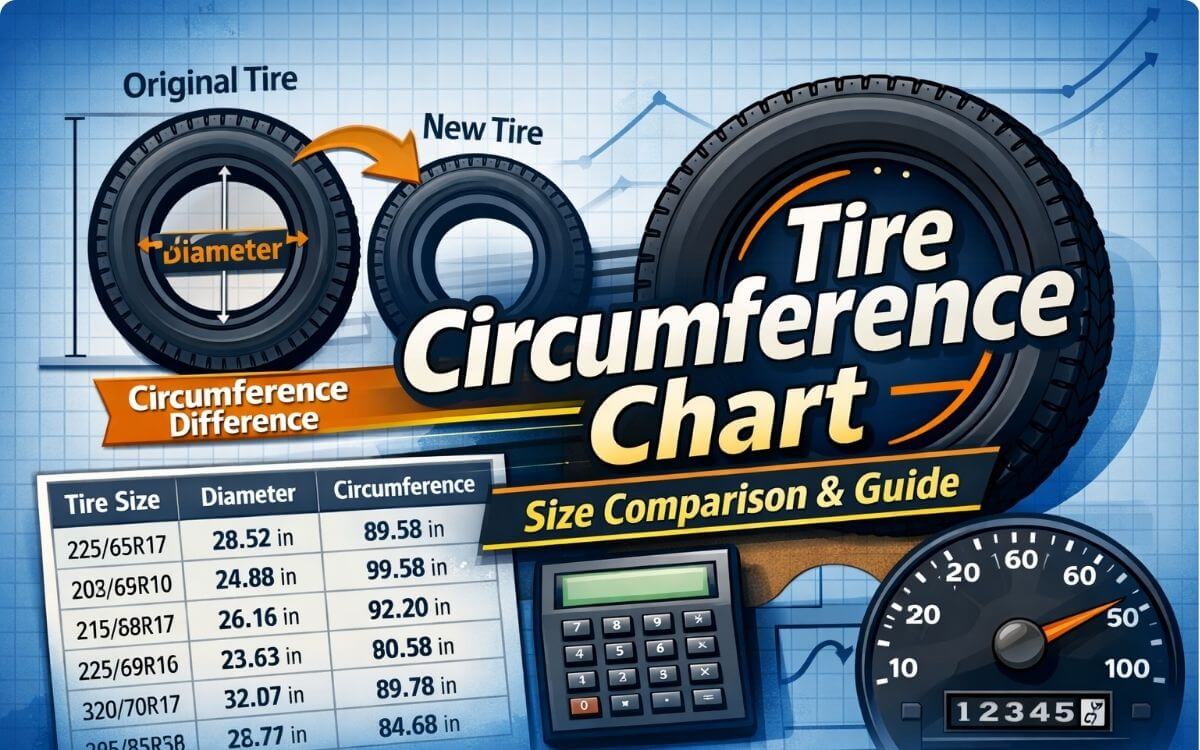
A tire circumference chart is one of the most useful tools for anyone comparing tire sizes, planning a tire upgrade, or checking how a new tire will affect driving performance. At first glance, tire sizes can look confusing. A code like 225/65R17 tells you the width, sidewall ratio, and rim size, but it does not instantly tell you how far the tire rolls in one full rotation. That is where circumference matters.
This guide gives you a clear chart, explains how to use it, and shows why tire circumference affects real-world driving. Whether you are trying to understand speedometer changes, compare replacement tires, or avoid fitment mistakes, this article is designed to help you make a smart decision quickly.
What Is Tire Circumference?
Tire circumference is the distance around the outside of a tire. In simple terms, it is how far the tire moves the vehicle forward in one full rotation.
That matters because the circumference affects several things at once. If the circumference is larger, the tire travels farther each rotation. If it is smaller, it travels less. That difference can change:
- speedometer readings
- odometer accuracy
- gearing feel
- fuel economy
- clearance and fitment
Many people focus only on tire diameter, but circumference is often the more useful number when you are comparing tires. The diameter tells you the tire’s height from top to bottom. Circumference tells you the actual rolling distance, which is what matters on the road.
Tire Circumference Chart
Passenger Car Tire Circumference Chart
These are the most common tire sizes used in sedans and compact cars.
| Tire Size | Diameter (in) | Circumference (in) | Circumference (mm) |
| 185/65R15 | 24.47 | 76.87 | 1952 |
| 195/65R15 | 24.98 | 78.48 | 1993 |
| 205/55R16 | 24.88 | 78.16 | 1985 |
| 205/60R16 | 25.69 | 80.69 | 2049 |
| 215/55R17 | 26.31 | 82.66 | 2099 |
| 225/45R17 | 24.97 | 78.45 | 1992 |
| 225/50R17 | 25.86 | 81.24 | 2063 |
| 225/55R17 | 26.74 | 84.02 | 2134 |
| 235/40R18 | 25.40 | 79.80 | 2027 |
| 235/45R18 | 26.33 | 82.71 | 2100 |
| 245/45R18 | 26.68 | 83.82 | 2129 |
| 245/40R19 | 26.72 | 83.93 | 2131 |
👉 Best for: Daily driving, fuel efficiency, and standard replacements
SUV & Light Truck Tire Circumference Chart
Designed for SUVs, crossovers, and light trucks—these tires are larger and impact performance more significantly.
| Tire Size | Diameter (in) | Circumference (in) | Circumference (mm) |
| 225/65R17 | 28.52 | 89.58 | 2275 |
| 235/65R17 | 29.03 | 91.19 | 2316 |
| 235/70R16 | 28.95 | 90.96 | 2310 |
| 235/75R15 | 28.88 | 90.72 | 2304 |
| 245/70R16 | 29.50 | 92.69 | 2354 |
| 255/65R17 | 30.05 | 94.41 | 2398 |
| 265/65R17 | 30.56 | 96.02 | 2438 |
| 265/70R17 | 31.61 | 99.29 | 2522 |
| 275/65R18 | 32.07 | 100.77 | 2559 |
| 275/60R20 | 32.99 | 103.65 | 2632 |
| 285/50R20 | 31.22 | 98.08 | 2491 |
| 285/45R22 | 32.10 | 100.84 | 2561 |
👉 Best for: Off-road, heavy loads, and larger vehicles
Performance / Low-Profile Tire Circumference Chart
Used in sports cars and modified vehicles—these tires prioritize handling over comfort.
| Tire Size | Diameter (in) | Circumference (in) | Circumference (mm) |
| 215/45R17 | 24.62 | 77.34 | 1964 |
| 225/40R18 | 25.09 | 78.81 | 2001 |
| 235/35R19 | 25.48 | 80.04 | 2032 |
| 245/35R19 | 25.75 | 80.90 | 2054 |
| 255/35R19 | 26.03 | 81.77 | 2076 |
| 265/35R20 | 27.30 | 85.78 | 2178 |
| 275/35R20 | 27.58 | 86.64 | 2200 |
| 275/30R20 | 26.50 | 83.24 | 2114 |
| 285/30R20 | 26.73 | 83.98 | 2133 |
| 305/30R20 | 27.20 | 85.47 | 2170 |
👉 Best for: High-speed stability and cornering performance
How to Use the Tire Circumference Chart
Using the chart is simple once you know your tire size. First, find the size printed on the tire sidewall or in your owner’s manual. Then look it up in the chart and compare it with your current tire or the tire you plan to buy.
Here is a practical example. Suppose your vehicle originally uses 225/65R17, and you are looking at 235/65R17 as an option. The chart shows that the new tire has a slightly larger circumference. That means the vehicle will travel a little farther with each rotation. In real driving, that can make the speedometer read a little lower than before.
This is why a chart is better than guessing. It helps you make a choice based on numbers instead of hope.
A good habit is to compare the circumference change before buying. If the replacement tire is very close to the original, you are more likely to keep the vehicle’s calibration, comfort, and handling feel closer to stock.
Why Tire Circumference Matters
Tire circumference is not just a technical detail. It changes how your vehicle behaves in everyday use.
Speedometer Accuracy
If you install a tire with a larger circumference, the car covers more ground per rotation. In that case, the speedometer may read lower than your actual road speed. A smaller circumference can do the opposite and make the speedometer read higher.
Fuel Efficiency
A much larger tire can add rolling resistance and extra rotational weight. That may reduce fuel economy slightly, especially if the tire is also wider or heavier.
Gear Ratio & Performance
Changing tire circumference affects the effective gearing of the vehicle. A larger tire can make the car feel a little taller geared, which may reduce acceleration feel. A smaller tire can make acceleration feel quicker, but it may also raise engine speed at highway cruising.
Odometer Accuracy
Your odometer tracks distance based on wheel rotation. If the circumference changes, the distance reading changes too. That matters for maintenance intervals, resale value, and long-term tracking.
Common Mistakes When Using Tire Charts
A tire circumference chart is easy to use, but people still make a few common mistakes.
One mistake is comparing only the width. Two tires can have the same width and still have very different circumference values because their sidewall ratios are different.
Another mistake is ignoring the aspect ratio. That number has a big effect on total height, and therefore on circumference.
A third mistake is assuming all tires with the same size label are exactly identical. In reality, two different brands may measure slightly differently.
A final mistake is forgetting about clearance. Even if the circumference change looks acceptable, the tire still has to fit in the wheel well without rubbing.
When You Should Use a Tire Circumference Chart
A tire circumference chart is useful any time you are comparing tire sizes, but it is especially helpful in these situations:
You should use one when you are:
- replacing worn tires and want to stay close to factory size
- upgrading to larger or smaller wheels
- switching to all-terrain or winter tires
- checking speedometer accuracy after a tire change
- comparing performance options for a modified vehicle
- making sure a new tire will not cause rubbing
If the tire change is small, a chart can give you quick peace of mind. If the change is large, the chart can warn you before you buy the wrong size.
FAQs
What is the circumference of my tire?
It depends on the exact tire size, and sometimes on the brand and model. You can find the size on the sidewall, then use a tire circumference chart or the formula to estimate it.
How do I calculate tire circumference?
First calculate the tire’s full diameter from its width, aspect ratio, and rim size. Then multiply that diameter by π. A chart is faster, but the formula works when you need a custom check.
Does tire size affect speed?
Yes. A larger circumference can make the vehicle travel farther per rotation, which can change speedometer and odometer readings. A smaller circumference can do the opposite.
Can I use a different tire size safely?
Sometimes, yes. The key is to check circumference, clearance, and vehicle compatibility before buying. A small difference is usually easier to manage than a large one.
What is the best tire size difference to aim for?
A closer match is usually better. The smaller the circumference change, the less likely you are to create speedometer or fitment issues.
Conclusion
A tire circumference chart gives you a simple way to compare tire sizes and make better choices. Instead of guessing, you can look at the real rolling distance and see how one tire differs from another. That helps with speedometer accuracy, fitment, gearing feel, and everyday driving comfort.
If you are planning a tire change, do not stop at the size code on the sidewall. Check the circumference, compare the difference, and make sure the new tire matches your driving needs. A few minutes spent with the right chart can save you a lot of trouble later.
