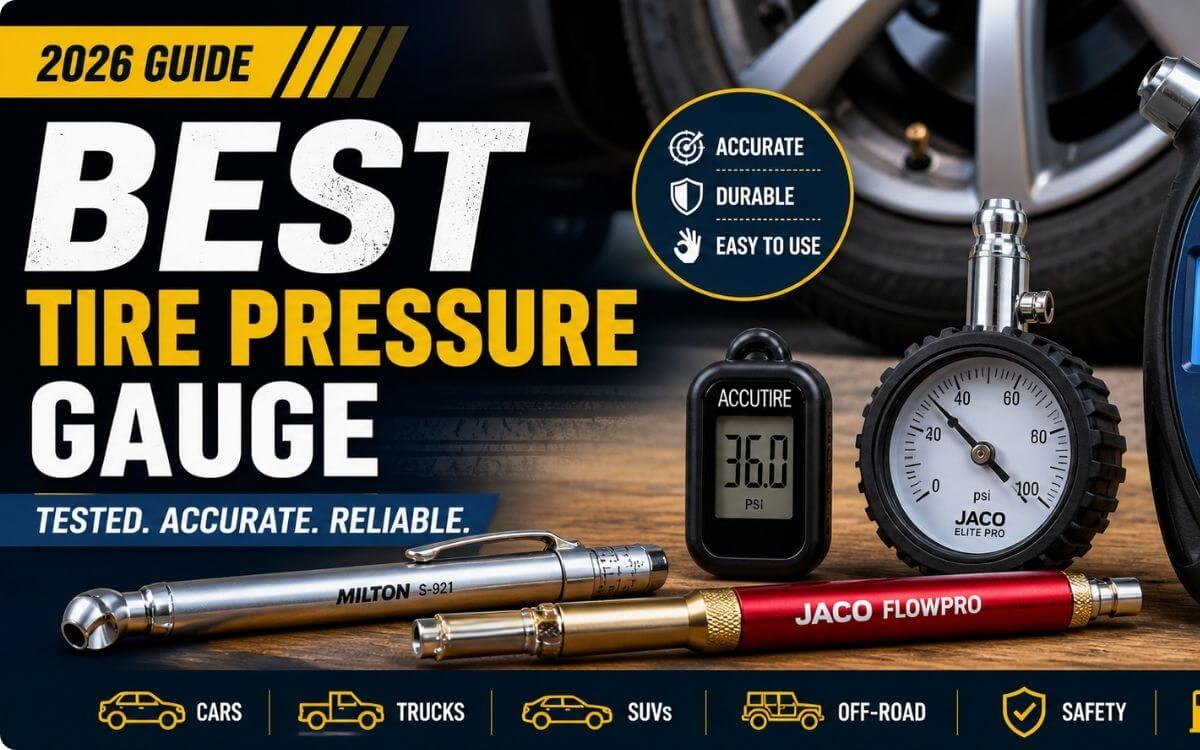
Best Tire Pressure Gauge 2026
A reliable tire pressure gauge is one of the simplest tools you can own, but it can make a big difference in how your vehicle performs. The right best tire pressure gauge helps you check PSI quickly and accurately, so you can keep your tires properly inflated, improve fuel efficiency, reduce uneven wear, and drive with more confidence. That matters whether you commute every day, take long road trips, or just want to avoid unnecessary tire problems.
The challenge is that not all tire gauges are the same. Some are digital and easy to read, some are analog and built for durability, and others are compact pencil-style gauges that work well as a budget-friendly backup. There are also inflator gauges and off-road deflators for drivers who need more than a basic pressure check.
In this guide, we break down the best tire pressure gauge options based on accuracy, ease of use, build quality, and value. You will also learn how to choose the right type for your vehicle, what features really matter, and which tools are worth buying for everyday use.
Why You Can Trust Our Review
The best tire pressure gauge is not just the one with the most features. It is the one that fits the way you actually use your vehicle. To keep this guide useful, the recommendations below are based on published manufacturer specifications, practical use cases, and trusted tire-care guidance from NHTSA, AAA, the Department of Energy, and product makers themselves.
That matters because tire pressure is not a one-size-fits-all topic. A commuter who checks pressures in the driveway has different needs from a truck owner who tows, and both have different needs from an off-road driver who airs down on the trail. A good review should reflect those differences instead of pretending every driver needs the same tool.
How We Tested Tire Pressure Gauges
For a guide like this, the most helpful way to compare gauges is to look at four things: accuracy, readability, build quality, and fit for the job. A gauge that is easy to read but difficult to connect to the valve stem is not a good choice. A tough gauge that gives slow or unclear readings is not ideal either.
Accuracy is the most important factor. For everyday driving, even a small error matters because tire pressure affects wear, fuel use, and handling. That is why published calibration details, PSI range, and resolution are useful when comparing one model to another.
Ease of use also matters more than people think. The best gauge is often the one you will actually use every month. Large displays, comfortable grips, angled chucks, and clear mechanical dials all make regular tire checks faster and less frustrating.
Best Tire Pressure Gauges Reviews
1. Best Overall: JACO ElitePro Digital Tire Pressure Gauge
The JACO ElitePro Digital Tire Pressure Gauge is a strong all-around pick for everyday drivers who want something easy to read and easy to trust. It is a good choice if you want one tool that feels simple to use but still gives you a more polished, accurate experience than a basic cheap gauge.
What stands out first is the digital display. Instead of guessing where a needle lands or trying to read a tiny scale, you get a clear number right away. That makes it especially helpful for beginners or anyone who checks tire pressure only once in a while and wants the process to be quick.

It also feels like a serious tool, not a flimsy pocket gadget. The hose gives you a little more reach, and the angled chuck helps when the valve stem is in an awkward spot. That can save time and reduce frustration, especially on tight wheel designs.
This gauge is best for regular car owners, SUV drivers, and anyone who wants a dependable tool for monthly tire checks, road trips, or general garage use. It is not the cheapest option, but it gives a nice balance of accuracy, comfort, and ease of use.
Key Features
- Digital display that is easy to read
- 5 to 100 PSI range
- 0.10 PSI resolution
- Angled steel chuck for easier valve access
- Flexible hose for better reach
- Runs on AAA batteries
- Built for everyday tire checks
Pros and Cons
Pros
- Very easy to read
- Feels more accurate and refined than basic budget gauges
- Comfortable to use
- Good for beginners
- Works well for everyday drivers
- Handy hose and chuck design make tire checks less awkward
Cons
- Costs more than a simple pencil gauge
- Needs batteries
- Slightly more tool than some casual users may need
2. Best Compact: Accutire MS-4021B Digital Tire Pressure Gauge
The Accutire MS-4021B is a good pick if you want a tire pressure gauge that is small, simple, and easy to keep in the car. It is the kind of tool that fits nicely in a glovebox or center console, so you are more likely to have it when you need it.

What makes it useful is how straightforward it feels. You do not need any special knowledge to use it. Just attach it to the valve stem, wait for the reading, and check whether your tires are where they should be. That makes it a solid choice for new drivers, busy commuters, and anyone who wants a basic digital gauge without extra fuss.
It is not the fanciest option on the market, but that is part of the appeal. It does the main job well: giving you a quick tire pressure reading in a compact size that is easy to store and carry.
Key Features
- Small, compact design that is easy to store
- Digital display for quick reading
- Simple one-tool operation
- Good fit for glovebox or travel use
- Designed for routine tire checks
Pros and Cons
Pros
- Very portable
- Easy for beginners to use
- Digital display is simple to read
- Convenient to keep in the car
- Good choice for quick pressure checks
Cons
- Smaller size may feel less sturdy than larger gauges
- Not as feature-rich as premium options
- Better for basic use than heavy-duty garage work
3. Best Inflator Gauge: Jaco FlowPro Digital Tire Inflator with Pressure Gauge
The Jaco FlowPro is a smart choice if you want one tool that can both check tire pressure and add air. That makes it especially useful for people who keep a compressor at home and prefer doing tire maintenance in the garage instead of stopping at a gas station.

It feels more useful than a regular pressure gauge because it saves a step. You do not have to check the pressure with one tool and then switch to another one to fill the tire. You can do both with the same device, which makes the whole process faster and easier to manage.
This is a good fit for drivers who like to stay on top of tire care themselves. It is especially helpful for home mechanics, truck owners, and anyone who checks or tops off tires often. It is not the smallest or simplest tool in the group, but it is one of the most practical.
Key Features
- Works as both a tire inflator and a pressure gauge
- Digital display for easy reading
- 200 PSI range
- 0.10 PSI resolution
- Quick-connect chuck for easier use with air compressors
- Long hose for better reach in the garage
- Designed for regular home tire maintenance
Pros and Cons
Pros
- Lets you check and inflate tires with one tool
- Saves time during tire maintenance
- Easy-to-read digital display
- Useful for garage use and regular top-offs
- Good choice for people who work on their own vehicles
Cons
- Bigger and less portable than a basic gauge
- Not as simple as a handheld tire checker
- Best for people who already use an air compressor
- More tool than a casual driver may need
4. Best Budget Pick: Milton S-921 Pencil Tire Pressure Gauge
The Milton S-921 is a very basic tire pressure gauge, and that is exactly why many people like it. It is small, cheap, and easy to keep in a glovebox, tool bag, or center console without taking up much space.
This is a good choice if you just want a simple way to check tire pressure without spending much money. It does the job without extra features, screens, or batteries. For many drivers, that is enough.

It is especially useful as a backup gauge. If you already have a digital tool but want something you can always keep on hand, this is a practical option. It may not feel fancy, but it is reliable in a simple, no-nonsense way.
Key Features
- Pencil-style design that is small and easy to carry
- 5 to 50 PSI range
- No batteries needed
- Metal body for a more durable feel
- Easy to store in a glovebox or pocket
- Simple pressure reading with no setup
Pros and Cons
Pros
- Very affordable
- Small and portable
- No batteries to replace
- Easy to use for quick checks
- Good backup tool to keep in the car
Cons
- Not as easy to read as a digital gauge
- Feels more basic than premium options
- Can be less comfortable for people who want a firmer grip
- Better for simple use than precision-focused buyers
5. Best Analog Gauge: JACO ElitePro Tire Pressure Gauge – 100 PSI
The JACO ElitePro Tire Pressure Gauge is a strong analog option for drivers who want a simple tool that feels solid and dependable. It does not need batteries, and it gives you a clear pressure reading with a large glow dial that is easy to see. JACO says it is calibrated to ANSI standards with ±1.5% accuracy, and it uses a 100 PSI dial with one-PSI marks, which makes it a practical choice for regular tire checks.

This gauge is a good fit for people who like the feel of a classic mechanical tool and do not want to worry about charging or replacing batteries. The solid brass body, rubber protective guard, and 10-inch hose give it a more durable, premium feel than a basic budget gauge. It is useful for drivers who check tire pressure often and want something they can keep using for a long time.
Key Features
- Analog dial with a large 2-inch glow face for easier reading in low light.
- 100 PSI range with one-PSI markings.
- ANSI-standard calibration with ±1.5% accuracy.
- Solid brass body for a sturdy feel.
- Rubber protective guard to help protect the gauge from bumps.
- 10-inch hose for easier access to valve stems.
- No batteries needed.
Pros and Cons
Pros
- Easy to use once you get used to analog reading.
- No batteries to replace.
- Feels sturdy and well made.
- Good choice for drivers who want a simple, reliable mechanical gauge.
- A large dial is easier to read than many small analog gauges.
Cons
- Not as quick to read as a digital gauge for some users. This is a tradeoff with analog tools.
- Costs more than a basic pencil gauge.
- Takes a little more attention to read than a digital screen.
6. Best for Off-Road Drivers: ARB ARB601 Digital Tire Pressure Gauge
The ARB ARB601 is built for drivers who regularly take their vehicle off-road. If you drive on trails, sand, mud, or rocky roads, tire pressure becomes much more important because many off-road drivers lower their tire pressure for better traction and then refill their tires before heading back onto pavement.
That is where this gauge becomes useful. It helps you check pressure accurately while also making it easier to add or release air when needed. For off-road trips, that saves time and makes the process much less frustrating.

It also feels tougher than a standard tire gauge. The longer hose gives you more flexibility around larger truck or SUV tires, and the digital display is easier to read when you are outside in rough conditions.
For everyday city drivers, this is probably more tool than you need. But if you own a truck, Jeep, overlanding vehicle, or frequently drive off-road, it makes a lot more sense than buying a basic compact gauge.
Key Features
- Digital display for quick readings
- High 200 PSI range
- Long hose for easier reach
- Built for inflating and checking tire pressure
- Durable design for outdoor use
- Backlit screen for easier reading in low light
- Better suited for trucks, SUVs, and off-road vehicles
Pros and Cons
Pros
- Great for off-road trips
- Makes airing down and refilling easier
- Easy-to-read digital display
- Longer hose works well with larger tires
- Feels durable and built for rough use
Cons
- More expensive than standard tire gauges
- Too bulky for glovebox storage
- Overkill for regular daily drivers
- Casual drivers may never use all of its features
7. Fastest Air Down Tool: ARB ARB505 E-Z Deflator Kit
The ARB ARB505 E-Z Deflator Kit is designed for one main job: helping you reduce tire pressure quickly and accurately when you go off-road. If you drive on sand, mud, or rocky trails, lowering tire pressure can improve grip and make the ride smoother. This tool makes that process much faster and more controlled.
Instead of slowly letting air out and guessing the pressure, this tool lets you remove the valve core and watch the pressure drop in real time. That means you can reach your target PSI much faster and avoid going too low or too high by mistake.

It also has a built-in pressure gauge, so you can check the tire while you are airing down. This is useful when you want all four tires set to the same pressure before driving on rough terrain.
For casual city driving, you do not really need this tool. But for off-road drivers, it saves time and removes a lot of guesswork.
Key Features
- Built-in analog pressure gauge (0–60 PSI range)
- Valve core removal for faster air release
- One-PSI reading marks for better control
- Brass and stainless-steel construction for durability
- Protective rubber guard for handling outdoors
- Comes with a storage pouch for easy carrying
- Designed for trucks, SUVs, and off-road vehicles
Pros and Cons
Pros
- Very fast tire deflation compared to basic gauges
- Helps you reach exact off-road tire pressure easily
- Strong build quality for rough outdoor use
- Useful all-in-one tool (deflate + measure)
- Works well for sand, trails, and rocky terrain
Cons
- Not needed for everyday driving
- Takes a little practice to use correctly at first
- Bulkier than a simple pocket tire gauge
- More expensive than basic pressure tools
8. Best Pencil Gauge Alternative: ETENWOLF Pencil Tire Pressure Gauge (2 Pack)
The ETENWOLF Pencil Tire Pressure Gauge is a simple, no-frills option for people who want something basic but a bit more solid than the cheapest pencil gauges. It comes in a 2-pack, which is useful because you can keep one in the car and another at home or in a tool kit.
This type of gauge is very straightforward. There is no screen, no battery, and no setup. You press it onto the tire valve, and a small metal stick slides out to show the pressure. It is not fancy, but it gets the job done.

What makes this one a better “budget alternative” is the build quality. It feels sturdier than many ultra-cheap pencil gauges, and having two pieces adds extra convenience and backup.
It is best for drivers who want a simple, always-ready tool for quick pressure checks without spending much money or dealing with electronics.
Key Features
- Pencil-style mechanical design
- 2-pack for extra convenience or backup use
- No batteries needed
- Multiple PSI ranges depending on version (typically suited for cars and light vehicles)
- Metal body construction for better durability
- Compact size for easy storage in glovebox or tool kit
- Simple push-to-read operation
Pros and Cons
Pros
- Very affordable for a 2-pack
- Always ready to use (no batteries or charging)
- Small and easy to carry anywhere
- Good backup option for emergencies
- Stronger build than many cheap pencil gauges
Cons
- Not as easy to read as a digital gauge
- Less precise feeling compared to premium tools
- Can feel basic for users who prefer modern features
- Requires a bit of care to get an accurate reading each time
9. Easiest to Use: Viair 00032 Air Down Tire Pressure Gauge
The Viair 00032 is a good choice for drivers who want a simple tool that makes tire pressure checks easier, especially before and after off-road driving. It is built for people who need to let air out of their tires quickly and then check the pressure without dealing with a complicated setup.
What makes it easy to use is the simple design. You do not need to switch between multiple tools or guess where the pressure is landing. It is made for quick tire adjustments, which is helpful if you drive on sand, dirt, or rough trails and want to set your tires to the right pressure before getting back on the road.

It is not the smallest or most basic gauge in the group, but it is one of the most practical if you want a tool that is straightforward and useful right away. For off-road drivers, that can save time and make the whole process less stressful.
Key Features
- Built for airing down tires and checking pressure
- Simple analog reading
- No batteries needed
- Easy-to-hold design
- Good for off-road and trail use
- Lets you lower tire pressure more efficiently
- Made for trucks, SUVs, and similar vehicles
Pros and Cons
Pros
- Very easy to understand and use
- Helpful for off-road drivers
- No batteries or charging needed
- Good for quick pressure changes
- Makes airing down less awkward and time-consuming
Cons
- Not the best choice for casual everyday drivers
- Less useful if you only need a basic home tire gauge
- Not as compact as a simple pencil-style tool
- More specialized than a general-purpose pressure checker
10. Best Mid-Range Analog Option: AstroAI 60-PSI Tire Pressure Gauge
The AstroAI 60-PSI Tire Pressure Gauge is a good middle-ground option for drivers who want something more durable than a cheap pencil gauge but do not want to spend a lot on premium models.

It uses a simple analog design, which means there are no batteries to worry about. You just connect it to the tire valve, check the reading, and you are done. That makes it a practical choice for drivers who want something straightforward.
One thing many people like about this gauge is its solid feel. The rubber cover helps protect it if it gets dropped, and the grip feels more comfortable than smaller gauges. It is also compact enough to keep in your car without taking up much space.
This works best for regular car owners, SUV drivers, and people who want a reliable backup gauge for occasional tire checks.
Key Features
- 0–60 PSI pressure range
- Analog dial display
- No batteries required
- Rubber protective cover
- Durable brass and steel construction
- Compact size for easy storage
- Extended chuck for easier connection to tire valves
Pros and Cons
Pros
- Affordable price
- Simple to use
- No batteries needed
- Feels more durable than very cheap gauges
- Easy to store in a glovebox or tool bag
Cons
- Analog display may be harder for some people to read
- Not ideal for high-PSI truck tires
- Lacks advanced features found in digital models
How to Choose the Best Tire Pressure Gauge
Choosing a tire pressure gauge is not complicated, but it helps to know what actually matters. Most people either buy something too basic and struggle with accuracy, or buy something too advanced that they never fully use. The goal is to find a simple balance that fits your vehicle and driving habits.
Accuracy tolerance
Accuracy is one of the most important things to look at. A small difference in tire pressure can affect fuel use, tire wear, and safety over time.
A good rule is to look for a gauge that is accurate within about ±1 PSI or better. This level is more than enough for everyday driving and helps you trust the reading instead of guessing.
PSI range
Different vehicles need different pressure ranges, so the gauge should match your vehicle type.
Most passenger cars usually run around 30–40 PSI, so a basic range works fine for them. Trucks often need higher pressure, usually around 50–80 PSI, especially if they carry loads or tow. RVs and larger vehicles may need even higher ranges, so a wider PSI scale is better in those cases.
Build quality
A tire gauge does not need to be fancy, but it should feel solid. If it feels too light or fragile, it may not last long, especially if you keep it in a car or tool bag.
Metal parts, rubber protection, and a firm connection to the tire valve usually mean the tool will hold up better over time. This is important because a damaged or loose gauge can give wrong readings.
Display readability
This matters more than people expect. If you cannot clearly read the number, the gauge is not very useful.
Digital displays are easier for most beginners because they show a clear number. Analog dials can also work well, but they need a bit more attention to read correctly.
Choose whichever feels easiest for you to understand quickly without second-guessing.
Hose length
Some gauges come with a short tip, while others have a longer hose.
A longer hose helps when valve stems are in tight or awkward positions, especially on larger wheels or trucks. Short gauges are fine for basic use, but a longer hose can make tire checks more comfortable and less frustrating.
Deflation capability
Not all tire gauges can release air, but this feature is very useful for off-road drivers or people who adjust tire pressure often.
If you only check pressure at home, you may not need it. But if you drive on sand, dirt, or rough terrain, being able to lower tire pressure quickly can save time and improve control.
Battery requirements
Some gauges use batteries (usually digital ones), while others do not.
Battery-powered gauges are easier to read but need occasional battery changes. Non-digital gauges never run out of power, which makes them more reliable for long-term use.
If you want something always ready, a non-battery option can be a safer choice. If you want convenience and easy reading, a digital one may suit you better.
FAQs
What is the most accurate tire pressure gauge?
The most accurate gauge for you is usually the one with clear calibration specs, a proper PSI range, and a design you can use consistently. Among the products here, JACO’s ElitePro Digital and FlowPro digital inflator list strong accuracy claims and detailed specifications.
Are digital gauges better than analog?
Digital gauges are easier to read and often simpler for beginners, while analog gauges have the advantage of not needing batteries. The better choice depends on whether you value convenience or mechanical simplicity more.
Can tire pressure gauges lose calibration?
Yes, they can. That is why it helps to buy a gauge from a reputable brand with published accuracy details and to replace a tool if readings start to look inconsistent.
What PSI should my tires be?
Use the number listed on the vehicle placard, usually on the driver’s door jamb or door frame, or in the owner’s manual. Do not rely on the maximum pressure printed on the tire sidewall.
Are gas station gauges accurate?
They can be useful in a pinch, but they are not the best option if you want a consistent routine. A personal gauge is more reliable because it is always available and easier to use the same way every time.
Do I need a special gauge for trucks?
Not always, but trucks and towing setups often benefit from a wider PSI range and a more rugged tool. That is why models like the ARB601 and FlowPro 200 PSI inflator are better fits for heavier-duty use.
Final Verdict
If you want the best all-around choice, the JACO ElitePro Digital Tire Pressure Gauge is the safest recommendation for most drivers because it combines strong accuracy claims, a practical range, and easy everyday use.
If you want the cheapest simple backup, the Milton S-921 Pencil Tire Pressure Gauge is hard to beat. If you want a premium no-battery option, the JACO ElitePro 100 PSI analog gauge is a strong pick. And if you drive off-road, the ARB ARB505 E-Z Deflator Kit is built for the job.
The best tire pressure gauge is the one you will actually use. Pick one that fits your vehicle, your driving habits, and your comfort level, and you will make tire maintenance faster, easier, and much more reliable.
