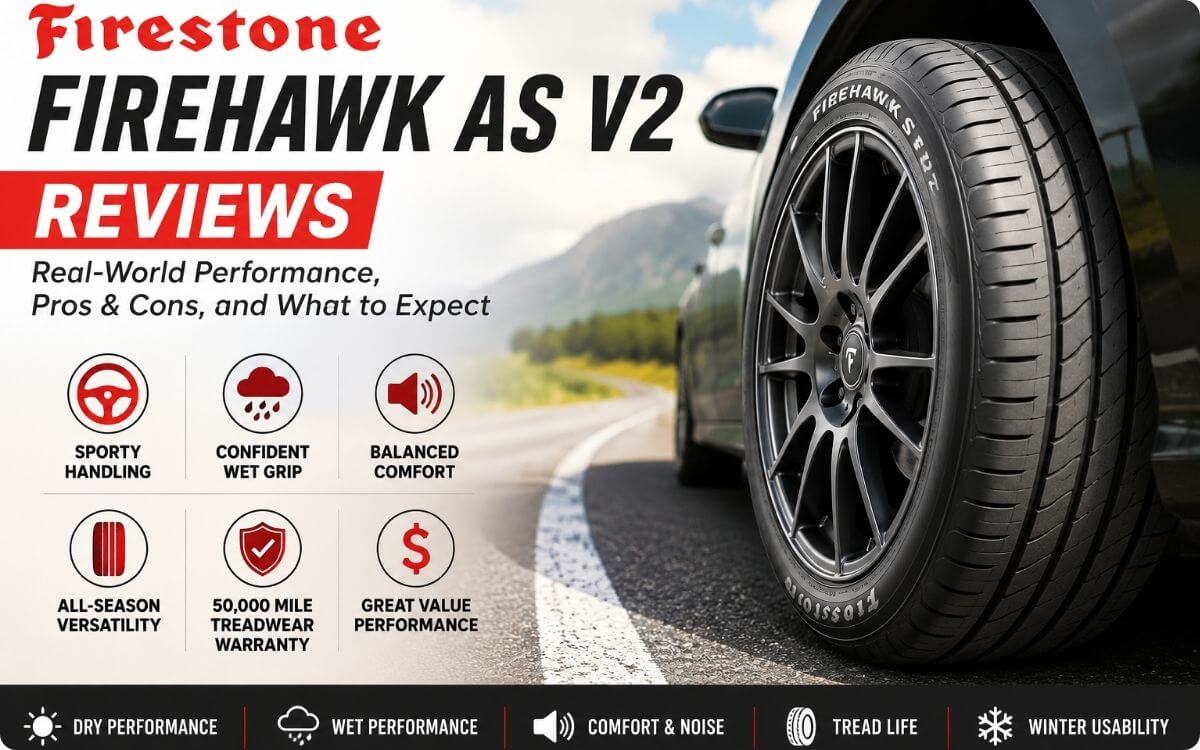
Firestone Firehawk AS V2 Reviews 2026
You’re probably trying to figure out one simple thing: is the Firestone Firehawk AS V2 actually worth putting on your car, or is it just another budget performance tire that looks better on paper than on the road?
The confusion makes sense. It sits in that tricky middle zone where it promises sporty handling, all-season usability, and a lower price than premium rivals—but real-world driving is where those claims get tested. Things like wet highway braking, tire noise after a few thousand miles, and how it feels when you push it a little harder in a corner matter more than spec sheets.
That’s why these Firestone Firehawk AS V2 reviews matter. This tire can feel like a smart value upgrade for some drivers, and a compromise for others, depending entirely on how and where you drive every day.
Firestone Firehawk AS V2 at a Glance
The Firestone Firehawk AS V2 is an ultra-high-performance all-season tire made for drivers who want sporty handling with year-round usability.

- Category: Ultra-high-performance all-season tire
- Fitment: 17–20 inch sizes for sporty sedans, coupes, and some crossovers (e.g., Honda Civic-type vehicles)
- Speed rating: Typically W-rated (up to 168 mph / 270 km/h)
- Treadwear warranty: 50,000 miles (limited)
- Price range: About $150–$200 per tire ($600–$800 per set)
What Firestone claims: Strong dry/wet grip, sporty handling, and all-season capability.
Real-world expectation: Sharp steering and good dry performance for the price, but only average tread life, moderate wet limit grip, and limited snow capability compared to premium rivals.
Our Real-World Review Methodology
We evaluate the Firestone Firehawk AS V2 using a real-world driver-focused approach, not just spec sheets. The goal is to understand how it behaves in everyday conditions—commuting, highway use, rain, and longer-term ownership.
Dry-road testing focuses on steering response, cornering stability, and braking feel during normal and spirited driving. We pay close attention to how confidently the tire handles highway merges, fast lane changes, and repeated braking in city traffic.
Wet-road evaluation is based on real rain conditions, including highway spray, standing water, and sudden braking events. A key scenario is emergency braking on a wet freeway ramp or mid-city intersection after rainfall.
Ride comfort is assessed on mixed road surfaces, including smooth highways and rough urban pavement. We observe how the tire absorbs impacts from potholes, patched asphalt, and uneven surfaces during daily commuting.
Noise testing includes both new and worn conditions, focusing on highway drone at 60–75 mph and how tread noise evolves after several thousand miles of use.
Treadwear expectations are based on the 50,000-mile warranty plus real owner feedback patterns. We compare expected lifespan under calm commuting versus aggressive driving and high-speed highway usage.
Winter usability is treated as a limitation check. In light snow or slush, we assess traction at low-speed starts and braking stability, but we do not consider it a winter-capable tire for harsh climates.
Our review is based on a combination of Firestone’s official data, independent retailer listings, verified owner feedback, and long-term user discussions from automotive forums. This helps balance manufacturer claims with real-world driving experience.
Dry Performance: How It Feels in Daily Driving and Aggressive Driving
Straight-line acceleration grip
On dry roads, the Firehawk AS V2 feels confident when accelerating hard, especially during highway merges or quick overtakes. Grip is solid for an all-season performance tire, though not as sharp as a dedicated summer tire. It stays stable rather than feeling aggressive.
Cornering confidence
Turn-in is predictable and controlled, with enough grip to handle spirited cornering in daily driving. For example, on a dry curved highway ramp, the tire holds the line well without feeling soft or unstable. It’s sporty, but still tuned for safety and comfort over maximum edge grip.
Braking performance
Dry braking is strong and progressive. In a city emergency stop or sudden highway slowdown, the tire inspires confidence without abrupt loss of traction. It’s reliable for daily driving, but not built for repeated high-performance braking like track-focused tires.
Highway stability
At sustained highway speeds, the tire feels planted and steady with minimal steering correction. Long drives are comfortable, and the car tracks straight even on slightly imperfect pavement. It leans more toward stable touring comfort than sharp performance tension.
Performance on sporty sedans and coupes
On sporty sedans and coupes, the AS V2 adds a balanced performance feel—better grip and response than basic all-seasons, but still refined enough for daily commuting. It suits drivers who want mild sporty handling without sacrificing comfort.
Best fit / limitations
Best for daily drivers who want safe, confident dry performance with a slight sporty edge. Not ideal for enthusiasts seeking maximum steering sharpness, track use, or ultra-firm performance feedback.

Wet Performance: Can It Handle Heavy Rain Safely?
Wet braking performance
In real-world rain driving, the Firehawk AS V2 feels controlled under braking rather than nervous. Firestone’s tread design helps maintain contact with the road, so normal city stops and moderate highway braking stay predictable even on wet pavement. It is not class-leading like top premium competitors, but it gives a reassuring, stable feel for daily rain driving.
Hydroplaning resistance
The tire uses wide circumferential grooves to push water away, which helps reduce the chance of floating on puddles. On wet highways with standing water, it stays more stable than many budget all-seasons, though sharp speed hits through deep water will still require caution.
Cornering in rain
In wet corners like highway ramps or city turns after heavy rain, it stays predictable rather than sliding suddenly. Grip is decent for an all-season performance tire, but you still need to drive with smooth inputs—especially at higher speeds.
Highway rain driving
At cruising speeds in heavy rain, it feels stable and confidence-inspiring for commuting. Lane changes and truck spray don’t unsettle it much, making it a solid everyday rain tire for highways.
Snow and Winter Performance: Where This Tire Starts to Struggle
The Firehawk AS V2 is an all-season performance tire, so winter capability is limited even though it can handle light snow.
Light snow performance
It can manage shallow, fresh snow in city driving if you’re gentle with throttle and braking. It’s fine for occasional winter dustings, but not for sustained snow-covered roads.
Ice performance limitations
Ice is the biggest weakness. On packed intersections or black ice, grip drops quickly and braking distances increase noticeably. It does not inspire confidence in icy conditions.
Cold-weather traction concerns
Below freezing, the rubber stiffens and traction becomes less consistent. You may notice reduced grip during cold morning commutes, especially on slushy or shaded roads.
When winter tires make more sense
If you regularly deal with snow, ice, or prolonged freezing temperatures, a dedicated winter tire is necessary. The Firehawk AS V2 is only suitable for drivers who see light, occasional snow and mostly dry or wet cold roads.
Ride Comfort and Road Noise Over Time
Comfort on rough roads
The Firehawk AS V2 feels firm but controlled over broken city roads and potholes. It is not a soft touring tire, but it avoids harsh impacts, making daily driving comfortable enough for sporty sedans and commuters. Firestone rates it 8/10 for ride comfort, which reflects its balanced but performance-leaning feel.
Highway noise levels
At highway speed, the tire produces a low, steady hum rather than loud road noise. It stays fairly quiet on smooth asphalt, but coarse concrete or aggressive driving will bring more tread sound into the cabin.
How noise changes as the tire wears
Noise stays reasonable early on, but gradually increases as the tread wears down—especially after mid-life mileage. It’s still acceptable for daily use, but it won’t remain as quiet as a touring tire over time.
Best fit / who should avoid it
Best for drivers who want a sporty tire that still stays comfortable for daily commuting and road trips. Avoid it if you want a soft, luxury-quiet ride or maximum long-term cabin silence.
Tread Life: How Long Does Firestone Firehawk AS V2 Really Last?
Firestone warranty coverage
The Firehawk AS V2 comes with a 50,000-mile limited warranty, but that assumes proper maintenance like regular rotations and correct alignment. It’s a benchmark, not a guaranteed real-world outcome.
Real-world mileage expectations
In real use, tread life varies a lot. Many drivers see roughly 25,000–40,000 miles, depending on driving style, road conditions, and vehicle weight. Aggressive driving can cut that much lower, while calm highway use pushes it closer to the warranty range.
Aggressive driving vs normal commuting lifespan
Driven gently in daily commuting, it wears reasonably well. But frequent hard cornering, fast launches, or heavy braking will noticeably shorten tread life. It’s a performance-leaning all-season, so grip comes before maximum longevity.
Rotation and maintenance impact on longevity
Regular rotation (around every 5,000–7,500 miles), correct tire pressure, and proper wheel alignment make a big difference. Poor maintenance can easily cost you thousands of miles of usable tread life.
Best fit / who should avoid it
Best for drivers who want sporty grip with decent lifespan. Avoid it if your top priority is maximum mileage or you tend to skip tire maintenance, because wear will come faster than touring-focused tires.
Fuel Economy and Rolling Resistance
Firestone positions the Firehawk AS V2 as a performance all-season tire, with the public product page focused on sporty grip, wet handling, and a 50,000-mile warranty rather than any fuel-economy or low-rolling-resistance claim. That usually tells you what the tire is optimized for: confident driving first, efficiency second.
For a normal gas car, the MPG hit is usually not dramatic, but it is fair to expect this tire to be a little less efficient than a true low-rolling-resistance touring tire. Tire Rack notes that rolling resistance affects fuel economy, with a 10% reduction in rolling resistance typically improving mpg by about 1% to 2%, and a 10% increase having the opposite effect; it also estimates that moving from worn tires to new tires can mean roughly a 2% to 4% mpg drop.
In real driving, that difference shows up most on a steady highway commute. If you do a lot of 65–75 mph driving, the Firehawk AS V2’s sporty tread and grippier compound may cost a little efficiency compared with an economy-focused all-season, especially over a full tank or two. In stop-and-go city traffic, the difference is usually harder to notice because other factors dominate fuel use.
For EVs, the trade-off matters more. EV tires are typically designed around low rolling resistance first, because less rolling resistance means less energy loss and more range, while performance-focused tires lean harder toward grip and handling. So on an EV, this tire is better suited to drivers who care more about steering feel and wet-road confidence than squeezing out the maximum range number.
Best for drivers who want a sporty all-season tire and can live with a modest efficiency trade-off. It is a weaker choice for anyone whose top priority is maximum MPG, maximum EV range, or the lowest possible running costs.
Common Complaints From Real Owners
Firestone does not design the Firehawk AS V2 as a fuel-economy-focused tire. It prioritizes grip, steering response, and wet performance, so rolling resistance is not the main strength.
In real-world driving, MPG impact is usually small but noticeable over time. On highway commutes at steady speeds, you may see a slight drop in fuel economy compared to touring or low-rolling-resistance tires. In city driving, the difference is minimal because stop-and-go conditions matter more than tire type.
Scenario: On a 70 mph highway commute, drivers typically report a small but consistent reduction in MPG after switching from eco-focused tires, especially over long trips.
For EVs, the effect is more noticeable. Because EV range is directly tied to rolling resistance, this tire may reduce range slightly compared to EV-optimized options, especially on long highway drives.
Best for drivers who want sporty handling and wet grip over efficiency. Avoid it if your main goal is maximum MPG or EV range.
Firestone Firehawk AS V2: Pros and Cons
Pros
- Strong dry grip with responsive steering and confident cornering
- Stable highway feel at normal speeds
- Good everyday wet braking and rain handling
- Sporty feel at an affordable price
Cons
- Tread wear can be faster under aggressive or highway-heavy driving
- Noticeable road noise increase as the tire wears
- Wet grip not as strong as premium rivals in heavy rain or standing water
- Firmer ride on rough roads
- Not suitable for snow-heavy conditions
Who Should Buy the Firestone Firehawk AS V2?
This tire fits drivers who want a noticeable step up in steering response and dry-road confidence without paying premium-brand pricing. It behaves more like a sporty daily tire than a comfort-focused touring tire, which is exactly why certain drivers like it.
Daily commuters who drive a mix of city roads and highway stretches will appreciate how stable it feels during quick lane changes or faster on-ramps. In a real-world highway scenario—merging at 60–70 mph and holding steady in fast traffic—the tire feels planted and predictable rather than soft or delayed in response.
Budget-conscious performance drivers are another strong match. If you want sharper handling than basic all-seasons but don’t want Michelin-level pricing, this tire delivers a balanced middle ground. It gives enough grip to make a compact sedan or sporty coupe feel more controlled without needing a summer tire.
Drivers in warm or rainy climates also benefit. In everyday wet commuting—like braking at a city intersection after a sudden rain shower—the tire generally feels controlled and progressive, not abrupt or nervous. That makes it suitable for regions with frequent rain but mild winters.
Who Should Avoid This Tire?
Drivers in harsh winter climates should avoid it. While it can handle light snow, it is not designed for consistent freezing temperatures or icy roads. In a real slushy morning scenario—accelerating from a stop on compacted snow—it will feel limited in traction compared to a true winter tire.
Drivers prioritizing maximum tread life will also be disappointed. If your driving pattern includes long highway commutes or high annual mileage, you may notice wear faster than expected compared to touring-focused all-seasons. That trade-off comes from its softer, more grip-oriented compound.
Luxury vehicle owners who value a quiet, isolated cabin may find it too firm over time. On rough city pavement, especially after the first several thousand miles, you can notice more road texture coming through than premium comfort tires.
Heavy EV owners are another caution point. EV weight accelerates tire wear, and in a real-world scenario like repeated stop-and-go urban driving with instant torque, tread life can drop faster than expected, making this tire a less efficient long-term choice for EV efficiency-focused drivers.
Firestone Firehawk AS V2 vs Top Alternatives
The Firehawk AS V2 sits in the budget performance all-season category, meaning it competes by offering sporty handling at a lower price, but it does not fully match the refinement, tread life consistency, or wet-grip confidence of the premium tier.
In real highway driving—steady 70 mph cruising with lane changes and passing—it feels stable and engaging, but rivals in this comparison often feel more controlled, quieter, and more composed as speeds increase.
Firestone Firehawk AS V2 vs Michelin Pilot Sport All Season 4
The Michelin Pilot Sport All Season 4 is the clear benchmark for wet grip, steering precision, and overall refinement. It feels more confident in heavy rain braking and high-speed cornering, especially in emergency maneuvers.
The Firehawk AS V2 responds well in normal dry and wet driving, but under hard rain braking—like sudden stop-and-go traffic on a flooded highway ramp—the Michelin delivers a more secure, planted feel.
Trade-off is cost: Michelin lasts well and performs better, but at a noticeably higher price.
Best choice: Michelin for maximum performance and confidence, Firestone for value-focused sporty driving.
Firestone Firehawk AS V2 vs Continental ExtremeContact DWS06 Plus
The Continental DWS06 Plus is more balanced overall, especially in wet traction and light snow capability. It feels more stable in unpredictable weather and tends to inspire more confidence during cold, damp mornings.
In real-world use—like a slushy early-morning commute or wet freeway at 65–75 mph—the Continental feels more controlled and predictable at the limit.
The Firehawk AS V2 feels a bit sharper in dry handling but less composed when conditions turn mixed.
Best choice: Continental for all-weather confidence, Firestone for dry-road sporty feel on a budget.
Firestone Firehawk AS V2 vs Bridgestone Potenza RE980AS+
The Bridgestone Potenza RE980AS+ leans more toward refined performance driving, with stronger high-speed stability and more consistent grip under aggressive cornering.
In a real scenario like fast highway lane changes or spirited driving on a winding road, the Bridgestone feels tighter and more confidence-inspiring at the limit.
The Firehawk AS V2 feels slightly softer in comparison and less precise when pushed hard, but it remains more affordable.
Best choice: Bridgestone for sharper performance, Firestone for everyday sporty commuting value.
Firestone Firehawk AS V2 vs General Tire G-MAX AS-05
The General G-MAX AS-05 is closer in spirit to the Firehawk AS V2—both are value-oriented performance all-seasons—but the General often delivers slightly better wet balance and more consistent wear behavior.
In real rainy-city driving with repeated stop-and-go braking, the G-MAX AS-05 tends to feel a bit more predictable, especially as the tire wears.
The Firehawk AS V2 counters with a slightly more responsive steering feel in dry conditions, which some drivers prefer in sporty sedans.
Best choice: General for balanced longevity and wet stability, Firestone for sharper dry-road response at a similar price point.
Read More: Goodyear Assurance MaxLife 2 Review
Price Breakdown: Is It Actually a Good Value?
The Firehawk AS V2 typically sits in the budget-to-mid performance all-season range. Expect roughly $150–$200 per tire depending on size and retailer, with a full set often landing around $600–$800 before installation. Installation, balancing, and fees usually add another $100–$200 total, depending on the shop.
Real value comes from what you get for the money: a sporty all-season tire with a 50,000-mile warranty. If you actually reach that mileage, cost-per-mile is competitive for its category. But if you drive aggressively or do mostly highway miles, faster wear can reduce that value advantage compared to touring tires.
In a real-world highway commute—daily 60–70 mph driving over long distances—the tire feels stable and engaging, but efficiency-focused drivers may find it slightly less economical than touring alternatives.
Best Vehicles for Firestone Firehawk AS V2
This tire fits best on sporty compact sedans, coupes, and daily drivers where steering response matters more than luxury comfort. Cars like the Honda Civic, Mazda3, or similar sporty trims are ideal matches.
In real city driving with quick stops and tight corners, it gives these cars a more controlled and confident feel compared to basic all-seasons.
It can also work on some small crossovers if comfort is not the priority, but it is not ideal for heavier vehicles or luxury SUVs where softness and quietness matter more.
Avoid it if your priority is maximum comfort, long tread life, or EV efficiency-focused driving, where touring all-seasons generally perform better.
Final Verdict: Should You Buy Firestone Firehawk AS V2?
The Firestone Firehawk AS V2 is a value performance all-season tire—good dry grip and sporty feel, but not a class leader in comfort, wear, or ultimate wet confidence.
If you want fun daily driving on a budget, it’s a solid pick. If you want premium refinement, longer tread life, or best-in-class rain performance, Michelin or Continental options are clearly better.
Bottom line: Great for sporty commuters on a budget. Skip it if comfort, longevity, or maximum safety margin in all conditions matters most.
