Tire Rotation vs Wheel Alignment: What’s the Difference?
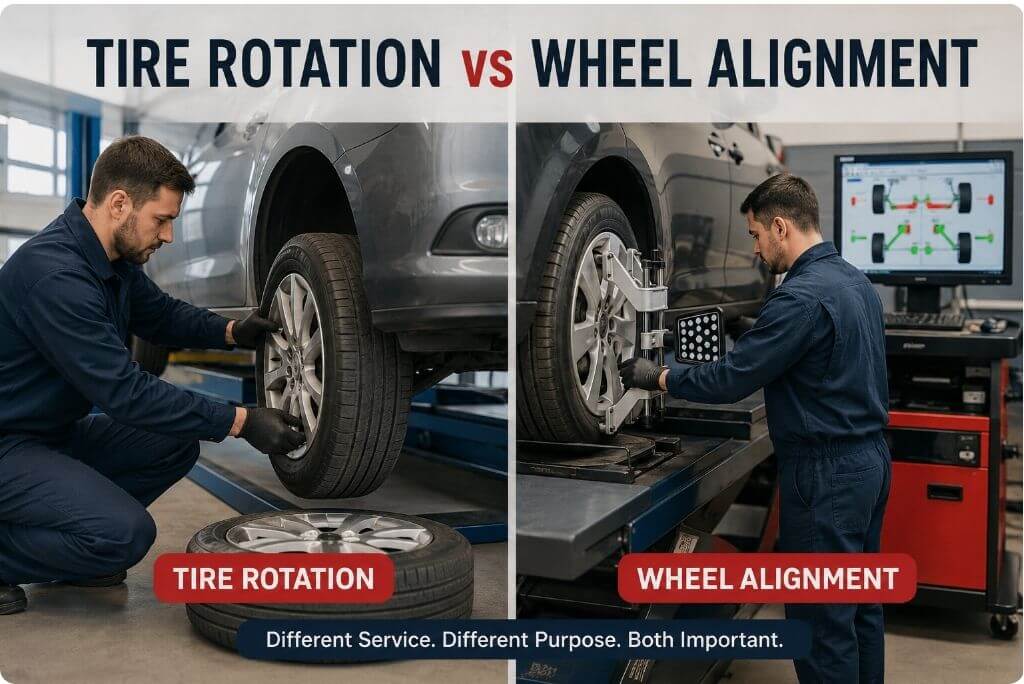
Many drivers think tire rotation and wheel alignment are the same service, but they actually solve different problems. Tire rotation moves your tires to different positions to promote even tread wear, while wheel alignment adjusts the wheel angles to keep your car driving straight and handling properly. In short, tire rotation helps extend tire life, and wheel alignment improves steering, stability, and overall vehicle performance.
In this guide, you’ll learn the key differences between tire rotation vs wheel alignment, the warning signs that indicate which service your car needs, how often each should be done, typical costs, and whether you should get one or both. By the end, you’ll know exactly which service is right for your vehicle and how to keep your tires lasting longer.
What Is Tire Rotation?
Tire rotation is the process of moving your tires to different positions on the vehicle. For example, the front tires may be moved to the rear, while the rear tires move to the front or switch sides, depending on your vehicle and tire type.
Tires don’t wear at the same rate. On most front-wheel-drive vehicles, the front tires handle steering, braking, and engine power, so they usually wear out faster than the rear tires. Driving habits, road conditions, and vehicle weight also affect how quickly each tire wears.
Rotating your tires helps spread this wear more evenly. This can improve traction, keep the ride smoother, and help you get the full life out of your tires. It won’t fix damaged or unevenly worn tires, but it can help prevent uneven wear from becoming a bigger problem.
Most vehicles benefit from regular tire rotation, including front-wheel-drive, rear-wheel-drive, all-wheel-drive, SUVs, trucks, and minivans. Following the rotation schedule in your owner’s manual is the best approach.
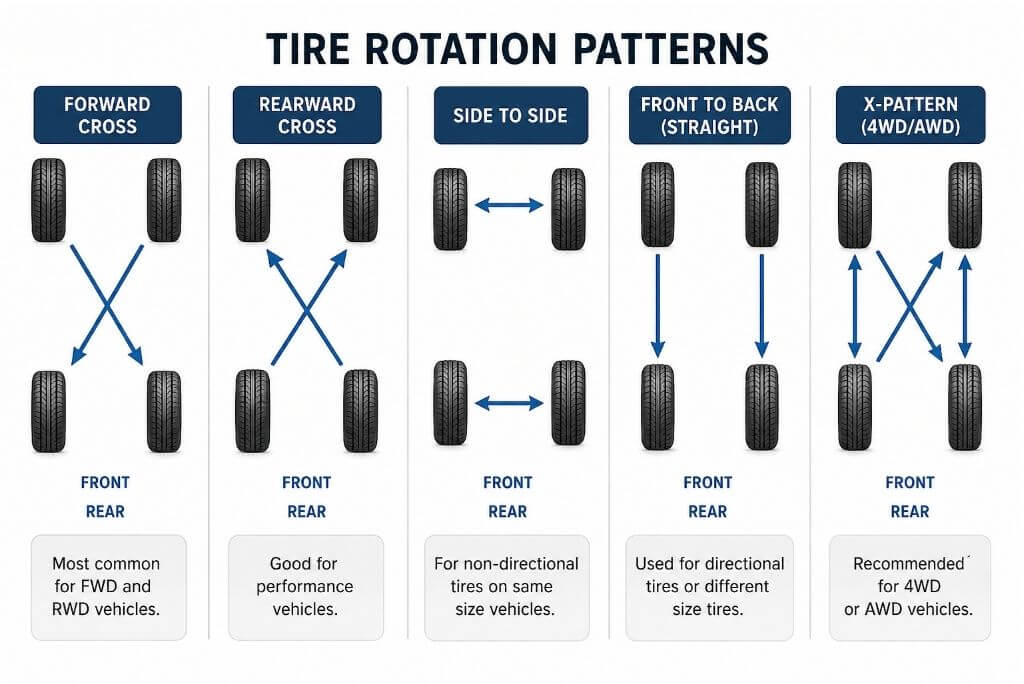
Common tire rotation patterns include:
- Front-to-back: Front and rear tires swap positions on the same side.
- Cross pattern: Front and rear tires switch positions and sides.
- X-pattern: All four tires move diagonally in an X-shaped pattern.
- Directional tire rotation: Tires stay on the same side because they are designed to roll in one direction only.
- Staggered setup: Vehicles with different front and rear tire sizes usually can’t use standard rotation patterns, so rotation options are limited.
What Is Wheel Alignment?
Wheel alignment is a service that adjusts the angles of your wheels so they point in the right direction. Despite the name, it doesn’t change the wheels or tires themselves. Instead, a technician adjusts parts of the vehicle’s suspension—the system that connects the wheels to the car.
When the suspension is out of alignment, the wheels no longer sit at the correct angles. This can cause the car to pull to one side, wear tires unevenly, or make the steering wheel sit off-center. An alignment won’t fix worn tires, but it can stop the problem from getting worse.
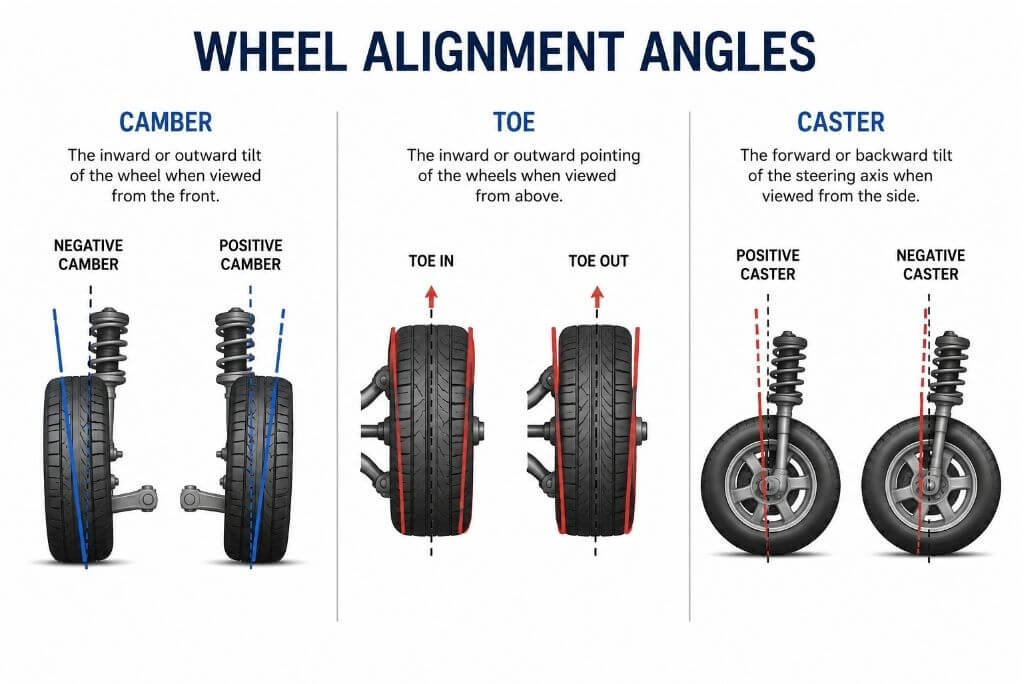
The three main alignment angles are:
- Camber: The inward or outward tilt of the tire when viewed from the front. Too much tilt can wear one edge of the tire faster.
- Toe: The direction the tires point when viewed from above. If they point too far inward or outward, the tires can scrub against the road instead of rolling smoothly.
- Caster: The angle of the steering system when viewed from the side. It helps the vehicle stay stable and allows the steering wheel to return to center after a turn.
These adjustments are small, but they make a big difference in how your vehicle drives and how long your tires last.
Tire Rotation vs Wheel Alignment: Key Differences
Tire rotation and wheel alignment are often recommended together, but they solve different problems. Tire rotation helps your tires wear evenly by moving them to different positions. Wheel alignment adjusts the wheel angles so your vehicle drives straight and handles properly.
Knowing the difference can help you choose the right service and avoid paying for work you don’t need.
| Feature | Tire Rotation | Wheel Alignment |
| Purpose | Helps all four tires wear evenly. | Keep the wheels pointed in the correct direction. |
| What gets adjusted | The tires are moved to different positions. | The wheel angles are adjusted using the suspension. |
| When it’s needed | At regular mileage intervals or when tire wear becomes uneven. | When the car pulls to one side, the steering wheel is off-center, or after a hard impact. |
| Typical cost | Usually $20–$60, or free with some tire purchases. | Usually $75–$200, depending on the vehicle and whether it’s a two- or four-wheel alignment. |
| Time required | About 20–40 minutes. | About 30–90 minutes. |
| Effect on tire wear | Helps prevent uneven future wear. | Stops incorrect wheel angles from causing rapid tire wear. |
| Effect on steering | Does not correct steering problems. | Improves straight-line driving and steering feel. |
| Fuel economy | Can help slightly by keeping tire wear even. | Can improve fuel economy if poor alignment was creating extra rolling resistance. |
| Handling | Helps maintain balanced grip as the tires wear. | Makes the vehicle feel more stable and predictable. |
| Safety | Helps all tires provide more consistent traction. | Improves vehicle control, especially during braking and highway driving. |
| Tire lifespan | Extends tire life by spreading wear more evenly. | Extends tire life by preventing unnecessary edge or uneven wear. |
Neither service replaces the other. A tire rotation cannot correct alignment problems, and a wheel alignment does not move the tires. For the best tire life and handling, most vehicles need both services at the appropriate time.
Signs You Need Tire Rotation
A tire rotation is usually due when the front tires wear faster than the rear ones. This is common because the front tires often handle more braking, steering, and turning.
Uneven tread depth is another clear sign. If one tire looks more worn than the others, rotating them can help balance future wear. You may also notice the tires getting noisier or the ride feeling slightly rougher as the wear becomes less even.
Many drivers rotate their tires based on mileage, even if they do not notice a problem. That is often the best approach, because waiting for obvious wear can shorten tire life.
A tire rotation can help prevent future wear, but it will not fix a damaged tire. If a tire has a puncture, bulge, crack, or severe wear, it needs to be inspected or replaced first.
Signs You Need Wheel Alignment
A wheel alignment is often needed if your car pulls to the left or right when you are driving on a straight road. That usually means the wheels are no longer pointed exactly where they should be.
Another common sign is a steering wheel that sits off-center even when the car is moving straight. You may also notice feathered tire wear, where the tread feels rough or uneven along the edge, or faster wear on the inside or outside of the tire.
Some drivers also feel the car is less steady than usual, especially at higher speeds. This can happen when the wheels are out of line and the vehicle is no longer tracking straight.
You should also have alignment checked after hitting a deep pothole, curb, or road debris. The same is true after suspension repairs, since changing those parts can affect the wheel angles.
An alignment can correct the cause of these problems, but it will not fix tires that are already badly worn or damaged.
Tire Rotation vs Wheel Alignment: Which One Do You Need?
The right service depends on the problem you’re trying to solve. If your tires are simply wearing at different rates and you’ve reached the recommended maintenance interval, a tire rotation is usually the right choice.
If your car pulls to one side, the steering wheel isn’t centered, or you recently hit a large pothole or curb, a wheel alignment is more likely to fix the issue.
Use this quick guide to help you decide:
| If your car… | You probably need… |
| Front tires wear faster than the rear tires | Tire Rotation |
| Pulls left or right on a straight road | Wheel Alignment |
| Has a crooked steering wheel | Wheel Alignment |
| Has reached the recommended rotation interval | Tire Rotation |
| Hit a pothole or curb | Wheel Alignment Inspection |
| Has uneven tire wear and steering problems | Both Services |
If you’re still unsure, ask a technician to inspect the tires before any work is done. A quick inspection can often identify the real cause and help you avoid paying for a service you don’t need.
Can You Need Both Services at the Same Time?
Yes. In many cases, tire rotation and wheel alignment are both worth doing because they solve different problems. Rotation helps the tires wear more evenly. Alignment helps the wheels point the right way and keeps the car driving straight.
A common example is a car that has not had regular maintenance. The tires may be wearing unevenly, and the steering may also feel off. In that case, rotating the tires alone will not fix the steering issue, and alignment alone will not stop uneven tire wear.
You might also need both after hitting a curb, driving through a deep pothole, or replacing worn suspension parts. These events can throw off the wheel angles and also leave the tires wearing unevenly over time.
The two services work together, but they are not the same thing. Rotation helps manage tire wear. Alignment helps the vehicle drive properly.
Tire Rotation vs Wheel Balancing vs Wheel Alignment
These three services are related, but they solve different problems. Tire rotation moves the tires around the car. Wheel balancing evens out the weight in each wheel and tire assembly. Wheel alignment adjusts the wheel angles so the car drives straight.
| Service | Purpose | What is adjusted | When needed |
| Rotation | Helps tires wear evenly | Tire position on the car | At regular mileage intervals or when wear starts to differ |
| Alignment | Helps the car drive straight and protects tires from uneven wear | Wheel angles through the suspension | When the car pulls, the steering wheel is crooked, or after a hard hit |
| Balancing | Reduces vibration and shaking | Small weight differences in the wheel and tire | When you feel vibration, after new tires are installed, or if a wheel was repaired |
A simple way to remember it: rotation changes where the tires sit, alignment changes how the wheels point, and balancing fixes how smoothly the wheel spins. Each one does a different job, so one service does not replace the others.
How Often Should You Rotate Tires and Get a Wheel Alignment?
There isn’t one maintenance schedule that fits every vehicle. Your driving habits, road conditions, and the manufacturer’s recommendations all play a role. The best approach is to follow your owner’s manual and pay attention to how your vehicle feels.
Tire Rotation
Most manufacturers recommend rotating your tires every 5,000 to 7,500 miles (about 8,000 to 12,000 km). Many drivers simply rotate their tires during every oil change if the timing matches the recommended interval.
You may need more frequent rotations if you regularly drive on rough roads, carry heavy loads, or drive aggressively. Vehicles with front-wheel drive often benefit from staying on schedule because the front tires usually wear faster.
Wheel Alignment
Unlike tire rotation, wheel alignment does not have a fixed mileage interval. You only need an alignment when your vehicle shows signs that the wheel angles may have changed.
It’s a good idea to have the alignment checked if:
- Your car starts pulling to one side.
- The steering wheel is no longer centered.
- You hit a large pothole or curb.
- Suspension or steering parts have been repaired or replaced.
- You’re installing new tires and the old tires showed uneven wear.
Following your vehicle manufacturer’s maintenance schedule and addressing problems early can help your tires last longer and keep your car driving safely.
Common Myths
Many drivers hear different advice about tire maintenance. Here are a few common myths and the facts behind them.
| Myth | Fact |
| Rotation and alignment are the same service. | They are different. Tire rotation moves the tires to different positions, while wheel alignment adjusts the wheel angles. |
| Wheel alignment includes tire rotation. | No. These are separate services. Some repair shops may recommend both during the same visit, but one does not include the other. |
| Tire rotation fixes steering problems. | No. If your car pulls to one side or the steering wheel is off-center, a wheel alignment is usually the better solution. |
| Wheel alignment fixes worn tires. | No. An alignment helps prevent uneven wear from getting worse, but it cannot restore tread that has already worn away. |
| New tires never need an alignment check. | Not always. If your old tires wore unevenly or the vehicle recently hit a pothole or curb, checking the alignment before or after installing new tires can help protect your investment. |
Understanding these differences can help you choose the right service, avoid unnecessary repairs, and get the most life out of your tires.
Real-World Scenarios
A crooked steering wheel often points to an alignment issue. The car may still drive, but it will not feel centered, and that can make longer trips more tiring.
If the front tires are wearing faster than the rear ones, tire rotation is usually the first thing to check. This is common and often happens before the wear becomes serious enough to notice right away.
A deep pothole can knock the wheels out of line. After that, the car may start pulling to one side or feel less steady at higher speeds. It is worth having the alignment checked soon after the impact.
New tires are another good time to think about both services. If the old tires wore unevenly, or the car has not had maintenance in a while, it is smart to check the alignment so the new tires do not wear out the same way.
Expert Tips to Extend Tire Life
A few simple habits can make a big difference in how long your tires last. Regular maintenance costs far less than replacing tires early.
- Check your tire pressure at least once a month and before long trips.
- Rotate your tires on schedule to help them wear evenly.
- Inspect the tread regularly for uneven or unusual wear.
- Avoid hard acceleration, sudden braking, and sharp cornering whenever possible.
- Have the wheel alignment checked after hitting a large pothole or curb, or after suspension repairs.
- Balance your tires if you notice vibration or whenever new tires are installed.
- Follow the maintenance schedule in your vehicle owner’s manual, as it is designed specifically for your vehicle.
No maintenance routine can prevent every tire problem, but staying consistent with these simple checks can improve safety, extend tire life, and help you get the best value from your tires.
Frequently Asked Questions
Is tire rotation the same as wheel alignment?
No. Tire rotation changes where the tires sit on the vehicle. Wheel alignment changes the angles of the wheels.
Which service should I get first?
That depends on the problem. If the car pulls or the steering wheel is crooked, alignment should be checked first. If the tires are wearing unevenly but the car drives normally, rotation may be the first step.
Can bad alignment ruin new tires?
Yes. If the alignment is off, new tires can wear out much faster than they should.
How do I know if I need both services?
If the car drives poorly and the tires show uneven wear, both may be needed. A technician can inspect the tire wear pattern and road feel to help decide.
Does wheel alignment improve fuel economy?
It can help when alignment problems are making the car work harder or creating extra drag from poor tire angles.
Can I drive with bad alignment?
You may be able to, but it is not a good idea for long. Bad alignment can make the car harder to control and can wear tires faster.
Does rotating tires make the ride smoother?
It can help if uneven wear is causing noise or vibration, but it is not the same as balancing or alignment.
Should I get an alignment every time I rotate my tires?
Not always. Rotation is routine maintenance. Alignment is usually done when there are symptoms or after an impact.
Final Verdict
Tire rotation and wheel alignment are both important, but they solve different problems. Tire rotation helps your tires wear evenly and last longer. Wheel alignment helps your car drive straight, feel stable, and avoid extra wear caused by poor wheel angles.
If you are trying to decide which service you need, start with the symptom. Uneven wear usually points to rotation. Steering problems usually point to alignment. And sometimes the best answer is both.
The safest and smartest approach is to keep up with your maintenance schedule, watch for changes in how the car feels, and deal with tire wear early instead of waiting too long.
