Toyota Camry Tire Pressure: Recommended PSI by Year and Tire Size
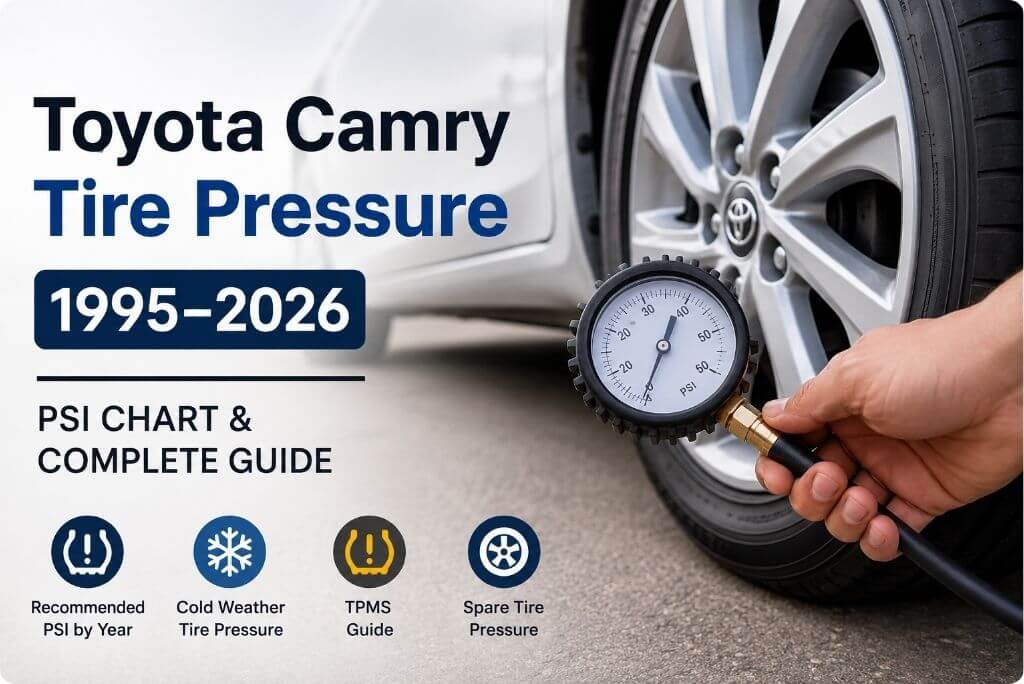
Finding the correct Toyota Camry tire pressure is important for safe handling, even tire wear, fuel economy, and overall driving comfort. The recommended tire pressure can vary depending on your Camry’s model year, trim, and original tire size, so there is not always one PSI that applies to every Camry. In this guide, you’ll find a comprehensive Toyota Camry tire pressure chart covering model years 1995 through 2026, along with practical information on cold tire pressure, how to check your PSI, and what to do when the TPMS warning light comes on. For the most accurate recommendation for your specific vehicle, always compare the chart with the tire information placard on your Camry and the owner’s manual.
What Is the Recommended Tire Pressure for a Toyota Camry?
The recommended tire pressure for a Toyota Camry depends on the model year, trim, and original tire size. Many Camry models use a recommended cold tire pressure in the mid-30 PSI range, but the exact specification is not the same for every model year or configuration.
For the correct tire pressure for your specific Camry, check the tire information placard on the driver’s-side door jamb or refer to your owner’s manual. This information shows the manufacturer’s recommended cold tire inflation pressure for your vehicle. The recommended PSI on the vehicle placard—not the maximum pressure printed okon the tire sidewall—should be your primary reference when inflating the tires.
If you’re looking for a quick reference, use the Toyota Camry tire pressure chart below to find the recommended pressure for your model year and original tire size. If your Camry has aftermarket wheels or a non-original tire size, the chart may not apply directly, so verify the correct pressure for your specific setup before adjusting the tires.
Toyota Camry Tire Pressure Chart: 1995–2026
The tire pressure values in this chart are provided as a reference based on available owner’s manual specifications and original-equipment tire configurations. Recommended pressure can vary by model year, trim, tire size, vehicle load, and drivetrain. Always use the cold tire pressure listed on the tire information placard on your specific Toyota Camry as the final reference.
All pressures are cold tire pressures.
F/R = Front/Rear.
Unless otherwise noted, values below are for normal driving.
2026 Toyota Camry Tire Pressure
| OEM Tire Size | Front | Rear | Configuration |
| 205/65R16 | 38 PSI | 38 PSI | Hybrid LE |
| 235/45R18 | 35 PSI | 35 PSI | Applicable 18-inch configurations |
| 235/40R19 | 35 PSI | 35 PSI | Applicable 19-inch configurations |
Note: Verify the exact pressure on the vehicle’s door-jamb placard.
2025 Toyota Camry Tire Pressure
| OEM Tire Size | Front | Rear | Configuration |
| 205/65R16 | 38 PSI | 38 PSI | Hybrid LE |
| 235/45R18 | 35 PSI | 35 PSI | Applicable 18-inch configurations |
| 235/40R19 | 35 PSI | 35 PSI | Applicable 19-inch configurations |
Note: Exact pressure should be confirmed against the individual vehicle placard.
2024 Toyota Camry Tire Pressure
| OEM Tire Size | Front | Rear | Configuration |
| 205/65R16 | 35 PSI | 35 PSI | Applicable FWD configuration |
| 215/55R17 | 35 PSI | 35 PSI | FWD |
| 215/55R17 | 36 PSI | 36 PSI | AWD |
| 235/45R18 | 35 PSI | 35 PSI | FWD |
| 235/45R18 | 36 PSI | 36 PSI | AWD |
| 235/40R19 | 35 PSI | 35 PSI | Applicable configuration |
2023 Toyota Camry Tire Pressure
| OEM Tire Size | Front | Rear | Configuration |
| 205/65R16 | 35 PSI | 35 PSI | Applicable FWD configuration |
| 215/55R17 | 35 PSI | 35 PSI | FWD |
| 215/55R17 | 36 PSI | 36 PSI | AWD |
| 235/45R18 | 35 PSI | 35 PSI | FWD |
| 235/45R18 | 36 PSI | 36 PSI | AWD |
| 235/40R19 | 35 PSI | 35 PSI | Applicable configuration |
2022 Toyota Camry Tire Pressure
| OEM Tire Size | Front | Rear | Configuration |
| 205/65R16 | 35 PSI | 35 PSI | Applicable FWD configuration |
| 215/55R17 | 35 PSI | 35 PSI | FWD |
| 215/55R17 | 36 PSI | 36 PSI | AWD |
| 235/45R18 | 35 PSI | 35 PSI | FWD |
| 235/45R18 | 36 PSI | 36 PSI | AWD |
| 235/40R19 | 35 PSI | 35 PSI | Applicable configuration |
2021 Toyota Camry Tire Pressure
| OEM Tire Size | Front | Rear | Configuration |
| 205/65R16 | 35 PSI | 35 PSI | Applicable configuration |
| 215/55R17 | 35 PSI | 35 PSI | FWD |
| 215/55R17 | 36 PSI | 36 PSI | AWD |
| 235/45R18 | 35 PSI | 35 PSI | FWD |
| 235/45R18 | 36 PSI | 36 PSI | AWD |
| 235/40R19 | 35 PSI | 35 PSI | Applicable configuration |
2020 Toyota Camry Tire Pressure
| OEM Tire Size | Front | Rear | Configuration |
| 205/65R16 | 35 PSI | 35 PSI | Applicable configuration |
| 215/55R17 | 35 PSI | 35 PSI | FWD |
| 215/55R17 | 36 PSI | 36 PSI | AWD |
| 235/45R18 | 35 PSI | 35 PSI | FWD |
| 235/45R18 | 36 PSI | 36 PSI | AWD |
| 235/40R19 | 35 PSI | 35 PSI | Applicable configuration |
2019 Toyota Camry Tire Pressure
| OEM Tire Size | Front | Rear | Configuration |
| 205/65R16 | 35 PSI | 35 PSI | Applicable configuration |
| 215/55R17 | 35 PSI | 35 PSI | Applicable configuration |
| 235/45R18 | 35 PSI | 35 PSI | Applicable configuration |
| 235/40R19 | 35 PSI | 35 PSI | Applicable configuration |
2018 Toyota Camry Tire Pressure
| OEM Tire Size | Front | Rear | Configuration |
| 205/65R16 | 35 PSI | 35 PSI | Applicable configuration |
| 215/55R17 | 35 PSI | 35 PSI | Applicable configuration |
| 235/45R18 | 35 PSI | 35 PSI | Applicable configuration |
| 235/40R19 | 35 PSI | 35 PSI | Applicable configuration |
2017 Toyota Camry Tire Pressure
| OEM Tire Size | Front | Rear | Configuration |
| P205/65R16 | 35 PSI | 35 PSI | Applicable configuration |
| P215/55R17 | 35 PSI | 35 PSI | Applicable configuration |
| P225/45R18 | 33 PSI | 33 PSI | Applicable configuration |
2016 Toyota Camry Tire Pressure
| OEM Tire Size | Front | Rear | Configuration |
| P205/65R16 | 35 PSI | 35 PSI | Applicable configuration |
| P215/55R17 | 35 PSI | 35 PSI | Applicable configuration |
| P225/45R18 | 33 PSI | 33 PSI | Applicable configuration |
2015 Toyota Camry Tire Pressure
| OEM Tire Size | Front | Rear | Configuration |
| P205/65R16 | 35 PSI | 35 PSI | Applicable configuration |
| P215/55R17 | 35 PSI | 35 PSI | Applicable configuration |
| P225/45R18 | 33 PSI | 33 PSI | Applicable configuration |
2014 Toyota Camry Tire Pressure
| OEM Tire Size | Front | Rear | Configuration |
| P205/65R16 | 35 PSI | 35 PSI | Applicable configuration |
| P215/55R17 | 35 PSI | 35 PSI | Applicable configuration |
| P225/45R18 | 33 PSI | 33 PSI | Applicable configuration |
2013 Toyota Camry Tire Pressure
| OEM Tire Size | Front | Rear | Configuration |
| P205/65R16 | 35 PSI | 35 PSI | Applicable configuration |
| P215/55R17 | 35 PSI | 35 PSI | Applicable configuration |
| P225/45R18 | 33 PSI | 33 PSI | Applicable configuration |
2012 Toyota Camry Tire Pressure
| OEM Tire Size | Front | Rear | Configuration |
| P205/65R16 | 35 PSI | 35 PSI | Applicable configuration |
| P215/55R17 | 35 PSI | 35 PSI | Applicable configuration |
| P225/45R18 | 33 PSI | 33 PSI | Applicable configuration |
2011 Toyota Camry Tire Pressure
| OEM Tire Size | Front | Rear | Configuration |
| P215/60R16 | 34 PSI | 34 PSI | Applicable configuration |
| P215/55R17 | 32 PSI | 32 PSI | Applicable configuration |
2010 Toyota Camry Tire Pressure
| OEM Tire Size | Front | Rear | Configuration |
| P215/60R16 | 34 PSI | 34 PSI | Applicable configuration |
| P215/55R17 | 32 PSI | 32 PSI | Applicable configuration |
2009 Toyota Camry Tire Pressure
| OEM Tire Size | Front | Rear | Configuration |
| P215/60R16 | 32 PSI | 32 PSI | Applicable configuration |
| P215/55R17 | 32 PSI | 32 PSI | Applicable configuration |
Important: Some available 2009 manual versions show 30 PSI in one specification table and 32 PSI in another, so I would not publish a single universal 2009 value without checking the exact US-market manual/door placard for the vehicle. The chart above should therefore be treated as a reference, not a definitive factory specification.
2008 Toyota Camry Tire Pressure
| OEM Tire Size | Front | Rear | Configuration |
| P215/60R16 | 30 PSI | 30 PSI | Applicable configuration |
| P215/55R17 | 32 PSI | 32 PSI | Applicable configuration |
2007 Toyota Camry Tire Pressure
| OEM Tire Size | Front | Rear | Configuration |
| P215/60R16 | 30 PSI | 30 PSI | Applicable configuration |
| P215/55R17 | 32 PSI | 32 PSI | Applicable configuration |
2006 Toyota Camry Tire Pressure
| OEM Tire Size | Front | Rear | Configuration |
| P205/65R15 | 29 PSI | 29 PSI | LE |
| P215/60R16 | 29 PSI | 29 PSI | XLE, 2.4L SE |
| P215/55R17 | 30 PSI | 30 PSI | 3.3L V6 SE |
Toyota’s 2006 manual also lists alternative pressure specifications for different loading conditions. For example, the P205/65R15 configuration is shown at 32 PSI for full rated load, while the normal/reduced-load specification is 29 PSI. This is why the exact door-jamb placard should take priority.
2005 Toyota Camry Tire Pressure
| OEM Tire Size | Front | Rear | Configuration |
| P205/65R15 | 29 PSI | 29 PSI | Applicable configuration |
| P215/60R16 | 29 PSI | 29 PSI | Applicable configuration |
| P215/55R17 | 30 PSI | 30 PSI | Applicable configuration |
2004 Toyota Camry Tire Pressure
| OEM Tire Size | Front | Rear | Configuration |
| P205/65R15 | 29 PSI | 29 PSI | Applicable configuration |
| P215/60R16 | 29 PSI | 29 PSI | Applicable configuration |
2003 Toyota Camry Tire Pressure
| OEM Tire Size | Front | Rear | Configuration |
| P205/65R15 | 29 PSI | 29 PSI | Applicable configuration |
| P215/60R16 | 29 PSI | 29 PSI | Applicable configuration |
2002 Toyota Camry Tire Pressure
| OEM Tire Size | Front | Rear | Configuration |
| P205/65R15 | 29 PSI | 29 PSI | Applicable configuration |
| P215/60R16 | 29 PSI | 29 PSI | Applicable configuration |
2001 Toyota Camry Tire Pressure
| OEM Tire Size | Front | Rear | Load Condition |
| P205/65R15 | 29 PSI | 29 PSI | Reduced load, 1–4 passengers |
| P205/65R15 | 32 PSI | 32 PSI | Full rated load |
| P205/60R16 | 32 PSI | 32 PSI | Reduced or full rated load |
The 2001 manual explicitly differentiates pressure by load for the P205/65R15 configuration. This is an important correction to the earlier simplified chart.
2000 Toyota Camry Tire Pressure
| OEM Tire Size | Front | Rear | Configuration |
| P195/70R14 | 30 PSI | 30 PSI | Applicable configuration |
| P205/65R15 | 32 PSI | 32 PSI | Applicable configuration |
| P205/60R16 | 32 PSI | 32 PSI | Applicable configuration |
1999 Toyota Camry Tire Pressure
| OEM Tire Size | Front | Rear | Configuration |
| P195/70R14 | 30 PSI | 30 PSI | Applicable configuration |
| P205/65R15 | 32 PSI | 32 PSI | Applicable configuration |
1998 Toyota Camry Tire Pressure
| OEM Tire Size | Front | Rear | Load Condition |
| P195/70R14 | 30 PSI | 30 PSI | Normal driving |
| P205/65R15 | 29 PSI | 29 PSI | Reduced load, 1–4 passengers |
| P205/65R15 | 32 PSI | 32 PSI | Full rated load |
The 1998 owner’s manual clearly lists different pressures for the P205/65R15 depending on vehicle load. The earlier chart’s single 32 PSI value therefore needed this qualification
1997 Toyota Camry Tire Pressure
| OEM Tire Size | Front | Rear | Configuration |
| P195/70R14 | 30 PSI | 30 PSI | Applicable configuration |
| P205/65R15 | 32 PSI | 32 PSI | Applicable configuration |
1996 Toyota Camry Tire Pressure
| OEM Tire Size | Front | Rear | Configuration |
| 195/70R14 | 32 PSI | 32 PSI | DX |
| P195/70R14 | 30 PSI | 30 PSI | Applicable configurations |
| P205/65R15 | 32 PSI | 32 PSI | Applicable configurations |
1995 Toyota Camry Tire Pressure
| OEM Tire Size | Front | Rear | Configuration |
| 195/70R14 | 32 PSI | 32 PSI | DX |
| P195/70R14 | 30 PSI | 30 PSI | Applicable configurations |
| P205/65R15 | 32 PSI | 32 PSI | Applicable configurations |
How to Find the Exact Tire Pressure for Your Toyota Camry
The exact tire pressure for your Toyota Camry is listed on the driver’s-side door jamb tire information placard and in your owner’s manual. Toyota also says the correct tire pressure specs can be found through online manuals specific to your vehicle. Because tire pressure can vary by model year, trim, and tire size, this label is the best source for your exact Camry.
To check it correctly, look for the cold tire inflation pressure listed for your vehicle. Toyota’s guidance says tire pressure should be checked regularly with a gauge, and the tire pressure monitoring system should not be the only thing you rely on.
Follow these steps:
- Open the driver’s door and find the tire information placard on the door jamb.
- Check the recommended cold PSI for the front and rear tires.
- Make sure the tire size on the placard matches the tires on your Camry.
- Use a tire gauge to measure pressure when the tires are cold.
- Add or release air as needed until each tire matches the recommended pressure.
If the pressure warning light is on, Toyota says it can mean the tire pressure is low or that there is a problem with the tire pressure warning system.
Cold Tire Pressure Matters
Toyota’s tire-pressure guidance is based on cold tires, because pressure changes after driving. That means you should check the tires before the car has been driven for long, not right after a highway trip. Toyota’s manuals and quick-reference guides consistently tell drivers to use the vehicle label or owner’s manual for the correct tire inflation specifications.
Do Not Use the Sidewall Max PSI as Your Target
The number printed on the tire sidewall is not the same thing as the vehicle’s recommended pressure. For normal driving, use the Camry’s door-jamb placard or owner’s manual instead of guessing from the tire sidewall. Toyota points drivers back to the vehicle label and manual for the proper specification.
Why Toyota Camry Tire Pressure Can Vary
The correct tire pressure for a Toyota Camry is not always the same for every model year or every trim. Toyota sets tire pressure based on the vehicle’s original equipment, so the recommended PSI can change depending on the Camry’s factory tire size, wheel size, drivetrain, and trim level.
Here are the main reasons Camry tire pressure can vary:
1. Model Year
Toyota may use different tire and wheel setups in different model years. Even if two Camrys look similar, their recommended tire pressure may not match exactly.
2. Trim Level
A base model, sport trim, hybrid trim, or higher trim may come with different factory tires or wheels. That can change the recommended cold PSI.
3. OEM Tire Size
The original tire size on the vehicle is one of the biggest factors. A Camry with 16-inch tires may have a different recommendation than one with 18-inch or 19-inch tires.
4. Wheel Size
Wheel size often changes with trim level and can affect the tire size that comes with the car from the factory. Since tire pressure is tied to the original setup, wheel size can matter too.
5. Vehicle Configuration
Front-wheel drive and all-wheel drive versions may not always use the same pressure. Toyota may specify different PSI depending on the exact configuration.
6. Replacement Tires
If your Camry no longer has the original factory tires, the pressure shown in a generic online chart may not be the best match. Replacement tires can have different load ratings, construction, and recommended inflation needs.
7. Aftermarket Wheels
Aftermarket wheels can change the tire size or overall setup. In that case, the original factory chart may not apply directly, and the tire pressure should be checked with extra care.
Important Distinction
Changing the tire size does not mean you should automatically change the tire pressure on your own. The correct pressure should always be based on the vehicle manufacturer’s recommendation for the specific setup, not guessed from the tire sidewall or copied from another Camry model.
If you have a non-original tire size, replacement tires, or aftermarket wheels, the safest approach is to check the vehicle placard, review the owner’s manual, and get guidance from a qualified tire professional before adjusting the pressure.
Final Rule
Use the Toyota Camry tire pressure chart as a guide, but treat the driver’s-side door-jamb placard as the final reference for your exact vehicle.
What Does “Cold Tire Pressure” Mean?
“Cold tire pressure” means the pressure in your tires when they have not been driven for a while. This is the pressure you should use when checking or adjusting the tires on your Toyota Camry.
Driving heats up the tires, and when the tire temperature rises, the measured PSI can also rise. That is why it is important not to let air out of a tire just because it looks overinflated after driving. A warm tire can show a higher reading than it would when cold.
For the most accurate result, check your tire pressure before driving, or after the car has been parked long enough for the tires to cool down. Toyota’s guidance for recent Camry models explains cold tire pressure as a tire that has been parked for several hours or driven only a very short distance.
In simple terms, always check tire pressure when the tires are cold, not right after a trip. That gives you the reading Toyota intended and helps you set the pressure correctly.
How to Check Toyota Camry Tire Pressure
Checking your Toyota Camry tire pressure is simple, but it should be done the right way for an accurate reading. The most important thing is to check the tires when they are cold, because driving warms the air inside the tires and can raise the pressure reading.
Follow these steps:
- Find the recommended PSI.
Check the tire information placard on the driver’s-side door jamb or the owner’s manual for the correct cold tire pressure for your Camry. - Use a reliable tire gauge.
A digital or stick-style tire gauge works well. Do not rely only on the TPMS light or the dash reading if you want an exact measurement. - Check the tires when cold.
The best time is before driving, or after the car has been parked for several hours. - Remove the valve cap and press the gauge firmly onto the valve stem.
You should hear a short hiss of air as the gauge makes contact. - Read the pressure.
Compare the reading with the recommended PSI on the placard. - Adjust the pressure if needed.
Add air if the pressure is low, or release a small amount of air if it is too high. - Check all four tires.
Do not assume they are all at the same pressure. - Replace the valve cap.
This helps protect the valve stem from dirt and moisture.
If your Camry has a tire pressure monitoring system, the warning light can help alert you to a problem, but it should not replace a manual check. A gauge gives you the most accurate result.
For the best results, check your tire pressure at least once a month and before long drives.
Should You Use the PSI Printed on the Tire Sidewall?
No. You should not use the maximum PSI printed on the tire sidewall as the recommended tire pressure for your Toyota Camry.
The number on the tire sidewall indicates the tire’s maximum allowable inflation pressure under specified conditions. It is not necessarily the pressure Toyota recommends for your vehicle.
Instead, use the recommended cold tire pressure listed on the tire information placard on the driver’s-side door jamb or in your Camry owner’s manual. This is the pressure Toyota specifies for your vehicle’s original tire and wheel setup.
For example, if your tire sidewall says 44 PSI, that does not mean you should inflate your Camry’s tires to 44 PSI. Your vehicle’s recommended pressure may be lower.
The same rule applies when you replace your tires. Do not automatically use the maximum PSI printed on the new tire as your target pressure. If you are using the original tire size and a comparable replacement tire, start with the vehicle manufacturer’s recommended pressure. If you have changed the tire size, load rating, or wheel setup, consult the vehicle manufacturer information and a qualified tire professional for the correct inflation pressure.
Remember
- Door-jamb placard: Your primary reference for recommended tire pressure.
- Owner’s manual: Another reliable source for your Camry’s specifications.
- Tire sidewall: Shows the tire’s maximum inflation pressure, not your vehicle’s recommended PSI.
Always check and adjust your Toyota Camry’s tire pressure when the tires are cold, and follow the vehicle manufacturer’s recommended specification rather than simply inflating the tires to the maximum pressure shown on the sidewall.
What Happens If Your Toyota Camry Tire Pressure Is Too Low?
If your Toyota Camry tire pressure is too low, the tires have to work harder to carry the car. This can lead to several problems over time.
Increased Rolling Resistance
Underinflated tires create more resistance as they roll. That means the engine has to use more energy to move the car forward.
Reduced Fuel Economy
Because the tires are not rolling as efficiently, your Camry may use more fuel than it should.
Uneven Tread Wear
Low tire pressure can cause the outer edges of the tire to wear differently than the center. Over time, this can shorten tire life.
Poor Handling
A tire with low pressure may feel less responsive, especially when turning or braking. The car may not feel as stable as it should.
Increased Heat Buildup
When a tire runs underinflated, it flexes more than normal. That extra flexing creates heat, which can put extra stress on the tire.
Potential Tire Damage
If the pressure stays too low for too long, the tire can become damaged. In serious cases, this may lead to a flat tire or other tire failure.
The best way to avoid these problems is to check your Camry’s tire pressure regularly and keep it at the recommended cold PSI listed on the door-jamb placard or in the owner’s manual.
What Happens If Your Toyota Camry Tire Pressure Is Too High?
If your Toyota Camry tire pressure is too high, the tires may not perform as smoothly as they should. Overinflation can create its own set of problems, even if the tire still looks fine.
Harsher Ride
Overinflated tires can feel stiffer on the road, which may make the ride less comfortable over bumps and rough pavement.
Reduced Road Contact
When a tire is overinflated, it may not sit on the road surface as evenly as it should. That can affect how the tire grips the road in normal driving.
Uneven Tire Wear
Too much air can cause the center of the tread to wear faster than the edges over time.
Changes in Handling
An overinflated tire can make the car feel slightly different when steering, braking, or cornering. It may not feel as balanced as it should.
Less Comfortable Daily Driving
Even if the tire pressure is not extremely high, running above the recommended cold PSI can make everyday driving feel less refined.
If your Camry tires are overinflated, release air slowly and check the pressure again with a gauge. The goal is to match the recommended cold tire pressure listed on the driver’s-side door-jamb placard or in the owner’s manual, not the maximum pressure printed on the tire sidewall.
Toyota Camry TPMS Warning Light: What It Means
If the TPMS warning light comes on in your Toyota Camry, it usually means one or more tires may be underinflated. TPMS stands for Tire Pressure Monitoring System, and it is designed to alert you when tire pressure drops below the recommended level.
When the warning light appears, do not ignore it. Start by checking all four tires with a tire gauge and compare the readings with the recommended cold tire pressure listed on the driver’s-side door-jamb placard or in the owner’s manual. If one or more tires are low, inflate them to the correct PSI and check the light again.
Sometimes the TPMS light can come on even if the tires look normal. A sudden temperature drop can lower tire pressure, and a damaged tire or slow leak can also trigger the warning. In some cases, the issue may be with the TPMS system itself rather than the tire pressure.
If the light stays on after you have corrected the tire pressure, or if it keeps coming back, inspect the tires for leaks or damage and have the system checked by a qualified tire or service professional.
What to do when the TPMS light comes on
- Check all tires with a gauge.
- Compare each reading with the recommended cold PSI.
- Add air if any tire is low.
- Inspect for visible damage or a slow leak.
- Drive the vehicle if needed and see whether the light resets.
- If the light remains on, have the system inspected.
The TPMS light is a helpful warning, but it should not replace regular manual tire pressure checks. A gauge gives you the most accurate reading.
How Often Should You Check Toyota Camry Tire Pressure?
You should check your Toyota Camry’s tire pressure at least once a month and before long road trips. Regular checks help you catch slow leaks and normal pressure loss before they become bigger problems.
It’s also a good idea to check your tire pressure when:
- The weather changes significantly, especially when temperatures drop.
- The TPMS warning light comes on.
- You notice the car handling differently.
- The vehicle has been sitting unused for an extended period.
- You are preparing for a long highway trip.
- You have recently repaired or replaced a tire.
Always check the pressure when the tires are cold and use the recommended PSI listed on your Camry’s driver’s-side door-jamb placard or in the owner’s manual.
Regularly checking your tire pressure can help maintain proper handling, support even tread wear, and improve fuel efficiency.
Toyota Camry Tire Pressure in Cold Weather
Cold weather can cause your Toyota Camry tire pressure to drop. As the temperature falls, the air inside the tires contracts, which can lower the PSI reading even if the tire has no leak. This is why tire pressure often seems lower on cold mornings, especially during the fall and winter months.
Seasonal temperature changes can affect all four tires at the same time. A Camry that was properly inflated in warm weather may show a lower reading after a sudden cold front. This does not always mean the tires are damaged. In many cases, it simply means the pressure needs to be adjusted back to the recommended cold PSI.
This is also one reason the TPMS warning light may come on during cold weather. When the outside temperature drops, the tire pressure can fall enough to trigger the warning even though the tires looked fine the day before.
The best approach is to check and adjust your tire pressure based on the recommended cold tire pressure listed on the driver’s-side door-jamb placard or in the owner’s manual. Do not guess based on how the tire feels or wait until the tires warm up from driving. Check them when they are cold, then inflate them to the correct PSI.
If you live in an area with big seasonal temperature swings, checking tire pressure more often during colder months is a smart habit. It helps your Camry maintain proper handling, tread wear, and everyday driving comfort.
Toyota Camry Spare Tire Pressure
The spare tire pressure for a Toyota Camry should be checked separately from the regular road tires. For the 2023 Camry, available reference data shows a compact spare pressure of 60 PSI. That value should be treated as year-specific, not as a universal setting for every 1995–2026 Camry. Toyota also says the correct tire pressure specifications should be checked on the driver’s door-jamb sticker, in the owner’s manual, or through the model-specific online manual.
If your Camry has a compact spare, do not assume it should match the pressure of the four main tires. Temporary spare tires are designed differently, and their inflation requirement can be higher than the regular tires. Before using or inflating the spare, always confirm the exact specification for your model year and vehicle setup.
For this article, the safest rule is simple: use the spare-tire pressure listed for your exact Camry, and do not copy the regular tire PSI to the spare tire.
Can I Use a Different Tire Size on My Toyota Camry?
Yes, you can use a different tire size on your Toyota Camry in some cases, but it should not be done casually. A different tire size can change how the car rides, handles, and reads tire pressure. It can also affect the correct inflation pressure, so you should not assume the original PSI still applies after a tire-size change.
If you switch to a different tire size, the safest approach is to check the new tire’s load and size requirements, review your Camry’s owner’s manual, and confirm the recommended pressure with the tire information placard or a qualified tire professional. The pressure that worked for the original factory tire may not be the best choice for a replacement setup.
It is especially important not to copy the PSI from another Camry you saw online. Even the same model year can have different tire sizes, wheel sizes, or drivetrain configurations, and those differences can change the correct recommended pressure.
If you are using replacement tires that match the original size and load rating, start with the manufacturer’s recommended cold tire pressure for your Camry. If the size, load rating, or wheel setup has changed, confirm the correct pressure before driving long distances.
In short, a tire size change does not automatically mean you should change the tire pressure on your own. Use the vehicle placard, the owner’s manual, and professional guidance when needed.
Final Takeaway
The correct Toyota Camry tire pressure depends on the vehicle’s model year, trim, tire size, and overall configuration. Use the year-by-year chart in this guide as a helpful reference, but always verify the exact recommended cold PSI on your Camry’s driver’s-side door-jamb placard.
Check your tire pressure when the tires are cold, and do not use the maximum PSI printed on the tire sidewall as the vehicle’s recommended inflation pressure. Following the manufacturer’s recommended PSI can help your Camry maintain proper handling, tire wear, and fuel efficiency.
