Michelin X-Ice Snow Review: Is It Still Good in 2026?
The Michelin X-Ice Snow is a studless winter tire designed for drivers who regularly face snow and ice. Independent testing shows that its strongest areas are snow performance, ice braking, ride comfort, and efficiency. However, the same testing also shows a clear tradeoff: wet and dry-road braking can lag behind competing winter tires.
That makes the X-Ice Snow a better fit for severe winter conditions than for drivers who spend most of the season on clear, wet pavement. And in 2026, there is another factor to consider: Michelin has introduced the newer X-Ice Snow+, which is designed to improve braking, tread life, and efficiency over the previous generation.
So, is the Michelin X-Ice Snow still worth buying? For the right winter-driving conditions, yes—but its price and the newer X-Ice Snow+ should be part of the decision.
Michelin X-Ice Snow at a Glance
| Specification | Michelin X-Ice Snow |
| Tire type | Studless winter tire |
| Primary use | Snow and ice conditions |
| 3PMSF certified | Yes |
| Ice Grip certified | Yes |
| M+S rated | Yes |
| Vehicle applications | Cars, CUVs, SUVs, pickups, and selected EV applications |
| Original launch | 2020 |
| North American treadwear warranty | 40,000 miles / 60,000 km |
| Original launch size range | 14–22 inches |
| 2026 successor | Michelin X-Ice Snow+ |
Important: The 40,000-mile / 60,000-km figure is a limited treadwear warranty, not a guaranteed service life. Actual mileage varies with the vehicle, alignment, driving habits, road conditions, climate, maintenance, and other factors. Current sizes and availability vary by market.

How Does the Michelin X-Ice Snow Perform?
The Michelin X-Ice Snow has a clear performance profile: excellent snow performance, strong ice braking, good ride refinement, and strong efficiency, but noticeable compromises on wet and dry pavement.
The 2026 Tire Rack test reinforces that split. The X-Ice Snow finished at or near the front in snow and ice, while ranking last in both wet and dry braking. Its longer independent test history shows a similar pattern, although ice traction and handling have varied more between tests and tire sizes.
Snow Performance
Snow is one of the X-Ice Snow’s strongest areas.
In Tire Rack’s 2026 testing, it ranked 1st out of 10 in snow braking, stopping in 17.099 meters. It also ranked 3rd out of 10 in snow handling, only 1.2% behind the best tire. The test also gave it a strong subjective snow-handling score.
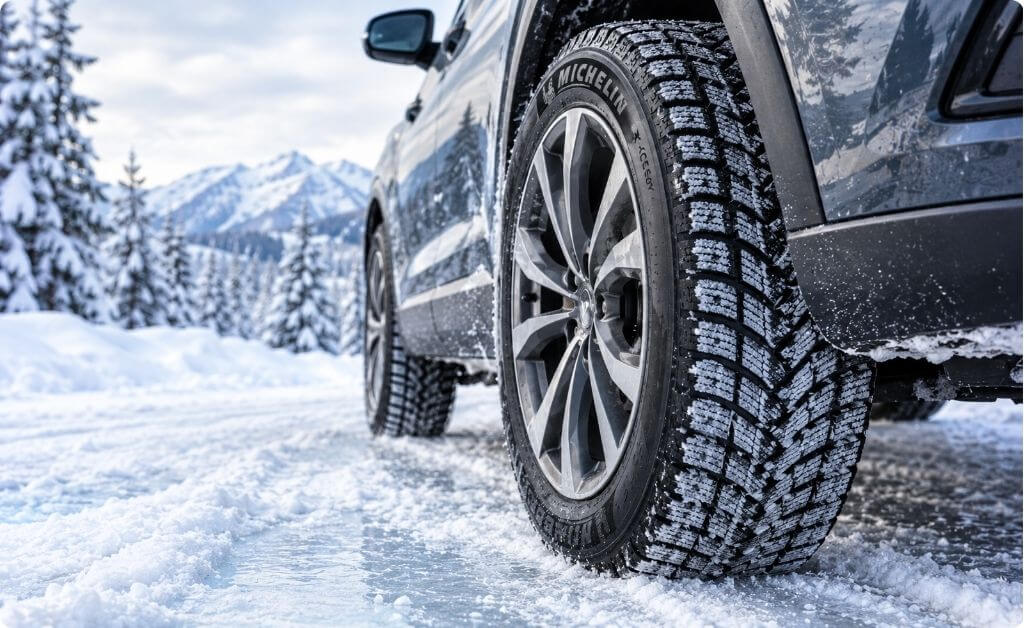
Its historical results support that performance. In a 2020 Test World comparison, the X-Ice Snow finished 2nd out of 20 in snow braking and 3rd out of 20 in snow handling. In Vi Bilägare’s 2023 test, it ranked 2nd out of 8 in snow braking, just 0.2% behind the winner.
These results matter more than Michelin’s marketing claims because they come from different independent tests, tire sizes, and testing programs. The exact rankings change, but the X-Ice Snow repeatedly performs near the front in snow.
Michelin’s winter-focused tread design, dense siping, and cold-weather compound are intended to maintain grip in low temperatures and snow. Those design features help explain its winter bias, but the independent test results are the stronger evidence of how the tire actually performs.
For drivers who regularly deal with snow-covered roads, the takeaway is simple: the X-Ice Snow provides strong braking and predictable handling when snow is the dominant road condition.
Verdict: Excellent snow performance. Snow traction is one of the clearest reasons to choose the X-Ice Snow.
Ice Performance
The X-Ice Snow also performs very well on ice, particularly when braking.
In Tire Rack’s 2026 test, it ranked 2nd out of 10 in ice braking, stopping in 12.009 meters, only 0.21 meter behind the test leader. It also ranked 2nd out of 10 in ice traction, finishing just 0.07 second behind the best result.
Earlier independent testing produced similarly strong braking results. The X-Ice Snow ranked 1st out of 8 for ice braking and 1st out of 8 for ice traction in Vi Bilägare’s 2024 Nordic friction test. It also won both categories in the publication’s 2023 test.
However, ice performance needs to be broken down into separate measurements. Braking, acceleration traction, and cornering/handling are not interchangeable. A tire can stop extremely well on ice without being the strongest tire when accelerating or cornering.
That is where the X-Ice Snow’s results become more mixed. Some tests have placed it well behind the leaders for ice traction or handling, including a 2023 test where it ranked 7th out of 8 for ice traction and a 2021 test where it ranked 13th out of 16 for ice handling.
For that reason, calling the X-Ice Snow simply “the best tire on ice” would go beyond the evidence. Its record is strongest for ice braking, while ice traction and handling have varied considerably between tests.
Verdict: Excellent ice braking, but more mixed ice-handling and traction results.
Wet-Road Performance
Wet pavement is one of the X-Ice Snow’s biggest weaknesses.
In Tire Rack’s 2026 test, it ranked 10th out of 10 in wet braking, stopping in 39.319 meters. That was 10.97 meters longer than the best tire in the test. It also ranked near the bottom for wet cornering grip.
The same pattern appeared in 2025. In a 14-tire winter comparison, the X-Ice Snow finished 14th out of 14 in wet braking, with a 41.1-meter stopping distance. It also ranked 12th out of 14 in wet handling.
This is not an isolated result. Earlier independent tests also show weak wet braking, including a 14th-place finish out of 16 in 2021 and 15th out of 20 in a 2020 winter comparison.
Michelin’s launch material did report improvements in slush and hydroplaning resistance compared with the previous generation. Those manufacturer findings are relevant, but they do not change the broader independent-test pattern for wet braking and handling.
The practical takeaway is that the X-Ice Snow can be used on wet roads, but drivers should not expect the same level of grip they get from its snow and ice performance. Longer stopping distances and lower cornering grip are the tradeoffs.
Verdict: Wet performance is a major weakness. This is one of the most important compromises to consider before buying the X-Ice Snow.
Dry-Road Performance
Dry pavement is another area where the X-Ice Snow gives up performance in favor of winter capability.
In Tire Rack’s 2026 test, it ranked 10th out of 10 in dry braking, stopping in 31.394 meters. That was 6.07 meters longer than the best tire in the test. Its dry-circle grip also ranked below the leaders.
The broader test history points in the same direction. The X-Ice Snow finished 16th out of 20 in dry braking in a 2020 Nordic winter test, while Vi Bilägare placed it 7th out of 8 for dry braking in both 2020 and 2023.
That does not make it unsuitable for dry winter roads. A dedicated winter tire still needs to work when roads are clear, and the X-Ice Snow provides predictable steering and usable road manners. In the 2026 Tire Rack test, its subjective road score actually ranked 2nd out of 10, showing that dry-road drivability and dry braking are not the same thing.
The bigger issue is for drivers who spend most of winter on clear pavement. If snow and ice are rare and dry or wet roads are the norm, a tire designed around a broader range of conditions may provide a better balance.
Verdict: Acceptable for winter use, but dry-road performance is not a strength.
Ride Comfort and Noise
Ride comfort is a genuine strength of the X-Ice Snow, although its noise performance is more dependent on the test and measurement method.
Tire Rack’s earlier testing praised the tire’s controlled ride, noting that it absorbed impacts well and maintained a good balance between stiffness and compliance. Its steering was also described as natural and predictable for a non-performance winter tire.
The longer independent test record supports the comfort advantage. In a 2025 Teknikens Värld comparison, the X-Ice Snow ranked 1st out of 20 for comfort. It has also produced strong subjective noise results in several earlier winter tests.
However, it would be inaccurate to call it consistently the quietest winter tire. In Tire Rack’s 2026 test, the X-Ice Snow ranked 6th out of 10 for subjective noise, while Vi Bilägare’s measured noise results placed it 7th out of 8 in both 2024 and 2023.
Those differences highlight an important point: ride comfort and measured external noise are not the same thing. The X-Ice Snow can provide a smooth, refined ride without necessarily producing the lowest measured noise level in every test.
For everyday winter driving, its road manners remain a meaningful advantage, especially for drivers who value a comfortable ride as much as outright winter grip.
Verdict: Comfort is a genuine strength, but the X-Ice Snow is not consistently the quietest tire in independent testing.
What Independent Tests Say About the Michelin X-Ice Snow
The Michelin X-Ice Snow has been tested extensively since its introduction, and the results show a fairly consistent performance pattern. It is strongest in snow, ice braking, and comfort, while wet and dry braking are recurring weaknesses.
It has been tested in different tire sizes, vehicles, weather conditions, and comparison groups. Because of those differences, no single ranking tells the whole story. The repeated pattern across independent tests is more useful than assigning the tire one overall score.
| Year | Independent test | Test size | Overall result |
| 2026 | Tire Rack All-Weather vs. Winter | 215/55 R17 | 2nd/10 |
| 2025 | Teknikens Värld Winter Test | 235/45 R18 | 4th/20 |
| 2025 | Tyre Reviews Best Snow Tires | 205/55 R16 | 4th/7 |
| 2025 | Tekniikan Maailma Friction/Studded | 205/55 R16 | 6th/14 |
| 2024 | Vi Bilägare Nordic Friction | 225/45 R17 | 4th/8 |
| 2024 | Teknikens Värld Winter Test | 225/50 R17 | 5th/17 |
| 2023 | Vi Bilägare Studless Friction | 225/45 R17 | 4th/8 |
| 2023 | TESTIRENKAAT Studless vs. Studded | 205/55 R16 | 3rd/8 |
| 2022/23 | Tyre Reviews Studless Winter | 205/55 R16 | 1st/9 |
| 2021 | Tyre Reviews Winter Comparison | 245/40 R18 | 1st/3 |
| 2021 | Teknikens Värld Studless/Studded | 205/55 R16 | 4th/16 |
| 2020 | Vi Bilägare Nordic Friction | 205/60 R16 | 6th/8 |
| 2020 | Tyre Reviews Best Winter Tires | 205/55 R16 | 1st/19 |
| 2020 | Test World Nordic/Studded | 205/55 R16 | 8th/20 |
The X-Ice Snow’s long record shows that it is not a one-test wonder. It has repeatedly been competitive in winter-focused testing, with several top finishes.
At the same time, rankings should not be compared as though every test were identical. Surface type, temperature, vehicle, tire size, competitors, and scoring methods can all affect the result.
That is why this review does not assign the X-Ice Snow an arbitrary 1–10 overall score. The more useful conclusion is that the tire has a strong winter-focused performance profile with clear wet- and dry-road compromises.
Test-size and protocol note: Independent results above are not directly interchangeable. A 215/55 R17 tire tested on one vehicle and surface may behave differently from a 205/55 R16 tire tested in another vehicle and climate. Use the results to understand the tire’s overall performance pattern rather than treating individual rankings as universal.
Michelin X-Ice Snow Tread Life and Warranty
The Michelin X-Ice Snow comes with a 40,000-mile / 60,000-km limited treadwear warranty in North America. This is a warranty provision, not a promise that every set will reach 40,000 miles.
Michelin has also claimed that the X-Ice Snow can provide up to one additional winter compared with leading competitors. Its own testing was conducted in northern Finland and included new and worn tires, including testing after approximately 10,000 km and at 4 mm of remaining tread.
Those are manufacturer test results, so they should be treated separately from independent testing.
Actual tread life depends on the vehicle, alignment, tire position, driving style, acceleration, road surfaces, temperatures, maintenance, and seasonal mileage.
The warranty provides protection against qualifying premature treadwear under Michelin’s terms. It should not be interpreted as a guaranteed mileage figure.
Michelin X-Ice Snow Pros and Cons
Pros
- Excellent snow performance — Repeated independent tests place the X-Ice Snow near the front for snow braking and handling.
- Strong ice braking — It has produced several class-leading ice-braking results, including 1st/8 in Vi Bilägare’s 2023 and 2024 tests.
- Comfortable ride — Independent testing consistently shows strong ride comfort and good refinement.
- Good efficiency — Several tests have found the X-Ice Snow competitive or class-leading for rolling resistance and fuel consumption.
- 3PMSF and Ice Grip certified — The tire is designed and certified for severe winter conditions.
- 40,000-mile North American treadwear warranty — Michelin provides this limited warranty under its North American warranty program.
- Strong independent-test record — The X-Ice Snow has remained competitive across multiple tests since its 2020 launch.
Cons
- Weak wet braking — Recent independent tests repeatedly place it near the bottom of the field in wet braking.
- Dry braking can lag leading competitors — Dry-road stopping performance is a consistent tradeoff.
- Ice handling is less consistent than ice braking — Excellent braking results do not always translate into equally strong ice-handling results.
- A newer successor is now available — Michelin introduced the X-Ice Snow+ in 2026, giving buyers a newer option to consider.
- Best suited to winter-focused use — Its strongest performance appears when snow and ice are important enough to justify its wet- and dry-road compromises.
Is Michelin X-Ice Snow Still Worth Buying in 2026?
Yes, but the answer depends heavily on your winter conditions and the price you can get.
The X-Ice Snow makes sense when snow and ice are a regular part of winter, especially if you value strong winter traction and a comfortable ride. Its extensive independent-test history also gives it an advantage over a newer tire with little independent evidence.
The biggest reason to think twice is the newer X-Ice Snow+. Michelin launched the Snow+ in 2026 as the next generation, with changes aimed at braking, tread life, and efficiency.
That does not make the original X-Ice Snow obsolete. If the original model is substantially discounted, its strong snow performance and long testing record can make it an attractive value.
If the price difference is small, however, the newer Snow+ is the more logical choice for a buyer who wants Michelin’s latest generation.
Michelin X-Ice Snow vs. X-Ice Snow+
The introduction of the X-Ice Snow+ changes how the original X-Ice Snow should be evaluated in 2026.
| Feature | X-Ice Snow | X-Ice Snow+ |
| Generation | Original | Newer generation |
| Launch | 2020 | 2026 |
| Winter focus | Snow and ice | Snow and ice |
| 3PMSF | Yes | Yes |
| Ice Grip | Yes | Yes |
| Treadwear warranty | 40,000 miles in North America | 45,000 miles in the U.S. |
| Launch size range | 14–22 inches | 15–23 inches |
| Main positioning | Proven winter tire | Newer successor |
| 2026 buying consideration | Strong option if discounted | Stronger choice when prices are close |
The X-Ice Snow+ is designed as an evolution of the original rather than a completely different type of tire. Michelin says the newer tire improves braking, tread life, and efficiency.
Some of those improvements come from Michelin’s own testing, so they should be treated as manufacturer claims rather than independent proof. The Snow+ is also newer, meaning it does not yet have the same long independent-test history as the original X-Ice Snow.
That creates a straightforward 2026 buying rule: if the original X-Ice Snow is substantially cheaper, it can still make sense; if prices are close, the Snow+ deserves stronger consideration.
Who Should Buy Michelin X-Ice Snow?
The Michelin X-Ice Snow is a good fit for drivers who regularly encounter snow, ice, and consistently cold winter conditions and want a dedicated studless winter tire.
It makes the most sense for drivers in northern climates where winter traction is a priority for a significant part of the season. Its strong snow performance and excellent ice-braking results are more valuable for these drivers than its weaker wet- and dry-road performance is a disadvantage.
The X-Ice Snow is also a good choice for drivers who value a comfortable, refined ride from their winter tires. Its independent-test record shows strong comfort alongside its winter traction.
It can be particularly attractive when the original X-Ice Snow is available at a meaningful discount compared with the newer X-Ice Snow+. The original model has a substantial independent-test history, so buying the older generation at the right price does not mean choosing an unproven tire.
The best match is therefore a driver who cares more about dependable snow and ice performance than having the best possible braking on clear pavement.
Who Should Choose Something Else?
The Michelin X-Ice Snow is a specialized winter tire. Its strongest results come on snow and ice, while independent testing repeatedly shows compromises on wet and dry pavement.
You should consider another tire if most of your winter driving is on wet or clear roads. The X-Ice Snow has repeatedly ranked near the bottom for wet and dry braking, so its winter-focused design may not match your typical conditions.
It may also be a poor fit if dry-road braking and handling are major priorities. Drivers who spend most of the season on bare pavement may benefit from a tire with a broader performance balance.
You should also compare prices carefully if the X-Ice Snow+ is only slightly more expensive. The Snow+ is Michelin’s newer generation and is designed to improve braking, tread life, and efficiency.
Finally, consider another option if your climate gets relatively little snow or ice. A dedicated winter tire makes the most sense when its specialized winter traction will actually be used.
Bottom line: If your winter is mostly wet, clear, and mild, the X-Ice Snow’s snow-and-ice specialization may be more compromise than you need.
FAQs: Michelin X-Ice Snow Review
Is Michelin X-Ice Snow a good winter tire?
Yes. The Michelin X-Ice Snow is a strong dedicated winter tire, especially for snow and ice. Independent testing consistently shows strong snow performance and excellent ice braking, although wet and dry braking are notable weaknesses.
Is Michelin X-Ice Snow good on ice?
Yes, particularly for ice braking. In Tire Rack’s 2026 test, it ranked 2nd out of 10 for ice braking and 2nd for ice traction. However, its ice-handling results have been less consistent across different tests, so it should not be described as the best tire for every type of ice performance.
How does X-Ice Snow perform in snow?
Snow performance is one of its biggest strengths. It ranked 1st out of 10 for snow braking in Tire Rack’s 2026 test and has repeatedly finished near the front in earlier independent winter tests.
Is Michelin X-Ice Snow good in rain?
Rain is one of the X-Ice Snow’s weaker areas. In Tire Rack’s 2026 test, it ranked last out of 10 for wet braking, and other independent tests have also found relatively weak wet braking and handling. It is better suited to drivers who regularly encounter snow and ice than those who mostly drive on wet pavement.
How long does Michelin X-Ice Snow last?
There is no fixed mileage figure for how long an X-Ice Snow set will last. Actual tread life depends on the vehicle, alignment, driving habits, road conditions, temperature, maintenance, and seasonal mileage.
Michelin provides a 40,000-mile / 60,000-km limited treadwear warranty in North America, but that warranty should not be interpreted as a guaranteed service life.
Does Michelin X-Ice Snow have a treadwear warranty?
Yes. The Michelin X-Ice Snow has a 40,000-mile / 60,000-km limited treadwear warranty in North America, subject to Michelin’s warranty terms and conditions.
The warranty provides coverage for qualifying treadwear; it does not guarantee that every set will last 40,000 miles.
Is X-Ice Snow or X-Ice Snow+ better?
The X-Ice Snow+ is the newer generation and is the more logical choice when its price is close to the original X-Ice Snow. Michelin designed it to improve braking, tread life, and efficiency.
However, the original X-Ice Snow remains a credible choice when it is available at a meaningful discount and its strong snow and ice performance matches your needs.
Final Verdict
The Michelin X-Ice Snow remains a strong dedicated winter tire when snow and ice traction are the priority. Independent testing supports its strong winter performance and comfortable ride, while also showing clear compromises on wet and dry pavement.
For 2026 buyers, the decision is more nuanced because Michelin has introduced the newer X-Ice Snow+. If the original X-Ice Snow is substantially discounted, its proven winter performance can still make it a good buy. If prices are close, the newer X-Ice Snow+ deserves stronger consideration because it brings Michelin’s latest improvements in braking, tread life, and efficiency.
Bottom line: Buy the X-Ice Snow for proven winter performance at the right price; choose Snow+ when the price difference is small.
