Golf Cart Tire Size Chart (Complete Fitment & Upgrade Guide)
Choosing the right tire size for your golf cart is easier when you know what the numbers mean. Whether you’re replacing worn-out tires or planning an upgrade, using the correct size helps improve safety, ride quality, and overall performance.
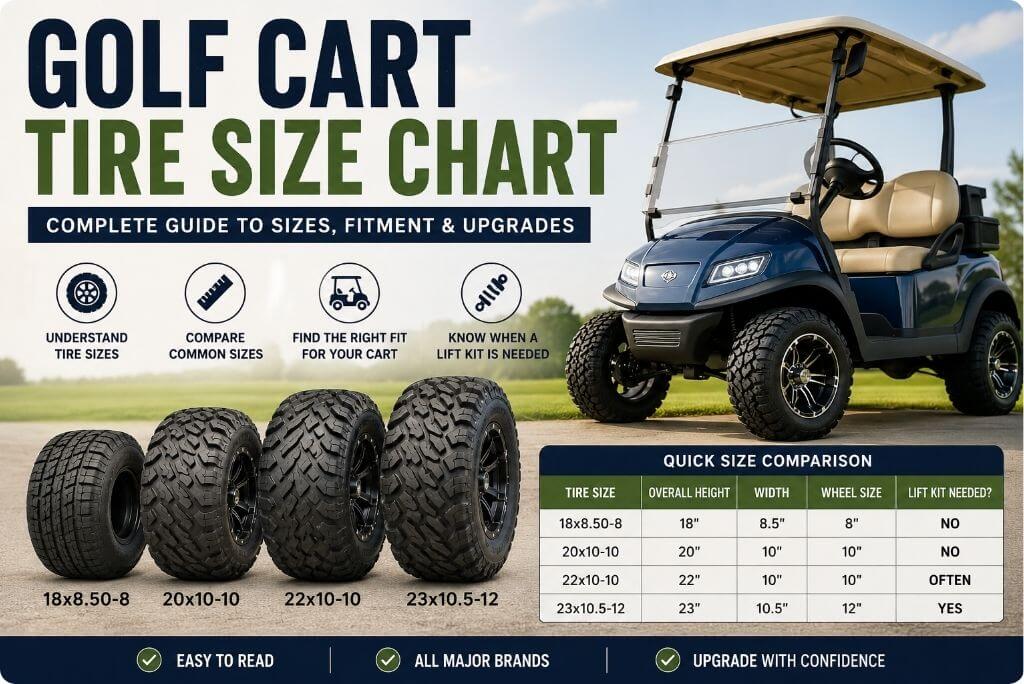
This golf cart tire size chart makes it easy to compare common tire sizes, understand sidewall markings, and find the right fit for your cart. You’ll also learn which tire sizes work on popular brands like Club Car, EZGO, Yamaha, ICON, Evolution, and Advanced EV, plus when a lift kit may be needed for larger tires.
If you’re unsure whether to stay with the factory size or move to a larger tire, this guide will help you make the right choice. By the end, you’ll know how to read golf cart tire sizes, compare upgrade options, and choose tires that fit your cart with confidence.
Understanding Golf Cart Tire Sizes
If you’ve ever looked at the side of a golf cart tire, you’ve probably seen a number like 18×8.50-8 or 20×10-10. At first, these numbers can seem confusing, but they’re actually easy to understand once you know what each one means.
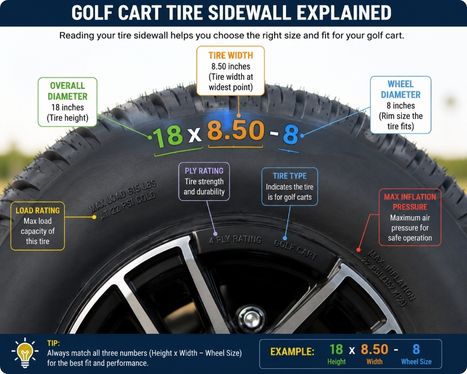
A golf cart tire size tells you three things: the tire’s overall height, its width, and the wheel size it fits. Knowing these measurements helps you choose replacement tires that fit properly and avoid clearance problems.
For example, take the tire size 18×8.50-8:
- 18 is the tire’s overall height in inches.
- 8.50 is the tire’s width at its widest point, also in inches.
- 8 is the wheel diameter, meaning the tire fits an 8-inch wheel.
A size like 20×10-10 follows the same pattern. The tire is 20 inches tall, 10 inches wide, and fits a 10-inch wheel.
The easiest way to find your current tire size is to look at the tire sidewall. The sidewall is the outer part of the tire, where the size is molded into the rubber. You don’t need to remove the wheel or use any special tools.
Keep in mind that a taller tire isn’t always a better upgrade. Increasing the tire height can improve ground clearance, but it also reduces the space between the tire and the golf cart’s body. On many stock golf carts, very tall tires may rub when turning unless a lift kit is installed.
One common mistake is focusing only on the wheel diameter. For example, two tires can both fit a 10-inch wheel but have very different overall heights. That’s why you should always compare all three numbers—not just the last one—before buying new tires.
Once you understand how to read these numbers, choosing the correct tire size becomes much easier, whether you’re replacing worn tires or planning an upgrade.
Complete Golf Cart Tire Size Chart
Note: Actual fitment depends on your golf cart model, wheel width, wheel offset, suspension, and whether a lift kit is installed. This chart is a general fitment guide covering the most common golf cart tire sizes.
| Tire Size | Overall Diameter | Tire Width | Wheel Size | Common Use | Lift Kit Required |
| 18×8.5-8 | 18″ | 8.5″ | 8″ | Factory turf tires, golf courses | No |
| 18×9.5-8 | 18″ | 9.5″ | 8″ | Wider factory replacement | No |
| 20×8-8 | 20″ | 8″ | 8″ | Light street use | Usually No |
| 20×10-8 | 20″ | 10″ | 8″ | Neighborhood & utility carts | Usually No |
| 20×8-10 | 20″ | 8″ | 10″ | Street carts | Usually No |
| 20×10-10 | 20″ | 10″ | 10″ | Most popular upgrade | Usually No |
| 20×10-12 | 20″ | 10″ | 12″ | Premium wheel upgrade | Usually No |
| 22×9.5-10 | 22″ | 9.5″ | 10″ | All-terrain | Often Yes |
| 22×10-10 | 22″ | 10″ | 10″ | Lifted carts | Often Yes |
| 22×11-10 | 22″ | 11″ | 10″ | Off-road & trail riding | Often Yes |
| 22×10-12 | 22″ | 10″ | 12″ | Street and trail use | Often Yes |
| 22×11-12 | 22″ | 11″ | 12″ | Utility & hunting carts | Often Yes |
| 22×10-14 | 22″ | 10″ | 14″ | Custom builds | Often Yes |
| 23×10-10 | 23″ | 10″ | 10″ | Lifted off-road carts | Yes |
| 23×10.5-12 | 23″ | 10.5″ | 12″ | Aggressive trail setup | Yes |
| 23×10-14 | 23″ | 10″ | 14″ | Custom street carts | Yes |
| 23×10.5-14 | 23″ | 10.5″ | 14″ | Show and trail builds | Yes |
| 24×10-10 | 24″ | 10″ | 10″ | Heavy off-road use | Yes |
| 24×10-12 | 24″ | 10″ | 12″ | Hunting & farm carts | Yes |
| 24×11-12 | 24″ | 11″ | 12″ | Mud and trail riding | Yes |
| 24×10-14 | 24″ | 10″ | 14″ | Large custom wheels | Yes |
| 24×11-14 | 24″ | 11″ | 14″ | Extreme off-road builds | Yes |
| 25×10-12 | 25″ | 10″ | 12″ | High-lift carts | Yes |
| 25×11-12 | 25″ | 11″ | 12″ | Deep mud & rough terrain | Yes |
| 25×10-14 | 25″ | 10″ | 14″ | Large wheel conversions | Yes |
| 25×12-12 | 25″ | 12″ | 12″ | Maximum flotation | Yes |
| 26×11-12 | 26″ | 11″ | 12″ | Extreme off-road | Yes |
| 26×11-14 | 26″ | 11″ | 14″ | Rock, mud & trail use | Yes |
Factory Tire Sizes by Golf Cart Brand
Factory tire sizes vary by manufacturer and model year. While many golf carts use similar tire sizes, it’s always a good idea to check the size printed on your current tire or confirm it in your owner’s manual before ordering replacements.
Club Car
Most Club Car DS and Club Car Precedent models leave the factory with 18×8.50-8 tires. This size offers a comfortable ride and works well on paved paths and golf courses.
Newer models, such as some Club Car Onward trims, may come with 10-inch or 12-inch wheels and larger factory tires. If your cart has upgraded wheels from the factory, replace them with the same size unless you’re planning a complete wheel-and-tire upgrade.
| Club Car Model | Common Factory Tire Size |
| Club Car DS | 18×8.50-8 |
| Club Car Precedent | 18×8.50-8 |
| Club Car Tempo | 18×8.50-8 |
| Club Car Onward | 18×8.50-8, 20×10-10* |
*Varies by trim and wheel package.
EZGO
Most EZGO TXT and EZGO RXV golf carts also use 18×8.50-8 tires from the factory. This size provides predictable handling and keeps steering light.
Some premium RXV models and lifted editions are equipped with larger wheels and tires, so don’t assume every EZGO uses the same size.
| EZGO Model | Common Factory Tire Size |
| EZGO TXT | 18×8.50-8 |
| EZGO RXV | 18×8.50-8 |
| EZGO Valor | 18×8.50-8 |
| EZGO Express | 20×10-10* |
*Available on selected trims.
Yamaha
Many Yamaha Drive and Drive2 golf carts come with 18×8.50-8 tires. They are designed for smooth driving on golf courses and neighborhood roads.
Higher-end Drive2 models may include larger wheels from the factory, giving the cart a more modern look without changing its everyday usability.
| Yamaha Model | Common Factory Tire Size |
| Yamaha G-Series | 18×8.50-8 |
| Yamaha Drive | 18×8.50-8 |
| Yamaha Drive2 | 18×8.50-8, 20×10-10* |
*Depends on trim level.
ICON
Most ICON golf carts are built with larger wheels than traditional golf carts. Many models come factory-equipped with 20×10-10 tires, giving them extra ground clearance and a more aggressive appearance.
Because these carts already use larger tires, there is usually less need for an immediate upgrade.
| ICON Model | Common Factory Tire Size |
| ICON i20 | 20×10-10 |
| ICON i40 | 20×10-10 |
| ICON i60 | 20×10-10 |
Evolution
Evolution golf carts often include stylish aluminum wheels and 20×10-14 tires as standard equipment, especially on newer D5 and Classic models.
These larger wheels improve appearance, but replacement tires are generally more expensive than traditional 8-inch golf cart tires.
| Evolution Model | Common Factory Tire Size |
| Evolution Classic | 20×10-14 |
| Evolution Forester | 23×10.5-14* |
| Evolution D5 | 20×10-14 |
*Varies by package.
Advanced EV
Many Advanced EV models use 20×10-14 tires from the factory, especially the Advent and EV1 series. These larger tires are designed for neighborhood driving and light recreational use.
If you’re replacing worn tires, matching the original size is usually the simplest way to maintain the cart’s handling and ride quality.
| Advanced EV Model | Common Factory Tire Size |
| Advanced EV Advent | 20×10-14 |
| Advanced EV EV1 | 20×10-14 |
| Advanced EV Classic | 20×10-10* |
*May vary by model year and trim.
Tip: Factory tire sizes can change between model years and trim levels. Before buying new tires, check the size molded into your current tire’s sidewall. It is the most reliable way to ensure you order the correct replacement.
Golf Cart Tire Upgrade Chart
A tire upgrade usually comes down to two things: how much taller you want to go, and whether your cart has enough room to handle it. A small increase can improve ground clearance and give the cart a fuller look, but bigger tires can also make steering a little heavier and may reduce low-end power.
| Current Tire Size | Common Upgrade Size | Lift Kit Needed? | What to Expect |
| 18×8.50-8 | 20×10-10 | Usually no | Easy upgrade for most stock carts |
| 18×8.50-8 | 20×10-12 | Usually no | Similar fit, slightly more height |
| 20×10-10 | 22×10-10 | Often yes | More clearance, may rub on some carts |
| 20×10-10 | 22×11-10 | Often yes | Popular upgrade, but check turning space |
| 20×10-10 | 22×11-12 | Often yes | Best for carts with extra room |
| 22×11-10 | 23×10.5-12 | Yes | Better stance, needs proper clearance |
| 22×11-10 | 24×10.5-12 | Yes | More lift, more chance of rubbing |
| 23×10.5-12 | 25×10-12 | Yes | For lifted carts only |
For most stock carts, 20-inch tires are the safest upgrade. They usually fit well without major changes and give a clean, practical boost in height. Once you move to 22 inches and above, a lift kit becomes much more likely, and fitment matters more.
The main trade-off is simple: the bigger the tire, the more you gain in height and looks, but the more you need to check for rubbing, steering effort, and power loss. A good upgrade should fit cleanly first, then look good second.
What Tire Size Fits Without a Lift Kit?
If you want a larger tire but don’t want to install a lift kit, you’re not alone. Most golf cart owners simply want a little more ground clearance and a better appearance without changing the suspension.
For many stock golf carts, 20-inch tires are the largest size that fits comfortably. They provide a noticeable upgrade while still leaving enough space for normal steering and suspension movement.
The table below shows the sizes that commonly fit on popular models without a lift kit.
| Golf Cart Model | Factory Tire Size | Largest Size That Usually Fits Without a Lift Kit |
| Club Car DS | 18×8.50-8 | 20×10-10 |
| Club Car Precedent | 18×8.50-8 | 20×10-10 |
| Club Car Tempo | 18×8.50-8 | 20×10-10 |
| EZGO TXT | 18×8.50-8 | 20×10-10 |
| EZGO RXV | 18×8.50-8 | 20×10-10 |
| Yamaha Drive | 18×8.50-8 | 20×10-10 |
| Yamaha Drive2 | 18×8.50-8 | 20×10-10 |
| ICON (20-inch factory models) | 20×10-10 | Factory size |
| Evolution (20-inch factory models) | 20×10-14 | Factory size |
| Advanced EV (20-inch factory models) | 20×10-14 | Factory size |
Keep in mind that there is no single answer for every golf cart. Tire tread design, wheel offset, and wheel width can all affect how much space is available. Two tires with the same listed size may fit slightly differently because some brands have wider shoulders or deeper tread.
If you’re thinking about moving to 22-inch tires or larger, check the manufacturer’s recommendations first. While some carts have enough room, many stock models will rub the fenders or suspension during sharp turns unless a lift kit is installed.
When you’re replacing factory tires, staying with the original size—or upgrading to a common 20-inch tire—is usually the easiest way to improve the look of your golf cart while keeping the ride and handling close to stock.
Tire Size vs Ground Clearance
Bigger tires raise the cart a little, which gives you more room under the frame. That can help on curbs, grass, gravel, and uneven paths. The trade-off is that larger tires can make the cart feel slower off the line and may need more space to turn.
| Tire Size | Approx. Ground Clearance Gain | Best For | Small Trade-Off |
| 18″ | Base height | Stock carts, golf course use | Lowest clearance |
| 20″ | About 1 inch | Everyday driving, light upgrades | Slightly more weight |
| 22″ | About 2 inches | Rougher roads, light off-road use | May reduce speed a little |
| 23″ | About 2.5 inches | Lifted carts, mixed use | More chance of rubbing |
| 24″ | About 3 inches | Trail use, more clearance needs | Heavier steering and slower takeoff |
| 25″+ | 3 inches or more | Off-road builds | Usually needs a lift kit |
The main thing to remember is that ground clearance does not rise as much as tire size. A 2-inch taller tire does not always mean a full 2 inches of extra clearance, because some of that size sits on the ground.
For most owners, 20-inch tires are the easiest step up because they add a little height without changing the cart too much. Bigger sizes can work well too, but only when the cart has enough room and the extra height is actually needed.
How Larger Tires Affect Performance
Larger tires change how a golf cart feels on the road. They can improve the look and give you more clearance, but they also put a little more load on the cart.
Speed: Bigger tires can make the cart go slightly faster because each turn of the wheel covers more ground. The downside is that the cart may feel less lively when starting from a stop.
Torque: As tire size goes up, low-speed power usually drops a bit. You may notice this most when climbing hills, carrying passengers, or driving on soft ground.
Ride comfort: Taller tires can soften small bumps and make the ride feel smoother. That said, the tread style matters too, so a rough off-road tire can still ride firm.
Battery range: On electric carts, larger tires can reduce range because the motor works harder. The difference is often small with a mild upgrade, but it becomes more noticeable with very large tires.
Turning radius: Bigger tires need more space, so sharp turns can feel tighter or less natural. On some carts, this also increases the chance of rubbing at full lock.
Steering effort: Wider or taller tires usually take more effort to steer, especially at low speeds. If the cart already feels heavy to turn, a larger tire can make that more noticeable.
In short, a bigger tire is not just a style change. It can help with clearance and comfort, but the cart may lose a little speed, range, and easy handling in return.
Choosing the Right Tire Size
For smooth golf course use, turf-friendly or low-profile 18-inch or 19-inch tires usually make the most sense. GCTS recommends street and turf tires for smooth surfaces, and that matches what most owners want: quiet rolling, easy steering, and a clean ride around the neighborhood or clubhouse.
For mixed use, a 20-inch tire is often the sweet spot. It gives a little more height and comfort without turning the cart into a full lift build. For light trail use, 22-inch tires are more capable, but they usually belong on lifted carts. For real off-road work, 23-inch tires on a lifted cart make more sense than forcing a tall tire onto a stock setup.
One useful detail many owners miss is cargo weight. If your cart carries a flip seat, rear rack, tools, or passengers in the back, leave yourself extra clearance. Yamaha’s fitment guidance specifically warns that rear weight can affect whether a tire rubs, and that is good advice for almost every cart brand.
Common Golf Cart Tire Sizing Mistakes
A few mistakes cause most bad tire purchases:
- Buying by looking alone and ignoring the actual sidewall size.
- Assuming a tire fits just because it fits the wheel. Rim width affects how a tire sits and how wide it measures in real life.
- Ordering 22-inch or 23-inch tires for a stock cart without checking lift-kit requirements.
- Forgetting that accessories and cargo weight can create rubbing on the rear of the cart.
- Choosing the tallest tire available when a smaller size would solve the problem with less cost and less stress on the cart. That is a judgment call, but it is usually the smarter one.
Frequently Asked Questions
What is the standard golf cart tire size?
A very common stock size is 18×8.5-8, especially on fleet-style carts. Many newer carts also use 10-inch or 12-inch wheel setups from the factory, so the “standard” size depends on the model and trim.
Can I put 22-inch tires on a stock golf cart?
Usually not. GCTS’s lift-kit charts show that 22-inch tires generally need about a 4-inch lift for proper fitment.
Do larger tires make a golf cart faster?
Usually yes, a little. GCTS says taller tires can add about 1 to 2 mph to top speed because each rotation moves the cart farther.
What size tire fits without a lift kit?
For most carts, 18-inch tires are the safest no-lift choice. Some newer Yamaha and other carts can fit selected 20-inch tires, but the exact answer depends on the cart and whether it carries extra rear weight.
How do I know my current golf cart tire size?
Look at the sidewall. Tire Rack explains that the sidewall markings show the tire’s size, along with other useful information about the tire’s construction and rating details.
Final Takeaway
The best golf cart tire size is not always the biggest one. The right choice is the one that fits your cart, matches how you use it, and gives you the clearance and ride quality you actually need. For most stock carts, that means starting with an 18-inch tire; for mixed-use carts, a 20-inch setup often makes sense; and for lifted carts, 22-inch and 23-inch options open up more off-road ability. If you check the sidewall, confirm the wheel size, and respect lift-kit limits, you will avoid most tire-buying mistakes before they happen.
