Toyota 4Runner Tire Pressure: PSI Chart by Year
The recommended Toyota 4Runner tire pressure depends on the model year, original tire size, and configuration. Many listed older models use 32 PSI cold, while verified 2025 configurations use 33 PSI. Certain older models require 29 PSI, and some newer compact spares require 60 PSI.
Use the charts below to find the listed specification, then confirm it on your vehicle’s tire-pressure label. If the installed tire size or type has changed, obtain an inflation recommendation for that replacement setup.
Quick Answer: The listed 2010–2024 V6 configurations specify 32 PSI front and rear when cold. The 2010 2.7L four-cylinder specifies 33 PSI, as do the verified 2025 configurations and the listed June-production 2026 gasoline configurations. For 1998–2002 models, the manuals distinguish between 29 PSI for P225/75R15 and 32 PSI for P265/70R16. Check the spare separately.
Toyota 4Runner Tire Pressure Chart by Model Year
These charts cover the original tire configurations listed in the referenced U.S.-market Toyota 4Runner manuals. Coverage for 2026 is limited to the manual editions and configurations identified below.
All values are recommended cold tire pressures. PSI and kPa figures are reproduced as rounded specifications from the referenced manuals.
If you need help understanding the size markings, our Toyota 4Runner tire size chart explains nominal width, sidewall height, and overall diameter. Matching size alone does not establish the correct inflation pressure.
2025 Gasoline Toyota 4Runner Tire Pressure
The listed 2025 gasoline configurations specify 33 PSI / 230 kPa cold for the road tires. Spare pressure depends on the configuration.
| Manual configuration | Original road tire size | Front cold PSI | Rear cold PSI | Spare tire size | Spare cold PSI |
|---|---|---|---|---|---|
| 17-inch, type A | 245/70R17 110T | 33 | 33* | 245/70R17 110T | 33 |
| 17-inch, type B | 245/70R17 110T | 33 | 33* | T175/90D18 111M | 60 |
| 18-inch, type A | 245/70R18 110H | 33 | 33 | 245/70R18 110H | 33 |
| 18-inch, type B | 265/70R18 116T | 33 | 33 | 265/70R18 116T | 33 |
| 20-inch, type A | 265/55R20 113V | 33 | 33 | 265/55R20 113V | 33 |
| 20-inch, type B | 265/55R20 113V | 33 | 33 | 245/75R17 112S | 33 |
Loaded-2WD adjustment: For the two listed 17-inch configurations, Toyota instructs owners to add 4 PSI / 30 kPa to the rear tires only when the 2WD vehicle is loaded. This changes the specified rear pressure from 33 to 37 PSI under that condition. Apply this adjustment only when your vehicle matches the manual’s configuration and footnote.
“Type A” and “type B” are the manual’s configuration labels. Match the road-tire and spare specifications to your vehicle rather than choosing a row from wheel diameter alone.
2025 Hybrid Toyota 4Runner Tire Pressure
The listed 2025 hybrid configurations specify 33 PSI / 230 kPa cold, including their listed spares.
| Manual configuration | Original road tire size | Front cold PSI | Rear cold PSI | Spare tire size | Spare cold PSI |
|---|---|---|---|---|---|
| 18-inch, type A | 265/70R18 116S | 33 | 33 | 265/70R18 116S | 33 |
| 18-inch, type B | 265/70R18 116H | 33 | 33 | 265/70R18 116H | 33 |
| 20-inch, type A | 265/55R20 113V | 33 | 33 | 265/55R20 113V | 33 |
| 20-inch, type B | 265/55R20 113V | 33 | 33 | 245/75R17 112S | 33 |
These configurations are listed in the 2025 hybrid owner’s manual, OM35B86U, printed pages 624–625. The gasoline and hybrid tables use different tire service descriptions, so keep those specifications separate.
2026 Gasoline Toyota 4Runner: From June 2026 Production
The following configurations are listed in owner’s manual OM35C28U, identified as covering vehicles produced from June 2026.
| Manual configuration | Original road tire size | Front cold PSI | Rear cold PSI | Spare tire size | Spare cold PSI |
|---|---|---|---|---|---|
| 17-inch, type A | 245/70R17 110T | 33 | 33* | 245/70R17 110T | 33 |
| 17-inch, type B | 245/70R17 110T | 33 | 33* | T175/90D18 111M | 60 |
| 18-inch, type A | 245/70R18 110H | 33 | 33 | 245/70R18 110H | 33 |
| 18-inch, type B | 265/70R18 116T | 33 | 33 | 265/70R18 116T | 33 |
| 20-inch, type A | 265/55R20 113V | 33 | 33 | 265/55R20 113V | 33 |
| 20-inch, type B | 265/55R20 113V | 33 | 33 | 245/75R17 112S | 33 |
Loaded-2WD adjustment: The same rear-only 4 PSI increase applies to loaded 2WD vehicles in the two listed 17-inch configurations. The resulting rear specification is 37 PSI under that condition.
The specifications appear on printed pages 624–625. For an earlier-production 2026 vehicle, check its matching manual and pressure label instead of assuming this edition applies.
2026 Hybrid Toyota 4Runner: Limited Verified Coverage
The inspected entry from the 2026 hybrid manual OM35C29U provides the following specification:
| Verified configuration | Original road tire size | Front cold PSI | Rear cold PSI | Spare tire size | Spare cold PSI |
|---|---|---|---|---|---|
| 18-inch, type A | 265/70R18 116S | 33 | 33 | 265/70R18 116S | 33 |
This row covers the inspected configuration only. For other 2026 hybrid configurations, consult the matching owner’s manual and vehicle tire-pressure label.
2010–2024 Toyota 4Runner Tire Pressure
The listed 2010–2024 V6 configurations specify 32 PSI / 220 kPa cold. The important exception is the 2010 2.7L four-cylinder, which specifies 33 PSI / 230 kPa.
| Model year | Engine or application | Original tire sizes listed in the manual | Front cold PSI | Rear cold PSI | Spare cold PSI |
|---|---|---|---|---|---|
| 2010 | 2.7L four-cylinder | P265/70R17 113S | 33 | 33 | 33 |
| 2010 | 4.0L V6 | P265/70R17 113S; P245/60R20 107H | 32 | 32 | 32 |
| 2011 | U.S. 4.0L V6 configurations | P265/70R17 113S; P245/60R20 107H | 32 | 32 | 32 |
| 2012 | Listed configurations | P265/70R17 113S; P245/60R20 107H | 32 | 32 | 32 |
| 2013 | Listed configurations | P265/70R17 113S; P245/60R20 107H | 32 | 32 | 32 |
| 2014 | Listed configurations | P265/70R17 113S; P245/60R20 107H | 32 | 32 | 32 |
| 2015 | Listed configurations | P265/70R17 113S; P245/60R20 107H | 32 | 32 | 32 |
| 2016 | Listed configurations | P265/70R17 113S; P245/60R20 107H | 32 | 32 | 32 |
| 2017 | Listed configurations | P265/70R17 113S; P245/60R20 107H | 32 | 32 | 32 |
| 2018 | Listed configurations | P265/70R17 113S; P245/60R20 107H | 32 | 32 | 32 |
| 2019 | Listed configurations | P265/70R17 113S; P245/60R20 107H | 32 | 32 | 32 |
| 2020 | Listed configurations | P265/70R17 113S; P245/60R20 107H | 32 | 32 | 32 |
| 2021 | Listed configurations | P265/70R17 113S; P245/60R20 107H | 32 | 32 | 32 |
| 2022 | Listed configurations | P265/70R17 113S; P245/60R20 107H | 32 | 32 | 32 |
| 2023 | Listed configurations | P265/70R17 113S; P245/60R20 107H | 32 | 32 | 32 |
| 2024 | Listed configurations | P265/70R17 113S; P245/60R20 107H | 32 | 32 | 32 |
For a 2010 4Runner, check the engine before using a general 32 PSI recommendation. The four-cylinder and V6 specifications differ, including their spare pressures.
The listed V6 configurations use the same pressure for their 17-inch and 20-inch tires. Wheel diameter alone does not determine the correct PSI.
1998–2009 Toyota 4Runner Tire Pressure
For 1998–2002 models, the manuals distinguish between 29 PSI for P225/75R15 and 32 PSI for P265/70R16. The original configurations listed below for 2003–2009 specify 32 PSI.
| Model year | Original tire sizes listed in the manual | Front cold PSI | Rear cold PSI |
|---|---|---|---|
| 1998 | P225/75R15 | 29 | 29 |
| 1998 | P265/70R16 | 32 | 32 |
| 1999 | P225/75R15 | 29 | 29 |
| 1999 | P265/70R16 | 32 | 32 |
| 2000 | P225/75R15 | 29 | 29 |
| 2000 | P265/70R16 | 32 | 32 |
| 2001 | P225/75R15 | 29 | 29 |
| 2001 | P265/70R16 | 32 | 32 |
| 2002 | P225/75R15 102S | 29 | 29 |
| 2002 | P265/70R16 111S | 32 | 32 |
| 2003 | P265/70R16 111S; P265/65R17 110S | 32 | 32 |
| 2004 | P265/70R16 111S; P265/65R17 110S | 32 | 32 |
| 2005 | P265/70R16 111S; P265/65R17 110S | 32 | 32 |
| 2006 | P265/70R16 111S; P265/65R17 110S; P265/60R18 109H | 32 | 32 |
| 2007 | P265/70R16 111S; P265/65R17 110S; P265/60R18 109H | 32 | 32 |
| 2008 | P265/70R16 111S; P265/65R17 110S; P265/60R18 109H | 32 | 32 |
| 2009 | P265/70R16 111S; P265/65R17 110S; P265/60R18 109H | 32 | 32 |
Manual pressure units: 29 PSI is listed with 200 kPa; 32 PSI is listed with 220 kPa.
For 1998–2002 vehicles, match the original tire specification as well as the model year. Do not apply the 32 PSI row to a configuration whose label specifies 29 PSI.
What About 1997 and Older 4Runners?
Models from 1997 and earlier are outside this verified numeric chart. Use the tire-pressure label and owner’s manual that match your vehicle.
If the label is missing or unreadable, obtain the matching specifications through Toyota. Do not use a nearby model year’s pressure as a substitute.
You can find matching editions through Toyota’s owner’s manual directory. The chart specifications come from Toyota-authored manuals; some referenced older editions were accessed through third-party manual archives.
Toyota 4Runner Spare Tire Pressure
The spare can require a different pressure from the four road tires. Its size and configuration matter, especially on newer gasoline models equipped with a compact spare.
| Model year or configuration | Listed spare | Recommended cold pressure |
|---|---|---|
| 1998–2005 | Spare values not included in this chart | Check matching manual and vehicle label |
| 2006–2009 listed configurations | Listed spare configuration | 32 PSI / 220 kPa |
| 2010 2.7L four-cylinder | Listed spare configuration | 33 PSI / 230 kPa |
| 2010–2024 listed V6 configurations | Listed spare configuration | 32 PSI / 220 kPa |
| Verified 2025 configurations and listed June-production 2026 gasoline configurations | Non-compact spares identified in the charts | 33 PSI / 230 kPa |
| Listed 2025 gasoline and June-production 2026 gasoline 17-inch type B configuration | T175/90D18 111M compact spare | 60 PSI / 420 kPa |
| Verified 2026 hybrid 18-inch type A entry | 265/70R18 116S | 33 PSI / 230 kPa |
For 1998–2005, the road-tire pressures should not be treated as separately verified spare recommendations.
Check the spare regularly with a gauge. A spare stored under the vehicle can lose pressure without being noticed, and spare monitoring varies by model and equipment.
How to Find and Check Your Exact Tire Pressure
Start with the tire-pressure label on the driver’s door jamb. Read the front and rear recommendations, and check the original tire size shown on the label.
Compare that size with the installed tires. If they differ in size or type, the original chart may not establish the correct pressure for the replacement setup.
Measure When the Tires Are Cold
Check before the first drive, preferably after the vehicle has been parked for at least three hours.
Driving normally raises tire pressure. Do not release air from warm tires simply to bring the reading down to the cold specification. Recheck after the tires have cooled.
Check and Adjust Each Tire
- Read the vehicle label. Note the specified front and rear pressures, and find the spare’s recommendation in the matching manual.
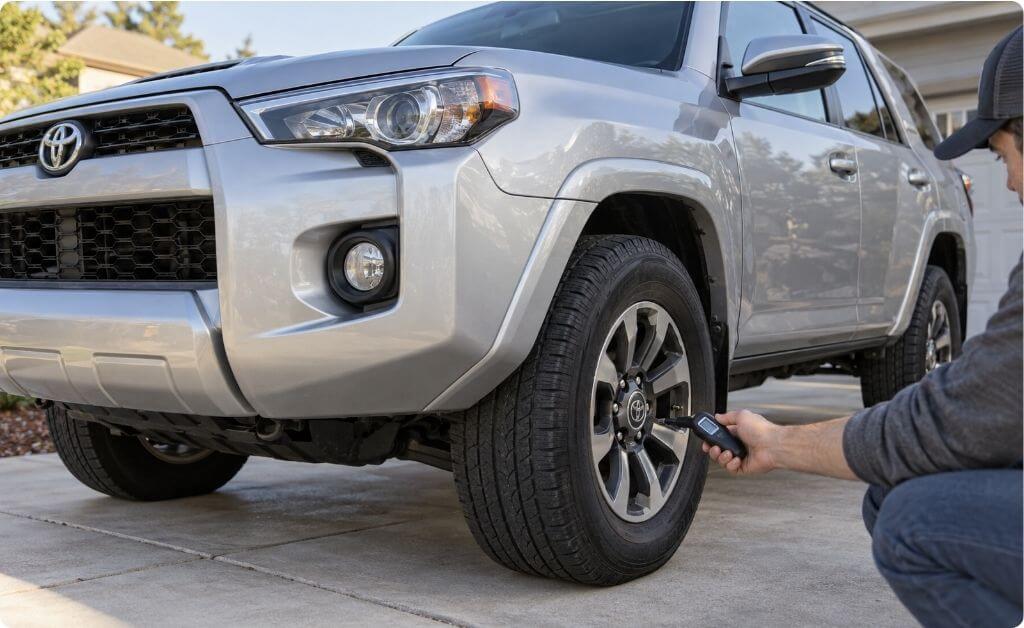
- Remove the valve cap. Press an accurate pressure gauge firmly onto the valve stem.
- Record the reading. Measure each tire individually.
- Adjust the cold pressure. Add air when needed. If a cold tire is overinflated, release a small amount and measure again.
- Replace the valve cap. Repeat for the remaining tires and check the spare against its own specification.
Check pressure at least monthly, before a long trip, and before carrying a heavy load. Recheck when seasonal temperatures change. A tire’s appearance cannot reliably confirm that its pressure is correct.
Why Is Your 4Runner’s Tire Pressure Light On?
For TPMS-equipped models, consult the warning-light instructions in the matching owner’s manual. The behavior below is documented in the inspected 2009 4Runner manual.
| Warning-light behavior | Meaning in the inspected manual | What to do |
|---|---|---|
| Comes on and remains illuminated | Low tire pressure | Stop safely, check pressures with a gauge, and adjust to specification |
| Flashes for approximately one minute, then remains illuminated | TPMS malfunction | Check pressures manually and arrange a system inspection |
The 2009 manual includes the spare in its pressure-check instruction. Whether the spare is monitored depends on the model and configuration.
Cold Weather and Pressure Warnings
Falling temperatures can lower tire pressure enough to trigger a warning. Measure the cold pressure and add air as needed to reach the specified value.
A light that later goes out as the tires warm still warrants a cold-pressure check.
Resetting or Initializing the System
Correct tire pressure before performing any reset or initialization. Resetting the system does not repair a leak or add air.
Procedures vary by year and equipment. For example, the 2020 Toyota 4Runner Quick Reference Guide describes a TPWS → Set Pressure initialization function. Follow the complete instructions for your model rather than applying that menu sequence to every 4Runner.
If one tire repeatedly loses pressure, have it inspected. If the light indicates a malfunction, arrange a TPMS inspection even when the gauge readings are correct.
Tire Pressure for Heavy Loads, Towing, and Aftermarket Tires
Check inflation before towing or carrying a heavy load. Follow the vehicle label and matching manual, including any configuration-specific adjustment.
For the listed 2025 and June-production 2026 gasoline 17-inch 2WD configurations, the charts include Toyota’s loaded-vehicle rear-pressure adjustment. That footnote should not be applied to every 4Runner or treated as a universal towing rule.
Larger Tires and LT Replacements
Changing tire size or switching from passenger-car tires to LT tires requires checking the replacement tire’s load capacity at the proposed pressure.
A higher load index or load-range letter alone does not prove that the replacement carries the required load at the original PSI. Tire manufacturers use size-specific load-and-inflation information to establish the appropriate recommendation.
Give the installer:
- The original tire specification and vehicle placard pressures.
- The replacement tire’s complete size, load index, and load designation.
- Details of the vehicle’s intended loading and use.
Ask for the recommended front and rear cold pressures for that installation. Toyo’s load-and-inflation guidance explains the role of manufacturer tables.
Our truck tire load range chart also explains LT load-range markings and why their reference pressures do not establish your 4Runner’s everyday inflation setting.
Should You Use the Sidewall Maximum PSI?
For the original tire setup, use the vehicle’s recommended pressure. The sidewall maximum is a tire limit, not the normal inflation recommendation for your 4Runner.
For a changed size or tire type, obtain a replacement-specific recommendation. Do not choose pressure solely from the wheel diameter, load-range letter, or maximum-pressure marking.
Toyota 4Runner Tire Pressure FAQs
Is Toyota 4Runner Tire Pressure 32 or 33 PSI?
Both appear in Toyota specifications. The listed 2010–2024 V6 configurations use 32 PSI cold, while the 2010 2.7L four-cylinder uses 33 PSI. The verified 2025 configurations and listed June-production 2026 gasoline configurations also use 33 PSI. Match your vehicle to the relevant chart and label.
Do Older 4Runners Use 29 PSI?
Some do. The inspected 1998–2002 manuals specify 29 PSI front and rear for P225/75R15 tires, compared with 32 PSI for P265/70R16 tires.
Is 35 PSI Correct for a Toyota 4Runner?
The original configurations listed here specify 29, 32, or 33 PSI for normal cold inflation. There is no general 35 PSI recommendation in these charts. Follow your vehicle label or the appropriate replacement-tire recommendation.
What Pressure Does the Compact Spare Need?
The listed T175/90D18 111M compact spare requires 60 PSI / 420 kPa cold in the identified newer gasoline configurations. Check that your spare matches this specification.
Should I Lower Tire Pressure in Winter?
Maintain the recommended cold pressure. Colder weather can reduce inflation pressure, so check with a gauge and add air as needed to reach the specification.
Can I Keep the Same PSI After Installing LT Tires?
Do not assume so. The replacement’s load capacity at the proposed pressure must be checked using the applicable manufacturer’s load-and-inflation information.
Related Topic: Best Tires for Toyota 4Runner
Conclusion
Use the Toyota 4Runner tire pressure chart that matches your model year, original tire size, and configuration. Confirm the setting on the vehicle label, measure when cold, and check the spare separately.
If you change tire size or type, have the inflation recommendation verified for the replacement setup before using the original PSI.
