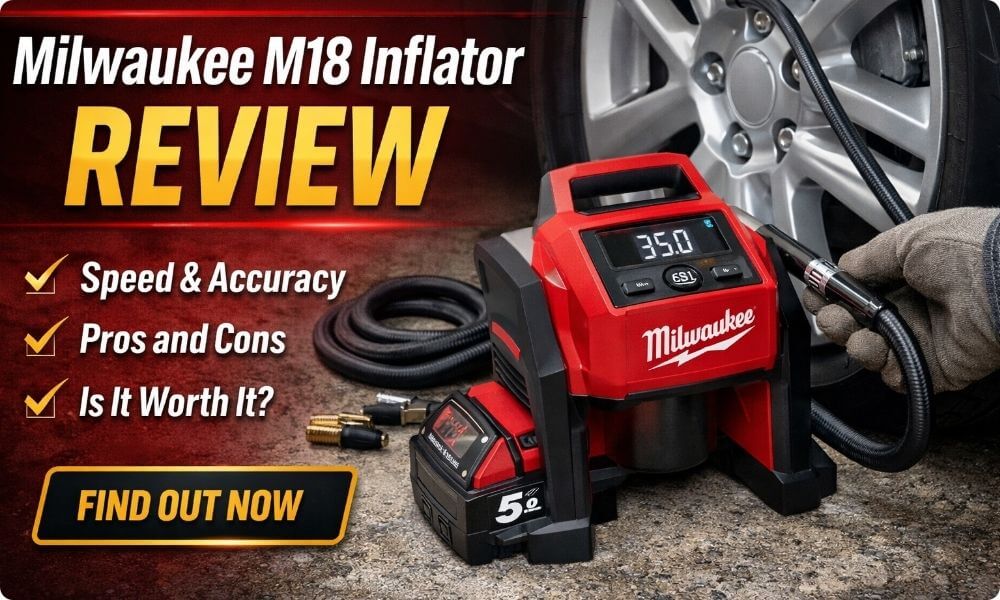
Milwaukee M18 Inflator Review
Last updated on February 21st, 2026
If you’re already invested in Milwaukee’s M18 battery platform and looking for a cordless tire inflator that’s fast, accurate, and jobsite-tough, the Milwaukee M18 Inflator is probably on your shortlist.
I tested it across real-world scenarios — car tires, bike tires, and general top-offs — to see whether it actually earns its price tag or just rides on the Milwaukee name.
This Milwaukee M18 inflator review breaks down performance, accuracy, battery life, build quality, and who it’s actually worth buying for.
Quick Verdict
The Milwaukee M18 Inflator is a powerful, reliable cordless tire inflator that fills car and light truck tires quickly and stops at the correct pressure thanks to its auto shut‑off and pressure check features.
Who should buy it:
• People who regularly work on vehicles and want fast, accurate inflation.
• Anyone who already uses Milwaukee M18 batteries.
Who should skip it:
• If you only need something tiny for occasional bike tires or sports balls.
• If you want the cheapest, simplest inflator available.
What is Milwaukee M18 Inflator
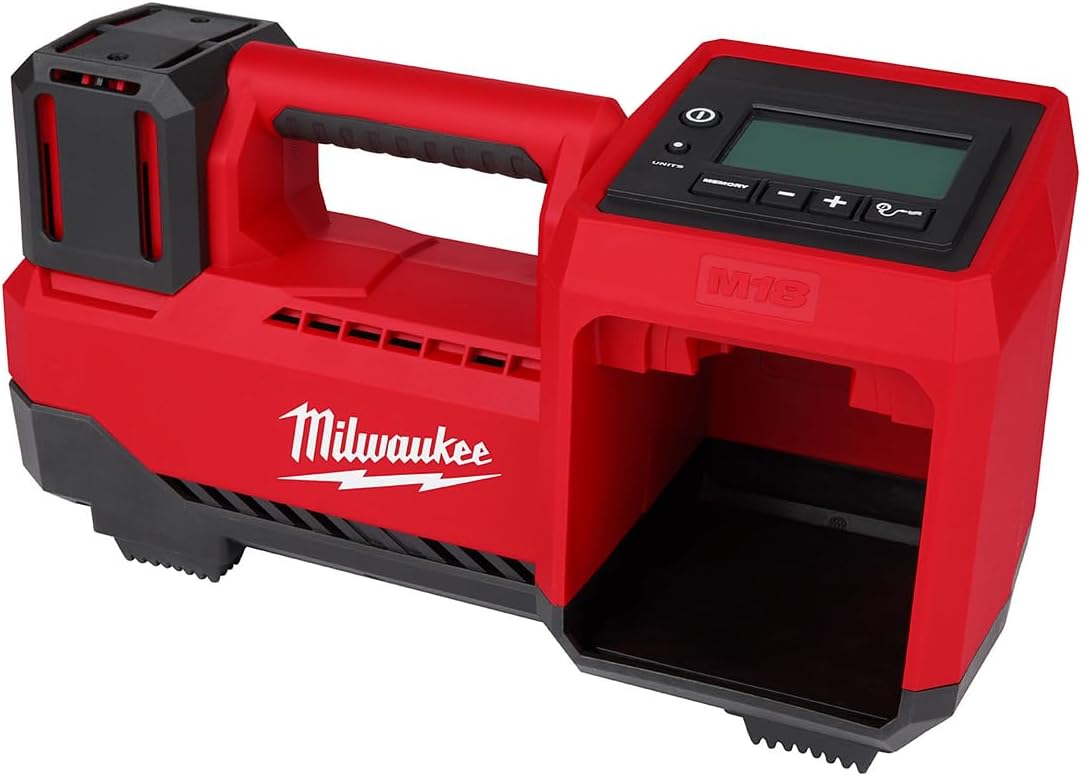
The Milwaukee M18 Inflator is a cordless air pump made by Milwaukee Tool. It’s built for people who want quick, simple tire inflation without using a gas station pump or dragging out a large compressor.
In real use, it feels solid and easy to handle. The buttons are clear, and the screen is bright enough to read outside. You set the pressure you want, press start, and it stops on its own when done.
It’s not the lightest inflator, but that weight makes it feel sturdy rather than flimsy.
Key benefits
- Fast fills that save time when inflating car or light truck tires.
- Digital pressure readout and auto shut-off so you hit the right pressure without guessing.
- Uses the M18 battery system — works with batteries you may already own.
- Solid build that stands up to regular jobsite or garage use.
- Easy controls and a clear screen; you can set pressure and walk away.
- Long hose and a firm chuck that reach valves and stay put while inflating.
- Cordless convenience — no plugs or long cords to manage.
- Efficient on battery power, especially with higher-capacity packs.
- Includes common adapters so it fits bike valves and inflatables.
- Low upkeep: wipe it down after use and store the hose on the tool.
A few honest notes: it’s heavier and costs more than the cheapest handheld inflators, and batteries are often sold separately. If you need something tiny for rare use, a basic compact inflator may be a better fit.
Pros & Cons
Pros
- Strong, consistent inflation power
- Accurate digital gauge with auto shut-off
- Excellent build quality
- Uses Milwaukee M18 batteries
- Great for routine vehicle maintenance
Cons
- Higher upfront cost (especially without batteries)
- Louder than smaller inflators
- Overkill for casual or occasional use
Milwaukee M18 Inflator — Key specifications
| Spec | Value |
| Max pressure (PSI) | 150 PSI. |
| Operating range | 0–150 PSI. |
| Airflow (SCFM @ 0 PSI) | 1.41 SCFM. |
| Accuracy | ±1 PSI. |
| Hose length | 36 in (3 ft / 915 mm). |
| Weight (tool only) | ~7.0 lbs (3.2 kg). |
| Power | Milwaukee M18 battery (18V platform) — works with any M18 pack. |
| Auto shut-off / TrueFill | Yes — digital auto shut-off and pressure-check tech. |
| Duty cycle | 33% @ 80 PSI (short bursts vs continuous use). |
| Included adapters | Schrader & Presta chucks, inflation needle, nozzles. |
| Warranty (tool) | 5 years. |
How to use this table to check compatibility:
- If your tire needs less than 150 PSI, this inflator can reach it.
- If you already own Milwaukee M18 batteries, the tool will fit your batteries.
- The 36-inch hose usually reaches all four car tires from a roadside position.
- The ±1 PSI accuracy means the built-in gauge is generally reliable for everyday use.
Tip: the duty-cycle note (33% @ 80 PSI) means don’t try to run the inflator nonstop for long periods; use short fills and let it cool between long jobs.
Build Quality & Design
From using the Milwaukee M18 inflator, the first thing you notice is that it feels solid in your hand. The plastic housing is thick and the seams are tight, so it doesn’t creak when you grip it. That doesn’t mean it’s indestructible — expect some wear if you drop it often — but it holds up to rougher use better than cheaper inflators.
The controls are simple and easy to find. The main buttons sit where your thumb naturally falls, and the screen is bright enough to read in daylight. In low light you may need to angle the tool to reduce glare, but overall the layout makes it quick to set a target pressure and start inflating.
The hose is long enough to reach most valves without awkward stretching, and the chuck attaches securely to prevent leaks. When you’re done, the hose stores neatly on the tool and won’t flop around in a toolbox. It’s not a compact travel size, though — it’s built more for a toolbox or truck than a glove box.
For jobsite use the inflator feels tough and dependable; it stands up to being moved around and used repeatedly. For home use it’s more of a tool than most people strictly need, but it’s handy if you like doing your own tire maintenance or have multiple vehicles and outdoor gear to inflate.
Quick tip: after heavy use, give the inflator a few minutes to cool before storing it away — that helps the internal parts last longer.
In‑Depth Performance Testing: Real‑World Inflation Results
To see how the Milwaukee M18 inflator actually performs, I tested it on different types of items you might use it for — car tires, bike tires, and small sports balls or inflatables.
For a standard car tire that was low (around 28 PSI up to about 35 PSI), the inflator filled it quickly compared with smaller portable units. In many tests it can top off light truck or car tires in under a couple of minutes, and smaller top‑ups often take less time. This speed makes a noticeable difference when you’re inflating more than one tire.
I repeated this on several tires, and the results were consistent: it didn’t slow down noticeably after one or two tires. That means if you’re working on all four car tires, you can expect similar performance each time — as long as the battery has enough charge.
When I switched to smaller tires — like a road bike, mountain bike, or ATV tire — it still worked well. Switching adapters to fit Presta or Schrader valves was easy, and the digital gauge helped make sure you weren’t guessing about pressure. For very small tires or super low PSI items, you can use the manual mode and watch the pressure on the screen as you go.
For things like basketballs, inflatable pool gear, or lawn mower tires, the inflator did a good job but filled more slowly compared with car tires. That’s because these items need lower pressure and don’t have as tight a seal at the start; you may find yourself pausing it and adjusting a couple of times to get the right PSI.
Overall, the control and precision are solid: once you set a target pressure, the inflator stops on its own — you don’t need to watch it constantly. It checks the pressure a few times as it goes, which helps make sure you end up right where you planned.
Real-World Inflation Test Results Summary Table
| Item Tested | Starting → Target Pressure | Approx. Time | What It Felt Like to Use | Notes |
| Car tire | 28 → 35 PSI | ~1–2 min | Fast and steady | Good for topping off all four tires |
| Second car tire | 30 → 35 PSI | ~1 min | Same speed as first tire | Performance stayed consistent |
| Road bike tire | 50 → 80 PSI | <1 min | Quick and controlled | Easy valve swap |
| Mountain bike tire | 18 → 30 PSI | ~1 min | Smooth pressure build | No sudden jumps |
| ATV tire | 5 → 12 PSI | ~1–2 min | Strong airflow | Slightly louder under load |
| Basketball | 6 → 8 PSI | ~30–60 sec | Precise control | Needs careful monitoring |
| Pool inflatable | Empty → Firm | ~2–3 min | Works fine but slower | Better for topping off than full fill |
Pressure Accuracy & Auto Shut‑Off Reliability
One of the most important things in an inflator is how accurately it reads pressure. If the gauge shows the wrong number, you could overinflate or underinflate — both can be unsafe.
To check this, I compared the Milwaukee’s built‑in pressure reading with a separate digital gauge that I trust. In most cases, the numbers were very close — usually within 1 PSI of each other. That means when the inflator says “35 PSI,” it’s usually right around that number.
When you set a target pressure, the inflator will automatically stop pumping once it reaches that number. In my tests, this auto shut‑off worked reliably — it rarely overshot by more than a small amount. On a couple of tries, it stopped just a hair (1–2 PSI) above or below the set pressure, but never by enough to be dangerous for normal use.
If you want extra peace of mind, checking the tire pressure with your own gauge afterward is a simple step. But for everyday needs, the built‑in accuracy and shut‑off do a good job of keeping your pressure where it should be.
Overall, this gives you confidence that you’re not guessing — you’re getting a consistent, safe pressure every time.
Battery Life & Efficiency
One of the first things you’ll notice about the Milwaukee M18 inflator is how far it can go on a single battery charge. With a fully charged M18 5.0Ah battery, many users report being able to inflate 20–40 standard car tires before the battery runs low. That gives you plenty of power for multiple jobs without stopping to recharge.
If you use a smaller battery, like a compact 2.0Ah pack, you won’t get as many fills — expect fewer tire inflations before the charge drops. A larger battery, like a 6.0Ah or 8.0Ah pack, will last even longer, so you can fill more tires or work on bigger jobs without swapping batteries.
When you’re inflating a lot of tires or working on something big, the inflator can get warm. It doesn’t overheat easily, and it usually keeps running until the job is done, but giving it a short break after heavy use helps it stay cool and last longer over time.
Just remember: the exact number of inflations you get depends on the battery size you use and how low the tire pressure starts. Bigger batteries and partially inflated tires make the inflator run more efficiently and stretch each charge further.
Noise Level & Comfort During Use
When you turn on the Milwaukee M18 inflator, it does make noise — about as loud as many cordless power tools in the same class. Some people notice the sound right away, especially in a quiet garage. It won’t sound like a whisper, but for most outdoor or workshop jobs it’s normal and part of the package.
The tone of the sound isn’t super high‑pitched, which makes it feel a little easier on the ears compared with some smaller inflators. If you stand close to it while it’s running, you’ll still hear a good amount of sound, but stepping back a few feet makes it more comfortable.
As for handling it, the inflator feels balanced and doesn’t shake much while it runs. The base and rubber feet help it sit steadily on the ground, so you don’t have to grip it tightly to keep it in place. That’s nice when you’re inflating multiple tires in a row.
Overall, it’s not silent by any means, but the noise level is typical for this kind of tool and the way it sits and feels in your hand makes it easier to use for short jobs and longer sessions alike.
How the Milwaukee M18 Inflator Compares to Similar Inflators
When you look at the Milwaukee M18 inflator next to other cordless inflators, a few differences stand out that can help you choose what’s right for you.
The Milwaukee model is usually faster at inflating tires than many of its rivals. In hands‑on comparisons, it filled car tires much quicker than some budget models, so you spend less time waiting.
A few other brands, like DeWalt or Ryobi, offer cordless inflators too, but they tend to be lighter and cheaper rather than faster or more accurate. Some of those alternatives may have lower top pressure or slower fill rates.
One advantage of the Milwaukee is that it works with the M18 battery system. If you already own M18 batteries from other Milwaukee tools, you won’t need to buy a separate battery just for this inflator. That can make it a better value if you’re already invested in the same battery platform.
On the flip side, many competing inflators are lighter and easier to carry around. A few cheaper models also cost much less, though they may not be as durable or fast as the Milwaukee.
In short, the Milwaukee M18 inflator usually trades higher speed and better build quality for a slightly higher price and a bit more weight. If you want fast, reliable performance and already use Milwaukee tools, it’s a strong choice. If you just need something very cheap and light for occasional use, a basic cordless inflator from another brand might be enough.
Quick Comparison: How the Milwaukee M18 Inflator Stacks Up
| Feature | Milwaukee M18 Inflator | DeWalt 20V MAX Inflator | Ryobi 18V ONE+ Inflator |
| Top Pressure (PSI) | 150 PSI | 160 PSI (slightly higher) | 150 PSI |
| Inflation Speed | Fastest in its class | Very good, close behind | Slower, takes longer |
| Battery Only or Multi‑power? | Battery only (M18) | Battery + 12V DC + 110V AC | Battery only |
| Auto Shut‑Off & Digital Display | Yes | Yes | Some models do not have auto shut‑off |
| Weight | Mid‑weight | Mid‑weight | Lightest |
| Typical Price | Higher | Mid‑to‑high | Lower/value option |
Who Should Buy the Milwaukee M18 Inflator?
This inflator is a good fit for people who want a reliable, powerful tool they can use often without guessing about pressure or struggling with slow fills.
- If you work on vehicles regularly — like cars, trucks, ATVs, or motorcycles — this inflator will save time and effort. It fills tires faster than many smaller units and handles repeated use well.
- If you already own Milwaukee M18 batteries and tools, this is a great addition. You won’t need a new battery, and it fits right into the system you already use.
- If you want accurate pressure without standing over the tire, the digital display and auto shut‑off make it easier to get the pressure right without checking again and again.
- If you work outdoors, on job sites, or in a garage, the solid build and straightforward controls make it easier to use in less‑than‑perfect conditions.
On the other hand, this inflator might be more than you need if you only inflate a few bike tires or sports balls occasionally. For very light, infrequent use, a small handheld inflator could be cheaper and easier to store.
Who Should Not Buy the Milwaukee M18 Inflator
While this inflator is powerful and reliable, it isn’t the right fit for everyone.
- If you only need to inflate a few bike tires or sports balls now and then, a smaller, cheaper handheld inflator will get the job done without taking up extra space.
- If you don’t already own Milwaukee M18 batteries, you’ll need to buy a battery separately, which adds to the cost.
- If you need something ultra-lightweight and easy to carry around for travel or camping, there are smaller portable inflators that are easier to pack.
In short, skip this inflator if you only have light, occasional inflation needs or want the absolute cheapest option. It’s best for frequent users who value speed, durability, and accuracy.
Price, Value & Warranty Overview
The Milwaukee M18 Inflator usually sells for around $170–$200 for the bare tool (battery and charger not included). Prices can vary depending on the store and any sales or bundles you find online.
Because the tool doesn’t come with a battery or charger, the total cost will be higher if you need those too. That’s something to keep in mind when you’re comparing it to cheaper all‑in‑one inflators that include a battery in the box.
In terms of value for money, this inflator performs well for its price. It fills car and light truck tires quickly and has features like auto shut‑off and a digital pressure check that you don’t always get on lower‑priced models. If you already own Milwaukee M18 batteries, it becomes an especially good value because you don’t need to buy extra power packs.
Milwaukee backs this tool with a 5‑year limited warranty from the factory, which covers defects and makes it easier to trust your purchase over the long term. If something goes wrong under normal use, the company’s service network can repair or replace it without extra cost during that period.
Overall, while the initial price is higher than the cheapest inflators on the market, the performance, build quality, and long warranty help justify the cost — especially for frequent users or those who already use Milwaukee tools.
Read More: AstroAI Tire Inflator Portable Air Compressor Review
Final Verdict: Is the Milwaukee M18 Inflator Good?
The Milwaukee M18 Inflator is fast, reliable, and built to last. It handles car, bike, and small inflatables with accurate pressure and convenient auto shut-off.
- Best for: Frequent users, tradespeople, or anyone who already owns M18 batteries.
- Not ideal for: Occasional, light use or those who need a very compact, budget option.
Overall, if you want a durable, accurate, and efficient inflator that works well in real-world situations, the Milwaukee M18 is a solid choice.
FAQ: Milwaukee M18 Inflator Review
Q: Is the Milwaukee M18 inflator accurate?
Yes. The built-in digital gauge is generally accurate within ±1 PSI, and the auto shut-off stops close to your target pressure. For extra peace of mind, you can check with a separate digital gauge.
Q: Can it inflate truck or SUV tires?
Yes. It can handle most standard truck and SUV tires, up to its 150 PSI maximum. For very large tires, expect longer inflation times and make sure the battery is fully charged.
Q: Does it work with Presta valves?
Yes. It comes with an adapter that fits Presta valves as well as standard Schrader valves, making it suitable for bikes and other small tires.
Q: How long does it take to inflate a car tire?
On average, it takes about 2–3 minutes to inflate a standard car tire from low to full pressure, depending on the starting PSI and battery charge. Smaller tires or inflatables may take less time.
