Motorcycle Tire Size Chart
Last updated on September 16th, 2026
Choosing the correct motorcycle tire size starts with the tire size specified for your motorcycle. A tire can have the right wheel diameter but still be unsuitable because of rim width, front or rear position, load capacity, speed rating, construction, or available clearance.
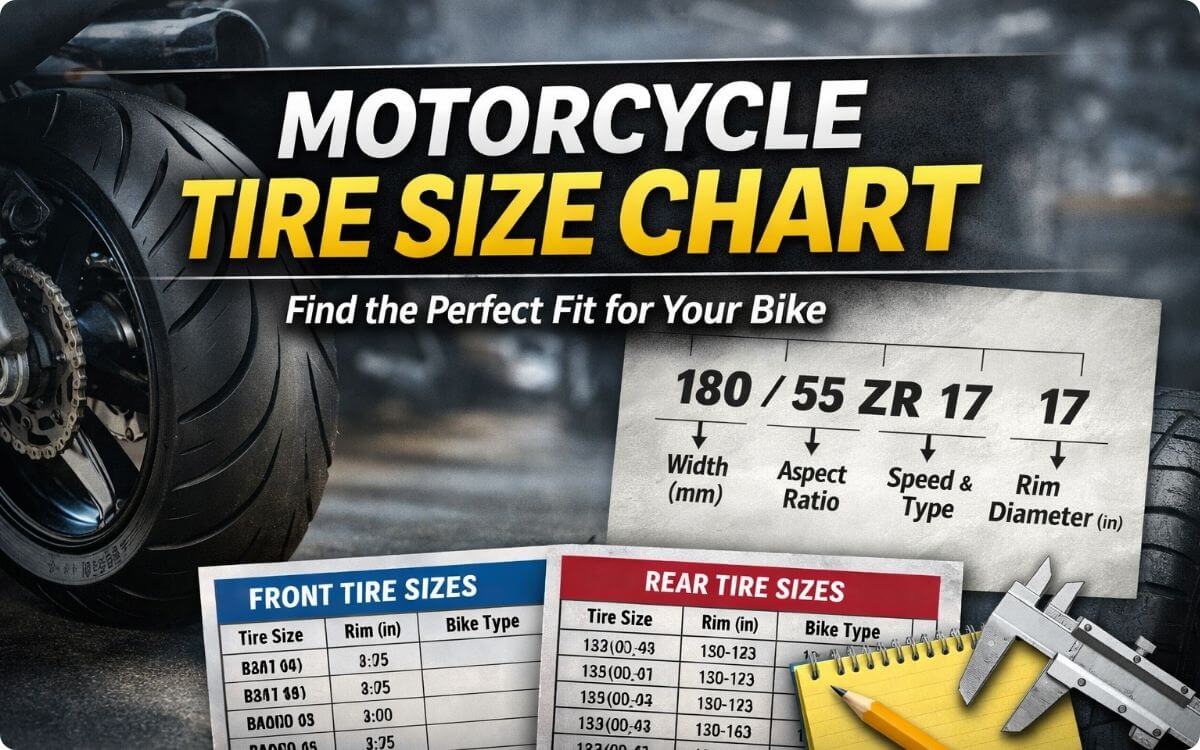
Use the motorcycle tire size chart below to compare common front and rear sizes by wheel diameter, typical application, and manufacturer rim guidance. It includes common street, cruiser, touring, adventure, dual-sport, and selected off-road sizes.
The rim information is a reference, not a universal fitment guarantee. Always confirm the tire size specified for your motorcycle in the owner’s manual or manufacturer documentation before buying a replacement tire.
Motorcycle Tire Size Chart
This chart organizes common motorcycle tire sizes by front or rear position and wheel diameter.
The numbers in a tire size identify the nominal tire width, aspect ratio, construction, and wheel diameter. For example, 120/70R17 is a 120 mm-wide radial tire with a 70-series aspect ratio designed for a 17-inch wheel.
The typical application column describes where a size is commonly used. It does not mean that every motorcycle in that category can use that size.
The manufacturer rim guidance column is also application- and tire-model-specific. Tire manufacturers may publish a standard rim or an approved approximate range for a particular tire. That information should not be treated as a universal rim specification for every tire with the same nominal size.
Important: Rim compatibility does not automatically mean motorcycle fitment. The motorcycle’s specified tire size, load and speed requirements, clearance, front/rear position, and manufacturer fitment information must also be checked.
Front Motorcycle Tire Size Chart
21-Inch Front Motorcycle Tire Size
| Tire Size | Wheel Diameter | Typical Application | Manufacturer Rim Guidance |
| 80/90-21 | 21 in | Street / Cruiser | Application-specific |
| 80/100-21 | 21 in | Off-road / Motocross | 1.60 in standard in cited application |
| 90/90-21 | 21 in | Street / Adventure | 1.85–2.50 in |
| 90/100-21 | 21 in | Off-road / Motocross | 1.60 in standard in cited application |
19-Inch Front Motorcycle Tire Size
| Tire Size | Wheel Diameter | Typical Application | Manufacturer Rim Guidance |
| 100/90-19 | 19 in | Street / Cruiser / Adventure | 1.85–2.75 in |
| 110/80-19 | 19 in | Adventure / Touring | 2.15–3.00 in |
| 110/90-19 | 19 in | Street / Cruiser | 2.15–3.00 in |
| 120/70-19 | 19 in | Adventure / Touring | 3.00–3.75 in |
18-Inch Front Motorcycle Tire Size
| Tire Size | Wheel Diameter | Typical Application | Manufacturer Rim Guidance |
| 90/90-18 | 18 in | Classic / Street | 1.85–2.50 in |
| 100/80-18 | 18 in | Street | 1.85–2.75 in |
| 100/90-18 | 18 in | Street / Classic | 2.15–2.75 in |
| 110/80-18 | 18 in | Street / Adventure | 2.15–3.00 in |
| 110/90-18 | 18 in | Street / Classic | 2.15–2.75 in, application-specific |
| 120/80-18 | 18 in | Street / Adventure | 2.50–3.00 in |
| 130/80-18 | 18 in | Adventure / Dual-sport | 3.00–3.50 in |
17-Inch Front Motorcycle Tire Size
| Tire Size | Wheel Diameter | Typical Application | Manufacturer Rim Guidance |
| 100/70-17 | 17 in | Street / Sport | 2.50 in recommended in cited application |
| 100/80-17 | 17 in | Street | 1.85–2.75 in |
| 110/70-17 | 17 in | Street / Sport | 2.75–3.50 in |
| 110/80-17 | 17 in | Street / Adventure | 2.15–3.00 in |
| 120/60-17 | 17 in | Sport / Street | 3.00–3.50 in |
| 120/70-17 | 17 in | Sport / Street | 3.00–3.50 in |
16-Inch Front Motorcycle Tire Size
| Tire Size | Wheel Diameter | Typical Application | Manufacturer Rim Guidance |
| 100/90-16 | 16 in | Street / Classic | 2.15–2.75 in |
| 110/90-16 | 16 in | Street / Classic | 2.15–3.00 in |
| 120/80-16 | 16 in | Street / Touring | 2.50–3.00 in |
| 130/90-16 | 16 in | Cruiser | 2.50–3.50 in |
| 150/80-16 | 16 in | Cruiser / Touring | 3.00–4.00 in |
Note: A 150/80-16 tire can appear in both front and rear applications. The nominal size alone does not determine the correct axle position.
Rear Motorcycle Tire Size Chart
18-Inch Rear Motorcycle Tire Size
| Tire Size | Wheel Diameter | Typical Application | Manufacturer Rim Guidance |
| 110/100-18 | 18 in | Off-road / Motocross | 2.15 in standard in cited application |
| 120/80-18 | 18 in | Street / Adventure | 2.50–3.00 in |
| 120/90-18 | 18 in | Street / Adventure / Off-road | 2.50–3.00 in in cited street application |
| 130/70-18 | 18 in | Street | 3.00–4.00 in |
| 130/80-18 | 18 in | Adventure / Dual-sport | 2.50–3.50 in |
| 140/70-18 | 18 in | Street / Touring | 3.50–4.50 in |
| 150/70-18 | 18 in | Street / Touring | 3.50–4.50 in |
17-Inch Rear Motorcycle Tire Size
| Tire Size | Wheel Diameter | Typical Application | Manufacturer Rim Guidance |
| 120/90-17 | 17 in | Street / Touring | 2.50–3.00 in |
| 130/70-17 | 17 in | Street | 3.50–4.00 in |
| 130/80-17 | 17 in | Adventure / Dual-sport | 3.00–3.50 in |
| 130/90-17 | 17 in | Street / Cruiser | 2.50–3.50 in |
| 140/70-17 | 17 in | Street / Sport | 3.50–4.50 in |
| 140/80-17 | 17 in | Street / Touring | 2.75–3.50 in |
| 150/60-17 | 17 in | Sport / Street | 4.00–4.50 in |
| 150/70-17 | 17 in | Street / Touring | 3.50–4.50 in |
| 160/60-17 | 17 in | Sport / Street | 4.50–5.00 in |
| 160/70-17 | 17 in | Street / Touring | Application-specific |
| 170/60-17 | 17 in | Sport / Touring | 4.50–5.50 in |
| 180/55-17 | 17 in | Sport / Touring | 5.50–6.00 in |
| 190/50-17 | 17 in | Sport / Touring | 5.50–6.00 in |
| 190/55-17 | 17 in | Sport / Touring | 5.50–6.00 in |
| 200/55-17 | 17 in | Sport / Touring | 6.00–6.50 in |
16-Inch Rear Motorcycle Tire Size
| Tire Size | Wheel Diameter | Typical Application | Manufacturer Rim Guidance |
| 120/90-16 | 16 in | Cruiser / Touring | 2.50–3.00 in |
| 150/80-16 | 16 in | Cruiser / Touring | 3.00–4.00 in |
| 160/80-16 | 16 in | Cruiser / Touring | 3.50–4.50 in |
| 170/70-16 | 16 in | Cruiser / Touring | Application-specific |
15-Inch Rear Motorcycle Tire Size
| Tire Size | Wheel Diameter | Typical Application | Manufacturer Rim Guidance |
| 130/90-15 | 15 in | Cruiser | 2.50–3.50 in |
| 140/90-15 | 15 in | Cruiser | 2.75–3.50 in |
| 150/80-15 | 15 in | Cruiser | 3.00–4.00 in |
| 160/80-15 | 15 in | Cruiser | 3.50–4.50 in |
| 170/80-15 | 15 in | Cruiser | 3.50–4.50 in |
| 180/70-15 | 15 in | Cruiser / Touring | 4.50–5.50 in |
Adventure and Off-Road Sizes in the Main Chart
The chart includes selected adventure, dual-sport, and off-road sizes without turning this page into a specialized motocross or off-road tire database.
Examples include:
- Front: 80/100-21, 90/90-21, 90/100-21, 110/80-19, 120/70-19
- Rear: 110/100-18, 120/90-18, 130/80-18, 140/70-18, 150/70-18
These sizes still require motorcycle-specific fitment verification. An off-road tire size that fits a particular wheel does not automatically fit every motorcycle using that wheel diameter.
How to Use This Motorcycle Tire Size Chart
Use the chart as a reference rather than as a substitute for your motorcycle’s fitment specifications.
Before buying a tire, check:
- Front or rear position — Confirm that the tire is designed and approved for the correct axle.
- Wheel diameter — The final number must match the motorcycle’s wheel diameter.
- Tire size — Compare the complete size designation, not just width or wheel diameter.
- Rim width — Confirm that the exact tire model is approved for your wheel width.
- Load capacity — The replacement tire must meet the motorcycle’s requirements.
- Speed rating — Confirm the required rating for your motorcycle.
- Construction — Check radial, bias, bias-belted, or other construction requirements.
- Clearance and fitment — A different size can affect swingarm, fork, fender, chain, belt, and other clearances.
Manufacturer rim guidance in this chart is included to help explain size and rim relationships. It should not be interpreted as proof that a tire will fit a particular motorcycle.
This chart focuses on common motorcycle tire sizes. It does not attempt to list every racing, custom, specialty, scooter, trike, vintage, or model-specific size available.
How to Read a Motorcycle Tire Size
A motorcycle tire size such as 120/70R17 contains several pieces of information.
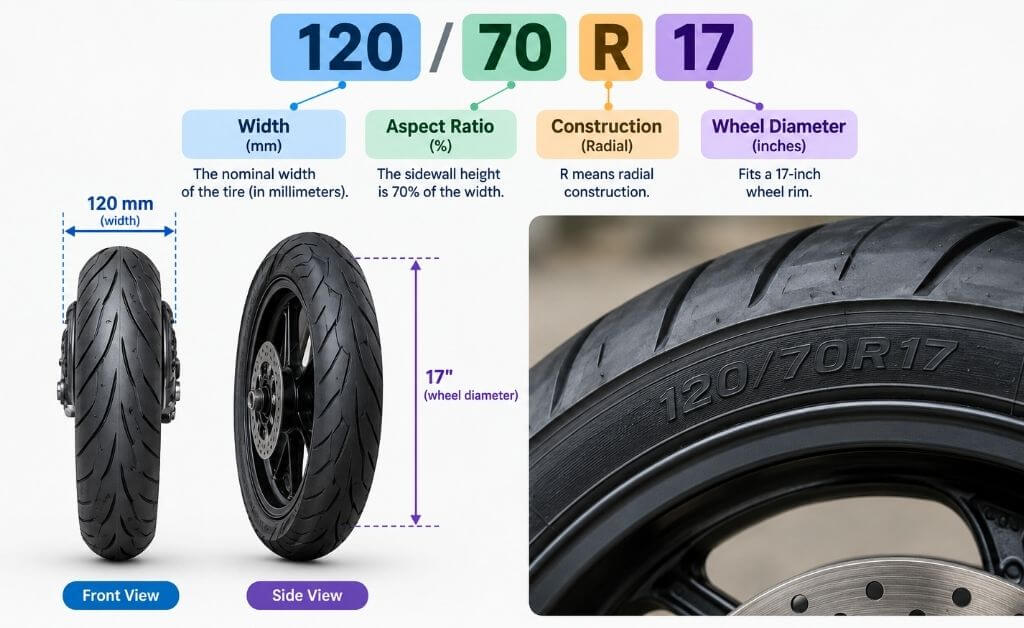
- 120 — The tire’s nominal width is 120 mm.
- 70 — The aspect ratio is 70, meaning the sidewall height is about 70% of the nominal width.
- R — The tire uses radial construction.
- 17 — The tire is designed for a 17-inch wheel.
For a 120/70 tire, the approximate sidewall height can be calculated as:
120 × 0.70 = 84 mm
Some motorcycle tires also include additional markings such as a load index and speed rating. For example, a marking such as 73W combines the tire’s load index with its speed rating.
The complete marking matters. Two tires with the same basic size may still differ in construction, load rating, speed rating, intended application, or manufacturer approval.
If you need to compare Metric, Alpha, and inch-based motorcycle tire sizing systems, use the separate Motorcycle Tire Size Conversion Chart rather than treating this reference chart as a conversion table.
Always compare the complete tire specification with the motorcycle manufacturer’s requirements before selecting a replacement.
What Rim Width Does a Motorcycle Tire Need?
Rim width affects how a motorcycle tire sits on the wheel. Using an unsuitable rim width can change the tire’s shape and affect handling, clearance, and performance.
There is no single universal rim-width range for every tire carrying the same nominal size. The correct range depends on the specific tire model and application.
For example, a tire manufacturer may publish a standard rim and an approximate approved range for one tire model. Another tire with the same size designation may have different recommendations.
Before installation:
- Check the motorcycle manufacturer’s wheel specification.
- Check the wheel or rim marking when available.
- Check the tire manufacturer’s technical information for the exact tire model.
- Confirm that the tire is approved for the motorcycle’s front or rear position.
- Check clearance if changing from the original tire size.
Most importantly, rim compatibility is not the same as motorcycle fitment. A tire may physically match a rim width but still be unsuitable for the motorcycle because of load, speed, clearance, construction, or manufacturer fitment requirements.
For a standard replacement, the safest approach is to use the motorcycle manufacturer’s specified tire size and a tire manufacturer’s approved rim specification.
Can You Use a Different Motorcycle Tire Size?
Sometimes a motorcycle can use a different tire size, but a different size should not be treated as automatically interchangeable.
Changing the size can affect more than the tire’s appearance. It may change the tire’s overall diameter, steering response, ride height, clearance, handling characteristics, and the relationship between the tire and wheel.
Before considering a different size, verify:
- motorcycle manufacturer specifications
- front or rear application
- wheel diameter
- rim width
- load index
- speed rating
- tire construction
- fender, fork, swingarm, chain, and belt clearance
- tire manufacturer’s fitment information
A wider tire is not automatically an upgrade. If the tire is too wide for the wheel or motorcycle, the resulting tire profile may be unsuitable even when the wheel diameter is correct.
For a normal replacement, staying with the motorcycle manufacturer’s specified size is the simplest way to avoid unnecessary fitment problems.
If you intentionally change size, verify the complete fitment rather than relying on a size cross-reference or the fact that another motorcycle uses the same tire size.
Related Post: Motorcycle Tire Pressure Chart
How to Confirm the Correct Tire Size for Your Motorcycle
The most reliable way to identify your motorcycle’s correct tire size is to start with the motorcycle manufacturer’s specifications.
1. Check the Motorcycle’s Tire Information Label
Look for the tire-size information on the motorcycle. Depending on the model, it may be located on a frame label, swingarm label, or another manufacturer-specified location.
2. Check the Owner’s Manual
The owner’s manual can provide the recommended front and rear tire sizes along with other specifications such as load, speed, pressure, and wheel information.
3. Check the Existing Tire Sidewall
The current tire provides useful information about the size that is installed. However, do not assume that an aftermarket tire represents the motorcycle’s original specification.
A previous owner may have installed a different size.
4. Verify the Complete Tire Specification
Check more than the basic size. Confirm:
- front or rear position
- load index
- speed rating
- construction
- tube or tubeless requirement
- rim compatibility
- manufacturer fitment information
5. Check the Exact Replacement Tire
If you already selected a tire model, verify that the manufacturer lists that tire for your motorcycle or application.
This is especially important when changing tire size, wheel size, construction, or intended use.
Frequently Asked Questions
What is the most common motorcycle tire size?
There is no single tire size that fits most motorcycles. Motorcycle tire sizes vary significantly by motorcycle type, wheel diameter, engine class, and intended use.
Sizes such as 120/70-17 and 180/55-17 are common in some street and sport applications, while 90/90-21 and 150/70-17 are used in different adventure applications. Cruiser and touring motorcycles use many different 15-, 16-, 17-, 18-, and 19-inch sizes.
The correct size for your motorcycle should always come from its manufacturer specifications.
How do I know what tire size my motorcycle needs?
Check the motorcycle’s tire information label and owner’s manual first. Then compare that specification with the tire manufacturer’s fitment information.
The sidewall of the current tire can help identify the installed size, but it should not override the motorcycle manufacturer’s specification.
What do the numbers on a motorcycle tire mean?
A size such as 120/70R17 indicates a nominal 120 mm tire width, a 70-series aspect ratio, radial construction, and a 17-inch wheel diameter.
Additional markings may identify the tire’s load index and speed rating.
Can I put a wider tire on my motorcycle?
Not automatically. A wider tire must be compatible with the wheel, motorcycle, clearance, load requirements, and manufacturer’s fitment specifications.
A wider tire can also change the tire profile and handling characteristics. Do not select a wider tire based only on appearance or the fact that it fits the same wheel diameter.
Does rim width matter for motorcycle tires?
Yes. The rim width affects how the tire is seated and shaped.
Always check the approved rim width for the exact tire model. A tire that fits a particular wheel diameter is not necessarily suitable for every rim width.
Can front and rear motorcycle tires be the same size?
Sometimes, but it depends on the motorcycle and tire application.
Some tire sizes can appear in both front and rear applications, while others are designed specifically for one axle. The tire’s nominal size alone does not determine where it can be used.
Follow the motorcycle manufacturer’s front and rear specifications and the tire manufacturer’s application information.
Final Answer
The correct motorcycle tire size depends on your motorcycle’s manufacturer specifications, wheel size, rim compatibility, and front or rear application.
Use this motorcycle tire size chart as a reference for common sizes, then confirm the exact replacement specification in the owner’s manual, motorcycle tire information label, and tire manufacturer’s fitment information.
If you are considering a different tire size, verify the complete fitment—including rim width, load, speed rating, construction, and clearance—instead of relying only on tire width, wheel diameter, or a size cross-reference.
