Trailer Tire PSI Chart (Complete Guide)
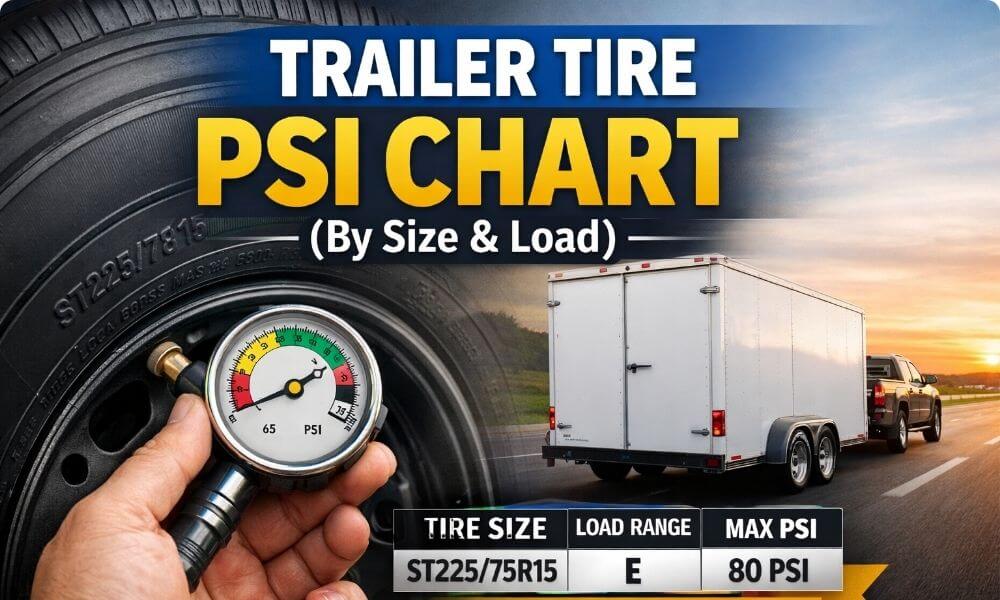
A Trailer Tire PSI Chart is one of the simplest tools you can use to keep your trailer safer on the road. The right tire pressure helps support the load, improve stability, reduce uneven wear, and lower the risk of blowouts on long trips.
But trailer tires are not the same as car tires, and the correct PSI depends on the tire size, load range, wheel rating, and trailer maker’s recommendation. In this guide, you will get a clear, easy-to-use trailer tire PSI chart along with practical tips to help you set the right pressure with confidence.
What PSI Should Trailer Tires Be?
In many cases, trailer tires should be inflated to the cold PSI listed on the tire sidewall, as long as that pressure does not exceed the wheel’s rating or the trailer manufacturer’s recommendation.
For example, Maxxis lists common ST trailer tires at 50 PSI for Load Range C, 65 PSI for Load Range D, and 80 PSI for Load Range E in several popular sizes.
Trailer tire guidance from Dexter also says to inflate to the trailer manufacturer’s recommended cold tire pressure or the tire’s maximum, and not to exceed rim or wheel limits.
Trailer Tire PSI Chart (By Size)
| Tire Size | Load Range | Max PSI |
| 4.80-8 | B | 60 PSI |
| 4.80-8 | C | 90 PSI |
| 5.30-12 | B | 55 PSI |
| 5.30-12 | C | 80 PSI |
| 4.80-12 | B | 60 PSI |
| 4.80-12 | C | 90 PSI |
| ST145/R12 | B | 65 PSI |
| ST145/R12 | C | 80 PSI |
| ST145/R12 | D | 95 PSI |
| ST155/R12 | B | 65 PSI |
| ST155/R12 | C | 80 PSI |
| ST155/R12 | D | 95 PSI |
| ST175/80R13 | C | 50 PSI |
| ST175/80R13 | D | 65 PSI |
| ST185/80R13 | C | 50 PSI |
| ST185/80R13 | D | 65 PSI |
| ST185/80R13 | E | 80 PSI |
| ST175/80R14 | C | 50 PSI |
| ST175/80R14 | D | 65 PSI |
| ST205/75R14 | C | 50 PSI |
| ST205/75R14 | D | 65 PSI |
| ST205/75R14 | E | 80 PSI |
| ST215/75R14 | C | 50 PSI |
| ST215/75R14 | D | 65 PSI |
| ST215/75R14 | E | 80 PSI |
| ST205/75R15 | C | 50 PSI |
| ST205/75R15 | D | 65 PSI |
| ST205/75R15 | E | 80 PSI |
| ST225/75R15 | D | 65 PSI |
| ST225/75R15 | E | 80 PSI |
| ST225/75R15 | F | 95 PSI |
| ST235/75R15 | D | 65 PSI |
| ST235/75R15 | E | 80 PSI |
| ST235/75R15 | F | 95 PSI |
| ST235/80R16 | E | 80 PSI |
| ST235/80R16 | F | 95 PSI |
| ST235/80R16 | G | 110 PSI |
| ST235/85R16 | E | 80 PSI |
| ST235/85R16 | F | 95 PSI |
| ST235/85R16 | G | 110 PSI |
How to Use This Trailer Tire PSI Chart
Think of load range as how strong the tire is.
A tire marked B is made for lighter trailers. It works fine for small loads but isn’t built for heavy hauling.
C and D are stronger and more common for everyday trailers. If you carry moderate to heavy weight, these are usually the right choice.
E, F, and G are for heavy-duty use. These are designed for big trailers or when you’re carrying a lot of weight regularly.
Now about PSI. This is just the air pressure inside the tire.
The number shown in the chart is the maximum pressure, and it should be checked when the tire is cold. That means the trailer hasn’t been driven for a while. If you check it after driving, the pressure will read higher and give you the wrong idea.
In most cases, trailer tires are meant to be filled up to that max PSI. This helps them carry the full load safely and reduces the chance of overheating.
The downside is that a fully inflated tire can feel a bit stiff and may wear unevenly if the trailer is almost empty. But for safety, especially when carrying weight, staying near the max PSI is usually the better choice.
Trailer Tire PSI Chart (By Trailer Type)
| Trailer Type | Load Range | Max PSI |
| Small Utility Trailer | B | 55–60 PSI |
| Small Utility Trailer | C | 65–90 PSI |
| Lawn / Garden Trailer | B | 55–60 PSI |
| Lawn / Garden Trailer | C | 65–80 PSI |
| Jet Ski Trailer | B | 55–60 PSI |
| Jet Ski Trailer | C | 65–80 PSI |
| Boat Trailer (Small) | B | 55–60 PSI |
| Boat Trailer (Small) | C | 65–90 PSI |
| Boat Trailer (Large) | C | 65–90 PSI |
| Boat Trailer (Large) | D | 65 PSI |
| Camper Trailer (Light) | C | 50–65 PSI |
| Camper Trailer (Light) | D | 65 PSI |
| Travel Trailer | C | 50 PSI |
| Travel Trailer | D | 65 PSI |
| Travel Trailer | E | 80 PSI |
| Fifth-Wheel Trailer | D | 65 PSI |
| Fifth-Wheel Trailer | E | 80 PSI |
| Fifth-Wheel Trailer | F | 95 PSI |
| Car Hauler Trailer | D | 65 PSI |
| Car Hauler Trailer | E | 80 PSI |
| Car Hauler Trailer | F | 95 PSI |
| Equipment Trailer | E | 80 PSI |
| Equipment Trailer | F | 95 PSI |
| Equipment Trailer | G | 110 PSI |
| Dump Trailer | E | 80 PSI |
| Dump Trailer | F | 95 PSI |
| Dump Trailer | G | 110 PSI |
| Enclosed Cargo Trailer | C | 50 PSI |
| Enclosed Cargo Trailer | D | 65 PSI |
| Enclosed Cargo Trailer | E | 80 PSI |
| Flatbed Trailer | D | 65 PSI |
| Flatbed Trailer | E | 80 PSI |
| Flatbed Trailer | F | 95 PSI |
| Horse Trailer | D | 65 PSI |
| Horse Trailer | E | 80 PSI |
| Horse Trailer | F | 95 PSI |
| Toy Hauler Trailer | E | 80 PSI |
| Toy Hauler Trailer | F | 95 PSI |
| Toy Hauler Trailer | G | 110 PSI |
How to Read This Trailer Tire PSI Chart
This chart is meant to give you a quick idea of what tire pressure your trailer needs. You don’t need any technical background to use it—just match your trailer and tire type, and you’re good to go.
Trailer Type simply tells you what kind of trailer you have. For example, a small utility trailer is used for light loads, while a dump trailer or car hauler is built for heavier work. Pick the one that best matches how you use your trailer.
Load Range is a way of showing how strong the tire is. Think of it like levels—B is lighter, while E or G is much stronger and made for heavier loads. A higher letter doesn’t mean better in every case, just that it can handle more weight.
Max PSI is the air pressure the tire is designed to handle when it’s carrying its full load. This number matters more than most people think. Trailer tires usually perform best when they are filled close to this number, but always check your tire sidewall to be sure.
One small thing to keep in mind: this chart gives general guidance. Tires from different brands can vary slightly, so it’s always worth double-checking your specific tire before hitting the road.
Should You Always Use Max PSI?
In most cases, yes—you should use the maximum PSI written on the tire sidewall. Trailer tires are built to carry heavy weight, and they work best when fully inflated.
Running at max PSI helps the tire stay firm and stable, especially at highway speeds. It also reduces heat, which is one of the main reasons trailer tires fail.
That said, there are a few exceptions. Some trailer or tire manufacturers provide a load-based chart. This means if your trailer is much lighter than the tire’s full capacity, the recommended PSI could be slightly lower.
But here’s the honest part—most people don’t weigh their trailer often enough to adjust pressure safely. So lowering PSI without clear guidance can do more harm than good.
One small downside of using max PSI is a slightly firmer ride. The trailer may feel a bit more bouncy on rough roads. But that trade-off is worth it for better safety and tire life.
If you’re ever unsure, it’s safer to stay at the max PSI listed on the tire.
Common Mistakes to Avoid
A lot of trailer tire problems start with small mistakes that are easy to miss. The good news is that most of them are simple to avoid once you know what to look for.
- Using car tire habits for trailer tires. Trailer tires are built differently. Lowering the pressure for a softer ride can make them run hotter and fail sooner.
- Checking pressure after driving. Tires warm up on the road, so the reading goes up. That can make you think the tire is fine when it may not be.
- Guessing instead of checking the sidewall. The tire itself usually gives the safest PSI number. Guessing is a fast way to end up with the wrong pressure.
- Ignoring the spare tire. A spare that has low air is not much help in an emergency. It needs the same attention as the tires you use every day.
- Overloading the trailer. Even with the right PSI, too much weight can still damage the tires. The tire can only handle so much, and pushing past that limit is risky.
- Checking only one tire. Trailer tires can lose air at different rates. One tire being fine does not mean the others are fine too.
- Waiting until a tire looks bad. By the time a trailer tire looks worn out or badly flat, the damage may already be done. Regular checks catch problems earlier.
A little time spent checking pressure before a trip can save you from a much bigger headache later.
How to Check Trailer Tire Pressure
Start when the tires are cold. That means the trailer has been parked for a few hours and has not been driven recently. A warm tire can show a higher reading, which can make the pressure look better than it really is.
- Get a tire pressure gauge and check the number on the tire sidewall first. That number tells you the safest pressure for that tire. It gives you a clear target before you start.
- Remove the valve cap from one tire and press the gauge straight onto the valve stem. You should hear a small hiss for a second, then the gauge will show the pressure. Try not to angle it too much, or the reading may be off.
- Compare the reading with the PSI listed on the tire. If it is low, add air in small amounts and check it again. If it is too high, let out a little air until it matches the correct number.
- Repeat the same check on every tire. Trailer tires can lose air at different rates, so do not assume they are all the same just because one tire looks fine.
- Check the spare tire too. It is easy to forget, but a flat spare is useless when you really need it. A quick check now can save you trouble later.
- Put the valve caps back on tightly when you are done. They help keep dirt and moisture out of the valve stem. It is a small step, but it helps protect the tire over time.
This whole process only takes a few minutes, and it is one of the easiest ways to avoid tire trouble on the road.
Signs Your PSI Is Wrong
Your trailer usually gives small warning signs when the tire pressure is not right. You just need to know what to look for before it turns into a bigger problem.
One common sign is uneven wear on the tire. If the edges of the tire look more worn out than the center, the pressure is often too low. On the other hand, if the center wears out faster, the tire may be overinflated. Both situations slowly reduce tire life.
Another serious warning is a blowout. This usually happens when a tire runs too hot for too long, often because it does not have enough air. It can happen suddenly on the road, which makes it especially dangerous at highway speeds.
You may also notice poor handling while towing. The trailer can feel unstable, sway more than usual, or feel “loose” behind your vehicle. It may not track straight, especially when you are driving faster or carrying a load.
One small challenge is that these signs do not always show up early. By the time you notice them clearly, some damage may already be there. That is why regular pressure checks are always better than waiting for symptoms.
Read More: Trailer Tire Speed Rating Chart
FAQs
Do trailer tires need more PSI than car tires?
Often yes. Many ST trailer tires run at higher cold PSI because they are designed to support heavier loads and reduce sway. The exact pressure depends on the tire size and load range, so the sidewall and placard matter more than any general rule.
Can I lower trailer tire PSI for a softer ride?
Usually not a good idea. Trailer tires are load-focused, and lowering pressure can reduce load capacity and increase heat buildup. That can shorten tire life and raise the risk of failure.
How often should I check trailer tire pressure?
Check it cold before trips and at least monthly during regular use. Maxxis specifically recommends monthly cold checks with an accurate gauge.
Where should I find the right pressure?
Start with the trailer’s tire information placard, then confirm the tire sidewall and wheel rating. NHTSA says the placard lists the manufacturer’s recommended tire size, inflation pressure, and load limits.
Final thoughts
A trailer tire PSI chart is useful, but it is not a substitute for the tire sidewall, the wheel rating, and the trailer manufacturer’s guidance. The best approach is simple: use the right ST tire, check it cold, stay within the listed PSI and load limits, and do not treat trailer tires like car tires. That one habit can improve safety, reduce wear, and help prevent expensive breakdowns.
