Trailer Tire Size Chart: Load, PSI, Rim Width & Diameter
Last updated on September 27th, 2026
A trailer tire size tells you more than its wheel diameter. Two tires with the same size marking can have different load capacities and inflation requirements. Use the Trailer Tire Size Chart below to compare specific manufacturer-listed tires, then check your trailer’s placard, wheel rating and available clearance before buying a replacement.
Quick Answer
Match the tire size on your trailer’s placard or existing tire, then check the load capacity per tire, cold inflation pressure, rim diameter and suitable rim width. Each chart row below describes one particular tire model and load range or ply rating. A different model in the same nominal size can have different measured dimensions or ratings. The listed PSI is the manufacturer’s catalog pressure associated with that row’s load rating; consult the tire and trailer instructions for your actual installation.
Trailer Tire Size Chart: 8- to 12-Inch Wheels
Dimensions and capacity below belong to the specific model and rating shown, not every tire with that size marking. Diameter and section width are measured tire dimensions in inches; a rim width is the manufacturer’s listed measuring rim width. A dash means the table does not make a width claim for that row.
| Tire size | Load range / ply | Rim width (in.) | Diameter (in.) | Section width (in.) | Load per tire (lb) | Cold PSI |
|---|---|---|---|---|---|---|
| 4.80/4.00-8 | B | 3.75 | 16.1 | — | 590 | 60 |
| 4.80-8 | B | 3.75 | 16.3 | 4.7 | 585 | 60 |
| 4.80-8 | C | 3.75 | 16.3 | 4.9 | 760 | 90 |
| 5.70-8 | C | 3.75 | 18.4 | 6.0 | 910 | 75 |
| 5.70-8 | D | 3.75 | 18.7 | 6.0 | 1,070 | 100 |
| 16.5×6.5-8 | D | 5.38 | 16.6 | 6.8 | 910 | 90 |
| 165/65-8 | 6PR | 5.375 | 16.5 | — | 800 | 70 |
| 18.5×8.5-8 | C | 7.00 | 17.9 | 8.6 | 935 | 50 |
| 215/60-8 | 6PR | 7.00 | 18.3 | — | 935 | 50 |
| 215/60-8 | 8PR | 7.00 | 18.1 | — | 1,165 | 70 |
| 6.90/6.00-9 | 6PR | 4.50 | 21.1 | — | 1,298 | 60 |
| 205/50-10 | 12PR | 6.00 | 18.35 | — | 1,980 | 115 |
| 20.5×8.0-10 | C | 6.00 | 20.9 | — | 1,100 | 50 |
| 20.5×8.0-10 | D | 6.00 | 20.7 | — | 1,320 | 70 |
| 205/65-10 | 6PR | 6.00 | 20.5 | — | 1,100 | 50 |
| 205/65-10 | 8PR | 6.00 | 20.6 | — | 1,320 | 70 |
| 205/65-10 | 10PR | 6.00 | 20.4 | — | 1,650 | 90 |
| 4.80-12 | B | 4.00 | 20.6 | — | 785 | 60 |
| 4.80-12 | C | 4.00 | 20.6 | — | 990 | 90 |
| 5.30-12 | C | 4.00 | 21.6 | — | 1,050 | 80 |
| 5.30-12 | 8PR | 4.25 | 21.9 | — | 1,250 | 105 |
| ST145/R12 | D | 4.00 | 21.4 | — | 1,220 | 65 |
| ST145/R12 | E | 4.00 | 21.4 | — | 1,520 | 80 |
| ST145/80R12 | E | 4.50 | 21.0 | — | 1,520 | 80 |
Trailer Tire Size Chart: 13- to 16-Inch Wheels
An R in the tire size means radial construction; a D in the tire size means diagonal or bias construction. The separate load range D describes a load and pressure class, not construction.
| Tire size | Load range / ply | Rim width (in.) | Diameter (in.) | Load per tire (lb) | Cold PSI |
|---|---|---|---|---|---|
| ST175/80D13 | C | 4.50 | 24.0 | 1,360 | 50 |
| ST175/80R13 | C | 5.00 | 24.1 | 1,360 | 50 |
| ST175/80R13 | D | 5.00 | 24.1 | 1,570 | 65 |
| ST185/80D13 | C | 4.50 | 24.4 | 1,480 | 50 |
| ST185/80R13 | C | 5.00 | 24.7 | 1,480 | 50 |
| ST185/80R13 | D | 5.00 | 24.7 | 1,710 | 65 |
| ST205/75D14 | C | 5.50 | 25.8 | 1,760 | 50 |
| ST205/75R14 | C | 5.50 | 26.1 | 1,760 | 50 |
| ST205/75R14 | D | 5.50 | 26.1 | 2,040 | 65 |
| ST215/75D14 | C | 6.00 | 26.7 | 1,870 | 50 |
| ST215/75R14 | C | 6.00 | 26.7 | 1,870 | 50 |
| ST205/85D14.5 | F | 6.00 | 27.8 | 2,830 | 95 |
| 7-14.5LT | D | 6.00 | 26.1 | 1,870 | 70 |
| 8-14.5LT | F | 6.00 | 27.8 | 2,835 | 100 |
| ST205/75D15 | C | 5.50 | 27.1 | 1,820 | 50 |
| ST205/75R15 | C | 5.50 | 27.1 | 1,820 | 50 |
| ST205/75R15 | D | 5.50 | 27.1 | 2,150 | 65 |
| ST205/90D15 | D | 5.50 | 29.4 | 2,600 | 65 |
| ST225/75D15 | D | 6.00 | 28.3 | 2,540 | 65 |
| ST225/75R15 | D | 6.00 | 28.3 | 2,540 | 65 |
| ST225/75R15 | E | 6.00 | 28.1 | 2,830 | 80 |
| 7.00-15LT | E | 5.50 | 29.5 | 2,403 | 71 |
| ST225/90D16 | E | 6.00 | 31.6 | 3,520 | 80 |
| ST235/80R16 | E | 6.50 | 30.8 | 3,520 | 80 |
| ST235/80R16 | F | 6.50 | 30.7 | 3,740 | 95 |
| ST235/85R16 | E | 6.50 | 31.7 | 3,640 | 80 |
| ST235/85R16 | F | 6.50 | 31.7 | 3,960 | 95 |
| ST255/85R16 | E | 7.00 | 33.1 | 4,080 | 80 |
| 7.50-16LT | 10PR | 6.00 | 31.6 | 2,910 single | 77 |
Trailer Tire Size Chart: 17.5-Inch Wheels
These are manufacturer-listed commercial tire examples sometimes considered for compatible trailer setups. Check the tire’s intended service, wheel specifications and whether the trailer uses single or dual tires. A dual rating is per tire in a dual installation, not the combined capacity of two tires.
| Tire size | Rating | Approved rim width (in.) | Diameter (in.) | Single load per tire (lb) | Dual load per tire (lb) | Cold PSI |
|---|---|---|---|---|---|---|
| 215/75R17.5 | H | 6.00 / 6.75 | 30.2 | 4,805 | 4,540 | 125 |
| 235/75R17.5 | H | 6.75 / 7.50 | 31.4 | 6,005 | 5,675 | 125 |
| 245/70R17.5 | 18PR, 143/141K | 6.75 | 31.1 | 6,005 | 5,675 | 125 |
How to Use This Chart to Choose a Replacement Tire
- Read the tire size and required inflation on the trailer placard and the marking on the existing tire. Confirm the trailer’s axle and gross vehicle weight ratings; weigh a loaded trailer when possible.
- Match the exact size and construction, then select a tire whose per-tire capacity at the stated cold pressure covers its actual share of the loaded axle. A 3,500 lb axle with two tires suggests at least 1,750 lb per tire before considering uneven loading and the trailer maker’s requirements.
- Check the wheel’s diameter, width, pressure and load ratings; the wheel and valve must suit the intended cold PSI. Confirm speed and service requirements for the chosen tire. Our trailer tire speed rating chart explains the speed symbols; use the rating on the specific tire you buy.
- Compare actual diameter and section width, allowing room above, beside and between tires throughout suspension travel. Measure on the trailer rather than assuming all tires of one nominal size have identical dimensions.
For example, the chart’s Carlstar ST205/75R15 load range C carries 1,820 lb at 50 PSI; its load range D version carries 2,150 lb at 65 PSI. The D example needs a wheel and valve suitable for 65 PSI. A higher load range does not raise the trailer’s axle or wheel rating.
Once you have confirmed the required size, capacity and wheel fit, you can compare product options in our best trailer tires guide. Check each candidate’s current manufacturer specifications before ordering.
What the Numbers and Letters Mean
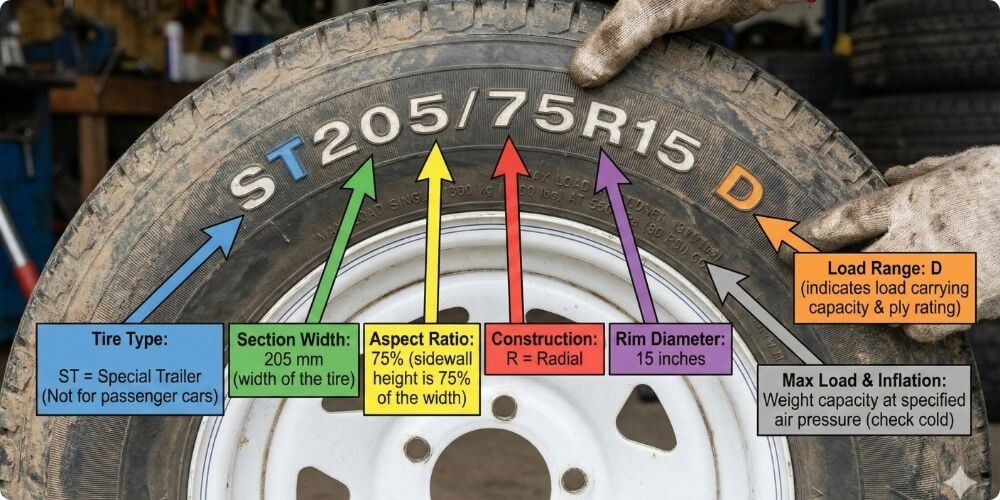
Take ST205/75R15 Load Range D:
| Marking | Meaning |
|---|---|
| ST | Special Trailer tire designation. |
| 205 | Nominal section width of 205 millimeters. |
| 75 | Aspect ratio: nominal sidewall height is 75% of section width. |
| R | Radial tire construction; a D in this position identifies diagonal or bias construction. |
| 15 | Wheel diameter of 15 inches; this is not the tire’s outside diameter. |
| Load Range D | Separate load and inflation classification; look up the tire’s actual per-tire capacity and pressure. |
In the Carlstar example above, the measured outside diameter is 27.1 inches, and the load range D tire is listed at 2,150 lb per tire at 65 PSI cold. “D” in load range D does not say whether the tire is radial or bias ply. Check a specific model’s sidewall or manufacturer listing before setting pressure.
For a broader explanation of metric passenger and light-truck size markings, see how to read tire size; trailer fitment still requires the trailer-specific load, pressure and wheel checks above.
Older Trailer Tire Size Markings
Older letter and numeric markings may point you toward a modern size, but these are comparison references, not guaranteed direct replacements. Radial and bias constructions can also differ. Match the measured dimensions and all fitment and capacity requirements before changing tires.
| Older marking | Modern size to compare | What to verify |
|---|---|---|
| B78-13ST | ST175/80R13 or ST175/80D13 | 13-inch wheel, dimensions, capacity and clearance. |
| F78-14ST | ST205/75R14 or ST205/75D14 | 14-inch wheel, dimensions, capacity and clearance. |
| H78-15ST | ST225/75R15 or ST225/75D15 | 15-inch wheel, dimensions, capacity and clearance. |
| 16.5×6.5-8 | 165/65-8 | Both use an 8-inch wheel designation; verify rim width, capacity and measured size. |
| 18.5×8.5-8 | 215/60-8 | Compare actual diameter and width, plus rim width and load rating. |
| 20.5×8.0-10 | 205/65-10 | Compare actual diameter and width, plus rim width and load rating. |
The numeric pairs appear as paired designations in Kenda’s catalog. For older letter sizes, use the references to narrow a search, then verify the candidate against the original equipment specifications. For example, the chart’s Carlstar 16.5×6.5-8 D is 910 lb at 90 PSI, whereas Kenda 165/65-8 6PR is 800 lb at 70 PSI: similar size references do not establish equal capacity.
Can You Change Trailer Tire Size?
Only after checking the wheel, the loaded axle’s required capacity and physical clearance. Consider two Carlstar Sport Trail load range C tires on 8-inch wheels:
| Check | Existing 4.80-8 C | Proposed 5.70-8 C | Change |
|---|---|---|---|
| Measured diameter | 16.3 in. | 18.4 in. | +2.1 in. |
| Measured section width | 4.9 in. | 6.0 in. | +1.1 in. |
| Measuring rim width | 3.75 in. | 3.75 in. | Same catalog measuring width; verify your wheel’s approved range. |
| Load per tire | 760 lb at 90 PSI | 910 lb at 75 PSI | +150 lb; different required pressure. |
The diameter increase moves the tire about 1.05 inches closer above to a fender, assuming the same axle center. If both tires sit in the same centered position, the added width takes about 0.55 inches per side. Wheel offset, tire deflection and suspension movement can change real clearance; measure all around the installed tire and between tires on a tandem axle. Confirm wheel and valve suitability and the trailer maker’s fitment requirements. Inflate the selected 5.70-8 tire according to its specification; do not transfer the old tire’s 90 PSI setting to a tire listed here at 75 PSI.
Trailer Tire Size Chart FAQs
How do I choose the correct trailer tire size?
Start with the trailer placard and existing tire marking. Confirm wheel diameter and width, loaded per-tire capacity, cold inflation, construction and physical clearance. Use a chart row only as the specification for its named tire model and rating.
Does a higher load range mean a larger tire?
No. It identifies a different load and inflation class. For example, both Carlstar ST205/75R15 radial examples here have a 27.1-inch measured diameter, but C is 1,820 lb at 50 PSI and D is 2,150 lb at 65 PSI. Verify the wheel’s pressure and load ratings before changing load range.
What PSI should I use for a trailer tire?
Use the cold inflation specified for the particular tire and application, considering the trailer placard and manufacturer instructions. The PSI in each chart row is the catalog pressure associated with that listed capacity, not a universal setting for all tires of that size. Check pressure before driving, while the tire is cold.
Can I replace a 16.5×6.5-8 tire with a 165/65-8?
Treat 165/65-8 as a size to investigate, not an automatic fit. The examples above have different measuring rim widths (5.38 vs. 5.375 inches), measured diameters (16.6 vs. 16.5 inches) and capacities (910 lb at 90 PSI vs. 800 lb at 70 PSI). Verify the actual wheel, required load, fender clearance and mounting requirements.
What do single and dual ratings mean for 17.5-inch tires?
Single is the load per tire when used singly at a wheel position; dual is the load per tire when paired at a wheel position. For the Continental 235/75R17.5 HTR2, the manufacturer lists 6,005 lb single and 5,675 lb dual per tire, both at 125 PSI. Check the actual tire, wheel and axle arrangement; do not use a single rating for a dual installation.
