W vs Y Speed Rating: What’s the Difference?
If you are comparing tires and keep seeing W vs Y speed rating, it is normal to feel unsure about what it really means. At first glance, it looks like a small letter choice. In reality, it can affect safety, performance, comfort, and even how much you pay for your tires.
Many drivers assume a speed rating is only about how fast a car can go. That is not quite right. A tire speed rating is really about how well a tire can handle sustained speed, heat, and stress over time. That matters whether you drive a sports car, a luxury sedan, an EV, or even a regular family car that just happens to need high-performance tires.
People usually run into this question when they are replacing worn tires, upgrading to better-performing ones, or trying to match the original tire spec on a vehicle. The good news is that the difference between W and Y is easy to understand once you look at it the right way.
What Is a Tire Speed Rating?
A tire speed rating is a letter on the tire’s sidewall that shows the highest speed the tire can safely handle while carrying its rated load, under specified conditions. It is a safety and fit guide, not a sign that the tire is “better” for everyday driving. NHTSA’s TireWise uses tire labeling to help drivers choose and care for tires, and Michelin explains that the rating is tied to the tire’s maximum speed at its maximum load.
These ratings come from laboratory tests, not from normal road use. In those tests, a properly inflated tire is run under controlled load and speed steps to check whether it can keep its shape and strength over time. The key idea is sustained speed, because heat builds up the longer a tire runs fast.
That heat matters. NHTSA says sustained high temperature can damage a tire and contribute to blowouts or tread separation, which is why speed rating, load rating, and the vehicle maker’s recommendation all need to be considered together. ETRTO also advises that the tire’s speed rating should match the vehicle’s maximum speed capability.
In simple terms: the speed rating helps you choose a tire that can safely handle the speed, load, and heat your car may put on it.
Full Speed Rating Chart Overview (Where W and Y Fit In)
Tire speed ratings follow a simple pattern: as the letter moves later in the alphabet, the tire is tested for higher sustained speeds under controlled conditions. It’s not about normal driving—it’s about how much stress the tire can safely handle.
Most everyday and performance tires fall somewhere between V, W, and Y. These are all considered high-performance ratings, but they are not identical.
Here’s a simple way to see where they sit:
| Speed Rating | Max Sustained Speed | Common Use |
| V | 240 km/h (149 mph) | Sporty everyday cars |
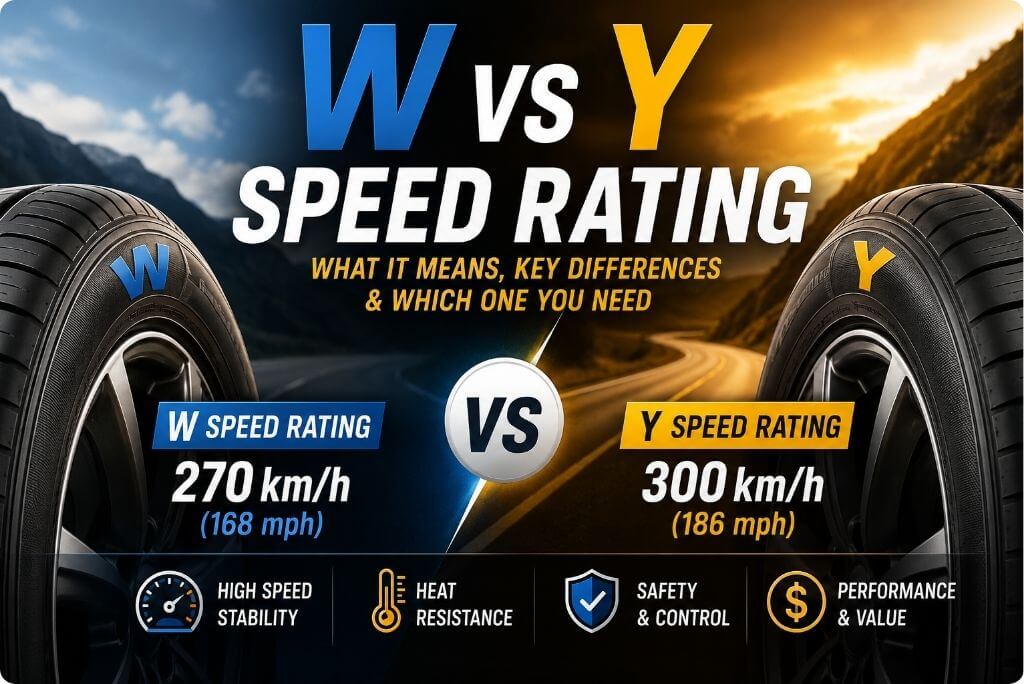
| W | 270 km/h (168 mph) | Performance sedans, sports cars |
| Y | 300 km/h (186 mph) | High-performance and luxury sports cars |
| (Y) | Over 300 km/h | Ultra high-performance vehicles |
W and Y are close together, but Y is built and tested to handle more heat and stress at very high speeds. That extra margin is mainly useful for powerful cars or aggressive driving conditions.
In simple terms: moving from V → W → Y means the tire has been tested to stay stable at higher speeds, with stronger focus on heat resistance and structural strength. It does not automatically mean better everyday grip or comfort.
W vs Y Speed Rating: Side-by-Side Comparison
W speed rating
A W-rated tire is tested for speeds up to 168 mph (270 km/h). It is commonly found on performance sedans, sports cars, and some higher-end vehicles.
Its main advantage is that it gives strong high-speed performance without going to the highest rating. For many drivers, that makes it a good balance of performance and cost.
The main downside is simple: it does not offer as much speed headroom as a Y-rated tire.
Y speed rating
A Y-rated tire is tested for speeds up to 186 mph (300 km/h). It is usually used on very fast sports cars and performance-focused vehicles.
Its biggest advantage is extra high-speed ability and a little more safety margin for demanding driving. It is built for more extreme conditions.
The trade-off is that Y-rated tires often cost more. For everyday driving, that extra capability may not be necessary.
Key differences at a glance
The difference between W and Y is not huge in normal driving, but it does matter for performance.
W gives you a lower top tested speed, while Y gives you more speed capability and a bit more heat tolerance. Y is usually the better choice for more powerful vehicles, while W is often enough for drivers who want strong performance without paying for the highest rating.
In simple terms: W is high-performance; Y is even higher-performance. The right choice depends on your car, your driving style, and what the manufacturer recommends.
W vs Y Speed Rating: Real-World Performance
On normal highways, most drivers will not feel a clear difference between W and Y tires. Both are designed for speeds far above everyday driving limits, so they feel very similar in regular use.
In daily driving, Y-rated tires do not suddenly make a car feel faster or more responsive. The difference is subtle and usually only shows up when driving closer to high-performance conditions.
Where you might notice a change is in high-speed stability. A Y-rated tire can feel a bit more controlled and steady when the car is pushed harder for longer periods. But for normal commuting, this is rarely something you experience.
In performance driving, the tire choice matters more when the car is being pushed near its limits. Even then, the speed rating is only part of the picture.
What really affects real-world performance is not the W or Y label, but things like wet grip, braking distance, and overall tire quality. A well-designed W-rated tire can easily feel safer and more predictable than a lower-quality Y-rated one.
The key point is simple: speed rating sets the safe limit, but everyday driving performance depends more on grip, braking, and how well the tire is built.
When W Is Enough and When Y Makes Sense
For most drivers, a W-rated tire is already more than enough. Even on fast highways, normal driving rarely comes close to its limits. If your car came with W-rated tires from the factory, there is usually a good reason for it.
W also makes sense for many performance cars that are built for speed, but still used on public roads. In most real-world situations, it offers more than enough safety and stability.
Y-rated tires start to make sense when the car is more powerful or designed for very high speeds. Some sports cars and luxury performance vehicles are built with that extra capability in mind. In those cases, Y helps support better stability when the car is pushed harder.
Driving style matters too. If you drive calmly and mostly in city traffic or normal highway speeds, W is usually the practical choice. If you often drive at higher speeds or want extra confidence in extreme conditions, Y can be worth it.
The most important rule is simple: always follow what your vehicle manufacturer recommends. That recommendation is based on how the car was tested and what it is designed to safely handle.
What Most Buyers Get Wrong About Speed Ratings
A common mistake is thinking that a higher speed rating automatically means a better tire. That is not true. A Y-rated tire is not “better” than a W-rated tire in every situation—it is just built for different conditions.
The speed rating is only one small part of how a tire performs. It tells you how well the tire can handle high speeds safely, but it does not tell the full story of how the tire feels on the road.
For daily driving, other things matter more. Grip is important when braking or turning. Comfort affects how smooth the ride feels. Wet handling matters when roads are slippery. And tread quality affects how long the tire lasts.
A tire with a lower speed rating can still perform better in everyday conditions than a higher-rated one, depending on its design.
The key idea is simple: speed rating is about high-speed safety, not overall tire quality. Choosing the right tire means looking at how and where you actually drive, not just picking the highest letter.
Safety Implications of Choosing W vs Y
Choosing the right speed rating is not just about performance—it also affects safety if the tire does not match how the car is used or what the manufacturer recommends.
If you use a lower rating than what your car requires, the tire may not handle heat well during long, fast drives. Over time, this can increase the risk of overheating or damage, especially on highways or in hot weather. In more extreme cases, it can reduce stability when the tire is pushed beyond its safe range. In some places, it may also affect insurance coverage if an accident is linked to incorrect tires.
On the other hand, choosing a higher rating than necessary is generally safe. There is no major safety risk in using Y-rated tires instead of W, for example. The trade-offs are usually small but noticeable in some cases.
You might feel a slightly firmer ride because higher-rated tires are often built with stiffer construction. They also tend to cost more, and in normal city or highway driving, you may not get any real benefit from the extra capability.
Heat, Load, and Engineering Behind Speed Ratings
Speed ratings are not just about how fast a tire can roll. The real limit is heat. As a tire moves faster, it bends more and the inside of the tire heats up. Too much heat can weaken the structure and reduce safety.
That is why higher-rated tires like Y are built to handle heat better than W-rated ones. They use stronger rubber mixes and more heat-resistant materials so the tire stays stable under stress for longer periods.
Inside the tire, there are layers of steel belts and reinforcement materials. These layers help the tire keep its shape at speed and under load. Higher speed ratings usually mean these internal layers are designed to handle more pressure and heat without deforming.
Speed, load, and temperature are always connected. A heavier load increases stress on the tire. Higher speed increases heat. And heat is what eventually limits performance and safety.
This is also why tire manufacturers test speed ratings carefully. Companies like Michelin, Bridgestone, and Continental run controlled tests where tires are pushed at increasing speeds to measure how well they handle heat and stress over time.
The key idea is simple: speed ratings are really a measure of how well a tire survives heat and pressure while driving fast—not just how fast it can go.
Cost and Practical Trade-Offs
Y-rated tires usually cost more than W-rated tires. The difference comes from stronger materials and extra testing needed to handle higher speeds and heat.
For everyday drivers, W-rated tires often offer better value. They still provide strong performance, but without the extra cost for speed capability you may never use.
The real trade-off is simple: paying more for higher performance vs keeping costs lower for normal driving needs.
Y-rated tires may give a slightly firmer, more performance-focused feel, while W-rated tires often feel more balanced and comfortable for daily use. The right choice depends on whether you value extra performance or better overall value for regular driving.
How to Choose Between W and Y
Start with your vehicle’s manual or the tire information sticker inside the driver’s door. This is the most reliable source because it shows what the car was designed to use safely.
Next, think about how you actually drive. If your driving is mostly city roads, normal highways, and steady speeds, a W-rated tire is usually enough. If you drive a high-performance car or often drive at higher speeds, a Y-rated tire may make more sense.
Road conditions and budget also matter. You don’t need to pay extra for performance you won’t use, but you also shouldn’t go below what your car requires.
A simple way to decide is this: choose W for balanced everyday driving. Choose Y if your car or driving style demands higher performance and extra stability at speed.
Read More: V vs H Speed Rating
Frequently Asked Questions
Can I use Y-rated tires instead of W-rated tires?
Yes, in many cases you can, as long as the tire meets your vehicle’s size and load requirements and is appropriate for the car. Always check the manufacturer’s recommendation first.
Do speed ratings affect fuel efficiency?
Not directly in a simple one-to-one way, but tire design can influence rolling resistance, which can affect fuel economy. Speed rating is only one part of that picture.
What happens if I exceed the speed rating briefly?
A short burst does not automatically ruin the tire, but speed ratings are based on sustained conditions. Repeated abuse, heat buildup, or poor tire condition can create risk.
Are higher speed ratings safer in rain?
Not necessarily. Wet safety depends more on tread design, rubber compound, tire condition, and proper inflation than on speed rating alone.
Do speed ratings affect tire lifespan?
They can. Higher-performance tires sometimes trade a little tread life for better grip and heat handling, but this depends on the specific tire model.
Conclusion: What Really Matters When Choosing W vs Y
The difference between W and Y speed rating is real, but it is often misunderstood. W-rated tires are designed for up to 270 km/h, while Y-rated tires are designed for up to 300 km/h. That matters, but not because most drivers will ever reach those speeds on a public road.
What matters more is how the tire handles heat, load, and stress in the real world. A W tire may be the perfect fit for one driver, while a Y tire may be the right choice for another. The best decision comes from matching the tire to the vehicle, the manufacturer’s guidance, and the way you actually drive.
If you remember just one thing, let it be this: choose the tire that gives you the right safety margin and performance for your needs, not just the highest letter on the sidewall.
