Motorcycle Tire Pressure Chart: Recommended Front & Rear PSI
Motorcycle tire pressure varies by motorcycle type, tire size, load, and intended use. This motorcycle tire pressure chart provides typical front and rear PSI ranges, but your exact pressure should come from the motorcycle manufacturer’s cold-pressure specification.
The ranges in this chart are a general reference, not a replacement for your owner’s manual or the tire-pressure label on your motorcycle. Manufacturers determine the recommended pressure for a specific motorcycle based on factors such as weight, handling, tire size, suspension, and expected load.
You’ll also find that front and rear tire pressures are often different. Passenger weight, luggage, long-distance riding, track use, and off-road conditions can also affect the appropriate pressure when the manufacturer provides separate recommendations.
For the most accurate reading, check your tires when they are cold and use a reliable pressure gauge. Never automatically use the maximum PSI printed on the tire sidewall as your motorcycle’s normal operating pressure.
This guide explains how to use the chart, find the correct pressure for your exact motorcycle, and avoid the most common motorcycle tire-pressure mistakes.
Motorcycle Tire Pressure Chart by Bike Type
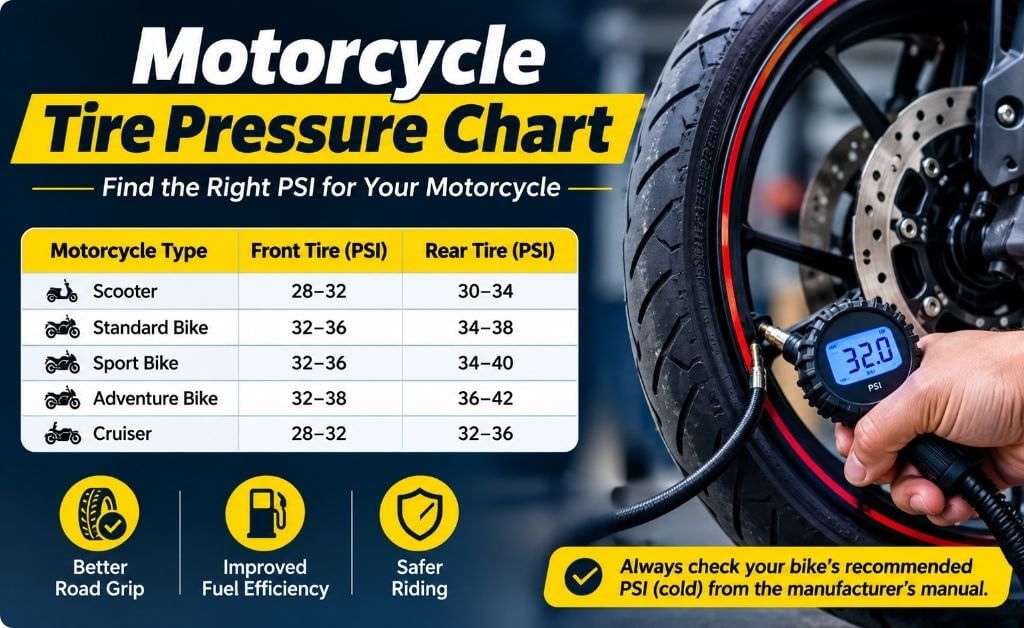
The following chart shows general cold-pressure ranges commonly associated with different motorcycle categories. These ranges are useful for understanding typical patterns, but the correct pressure for your motorcycle may fall outside them.
| Motorcycle Type | Typical Front PSI Range* | Typical Rear PSI Range* | Main Consideration |
| Moped / Small Motorcycle | 25–32 PSI | 28–36 PSI | Small tires and changing loads |
| 125cc–200cc Commuter | 25–32 PSI | 28–36 PSI | Daily urban riding |
| Standard / UJM | 30–36 PSI | 32–40 PSI | General street use |
| Naked Motorcycle | 30–36 PSI | 32–42 PSI | Weight and tire size vary widely |
| Streetfighter | 32–36 PSI | 36–42 PSI | Performance-oriented street riding |
| Lightweight Sport Bike | 30–36 PSI | 32–42 PSI | Street and track settings differ |
| Supersport / Superbike | 32–36 PSI | 36–42 PSI | Tire model and intended use matter |
| Sport-Touring Motorcycle | 32–36 PSI | 36–42 PSI | Passenger and luggage loads |
| Lightweight Cruiser | 30–36 PSI | 32–40 PSI | Rear load can vary |
| Heavyweight Cruiser | 32–40 PSI | 36–42 PSI | Motorcycle weight and load |
| Bagger | 34–40 PSI | 36–42 PSI | Heavy chassis and luggage |
| Full-Dress Touring | 34–40 PSI | 36–42 PSI | Solo vs. loaded riding |
| Luxury Touring | 34–40 PSI | 36–42 PSI | High weight and cargo capacity |
| Middleweight Adventure | 28–36 PSI | 30–42 PSI | Road and off-road use |
| Heavyweight Adventure | 32–38 PSI | 36–42 PSI | Weight and touring loads |
| Adventure-Touring | 32–38 PSI | 36–42 PSI | Surface and load conditions |
| Dual-Sport | 18–32 PSI† | 18–32 PSI† | Street vs. off-road use |
| Enduro | 12–22 PSI† | 12–22 PSI† | Terrain and tire setup |
| Trail Motorcycle | 10–20 PSI† | 10–20 PSI† | Low-speed off-road use |
| Motocross | 10–15 PSI† | 10–15 PSI† | Track surface and tire type |
| Cross-Country / Hare Scramble | 10–18 PSI† | 10–18 PSI† | Terrain and rim protection |
| Supermoto | 28–36 PSI | 30–40 PSI | Road vs. competition setup |
| Scrambler | 28–36 PSI | 30–40 PSI | Tire and terrain choice |
| Café Racer | 30–36 PSI | 32–40 PSI | Based on the underlying motorcycle |
| Retro / Modern Classic | 28–36 PSI | 30–40 PSI | Tire construction varies |
| Bobber | 30–38 PSI | 32–42 PSI | Custom tire setups vary |
| Chopper / Custom Motorcycle | 28–40 PSI | 30–42 PSI | Non-OEM wheels and tires |
| Electric Street Motorcycle | 32–42 PSI | 32–42 PSI | Motorcycle weight can be significant |
| Electric Off-Road Motorcycle | 12–25 PSI† | 12–25 PSI† | Terrain and tire setup |
| Small Scooter | 24–32 PSI | 28–36 PSI | Small wheels and passenger load |
| Mid-Size Scooter | 26–34 PSI | 28–40 PSI | Rear load often changes |
| Maxi-Scooter | 28–36 PSI | 32–42 PSI | Higher weight and highway use |
| Three-Wheel Motorcycle / Trike | Model-specific | Model-specific | Wheel layout differs significantly |
* General reference ranges only. These are not exact recommendations for every motorcycle in each category.
† Off-road pressures can vary significantly depending on terrain, speed, motorcycle weight, tire construction, and tube or tubeless setup. Do not apply low off-road pressures to sustained highway riding without appropriate manufacturer guidance.
Heavier motorcycles such as cruisers, touring bikes, and large adventure bikes often use higher pressures than lightweight dirt bikes, but the exact specification remains model-specific.
Important: Use this chart to understand typical pressure ranges. For the exact front and rear PSI, check your motorcycle’s official specification.
How to Find the Correct Tire Pressure for Your Exact Motorcycle
A general motorcycle tire pressure chart is useful for comparison, but it cannot tell you the exact PSI for your motorcycle. The correct pressure depends on the bike’s weight, tire size, load capacity, and intended use.
When you find different PSI numbers online, use this simple verification hierarchy. Start at the top and only move down if the higher-priority source is unavailable.
Motorcycle Tire Pressure Verification Hierarchy
1. Motorcycle Tire Pressure Label
↓
2. Owner’s Manual
↓
3. Official Manufacturer Documentation
↓
4. Applicable Tire Manufacturer Guidance
↓
5. General Motorcycle PSI Chart
1. Check the Motorcycle’s Tire Pressure Label
Your motorcycle’s factory tire-pressure label should be your first choice. Depending on the motorcycle, it may be located on the swingarm, frame, or under the seat.
This label is designed for your specific motorcycle and usually lists the recommended front and rear tire pressure. Some motorcycles also show different pressures for heavier loads or passenger riding.
2. Check the Owner’s Manual
If you cannot find the label, check the owner’s manual. This is especially useful because manuals may provide more detail than the motorcycle’s sticker.
Look for information about normal riding, carrying a passenger, and riding with luggage or maximum load.
3. Check Official Manufacturer Documentation
If the motorcycle was bought used, the label may be damaged or missing and the original manual may not be available. In that case, use the motorcycle manufacturer’s official website or official documentation for your exact model and year.
Avoid relying on forum posts or random online recommendations when official information is available.
4. Check Tire Manufacturer Guidance When Needed
Tire manufacturer guidance can become important for specialized situations, such as track use or certain off-road applications.
However, tire-specific advice should not automatically replace the motorcycle manufacturer’s normal street-pressure recommendation. Make sure the guidance applies to your exact tire and riding conditions.
5. Use General Motorcycle PSI Charts as a Reference
A motorcycle tire pressure chart is best used to understand typical pressure ranges across different types of motorcycles.
It should be your last reference—not your final answer for a specific bike.
The simplest rule is this: trust the specification written for your motorcycle before trusting a general PSI range found online. This approach helps prevent one of the most common mistakes riders make: using a pressure that is typical for a motorcycle category but incorrect for their exact motorcycle.
Front vs. Rear Motorcycle Tire Pressure: Why Are They Different?
It is common to see different recommended pressures for the front and rear motorcycle tires. This is because the two tires do different jobs and do not carry the same load.
The front tire is mainly responsible for steering and handles a large share of braking forces. The rear tire delivers power to the road and often carries more weight, especially when riding with a passenger or luggage.
Front and rear tires may also differ in size, width, and construction. For these reasons, manufacturers may specify different PSI for each tire.
| Front Tire | Rear Tire |
| Primarily handles steering and braking | Handles acceleration and often more load |
| Load is concentrated toward the front during braking | Load often increases with passengers and luggage |
| May use a different tire size or construction | May use a different tire size or construction |
| Pressure is specific to the motorcycle | Pressure is specific to the motorcycle |
| May differ from the rear PSI | May differ from the front PSI |
The difference is not always large. Some motorcycles may use similar front and rear pressures, while others have a noticeable gap.
The important rule is simple: never assume both tires should use the same pressure. Check the manufacturer’s recommended cold PSI for the front and rear tire separately.
Tire Sidewall PSI vs. Recommended Motorcycle PSI
One of the most common tire-pressure mistakes is using the maximum PSI printed on the tire sidewall as the pressure to run every day. That number is not necessarily the pressure your motorcycle needs.
The pressure recommended by the motorcycle manufacturer is based on the bike’s design, weight, tire size, and expected load. The sidewall marking serves a different purpose.
| PSI Reference | What It Represents |
| Motorcycle manufacturer PSI | The recommended cold operating pressure for that motorcycle and specified load condition |
| Tire sidewall maximum PSI | The maximum inflation pressure associated with the tire’s rating under specified conditions |
| Track recommendation | A specialized pressure setup for track riding based on the tire, motorcycle, and riding conditions |
| General online chart | A broad reference that may help with comparison but is not a model-specific specification |
For normal street riding, start with the motorcycle manufacturer’s recommended cold pressure, not the highest number printed on the tire.
The tire sidewall maximum is still important because it tells you about the tire’s inflation limit, but it should not automatically be treated as your target PSI.
Also, do not assume a track pressure or a number from another motorcycle applies to your bike. Different motorcycles and tire applications can require different pressures.
Core takeaway: The maximum PSI printed on a motorcycle tire is not automatically the correct operating pressure. For the right setting, follow your motorcycle manufacturer’s specification and check the pressure when the tires are cold.
When Should Motorcycle Tire Pressure Be Different?
For normal street riding, start with your motorcycle manufacturer’s recommended cold tire pressure. However, some riding situations may require a different specification or specialized guidance.
The important point is not to change pressure based on guesswork. Check whether your motorcycle or tire manufacturer provides guidance for your specific situation.
Passenger or Heavy Luggage
Adding a passenger or heavy luggage changes how much weight the motorcycle carries, especially over the rear tire.
Check your owner’s manual or tire-pressure label for a loaded riding specification. Some motorcycles list different pressures for solo and fully loaded use.
Do not assume that simply adding more air increases your motorcycle’s load capacity. Tire pressure does not override the motorcycle’s or tire’s maximum weight limits.
Long-Distance Touring
Before a long trip, check both tires while they are cold and consider your actual load, including passengers and luggage.
Use the manufacturer’s recommended pressure for that load condition. Long-distance riding is not a reason to choose a higher PSI unless the manufacturer specifically recommends it.
Track Riding
Street pressure is not automatically the correct pressure for track use.
Track settings can depend on the tire model, motorcycle, track temperature, riding pace, and whether tire warmers are used. Follow guidance provided specifically for your tires and track application.
Adventure and Off-Road Riding
Off-road riding creates a different balance between traction, tire stability, and rim protection. Lower pressure can improve grip on some surfaces, but reducing pressure too much can increase the risk of tire or wheel damage.
There is no single “best” off-road PSI. The correct setting depends on the motorcycle’s weight, terrain, tire type, speed, and whether the tire uses a tube or tubeless design.
Bottom line: Change from your normal street pressure only when there is a clear reason and reliable guidance for your motorcycle, tires, load, and riding conditions.
Cold vs. Hot Motorcycle Tire Pressure
Motorcycle tire pressure normally rises as the tires heat up while you ride. Friction with the road, tire flexing, and warmer surrounding air all increase the pressure inside the tire.
That is why the PSI you measure after a ride can be higher than the number shown in your motorcycle’s manual or on its tire-pressure label. Those recommended values are generally given as cold tire pressure.
A hot reading should not automatically be reduced back to the cold-pressure number. Once the tire cools, the pressure will drop again, and removing air while it is hot can leave the tire underinflated when cold.
| When You Check | What Happens |
| Before riding | Gives you the baseline cold-pressure reading to compare with the manufacturer’s specification |
| After normal riding | Pressure typically increases as the tires warm up |
| During seasonal temperature changes | The cold starting pressure can change, so regular checks are important |
For the most consistent results, check both tires before riding, when they are cold, and compare the readings with the motorcycle manufacturer’s recommended cold PSI.
Key takeaway: Set and evaluate your motorcycle tire pressure using the cold-pressure specification, not a hot reading taken after riding.
How to Check Motorcycle Tire Pressure Correctly
Checking motorcycle tire pressure takes only a few minutes, but doing it correctly matters. The goal is to compare an accurate reading with the correct pressure specification for your motorcycle.
1. Check Before Riding
Check tire pressure when the tires are cold, ideally before riding. A tire that has been ridden will warm up and show a higher PSI reading.
2. Use a Reliable Pressure Gauge
Use a good-quality digital or dial gauge. Consistency matters, so using the same gauge regularly can help you notice meaningful changes.
3. Measure Both Tires
Check the front and rear tires separately. They can lose pressure at different rates, so never assume that both tires have the same PSI.
Press the gauge firmly onto the valve stem and wait for a stable reading.
4. Compare With the Correct Specification
Compare your readings with the recommended cold pressure for your exact motorcycle. Use the motorcycle’s tire-pressure label or owner’s manual as your primary reference.
5. Adjust Gradually
Add or release air in small amounts rather than making a large adjustment at once. This makes it easier to reach the correct pressure without overshooting.
6. Recheck the Pressure
Measure again after every adjustment. Do not rely on the first reading after adding or releasing air.
7. Watch for Repeated Pressure Loss
A small pressure change over time can be normal, but repeated or rapid pressure loss deserves attention. Possible causes include:
- A leaking valve or valve core
- A puncture
- A damaged tire
- A wheel or rim sealing problem
If a tire repeatedly loses pressure, find and fix the cause rather than simply adding air before every ride.
Simple habit: Check both tires cold, compare them with your motorcycle’s recommended PSI, adjust gradually, and recheck before riding.
How Often Should You Check Motorcycle Tire Pressure?
Check your motorcycle tire pressure regularly as part of normal maintenance. Tires can gradually lose air, and you may not notice a problem just by looking at them.
It is especially important to check the pressure:
- Before a long ride or road trip
- After a significant change in outdoor temperature
- Before carrying a passenger or unusually heavy luggage
- When the motorcycle suddenly feels different while steering or handling
Your motorcycle’s owner’s manual may provide its own maintenance guidance, so follow that if it recommends a specific inspection schedule.
A simple habit is best: make tire-pressure checks part of your regular pre-ride routine rather than waiting until the tires look low or the motorcycle starts handling differently.
What Happens if Motorcycle Tire Pressure Is Too Low or Too High?
Correct tire pressure helps the tire work as intended. Pressure that is too low or too high can affect handling, comfort, and tire wear.
If Tire Pressure Is Too Low
Low pressure allows the tire to flex more as it rolls. This can create extra heat and may contribute to:
- Heavier or slower steering response
- Reduced stability
- Increased tire flex
- Excess heat buildup
- Abnormal tire wear
If Tire Pressure Is Too High
Too much pressure can make the tire feel less compliant, especially on rough roads. It may contribute to:
- A harsher ride
- Less compliance over bumps and uneven pavement
- Changes in how the tire contacts the road
- Abnormal tire wear
Incorrect tire pressure is not the only reason for poor handling or unusual tire wear. Suspension problems, wheel damage, tire condition, and other mechanical issues can cause similar symptoms.
If your motorcycle suddenly feels different, check tire pressure first—but don’t assume pressure is automatically the only cause.
Read More: Motorcycle Tire Load Rating Chart
6 Motorcycle Tire Pressure Mistakes to Avoid
1. Using the Tire Sidewall Maximum as the Target PSI
The maximum PSI printed on the tire sidewall is not automatically the correct operating pressure. Use your motorcycle manufacturer’s recommended cold pressure instead.
2. Copying Pressure From Another Motorcycle
Even similar motorcycles can have different tire sizes, weights, and load requirements. Always check the specification for your exact model.
3. Assuming Front and Rear PSI Must Match
Front and rear tires often perform different jobs and carry different loads. Check the recommended pressure for each tire separately.
4. Comparing a Hot Tire Reading With a Cold Specification
Tire pressure naturally rises after riding as the tire warms up. Don’t release air simply because a hot tire reads higher than the recommended cold PSI.
5. Ignoring Passenger or Luggage Recommendations
Extra weight can change the recommended tire pressure. Check your owner’s manual before riding with a passenger or heavy luggage.
6. Continuing to Ride With Repeated Pressure Loss
Regularly adding air without finding the cause can hide a puncture, leaking valve, or wheel problem. If a tire repeatedly loses pressure, inspect it and fix the issue before continuing to ride.
Related Topic: Motorcycle Tire Speed Rating Chart
Motorcycle Tire Pressure FAQ
What is the correct motorcycle tire pressure?
The correct pressure is the manufacturer-recommended cold PSI for your exact motorcycle. Check the tire-pressure label, owner’s manual, or official manufacturer documentation.
Should front and rear motorcycle tire pressure be the same?
Not necessarily. Front and rear tires often carry different loads and perform different jobs, so manufacturers may recommend different PSI for each.
Is the maximum PSI on the tire sidewall the recommended pressure?
No. The sidewall number is the tire’s maximum inflation rating under specified conditions, not automatically the correct everyday operating pressure for your motorcycle.
Should I change tire pressure when carrying a passenger?
Check your owner’s manual or tire-pressure label. Some motorcycles have different recommended pressures for solo and loaded riding.
Why does motorcycle tire pressure increase after riding?
Tires heat up while riding, causing the air inside to expand and the pressure to rise. Compare your pressure with the manufacturer’s specification when the tires are cold.
Can I use the same pressure after changing motorcycle tire brands?
Usually, start with your motorcycle manufacturer’s recommended pressure. If the new tire manufacturer provides specific application guidance, check that guidance before making changes.
What should I do if my motorcycle tire keeps losing pressure?
Repeated pressure loss can indicate a puncture, leaking valve, or wheel sealing problem. Find and fix the cause rather than repeatedly adding air and continuing to ride.
Final Takeaway: Use the Chart as a Reference—Not a Replacement for Your Motorcycle’s Specification
A motorcycle tire pressure chart is useful for understanding typical PSI ranges, but it cannot replace the specification for your exact motorcycle.
Follow this simple order:
Check cold pressure → Follow your motorcycle manufacturer’s specification → Account for official passenger, load, or special-use guidance → Use general charts only as a reference.
The right tire pressure is not the same for every motorcycle. When in doubt, trust the specification provided for your bike rather than a general PSI number found online.
