Motorcycle Tire Speed Rating Chart (Full 2026 Guide)
If you’ve ever looked at your motorcycle tire and wondered what letters like H, V, W, or ZR actually mean, you’re not alone. Those small markings can determine whether your tire is safe at highway speeds — or pushed beyond its limits.
Understanding a Motorcycle Tire Speed Rating Chart isn’t just about numbers. It’s about safety, performance, and making sure you don’t install the wrong tire on your bike. Choosing the wrong speed rating can affect heat resistance, handling, insurance compliance, and even your warranty.
Speed ratings are standardized under international testing guidelines set by organizations like the International Organization for Standardization and referenced by safety authorities such as the National Highway Traffic Safety Administration. But most riders never see how those lab tests translate to real-world riding.
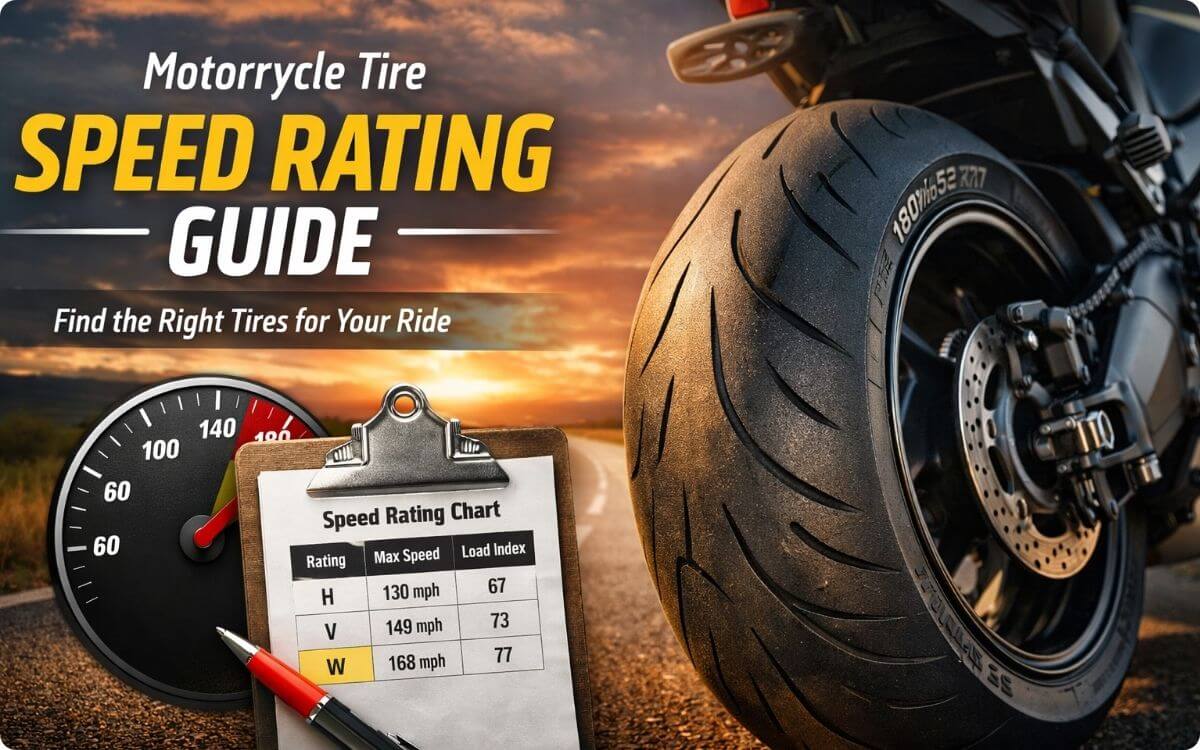
In this guide, you’ll find a clear, easy-to-read speed rating chart, simple explanations of each letter, and practical advice to help you choose the right tire for your riding style. Whether you commute daily, tour long distances, or ride a sport bike, this breakdown will help you buy with confidence — and ride safely.
Motorcycle Tire Speed Rating Chart (Complete Reference)
| Speed Rating | Maximum Speed (mph) | Maximum Speed (km/h) |
| B | 31 mph | 50 km/h |
| C | 37 mph | 60 km/h |
| D | 40 mph | 65 km/h |
| E | 43 mph | 70 km/h |
| F | 50 mph | 80 km/h |
| G | 56 mph | 90 km/h |
| J | 62 mph | 100 km/h |
| K | 68 mph | 110 km/h |
| L | 75 mph | 120 km/h |
| M | 81 mph | 130 km/h |
| N | 87 mph | 140 km/h |
| P | 93 mph | 150 km/h |
| Q | 99 mph | 160 km/h |
| R | 106 mph | 170 km/h |
| S | 112 mph | 180 km/h |
| T | 118 mph | 190 km/h |
| U | 124 mph | 200 km/h |
| H | 130 mph | 210 km/h |
| V | 149 mph | 240 km/h |
| ZR | 149+ mph | 240+ km/h |
| W | 168 mph | 270 km/h |
| (W) | 168+ mph | 270+ km/h |
| Y | 186 mph | 300 km/h |
| (Y) | 186+ mph | 300+ km/h |
What Is a Motorcycle Tire Speed Rating?
A motorcycle tire speed rating is a single letter stamped on the tire sidewall that tells you the maximum sustained speed the tire is built to handle safely. It’s a capability marker — not a promise that your bike will or should go that fast.
Speed ratings are mainly about heat resistance. Tires heat up as they roll; higher sustained speeds create more heat. A higher rating means the tire’s materials and construction were tested to resist that ongoing heat without failing.
Manufacturers test tires by running them at specific speeds while carrying a defined load for a set time. Those tests check how the tire handles continuous stress — load plus speed — rather than a one-off burst. That’s why the rating combines both speed capability and the tire’s load-handling behavior.
Keep in mind: a speed rating isn’t the same as grip, braking, or overall tire quality. Road surface, inflation, weight (rider + luggage), and tire wear all affect safety far more than the letter alone. Also, higher-rated tires can cost more even if your riding never approaches those speeds.
Major tire makers like Michelin and Bridgestone base their guidance on international testing standards such as those from the International Organization for Standardization, so matching or exceeding your bike’s OEM rating is the safest, simplest rule of thumb.
Where to Find the Speed Rating on Your Motorcycle Tire
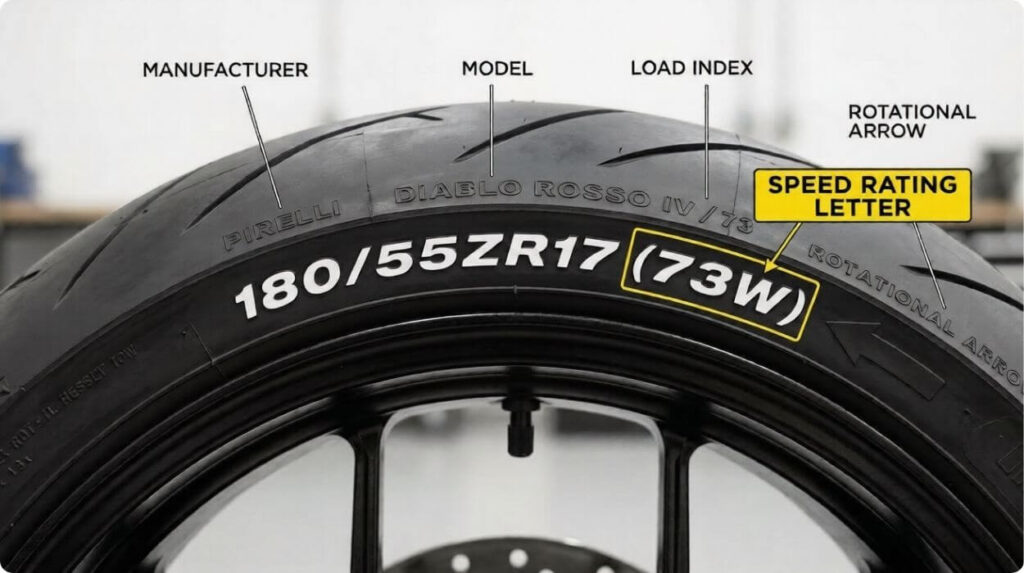
Finding the speed rating on your motorcycle tire is usually quick once you know what to look for. Check the sidewall — the long line of numbers and letters near the rim — and you’ll spot the speed letter near the end of that string.
Example tire marking: 180/55ZR17 (73W)
Breakdown of each part (plain language):
- 180 — the tire’s width in millimetres (how wide the tyre is across).
- 55 — the aspect ratio (the height of the sidewall as a percentage of the width).
- ZR — construction + high-speed category (R = radial construction; Z indicates high-speed capability in older notation).
- 17 — rim diameter in inches (the wheel size the tire fits).
- (73W) — inside the parentheses is the load index and the speed rating. 73 is the load index (how much weight the tire can carry). W is the speed rating letter — that single letter is what tells you the tire’s maximum sustained speed capability.
Where the speed rating letter sits on the sidewall:
- Usually it appears right after the load index, often in parentheses, or separated by a space (for example 73W or (73W)).
- On some tires you’ll also see a Z earlier (as in 180/55ZR17) — that Z is an older style indicator for higher-speed tires, but the definitive speed letter is the one after the load index (W in our example).
- Manufacturers sometimes print the rating in different spots or smaller type, so rotate the wheel and inspect the whole sidewall.
Does a Higher Speed Rating Mean a Better Tire?
Many riders assume a higher speed rating automatically means a better tire. That’s not really true.
A higher speed rating mainly means the tire can handle more heat at higher sustained speeds. The construction is designed to stay stable when the tire spins very fast for a long time.
But that doesn’t automatically mean better grip. Grip depends on rubber compound, tread design, road conditions, and temperature. A lower-rated touring tire can sometimes offer excellent grip for everyday riding.
Higher-rated tires also tend to cost more. You’re paying for added performance capability that you may never actually use. For some riders, that extra money brings no real benefit.
Speed ratings are designed for specific performance ranges. A sport bike that can reach 180 mph needs tires built to handle that stress. A cruiser that tops out at 110 mph simply doesn’t put the same demand on its tires.
For example, if you ride a cruiser that realistically won’t go past 110 mph, installing a very high speed-rated tire won’t suddenly make it handle better. It just means the tire can survive speeds your bike will never reach.
On the other hand, putting a low-rated tire on a 180 mph sport bike would be unsafe. That’s where speed rating truly matters.
The key is matching the tire to the motorcycle and how you actually ride — not just choosing the highest letter on the chart.
Can You Use a Lower Speed Rating Than OEM?
Using a tire with a lower speed rating than your motorcycle’s original equipment (OEM) is risky. Those tires aren’t built to handle the heat and stress your bike may produce at higher speeds, even if you rarely reach them. Over time, this can increase the chance of tire failure.
There can also be warranty issues. Many manufacturers require replacement tires to meet or exceed the OEM speed rating. Installing a lower-rated tire might void parts of your bike’s warranty if a problem is linked to the tires.
Insurance and legal concerns are another factor. Some regions require tires to meet the OEM speed and load ratings. If you get into an accident and your tires are below spec, your coverage could be affected. The National Highway Traffic Safety Administration emphasizes following manufacturer-recommended tire specifications for safety compliance.
For these reasons, it’s generally safest to match or exceed the OEM speed rating. Doing so ensures the tires can handle your bike’s performance, keeps you covered under warranty, and aligns with legal and safety standards. Even if a lower-rated tire seems cheaper, the potential risks usually outweigh the savings.
Speed Rating vs Load Index (Don’t Confuse Them)
It’s easy to mix up a tire’s speed rating and load index, but they mean very different things. The speed rating tells you the maximum speed the tire can handle safely over time. The load index shows how much weight the tire can carry. Both are important for safe riding.
Here’s a simple comparison:
| Feature | Speed Rating | Load Index |
| What it measures | Maximum safe speed | Maximum weight tire can carry |
| How it’s shown | Letter (e.g., W, H) | Number (e.g., 73, 77) |
| Why it matters | Prevents overheating at high speeds | Supports rider, passenger, and cargo safely |
Even if a tire has a high speed rating, it can fail if overloaded. Likewise, a tire with the correct load index but too low of a speed rating might overheat on the highway. Checking both ensures your tires match your motorcycle and your riding conditions, keeping you safe and prolonging tire life.
Real-World Factors That Affect Speed Rating Safety
Even if a tire has a high speed rating, real-world conditions can change how safely it performs. One of the biggest factors is underinflation. Tires that aren’t pumped up to the recommended pressure heat up faster and handle loads poorly, which reduces the margin for safe riding at higher speeds.
Carrying extra luggage or a passenger adds weight, which increases stress on the tire. More weight generates extra heat, especially on long rides, and can make a tire reach its limit faster than expected.
Hot weather is another factor. High ambient temperatures raise the tire’s surface temperature, which can push it closer to its safe operating limit, even at moderate speeds.
Finally, long highway rides put constant stress on tires. Continuous high-speed rotation builds heat over time, and some tires can degrade faster under sustained loads.
By understanding these real-world factors, riders can better gauge when a tire is operating safely and avoid surprises. Simple steps like checking tire pressure, not overloading, and taking breaks on long rides make a big difference.
How to Choose the Right Speed Rating for Your Motorcycle
- Check your owner’s manual first — it lists the OEM speed and load ratings your bike was designed for. Use that as the baseline.
- Match or exceed the OEM speed rating. Don’t fit a lower-rated tire; it can overheat or fail under stress.
- Think about how you ride. If you commute and stay below highway speeds, OEM-level ratings are usually fine. Sport riders who push high speeds should choose higher-rated tires that also prioritize grip.
- Touring riders carrying luggage or a passenger should pick a rating that safely handles the extra heat and load — and verify the load index too.
- Keep front and rear ratings compatible. Mixing wildly different ratings can change handling and stability.
- Don’t overpay for a rating you won’t use. Higher ratings cost more; only upgrade if your bike’s performance or riding needs justify it.
Common Mistakes Riders Make
Here are some common mistakes riders make when it comes to motorcycle tires:
- Assuming ZR means unlimited speed – ZR only indicates the tire is designed for higher speeds, not that it can go infinitely fast. Relying on it for extreme speeds is unsafe.
- Mixing different ratings front and rear – Using mismatched speed ratings can affect handling, stability, and overall ride safety.
- Downgrading to save money – Choosing a lower-rated tire may seem cheaper, but it increases the risk of overheating or tire failure.
- Ignoring the load index – Even with the right speed rating, a tire that can’t handle your bike’s weight, plus rider and luggage, is unsafe.
- Thinking a higher rating means longer lifespan – Speed rating reflects heat and stress resistance, not durability. A high-rated tire can wear out just as fast as a lower-rated one depending on use.
Frequently Asked Questions
What does ZR mean on motorcycle tires?
ZR indicates a high-speed tire, originally meant for motorcycles capable of speeds over 149 mph (240 km/h). It does not mean the tire can handle unlimited speed. Always check the specific speed rating letter after the load index for the exact limit.
Is V rating enough for highway riding?
Yes, a V-rated tire is rated for up to 149 mph (240 km/h), which covers typical highway speeds for most motorcycles. Make sure it also matches your bike’s load requirements.
Can I mix V and W rated tires?
Mixing different speed ratings front and rear is not recommended. It can affect handling and stability, especially during high-speed riding or emergency maneuvers. Always try to match the front and rear ratings.
Does speed rating affect insurance?
It can. Some insurance policies require tires to meet OEM speed and load ratings. Using a lower-rated tire may impact coverage if an accident occurs. Always follow manufacturer specifications.
Do speed ratings apply to wet conditions?
Speed ratings are based on dry, controlled testing conditions. Wet roads can reduce traction and increase risk, so always ride cautiously in rain, regardless of tire rating.
Can I go slower than the rated speed safely?
Yes. A tire can handle speeds below its rating safely. The rating is the maximum sustained speed, not a minimum requirement. Riding slower does not harm the tire.
Conclusion
When buying new tires, always make sure they meet or exceed your bike’s OEM minimum speed rating. Safety should come before saving a few dollars — a lower-rated tire may seem cheaper but can fail under stress.
Remember, the speed rating is about the tire’s ability to handle heat and sustained speeds, not just how fast your bike can go. Using the chart above helps you quickly check which tires are appropriate for your motorcycle.
Before ordering new tires, double-check your sidewall and compare it with the Motorcycle Tire Speed Rating Chart above. This simple step ensures you choose tires that are safe, reliable, and suited to your riding style.
