Toyota 4Runner Lug Nut Torque Specs by Year (1996–2026)
Toyota 4Runner lug nut torque specifications vary by model year and wheel type. Many older models use a specification of 110 N·m (83 ft-lb), while later models have separate torque requirements for steel and aluminum wheels.
For 2015–2024 4Runner models, Toyota specifies 83 ft-lb for steel wheels and 76 ft-lb for aluminum wheels. The 2025–2026 models use 154 ft-lb for the applicable steel-wheel configuration and 97 ft-lb for aluminum wheels.
Use the correct specification for your exact model year and installed wheel. The torque value, lug nut seat, and fastener compatibility must all be correct for a safe installation.
Toyota 4Runner Lug Nut Torque: Quick Answer
Here are the main Toyota 4Runner wheel nut torque specifications:
- 1996–2009: 110 N·m (83 ft-lb) in representative Toyota manuals reviewed.
- 2010–2011: 83 ft-lb (110 N·m), according to the identified owner’s manuals.
- 2012–2014: 81 ft-lb (110 N·m), according to the identified owner’s manuals.
- 2015–2024 steel wheels: 83 ft-lb (112 N·m).
- 2015–2024 aluminum wheels: 76 ft-lb (103 N·m).
- 2025–2026 steel wheels: 154 ft-lb (209 N·m) for the applicable steel-wheel configuration.
- 2025–2026 aluminum wheels: 97 ft-lb (131 N·m).
Important: Toyota’s published values are not identical across all model years. Check the owner’s manual for your specific 4Runner before tightening the wheel nuts. If you have aftermarket wheels, also follow the wheel manufacturer’s hardware and installation instructions.
Toyota 4Runner Lug Nut Torque Chart (1996–2026)
| Model year | Wheel type | Torque specification |
|---|---|---|
| 1996–2009 | Factory wheels | 110 N·m (83 ft-lb)* |
| 2010–2011 | Factory wheels | 83 ft-lb (110 N·m) |
| 2012–2014 | Factory wheels | 81 ft-lb (110 N·m) |
| 2015–2024 | Steel wheels | 83 ft-lb (112 N·m) |
| 2015–2024 | Aluminum wheels | 76 ft-lb (103 N·m) |
| 2025–2026 | Applicable steel-wheel configuration | 154 ft-lb (209 N·m) |
| 2025–2026 | Aluminum wheels | 97 ft-lb (131 N·m) |
The 1996–2009 figure is based on representative Toyota manual evidence. It should not be interpreted as an independent verification of every annual manual in this range.
Important note about 2010–2013 torque specifications
There is a difference between some Toyota owner’s manual values and Toyota’s tire rotation technical-tip chart.
The identified owner’s manuals list:
- 2010–2011: 83 ft-lb (110 N·m)
- 2012–2013: 81 ft-lb (110 N·m)
However, Toyota’s 2013 Tire Rotation Quick Reference Chart, document T-TT-0124-11, lists 82 ft-lb (112 N·m) for 2010–2013 4Runner models.
These figures should not be averaged or treated as interchangeable. Use the specification in the owner’s manual applicable to your vehicle. When the vehicle’s service documentation or wheel configuration creates uncertainty, confirm the correct procedure with Toyota service information or a Toyota dealer.
The technical tip also lists a 21 mm lug nut size for the 2010–2013 4Runner. This refers to the wrench or hex size, not the thread diameter.
You can review the Toyota Tire Rotation Technical Tip (PDF) for its chart and tightening recommendations.
Toyota 4Runner Lug Nut Torque by Generation
3rd Generation Toyota 4Runner (1996–2002)
Representative Toyota manual specifications for the 3rd-generation 4Runner list wheel nut torque at 110 N·m (83 ft-lb).
This is the working reference value for this generation based on the manuals reviewed. Check the exact model-year manual before installation rather than assuming every annual publication has been independently verified.
4th Generation Toyota 4Runner (2003–2009)
Representative 4th-generation owner’s manuals also list 110 N·m (83 ft-lb).
The 2003 and 2004 manuals reviewed support this figure. The same general specification is used as the working reference for 2005–2009, but the exact year’s manual remains the final reference.
5th Generation Toyota 4Runner (2010–2024)
The 5th generation requires attention to changes in the printed specifications.
For 2010–2011, the identified manuals list 83 ft-lb (110 N·m). For 2012–2014, the manuals list 81 ft-lb (110 N·m).
From 2015 through 2024, Toyota distinguishes between steel and aluminum wheels:
- Steel wheels: 83 ft-lb (112 N·m)
- Aluminum wheels: 76 ft-lb (103 N·m)
Do not apply the steel-wheel torque to an aluminum wheel simply because both fit the same vehicle.
6th Generation Toyota 4Runner (2025–2026)
The 2025–2026 4Runner uses a different set of specifications:
- Applicable steel-wheel configuration: 154 ft-lb (209 N·m)
- Aluminum wheels: 97 ft-lb (131 N·m)
Toyota’s manual also identifies the steel replacement wheel, including the compact spare in the relevant replacement procedure. The 154 ft-lb figure must not be treated as a universal torque specification for every aftermarket steel wheel.
Steel Wheels vs. Aluminum Wheels: Why Torque Specs Differ
Toyota publishes different wheel nut torque values for certain steel and aluminum wheel configurations. The correct value is determined by the vehicle and wheel application, not by a general rule about wheel material.
2015–2024 Toyota 4Runner
| Wheel type | Torque |
|---|---|
| Steel | 83 ft-lb (112 N·m) |
| Aluminum | 76 ft-lb (103 N·m) |
Toyota’s owner’s manuals also explain different wheel nut contact arrangements:
- When replacing an aluminum wheel with a steel wheel, the tapered portion of the nut contacts the steel disc wheel seat.
- When replacing an aluminum wheel with another aluminum wheel, the nut’s washer contacts the disc wheel.
This distinction matters when using a spare wheel or changing wheel types.
2025–2026 Toyota 4Runner
| Wheel type | Torque |
|---|---|
| Applicable steel-wheel configuration | 154 ft-lb (209 N·m) |
| Aluminum | 97 ft-lb (131 N·m) |
For the 2025–2026 generation, follow the wheel-specific contact instructions in the owner’s manual.
Toyota also offers accessory wheels with their own hardware requirements. For example, the instructions for a particular 2025 18-inch accessory alloy wheel require OE flat-seat lug nuts and explicitly prohibit conical-seat acorn lug nuts for that wheel.
This instruction applies to that specified accessory wheel. Do not automatically extend it to every factory or aftermarket 4Runner wheel.
OEM Wheels vs. Aftermarket Wheels
Factory Toyota wheels and aftermarket wheels may have different lug nut requirements.
Before installing aftermarket wheels, verify:
- Required thread diameter and pitch.
- Lug nut seat design and contact surface.
- Hex or socket size.
- Lug nut length and shank dimensions, where applicable.
- Required thread engagement.
- Wheel manufacturer’s tightening instructions.
A lug nut that threads onto a stud is not necessarily compatible with the wheel. Never assume that factory lug nuts will fit an aftermarket wheel correctly.
Toyota 4Runner Lug Nut Size, Thread Pitch, Socket Size and Seat Type
Correct fastener selection requires more than knowing the vehicle’s model year. Thread dimensions, hex size and wheel seat design must all be checked.
Thread Diameter and Pitch
Thread specifications describe the dimensions of the lug nut and wheel stud.
For example:
- M12 × 1.5 means a nominal 12 mm thread diameter and a 1.5 mm thread pitch.
- M14 × 1.5 means a nominal 14 mm thread diameter and a 1.5 mm thread pitch.
Secondary fitment catalogs commonly list M12 × 1.5 for pre-2025 Toyota 4Runner models. However, a complete Toyota primary-source dimensional verification for every model year and wheel application was not established during this research.
For 2025–2026 models, some aftermarket listings show M14 × 1.5, but the Toyota primary dimensional confirmation remains unresolved. Do not treat M14 × 1.5 as a confirmed universal OEM specification.
Before ordering replacement lug nuts, confirm the required thread specification through Toyota parts information for your exact vehicle or a qualified parts supplier.
Socket or Hex Size
A 21 mm socket is documented for particular Toyota 4Runner applications.
Toyota’s 2010–2013 tire rotation technical tip lists a 21 mm lug nut size. Toyota’s instructions for a specific 2025 accessory alloy wheel also specify a 21 mm lug nut wrench and a 21 mm deep-well socket.
However, replacement lug nuts and wheel locks may have different hex dimensions. Check the actual fastener before selecting a socket.
Use a securely fitting socket. A thin-wall socket may be necessary to avoid scratching the finish around an alloy wheel’s lug holes.
Lug Nut Seat Types
The seat is the surface where the lug nut contacts the wheel. It must match the wheel’s design.
Common designs include:
Conical seat: A tapered contact surface, commonly used with aftermarket wheels designed for a matching conical lug nut.
Flat seat with washer: A flat contact arrangement used by certain wheel and lug nut applications.
Mag-style seat: Some designs use a flat seating surface with an extended shank. The dimensions must match the wheel.
These seat designs are not interchangeable. A lug nut can have the correct thread pitch and still be unsuitable for a wheel if its seating surface does not match.
For aftermarket wheels, follow the wheel manufacturer’s hardware instructions. For Toyota factory or accessory wheels, use the applicable Toyota parts and installation information.
Toyota 4Runner Lug Nut Tightening Pattern: Six-Lug Star Pattern
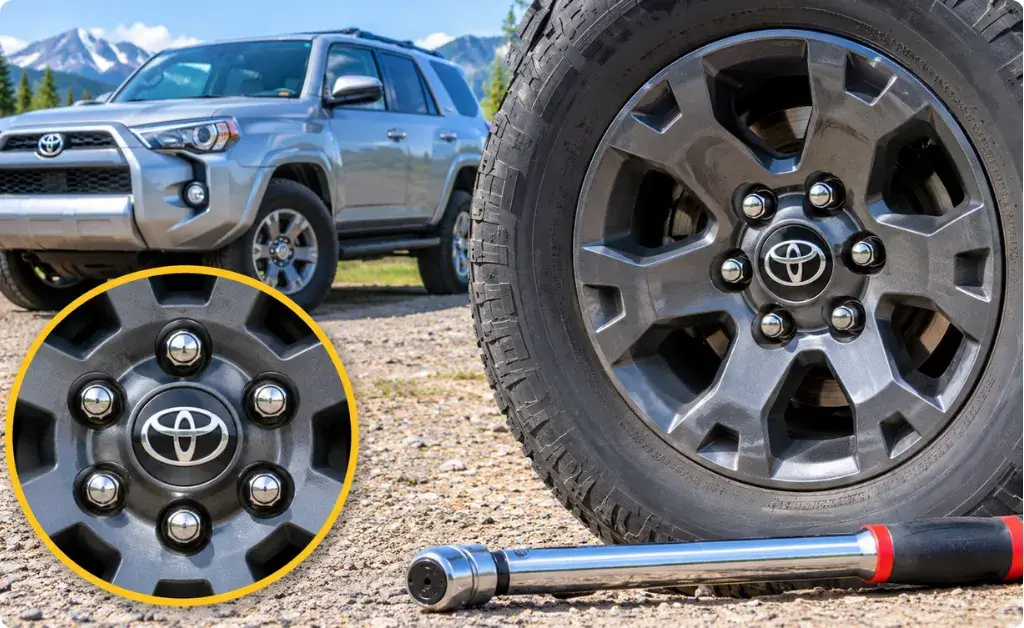
Toyota 4Runner wheels use six lug nuts. Tighten them in the crosswise or star sequence illustrated in the applicable owner’s manual.
Toyota’s 2016 and 2024 manuals instruct owners to tighten each wheel nut two or three times in the illustrated order.
The important points are:
- Follow the numbered order shown in the vehicle’s manual.
- Move between opposing areas of the wheel rather than tightening adjacent nuts consecutively.
- Repeat the specified sequence for the required tightening passes.
- Use the correct torque specification for the installed wheel.
Do not label the six nut positions clockwise and then assume that order is the correct tightening sequence. Use the actual six-lug diagram in the applicable manual.
For the specific 2025 accessory alloy wheel installation mentioned earlier, Toyota specifies its own A1–A6 sequence. Follow that document when installing that accessory wheel.
How to Tighten Toyota 4Runner Lug Nuts Correctly
The following is a general overview of wheel installation. Use the jack points, lifting procedure and safety instructions in your exact model-year owner’s manual.
1. Park and Secure the Vehicle
Park on firm, level ground. Apply the parking brake, select Park or the appropriate gear, and use wheel chocks where appropriate.
Do not attempt a wheel change in an unsafe roadside location or on unstable ground.
2. Loosen the Wheel Nuts Before Raising the Vehicle
While the tire is still on the ground, loosen each lug nut slightly. Do not remove them completely.
Use the wrench and procedure specified in the owner’s manual.
3. Raise the Vehicle at the Correct Jack Point
Use only the jack location and lifting instructions specified for your 4Runner. Never put any part of your body under a vehicle supported only by a jack.
Raise the vehicle only enough to remove the wheel safely.
4. Remove the Wheel and Inspect the Hardware
Remove the lug nuts and wheel. Inspect:
- Wheel studs and threads.
- Lug nut threads and seating surfaces.
- Wheel mounting holes.
- Wheel-to-hub contact surfaces.
Remove dirt and foreign material from the mounting surfaces. Toyota warns that foreign matter between the wheel and its contact surface can cause the wheel nuts to loosen.
Do not reuse damaged or visibly deformed fasteners.
5. Install the Wheel and Hand-Start the Lug Nuts
Position the wheel correctly against the hub. Start all lug nuts by hand and make sure they thread smoothly.
Do not force a nut that will not engage correctly. Check for damaged threads or incorrect fastener dimensions.
Confirm that the lug nut seat matches the wheel before tightening.
6. Follow the Six-Lug Tightening Sequence
Tighten the lug nuts in the crosswise sequence illustrated in the applicable Toyota manual.
Toyota specifies two or three tightening passes in the illustrated order in the 2016 and 2024 manuals.
7. Lower the Vehicle and Complete Tightening
Follow the lowering and tightening procedure in the owner’s manual. Use a calibrated torque wrench to verify the final torque as soon as possible after the wheel change.
Apply the specification for the exact vehicle and wheel combination. Do not estimate torque by feel or use an impact wrench as a substitute for final torque measurement.
8. Complete the Post-Installation Checks
Make sure the wheel sits correctly and all required lug nuts are installed and tightened.
Follow the applicable owner’s manual for post-installation torque checks. The 2025–2026 manual specifically instructs owners to retighten the wheel nuts within 100 miles (160 km) of driving after replacing a tire. Do not automatically apply this interval to every earlier 4Runner.
Related Post: Toyota 4Runner Tire Pressure: PSI Chart by Year
Common Toyota 4Runner Lug Nut Problems and Installation Mistakes
Using the Wrong Torque
Applying one torque value to every model year or wheel type can result in incorrect tightening. Check the torque chart and exact owner’s manual before installation.
Using an Incompatible Lug Nut Seat
A conical nut, flat-seat nut and mag-style nut are not interchangeable. The seat must match the wheel’s contact surface.
Cross-Threading
A lug nut should engage smoothly by hand. Forcing it onto a stud can damage the threads and prevent correct clamping.
Dirty Wheel Mounting Surfaces
Dirt, corrosion or other foreign material between the wheel and hub can interfere with proper seating. Clean and inspect the contact surfaces before installation.
Over-Tightening or Under-Tightening
Under-tightened wheel nuts may loosen during driving. Excessive tightening can damage wheel studs, nuts or wheel mounting surfaces.
Use a torque wrench rather than guessing the tightening force.
Using an Impact Wrench for Final Torque
Toyota’s tire rotation technical tip recommends using a manual torque wrench or torque stick for final tightening, not an impact tool.
Follow the applicable wheel manufacturer’s instructions for any permitted use of power tools.
Ignoring Damaged Wheel Hardware
Do not reinstall damaged studs, stripped lug nuts or cracked or deformed wheel mounting holes. Toyota advises having these components inspected by a Toyota dealer.
Applying Oil or Grease to Wheel Threads
Toyota specifically warns against using oil or grease on wheel bolts or wheel nuts. Lubrication can cause excessive tightening and damage the bolts or disc wheel.
Keep the threads free of oil and grease unless the applicable manufacturer instructions explicitly specify otherwise.
Related Topic: Toyota 4Runner Tire Size: Chart by Year
Frequently Asked Questions
What is the lug nut torque for a Toyota 4Runner?
It depends on the model year and wheel type. For example, 2015–2024 steel wheels use 83 ft-lb (112 N·m), while aluminum wheels use 76 ft-lb (103 N·m). The 2025–2026 models have separate steel- and aluminum-wheel specifications.
Are all Toyota 4Runner models tightened to 83 ft-lb?
No. Some older models use a printed specification of 83 ft-lb, while 2012–2014 owner’s manuals list 81 ft-lb. The 2015–2024 models also distinguish between steel and aluminum wheels.
What is the torque for a 2025 or 2026 Toyota 4Runner?
The owner’s manuals list 97 ft-lb (131 N·m) for aluminum wheels and 154 ft-lb (209 N·m) for the applicable steel-wheel configuration.
What size socket does a Toyota 4Runner use?
A 21 mm socket is documented for several applications, including Toyota’s 2010–2013 tire rotation reference and a specific 2025 accessory alloy wheel. Replacement lug nuts and wheel locks can have different hex sizes, so check the actual fastener.
What is the Toyota 4Runner lug nut thread pitch?
M12 × 1.5 is commonly listed by secondary fitment catalogs for pre-2025 4Runner models, but a complete year-by-year Toyota OEM dimensional verification was not established here. The 2025–2026 thread specification also requires primary-source confirmation. Verify the exact fastener before purchasing.
Can I use aftermarket lug nuts on a Toyota 4Runner?
Yes, when they are compatible with the vehicle’s studs and the installed wheel. Confirm the thread, seat design, hex size, length and required thread engagement. Follow the wheel manufacturer’s instructions.
Should I retighten the lug nuts after changing a tire?
Follow the instructions for your model year. Toyota’s 2025–2026 manual specifies retightening within 100 miles (160 km). Other manuals instruct owners to have the wheel nuts checked with a torque wrench as soon as possible after a wheel change.
Can I use grease or anti-seize on the wheel studs?
Toyota warns against using oil or grease on wheel bolts or wheel nuts. Keep the fastener threads free of lubricant unless the applicable manufacturer instructions specifically require it.
Important Safety Disclaimer
Toyota 4Runner lug nut torque specifications can vary by model year and wheel configuration. This guide is a general reference and does not replace the owner’s manual, Toyota service information or aftermarket wheel installation instructions.
Before installing or tightening a wheel, verify the correct torque, fastener dimensions and seat compatibility. Inspect the studs, lug nuts and wheel mounting surfaces for damage, and use a properly functioning torque wrench for final torque verification.
If a lug nut will not thread smoothly, a wheel will not seat correctly, or any stud, nut or wheel mounting hole is damaged, stop the installation and have the components inspected by a qualified technician.
Always follow the instructions for your exact Toyota 4Runner and installed wheel combination.
