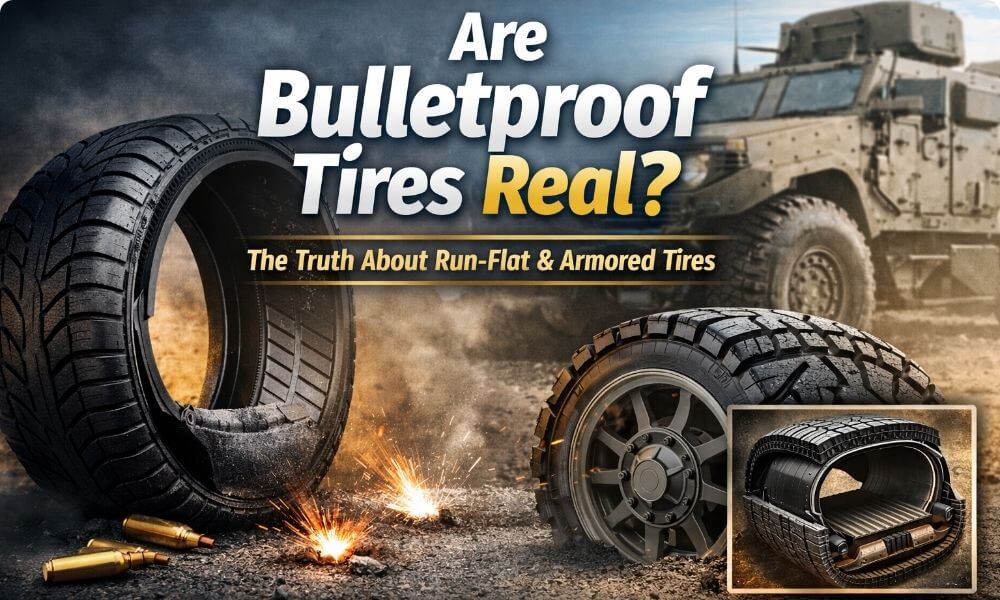
Are Bulletproof Tires Real?
You have probably heard the phrase “bulletproof tires” in movies, TV shows, or online ads. It sounds impressive, and it raises a simple question: are bulletproof tires real?
The honest answer is: not in the way most people imagine. There is no normal rubber tire that is completely immune to bullets. What does exist are tires and wheel systems designed to help a vehicle keep moving after damage. These include run-flat tires, self-sealing tires, and armored tire systems used on security or military vehicles.
This article explains what people really mean by bulletproof tires, what is actually available, how these systems work, and whether they are worth considering. By the end, you will know the difference between marketing hype and real-world tire technology.
What Are “Bulletproof Tires”?
When people say “bulletproof tires,” they usually mean tires that won’t fail even if they get damaged. Some imagine a tire that a bullet simply cannot go through. Others think it means a tire that lets you keep driving no matter what happens.
In simple terms, it sounds like a tire that is impossible to break.
But that’s not really how tires work.
Tires are made from rubber and flexible materials. That makes them strong, but not invincible. If something sharp or powerful hits them, they can still be damaged. So the idea of a completely “bulletproof” tire is not realistic for normal vehicles.
What people are actually referring to are stronger, smarter tire systems. These tires are designed to handle damage better than regular ones. For example, some can still support the car for a short distance even after losing air. Others can deal with small punctures without going flat right away.
The confusion comes from the name. “Bulletproof” sounds absolute, like nothing can harm it. In reality, these tires don’t prevent damage—they help you stay in control after it happens.
A better way to think about it is this:
they are not damage-proof, they are damage-tolerant.
That small difference makes a big impact on what you should expect from them.
The Truth: Do Bulletproof Tires Actually Exist?
The short answer is simple: no tire is completely bulletproof.
A tire can be made stronger, thicker, and more durable—but it can still be damaged. Rubber, no matter how advanced, cannot fully stop something like a bullet in every situation.
What does exist are tires and systems designed to handle damage better. Instead of preventing damage, they help you stay on the road after something goes wrong.
For example, run-flat tires are built so you can keep driving for a short distance even after losing air. This gives you time to reach a safe place instead of stopping immediately.
Self-sealing tires work differently. They can close small holes caused by things like nails, which helps prevent sudden air loss. But they are not made for serious damage.
Then there are armored tire systems, mostly used in security or military vehicles. These are much more advanced and can keep a vehicle moving even after heavy damage. They are effective, but also expensive and not meant for everyday use.
Each of these options solves a specific problem, but none of them make a tire truly bulletproof.
Here’s the key idea to remember:
They don’t stop damage—they help you keep driving after damage.
That’s what really matters in real-world driving.
Types of Tires That Are Often Called “Bulletproof”
1. Run-Flat Tires
Run-flat tires are probably the most common product people confuse with bulletproof tires. They are built with reinforced sidewalls that support the weight of the vehicle even when the tire has lost air.
That means if you get a puncture, you may still be able to drive to a repair shop instead of stopping on the side of the road. This can be especially helpful in bad weather, on busy roads, or in places where pulling over is unsafe.
Run-flat tires are not perfect, though. They usually offer only a limited driving range after a puncture, and they often ride a little firmer than standard tires. They also cost more in many cases. Still, for many everyday drivers, they are the most practical option in this category.
2. Self-Sealing Tires
Self-sealing tires are designed with a special layer inside the tire that helps close small punctures. If a nail or similar object makes a small hole, the sealant layer may help stop air from escaping quickly.
These tires can be a helpful safety feature, but they are not built for large damage. They are not meant to handle bullets, deep cuts, or serious sidewall injury. They work best for small punctures that happen during normal driving.
For many drivers, self-sealing tires offer a quiet kind of peace of mind. You may never notice the small puncture at all. But they are still limited, and they should not be mistaken for heavy-duty protection.
3. Armored or Military-Grade Tire Systems
This is the category closest to what people imagine when they hear “bulletproof tires.” Armored vehicles often use specially reinforced wheel and tire systems that can keep the vehicle moving even after severe damage.
These systems may include internal support rings or inserts that hold the vehicle up when the tire is destroyed. In some cases, the wheel itself is part of the protection system. These setups are much more advanced than regular run-flat tires, but they are also much more expensive and specialized.
You will usually find these systems on military vehicles, armored transport vehicles, or high-security vehicles. They are not common for everyday drivers, and for good reason. They are designed for extreme situations, not normal commuting.
4. Airless (Non-Pneumatic) Tires
Airless tires are a newer type of tire technology that does not rely on air pressure. Because they do not hold air, they cannot go flat in the usual way.
This makes them interesting from a durability point of view. They may be useful in certain work vehicles, off-road use, or future transportation designs. However, they are still not the same as bulletproof tires. A strong impact can still damage them, and they are not widely used in regular passenger cars yet.
They are promising, but they are not the answer for someone looking for a true bulletproof tire today.
How Bullet-Resistant Tires Actually Work
A bullet-resistant tire is not made to stop every bullet. Its main job is to help the vehicle keep moving after the tire is damaged. In simple terms, it is built to hold its shape long enough for the driver to get to safety.
One common design uses stronger sidewalls. The sidewalls are the outer edges of the tire, and they are the part that helps support the vehicle when air starts leaking out. In a normal tire, once the air is gone, the tire can collapse quickly. A stronger sidewall slows that down.
Some tires also use an internal support ring. This is a hard structure inside the tire that helps carry the vehicle’s weight if the tire loses air. Think of it like a backup support system. Even if the tire is badly damaged, the wheel can still keep turning for a short time.
A few tires also have self-sealing material inside them. If the damage is small, this material can close the hole by itself and reduce air loss. That can be useful for small punctures, but it will not save every tire. Bigger damage still causes problems.
When a tire is hit by a bullet, the air usually escapes fast. The tire does not magically stay perfect. What makes these tires useful is that the reinforced design helps stop the tire from collapsing right away. That gives the driver a chance to keep control of the vehicle and move away from danger.
There are limits, though. These tires are not meant for endless driving after damage. In many cases, they can only be driven for a short distance, often around 50 to 100 kilometers, and usually at a lower speed than normal. The exact range depends on the tire type, the vehicle, and how badly it was damaged.
They also work better in some situations than others. A small puncture is one thing. Heavy damage, repeated shots, or severe road impact can still make the tire fail. So while these tires can add an important layer of protection, they are not a full solution.
Bulletproof vs Run-Flat vs Armored Tires
Here is a simple comparison to make the differences easier to see.
| Feature | Run-Flat Tires | Self-Sealing Tires | Armored Tire Systems |
| Handles bullets | Limited | No | Yes, to some extent |
| Keeps driving after damage | Yes | Sometimes | Yes |
| Best for | Everyday safety | Small punctures | Security and military use |
| Cost | Moderate | Low to moderate | Very high |
| Common on regular cars | Yes | Yes | No |
The most important thing to notice is that these are not all the same thing. A run-flat tire may help you drive after losing air, but it will not make your vehicle bulletproof. A self-sealing tire may stop a nail puncture, but it will not handle major damage. An armored tire system is built for much more serious conditions, but it is specialized and expensive.
Who Actually Needs These Tires?
These types of tires are not meant for everyone. They are built for very specific situations where safety risks are higher than normal.
For example, security professionals often rely on them. If someone is transporting valuable items or protecting important people, they can’t afford to stop because of tire damage. Being able to keep moving, even for a short distance, can make a big difference.
They are also used on government and military vehicles. In those environments, roads can be rough and situations can change quickly. Tires that can handle damage and still move are part of the overall safety setup.
Some high-risk individuals, like diplomats or people in sensitive roles, may also use vehicles with these systems. It’s not about comfort—it’s about reducing risk in uncertain situations.
For the average driver, though, this level of protection is usually unnecessary. Most people drive in normal conditions where a standard tire or a slightly upgraded option works just fine.
If your main concern is avoiding being stuck on the roadside, run-flat tires are often enough. They give you time to reach a safe place without the cost and complexity of more advanced systems.
It really comes down to your daily driving needs. For most people, simple and reliable is the better choice.
Pros and Cons of “Bulletproof” Tire Solutions
These advanced tire systems offer clear benefits, but they also come with trade-offs.
Advantages:
- You can keep driving after a puncture or damage
- Increased safety in emergencies
- Less chance of being stranded
Disadvantages:
- Higher cost than standard tires
- Heavier weight, which can affect fuel efficiency
- Stiffer ride quality (less comfort)
- Not truly immune to damage
Cost Breakdown: What Should You Expect?
Costs vary widely depending on the type of tire system.
Run-flat tires usually cost more than standard tires, but they are still within reach for many car owners. Self-sealing tires can also be a moderate upgrade depending on the vehicle and brand. Armored tire systems, on the other hand, can become very expensive very quickly, especially once installation and vehicle modifications are included.
There is also the hidden cost of maintenance. Some run-flat tires need specific wheels or tire pressure monitoring systems. Armored setups may require special service providers. Before buying any of these, it is worth thinking beyond the purchase price and looking at the long-term cost of ownership.
Are Bulletproof Tires Legal and Available to Buy?
In most places, the answer is yes, but with an important difference: what is legal and available depends on the type of tire system.
Run-flat and self-sealing tires are commonly sold for regular vehicles and are legal in many markets. Armored tire systems are usually available through specialized suppliers and are often installed on dedicated security or armored vehicles. They may require vehicle changes or professional fitting.
The bigger question is not whether they are legal, but whether they are practical for your situation. A legal product is not always a useful one.
What Should You Buy Instead?
For most drivers, the smartest choice is usually run-flat tires or another strong, reliable tire type rather than chasing the idea of a fully bulletproof tire. If your main concern is getting stranded after a puncture, run-flats may give you exactly what you need.
If you drive off-road or in rough conditions, you may want to look at reinforced all-terrain tires instead. If you need serious security protection, then an armored vehicle setup may be more appropriate than trying to upgrade only the tires.
The right choice depends on your real use case. Start with the problem you are trying to solve, not the most dramatic-sounding product name.
Common Myths About Bulletproof Tires
One common myth is that bulletproof tires cannot be damaged at all. That is not true. Even the strongest tire systems have limits.
Another myth is that luxury cars always come with bulletproof tires. They do not. Some luxury and performance vehicles may use run-flat tires, but that is different from being bulletproof.
People also sometimes believe these tires last longer than regular ones. That is not always the case. In some situations, they may wear differently or offer less comfort.
The biggest myth of all is that these tires make a vehicle completely safe. They do not. They are one part of a larger safety strategy, not a full solution.
FAQ
Are bulletproof tires really bulletproof?
No. The term is usually used loosely. Real products are designed to resist damage or help a vehicle keep moving after damage.
Can run-flat tires stop bullets?
No. Run-flat tires are made to support the vehicle after air loss, not to block bullets.
How far can you drive on a damaged tire?
That depends on the tire and vehicle, but run-flat tires usually allow a limited distance at reduced speed.
Are bulletproof tires worth it?
For most drivers, no. Run-flat or self-sealing tires are usually more practical. Armored systems make sense only in special cases.
Final Verdict
So, are bulletproof tires real? Not in the simple, movie-style way most people imagine. What is real is a range of tire technologies designed to help a vehicle stay mobile after damage.
If you are an average driver, the most useful options are usually run-flat or self-sealing tires. If you need serious protection for security or specialized work, armored systems may be worth exploring. But for most people, the best choice is not the most dramatic one. It is the one that fits your real needs, your budget, and your driving habits.
The phrase “bulletproof tires” sounds exciting, but the real value is in practical safety, not flashy marketing.
