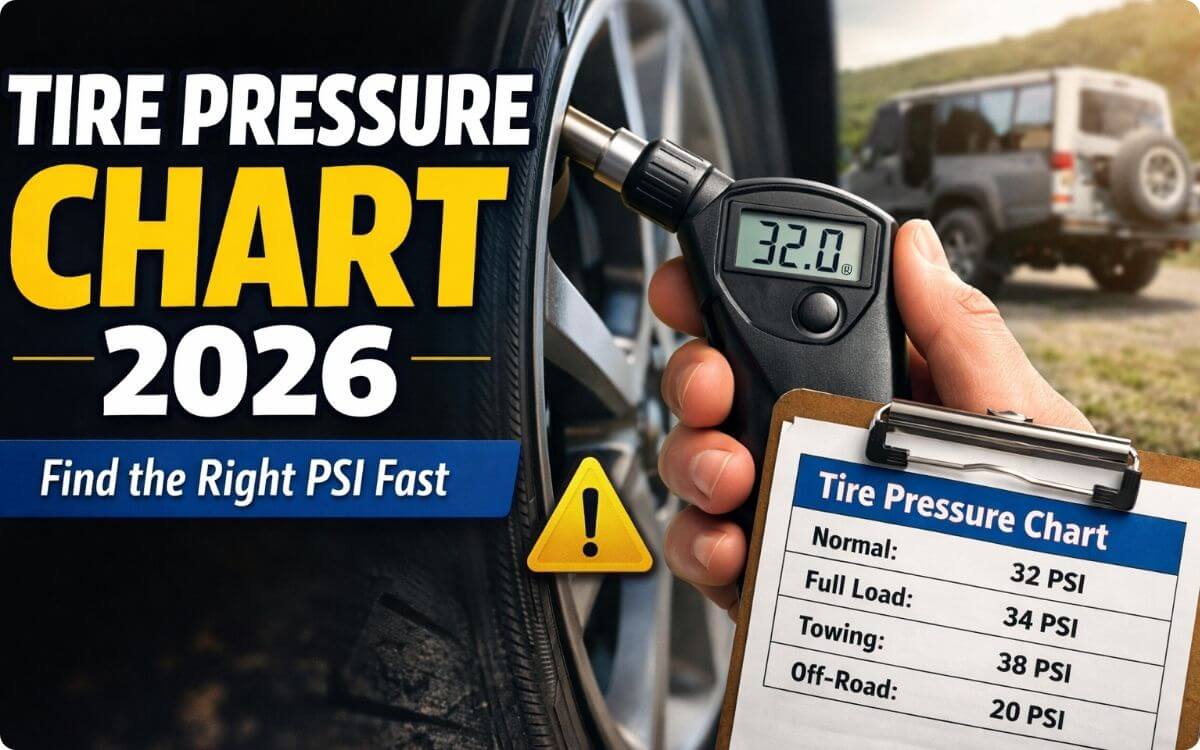
Tire Pressure Chart (PSI Guide for Cars, SUVs, Trucks & More)
Maintaining the correct tire pressure is one of the simplest ways to improve safety, fuel efficiency, and tire lifespan. If you’re looking for a clear, easy-to-use tire pressure chart, you’ll find multiple reference charts below — including vehicle type, seasonal adjustments, load conditions, and tire sidewall guidance.
⚠️ Important: Always confirm your exact PSI using the driver-side door jamb sticker or your owner’s manual. The charts below provide general guidance.
According to the National Highway Traffic Safety Administration, underinflated tires are a contributing factor in thousands of crashes each year and significantly reduce fuel economy. Proper inflation isn’t just maintenance — it’s safety.
Tire Pressure Chart (Most Common Vehicles)
Below is a general tire pressure chart for cold tires (vehicle parked at least 3 hours or driven less than 1 mile at low speed). This is designed for fast reference and satisfies users who want immediate PSI guidance.
⚠️ Always confirm with your driver-side door jamb sticker for exact specifications.
General Tire Pressure Chart (Cold Tires)
| Vehicle Type | Front Tires (PSI) | Rear Tires (PSI) | Notes |
| Compact Sedan | 30–33 | 30–33 | Ideal for daily commuting and city driving |
| Mid-Size Sedan | 32–35 | 32–35 | Most common passenger vehicle range |
| Full-Size Sedan | 32–36 | 32–36 | Slightly higher due to vehicle weight |
| Crossover (CUV) | 32–36 | 32–38 | May require slightly higher rear PSI |
| SUV (2-Row) | 32–38 | 32–40 | Heavier rear axle load |
| SUV (3-Row) | 35–40 | 35–42 | Increased passenger capacity |
| Minivan | 35–38 | 35–40 | Designed for full passenger loads |
| Pickup (Light Duty) | 35–45 | 35–45 | Varies by trim and tire rating |
| Pickup (Heavy Duty) | 40–60 | 45–80 | Load and towing dependent |
Seasonal Tire Pressure Chart (Temperature-Based PSI Guide)
Tire pressure changes with temperature. As it gets colder, PSI drops.
Rule of thumb:
For every 10°F decrease, tire pressure drops by about 1 PSI.
Cold Weather PSI Adjustment Chart
| Temperature Drop | PSI Change |
| 10°F decrease | –1 PSI |
| 20°F decrease | –2 PSI |
| 30°F decrease | –3 PSI |
| 40°F decrease | –4 PSI |
| 10°F increase | +1 PSI |
Example:
If your recommended PSI is 35 and the temperature drops 20°F overnight, your tires may now read 33 PSI.
Manufacturers such as Michelin recommend checking pressure monthly in colder seasons due to these fluctuations.
Tire Pressure by Tire Size (Sidewall Chart Explanation)
The PSI printed on your tire sidewall shows the maximum pressure the tire can safely hold, not the recommended pressure for your vehicle.
Always follow the recommended PSI on your driver-side door sticker.
Sidewall vs. Recommended PSI Chart
| Tire Type | Max PSI (Sidewall) | Recommended PSI (Vehicle) |
| Passenger Tire | 44–51 PSI | 30–35 PSI |
| Performance Tire | 50–51 PSI | 32–38 PSI |
| Light Truck (LT) | 65–80 PSI | 35–65 PSI (load dependent) |
| All-Terrain Tire | 50–80 PSI | 32–45 PSI |
Key takeaway:
Max PSI = safety limit.
Recommended PSI = optimal performance for your specific vehicle.
Tire Pressure Chart by Load Condition
Tire pressure may need adjustment depending on passengers, cargo, or towing. Always check your door jamb sticker for load-specific recommendations.
Load-Based Tire Pressure Chart
| Driving Condition | PSI Recommendation |
| Normal commuting | Follow manufacturer spec |
| Full passenger load | +2–3 PSI (if specified) |
| Heavy cargo (trunk/bed) | Increase per load chart |
| Towing trailer | Use towing PSI rating (often higher rear PSI) |
| Off-road (temporary use) | Adjust per terrain guidelines |
Important:
Never exceed the tire’s max PSI listed on the sidewall. For trucks and SUVs, manufacturers often provide separate load inflation charts for towing or hauling.
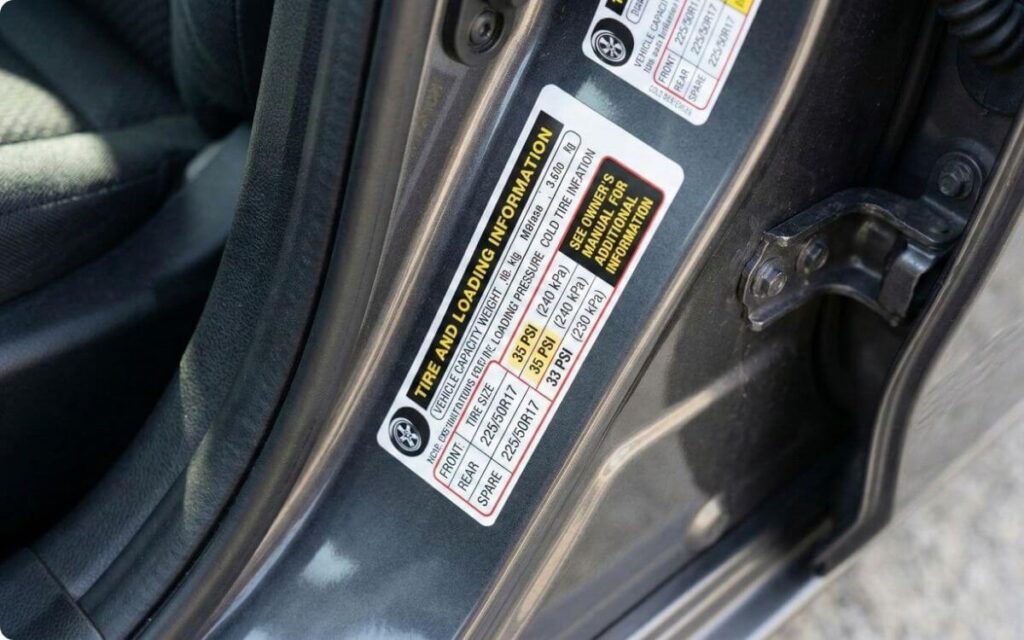
Where to Find Your Exact Tire Pressure (Before Using Any Chart)
Before using any tire pressure chart, check your vehicle’s official recommendation. It only takes a minute and gives you the exact number made for your car.
Driver-side door jamb sticker
Open the driver’s door and look at the frame where the door closes. You’ll see a small sticker with numbers listed for front and rear tires. This is the most accurate place to check. It’s made specifically for your vehicle model and trim.
Owner’s manual
If the sticker is missing or faded, the owner’s manual will list the correct tire pressure. The downside is that it can take a few minutes to find the right page, especially in older manuals.
Manufacturer website
Many car brands publish tire pressure information online. You’ll usually need your vehicle’s year, model, and trim. This is helpful if you bought the used car and don’t have the manual.
Inside the fuel door (some models)
A few vehicles place the tire pressure label inside the fuel door. Not all cars have this, so don’t worry if yours doesn’t.
How to Use a Tire Pressure Chart Correctly (Step-by-Step)
Using a tire pressure chart is simple, but a few small details make a big difference.
1. Check the pressure when the tires are cold.
Do this before driving or after the car has been parked for a few hours. Driving heats up the tires and can give you a higher reading than normal.
2. Use a digital tire gauge.
Remove the valve cap, press the gauge onto the valve, and read the number. Digital gauges are easier to read than the old stick-style ones, though they do need batteries.
3. Compare the number to your manufacturer’s PSI.
Look at your door sticker and match the front and rear numbers. Don’t rely only on the chart if your vehicle lists something different.
4. Adjust for weather or heavy loads if needed.
Cold weather can lower pressure. Carrying lots of passengers or cargo may require a small increase, depending on your vehicle’s guidance.
5. Recheck once a month.
Tires slowly lose air over time. A quick monthly check helps prevent uneven wear and keeps your car driving smoothly.
It only takes a few minutes, and it can save you money on fuel and tire replacements later.
Common Mistakes When Using a Tire Pressure Chart
Inflating to the tire’s max PSI (sidewall) — that’s a limit, not the recommended pressure.
Using the same PSI front and rear — many cars require different pressures.
Ignoring seasonal changes — cold air drops PSI; check more in winter.
Not adjusting for heavy loads or towing — extra weight often needs more air.
Checking pressure when tires are hot — wait until tires are cold for an accurate reading.
FAQs About Tire Pressure Charts
Is 40 PSI too high for my tires?
It depends on your vehicle. For most sedans, yes, but trucks and SUVs may need higher pressure. Always follow the manufacturer’s recommendation.
Should all four tires have the same PSI?
Not always. Many cars have slightly higher recommended PSI for the rear tires. Check your door sticker to be sure.
Does higher PSI improve gas mileage?
Slightly, but overinflating can make tires wear unevenly and reduce traction. Stick to the recommended numbers.
How often should I check tire pressure?
At least once a month and before long trips. Also check after major temperature changes.
Can I rely only on a tire pressure chart?
Charts are helpful, but your vehicle’s sticker and manual always take priority. Charts are general guidance, not exact numbers for your car.
Conclusion
Using a tire pressure chart helps keep your tires safe, last longer, and improve fuel efficiency. Always check your vehicle’s recommended PSI, adjust for weather or loads, and recheck monthly. Following these simple steps ensures a smoother, safer ride every time.
