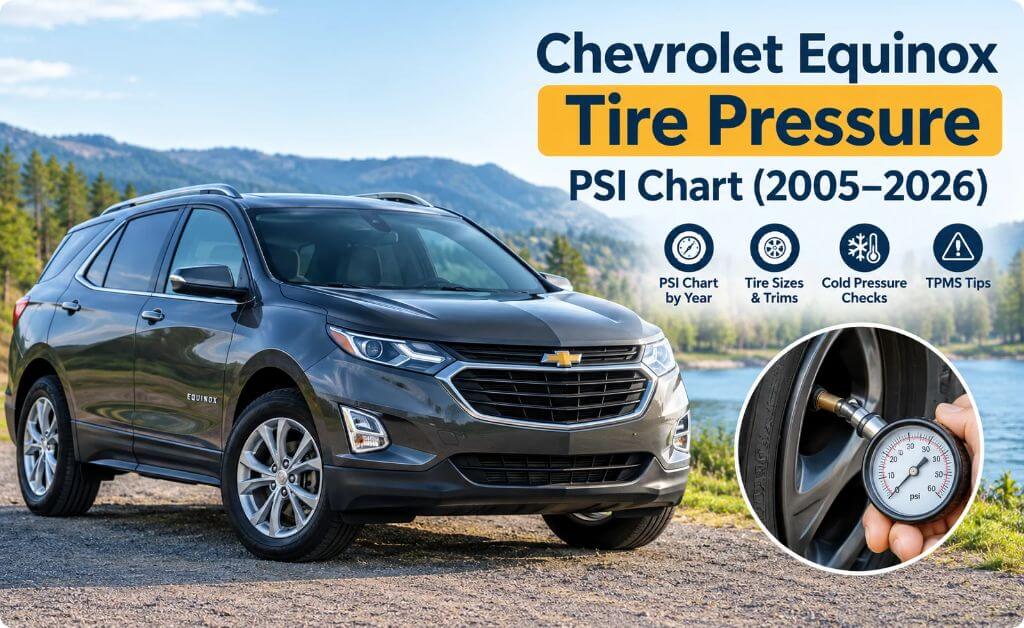
Chevrolet Equinox Tire Pressure: PSI Chart by Year (2005–2026)
The correct Chevrolet Equinox tire pressure depends on the model year, original tire size, trim, and vehicle configuration. Many Equinox tire-fitment references list 35 PSI for both front and rear tires, but that pressure does not apply to every configuration.
For example, a documented 2005 Equinox with P235/60R17 tires had a door-placard specification of 30 PSI, while some tire databases list 35 PSI for the same nominal size. Newer 235/65R17 fitment references also report 35–41 PSI, depending on the tire specification. NHTSA’s documented 2005 tire label and Michelin’s Equinox tire reference illustrate why a generic PSI figure should not automatically be applied to every vehicle.
This guide covers Chevrolet Equinox tire pressure from 2005 through 2026, common trim configurations, cold tire inflation, TPMS warnings, and spare-tire pressure. It focuses on the conventional gasoline-powered Equinox, not the separate Equinox EV.
Quick Answer: What Is the Correct Tire Pressure for a Chevrolet Equinox?
35 PSI is a common reference value for many Chevrolet Equinox configurations, but the correct pressure for your vehicle is the cold inflation pressure printed on its Tire and Loading Information label.
Use these guidelines:
- Check the driver’s door-jamb placard first. It specifies the recommended cold pressure for your vehicle’s original tire configuration.
- Match the tire size and trim. Different model years and wheel packages can use different tire sizes and pressure specifications.
- Measure pressure when the tires are cold. Driving heats the tires and can temporarily increase the reading.
- Do not use the tire sidewall’s maximum pressure as your target. The maximum pressure printed on a tire is not necessarily Chevrolet’s recommended vehicle pressure.
If your Equinox’s placard specifies 35 PSI, inflate the tires to 35 PSI when cold. If it specifies another value, follow the placard instead.
For model-specific instructions, consult Chevrolet’s official Owner’s Manuals and Guides.
Chevrolet Equinox Tire Pressure Chart by Year (2005–2026)
The following chart summarizes commonly reported front and rear pressures for Equinox model years and trims. The listed values are reference figures associated with common tire-fitment data; actual factory specifications can vary with the original tire size and equipment.
| Year | Trim | Front Tire | Rear Tire |
| 2005 | LS — P235/65R16 reference | 35 PSI | 35 PSI |
| 2005 | LT — P235/60R17 reference | 35 PSI | 35 PSI |
| 2006 | LS — P235/65R16 | 35 PSI | 35 PSI |
| 2006 | LT 1LT — P235/65R16 | 35 PSI | 35 PSI |
| 2006 | LT 2LT — P235/60R17 | 35 PSI | 35 PSI |
| 2007 | LS / LT — common fitments | 30 PSI | 30 PSI |
| 2008 | LS / LT / LTZ — common fitments | 30 PSI | 30 PSI |
| 2008 | Sport — 18-inch fitment | 30 PSI | 30 PSI |
| 2009 | LS / LT / LTZ — common fitments | 30 PSI | 30 PSI |
| 2009 | Sport — P235/50R18 reference | 32 PSI | 30 PSI |
| 2010 | LS / LT / LTZ — common fitments | 35 PSI | 35 PSI |
| 2011 | LS / LT / LTZ — common fitments | 35 PSI | 35 PSI |
| 2012 | LS / LT / LTZ — common fitments | 35 PSI | 35 PSI |
| 2013 | LS / LT / LTZ — common fitments | 35 PSI | 35 PSI |
| 2014 | LS / LT / LTZ — common fitments | 35 PSI | 35 PSI |
| 2015 | LS / LT / LTZ — common fitments | 35 PSI | 35 PSI |
| 2016 | L / LS / LT / LTZ — common fitments | 35 PSI | 35 PSI |
| 2017 | L / LS / LT / Premier — common fitments | 35 PSI | 35 PSI |
| 2018 | L / LS / LT / Premier — common fitments | 35 PSI | 35 PSI |
| 2019 | L / LS / LT / Premier — common fitments | 35 PSI | 35 PSI |
| 2020 | L / LS / LT / Premier — common fitments | 35 PSI | 35 PSI |
| 2021 | LS / LT / Premier — common fitments | 35 PSI | 35 PSI |
| 2022 | LS / LT / RS / Premier — common fitments | 35 PSI | 35 PSI |
| 2023 | LS / LT / RS / Premier — common fitments | 35 PSI | 35 PSI |
| 2024 | LS / LT / RS / Premier — common fitments | 35 PSI | 35 PSI |
| 2025 | LT — 235/65R17 reference | 41 PSI* | 41 PSI* |
| 2025 | LT — optional 235/55R19 reference | 35 PSI* | 35 PSI* |
| 2025 | ACTIV — 235/65R17 reference | 41 PSI* | 41 PSI* |
| 2025 | RS — 235/55R19 reference | 35 PSI* | 35 PSI* |
| 2025 | RS — optional 235/50R20 reference | 35 PSI* | 35 PSI* |
| 2026 | LT — 235/65R17 reference | 41 PSI* | 41 PSI* |
| 2026 | LT — optional 235/55R19 reference | 35 PSI* | 35 PSI* |
| 2026 | ACTIV — 235/65R17 reference | 41 PSI* | 41 PSI* |
| 2026 | RS — 235/55R19 reference | 35 PSI* | 35 PSI* |
| 2026 | RS — optional 235/50R20 reference | 35 PSI* | 35 PSI* |
*For 2025–2026, these figures reflect published tire-size pressure references, not a confirmed universal factory pressure for every trim. In particular, the 41 PSI figure is associated with a 235/65R17 104H tire reference. Use the pressure printed on your Equinox’s door-jamb placard if it differs. Michelin notes that replacement tire load and speed ratings can differ from the vehicle’s original specification and may require professional assessment.
Important note about 2005: The table’s 35 PSI entry for the P235/60R17 reference conflicts with an actual 2005 vehicle label documented by NHTSA, which specified 30 PSI front and rear for that tire size. This is why the individual vehicle placard takes priority over a general fitment table.
The tire sizes shown are common references, not a complete factory-fitment catalog for every year and trim. For the correct specification, compare your vehicle’s placard with the tire currently installed.
Why Do Chevrolet Equinox Tire Pressure Charts Disagree?
Online tire-pressure charts may combine data from different model years, trim levels, original tire sizes, and replacement tires. They can therefore report different pressures for tires that share the same nominal size.
The older Equinox models illustrate the problem. Some databases list 35 PSI for a 2005 P235/60R17 tire, while a documented vehicle’s placard shows 30 PSI.
The redesigned Equinox also requires attention to the exact tire configuration. The LT, ACTIV, and RS use different standard or optional tire sizes. A pressure listed for one tire’s load and speed rating should not automatically be applied to another tire simply because both fit the same wheel diameter.
For this reason, use the chart as a starting reference—not as a replacement for the manufacturer’s vehicle-specific label.
2025–2026 Chevrolet Equinox Tire Pressure by Trim
The redesigned Equinox offers three principal trims: LT, RS, and ACTIV. Their tire and wheel configurations differ.
| Trim | Common factory tire configuration | Pressure guidance |
| LT | 235/65R17 all-season; optional 235/55R19 on applicable packages | Use the cold pressure on the door placard. |
| ACTIV | 235/65R17 all-terrain | Check the vehicle label rather than assuming the LT specification applies. |
| RS | 235/55R19 standard; optional 235/50R20 | Match the installed tire size to the vehicle’s specified pressure. |
The factory tire sizes are useful for identifying the correct configuration, but tire size alone does not establish the recommended PSI.
Does the ACTIV Need More Pressure Because It Has All-Terrain Tires?
Not automatically. The ACTIV’s all-terrain tires have a different tread design, but that does not mean you should add air simply because the tire looks more rugged.
Use the pressure specified for your vehicle’s tire configuration. Do not substitute an online pressure recommendation for the door-placard value.
How to Find the Correct PSI for Your Chevrolet Equinox
If you’re unsure which pressure applies to your vehicle, follow these steps:
- Park safely and open the driver’s door.
- Locate the Tire and Loading Information label on the door opening or adjacent pillar.
- Read the recommended cold tire pressure and check whether the front and rear values differ.
- Compare the tire size on the label with the size printed on your installed tires.
- Inflate the tires to the specified pressure when cold.
If your installed tires differ from the original specification, do not assume the original pressure automatically applies. Confirm that the replacement size and load rating are suitable for your Equinox and obtain appropriate inflation guidance.
The owner’s manual explains tire maintenance and TPMS operation, while the vehicle label identifies the recommended pressure for the specified tire configuration.
Tire Sidewall Pressure vs. Recommended Vehicle Pressure
These figures have different purposes.
- Vehicle placard pressure: The manufacturer’s recommended cold inflation pressure for the vehicle’s specified tire configuration.
- Tire sidewall pressure: A tire marking that may identify maximum inflation pressure or other tire-specific information.
Do not inflate your Equinox to the sidewall’s maximum pressure just because it is higher than the vehicle placard value.
For help interpreting tire-size markings, see our tire size chart.
How to Check Chevrolet Equinox Tire Pressure
Checking pressure regularly can help identify underinflation before it causes avoidable tire wear or handling problems.
1. Check the Tires When Cold
Chevrolet recommends checking tires when cold. A practical guideline is to check before driving or after the vehicle has been parked for at least three hours.
Driving heats the tires and can increase the pressure reading. For a meaningful comparison, measure the tires before driving or after they have cooled.
2. Use a Tire Pressure Gauge
Remove the valve cap and press a suitable gauge firmly onto the valve stem. Read the measurement and compare it with the recommended cold pressure on the vehicle placard.
A visual inspection alone cannot accurately establish tire pressure.
3. Add or Release Air as Necessary
If a cold tire is below the recommended pressure, add air gradually and recheck it with the gauge. If it is above the specified cold pressure, release a small amount of air and measure again.
Check all four road tires, not only the tire that looks low. Replace the valve caps after checking.
4. Recheck the Pressure
Measure the tire again after adjusting it to confirm that it matches the specified cold pressure.
Check tire pressure at least once a month and before long trips. Check sooner if the TPMS warning appears, a tire looks low, or you suspect a puncture.
Chevrolet’s tire maintenance guidance also recommends regular manual checks when the tires are cold.
Does Cold Weather Affect Chevrolet Equinox Tire Pressure?
Yes. Tire pressure generally decreases as the temperature drops and increases as the tire warms up.
That does not mean you should automatically add several PSI for winter. Instead, measure the tires when cold and adjust them to the pressure recommended for your vehicle.
Keep these points in mind:
- Recheck pressure when the weather changes significantly.
- Do not release air from a warm tire simply because its reading is higher than the cold recommendation.
- Do not use a generic winter-pressure adjustment in place of the vehicle manufacturer’s instructions.
- Check the tires again before an extended trip or after a significant temperature change.
The goal is to maintain the specified cold pressure, not to keep the displayed reading unchanged regardless of temperature.
Chevrolet Equinox TPMS Warning Light: What Should You Do?
The Tire Pressure Monitoring System (TPMS) alerts you when it detects a low-pressure condition. It is a warning system, not a replacement for regular manual checks.
If the TPMS warning appears:
- Reduce speed and stop somewhere safe when practical.
- Check all four tires with a pressure gauge.
- Inspect for visible damage, a puncture, or a tire that is losing air.
- Adjust cold pressure to the vehicle placard’s recommendation when appropriate.
- If a tire is damaged, rapidly losing pressure, or unable to hold air safely, do not continue driving on it.
If the warning remains after the pressure has been corrected, follow the owner’s manual’s TPMS instructions. A sensor problem or another tire issue may require inspection.
Do not assume that a warning light is harmless just because the tires look properly inflated.
Chevrolet Equinox Spare Tire Pressure
Do not assume that the spare tire uses the same pressure as the four road tires.
The correct pressure depends on the spare-tire design and the instructions for your model year. Some Equinox owner manuals specify 60 PSI for the compact spare, which is substantially higher than the usual road-tire pressure.
Check the spare’s marking and the owner’s manual before inflating it. Do not apply the compact-spare value to a full-size spare or another tire configuration without verifying the specification.
Frequently Asked Questions
Is 35 PSI correct for a Chevrolet Equinox?
35 PSI is a common reference value for many Equinox configurations, but it is not universal. The recommended cold pressure on your vehicle’s tire placard is the correct value for your vehicle.
Should the front and rear tires have the same pressure?
Many Equinox configurations use the same front and rear pressure. However, some configurations or published references show different values. Follow your own vehicle’s placard if it specifies different front and rear pressures.
Can I inflate my Equinox tires to 40 or 41 PSI?
Only if that pressure is appropriate for your specific vehicle and tire configuration. Do not select 40 or 41 PSI solely because another Equinox owner or an online database reports that value.
How often should I check the tire pressure?
Check all four road tires at least monthly and before long trips. Check them sooner if the TPMS warning appears, temperatures change significantly, or you suspect a leak.
Should I use a different tire pressure for winter?
Do not automatically increase tire pressure for winter. Measure the tires when cold and follow the vehicle’s recommended pressure and applicable manufacturer instructions.
Does tire size affect the recommended pressure?
Yes. The original tire size and vehicle configuration matter. If you install a replacement tire with a different size or specification, confirm that it is suitable for your vehicle and determine the appropriate pressure rather than relying only on the old value.
Where can I find the recommended PSI for my Equinox?
Look for the Tire and Loading Information label in the driver’s door opening. You can also consult the appropriate Chevrolet owner’s manual for model-specific instructions.
Does a TPMS warning always mean a tire is flat?
No. The warning indicates that the system has detected a pressure-related condition. Check the actual pressure and inspect the tires as soon as it is safe to do so.
Final Takeaway
The correct Chevrolet Equinox tire pressure is the recommended cold inflation pressure for your vehicle’s specified tire configuration—not a generic number copied from another model year or trim.
Although 35 PSI is a common reference value, older fitments and newer tire-size references show why a single pressure recommendation cannot safely cover every Equinox from 2005 through 2026. Check your door-jamb placard, use a gauge to measure cold pressure, and investigate any TPMS warning instead of relying on appearance alone.
