Harley Davidson Tire Pressure Chart (Complete Guide)
If you searched for a Harley Davidson tire pressure chart, you probably want one thing first: the right PSI for your bike, without guessing. Harley-Davidson says tire pressure should be set from the owner’s manual or the bike’s label, checked when the tires are cold, and adjusted for the actual riding load. NHTSA also says proper tire pressure matters for safety, durability, and fuel economy.
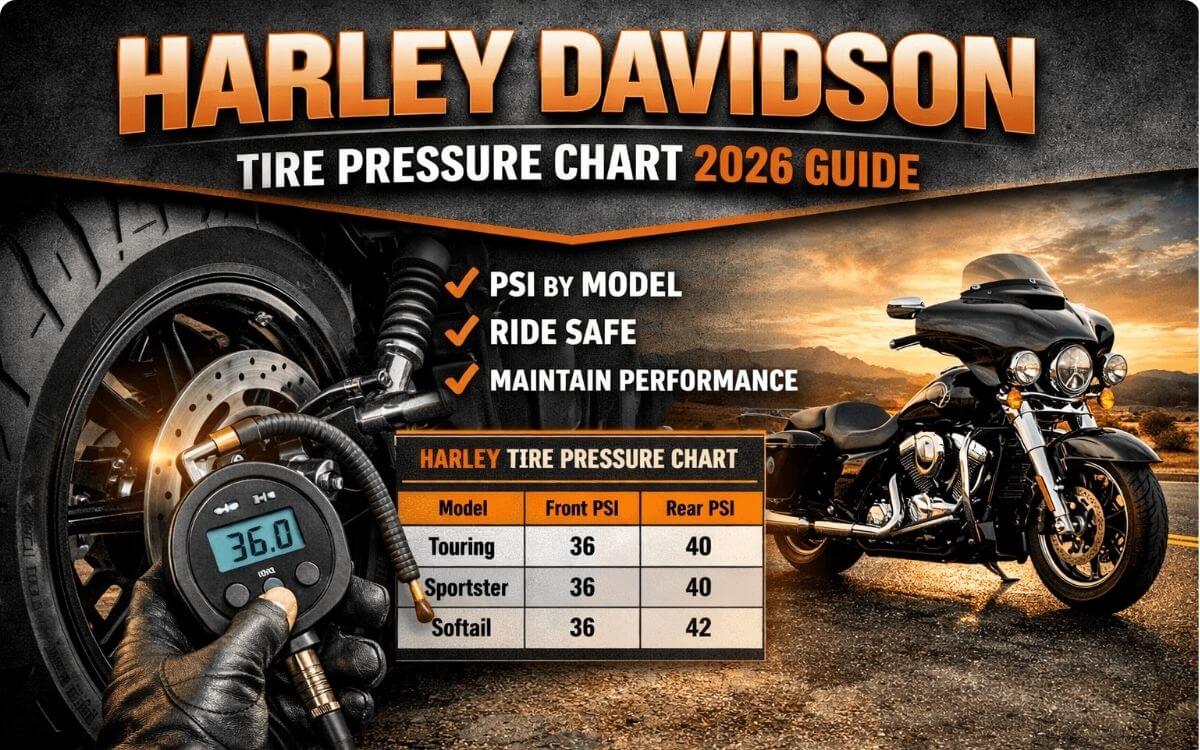
Harley Davidson Tire Pressure Chart
| Models | Front Tire Pressure (PSI) | Rear Tire Pressure (PSI) |
| Sportster Iron 883 | 30 | 36 |
| Sportster 1200 | 30 | 36 |
| Nightster | 36 | 40 |
| Forty-Eight | 30 | 40 |
| Street 500 | 32 | 36 |
| Street 750 | 32 | 36 |
| Street Rod | 36 | 40 |
| Pan America 1250 | 36 | 42 |
| Pan America 1250 Special | 36 | 42 |
| Softail Standard | 36 | 40 |
| Softail Slim | 36 | 40 |
| Street Bob | 36 | 40 |
| Low Rider S | 36 | 40 |
| Low Rider ST | 36 | 40 |
| Fat Bob | 36 | 40 |
| Fat Boy | 36 | 40 |
| Heritage Classic | 36 | 40 |
| Breakout | 36 | 40 |
| Deluxe (Softail) | 36 | 40 |
| Sport Glide | 36 | 40 |
| Road King | 36 | 40 |
| Road King Special | 36 | 40 |
| Street Glide | 36 | 40 |
| Street Glide Special | 36 | 40 |
| Road Glide | 36 | 40 |
| Road Glide Special | 36 | 40 |
| Road Glide Limited | 36 | 40 |
| Ultra Limited | 36 | 40 |
| Electra Glide Standard | 36 | 40 |
| CVO Street Glide | 36 | 40 |
| CVO Road Glide | 36 | 40 |
| CVO Limited | 36 | 40 |
| Dyna Super Glide | 36 | 40 |
| Dyna Low Rider | 36 | 40 |
| Dyna Fat Bob | 36 | 40 |
| Dyna Wide Glide | 36 | 40 |
How to Use Harley Davidson Tire Pressure Chart Correctly
Treat the chart as your starting point, not a guess. Harley says to check tire pressure before riding, use a good gauge, and measure when the tires are cold. Tires can stay warm for up to two hours after riding, which can make a pressure reading look higher than it really should be for adjustment.
A simple routine works best:
- Check pressure before the first ride of the day. Harley defines cold tires as tires that have not been recently ridden.
- Use a high-quality, calibrated gauge instead of relying only on feel or a quick glance.
- Set the tires to the manual’s cold PSI, not the number you think “sounds right.”
- Recheck after a major weather swing, a passenger is added, or luggage changes the bike’s load. Harley ties pressure to the “riding order weight,” meaning the bike plus rider, passenger, and gear.
Harley also gives temperature guidance in its service information. For example, when the air temperature is 31°C / 88°F, the recommended pressure for a bike that has been sitting cold may need a small increase, and a recently ridden bike may need a larger correction. That is why a hot tire reading should never be treated the same way as a cold one.
Tire Pressure Adjustments Based on Riding Conditions
Solo vs. Passenger Riding
Harley-Davidson’s own guidance says to inflate based on the motorcycle’s riding order weight. In plain language, that means solo riding, two-up riding, and loaded touring do not place the same demand on the tires. When you add a passenger or extra gear, the rear tire usually deserves the most attention because it carries more of the load. That is an inference from Harley’s load-based guidance and the way the factory sets rear pressures across many models.
Long-Distance Touring
For highway miles and long trips, correct pressure matters even more. NHTSA says proper inflation helps tire durability, safety, and fuel economy, while underinflation lowers fuel economy and shortens tire life. Harley’s touring manuals reflect that with steady cold pressure targets, especially on Road Glide, Street Glide, Road King, and Electra Glide models.
City Riding vs. Highway Riding
There is no special “city PSI” and “highway PSI” number hidden in the manual. The real job is to keep the tires at the correct cold pressure and adjust for load. Highway riding with a passenger and luggage is where a small pressure mistake becomes easier to feel, because the bike stays loaded for longer and the tire works harder. That is why regular checks matter more than trying to chase a different number for every road type.
Weather Impact
Temperature changes are real. Harley says tire pressure changes as tires warm from riding and as ambient temperature rises, and it gives example adjustments for different temperatures. In practical terms, a chilly morning can make a tire read low, and a hot day can raise the reading enough to confuse riders who check only by feel. That is one more reason to check before riding, while the tires are still cold.
How to Find the Correct PSI for Your Specific Harley Model
The best source is always the owner’s manual. Harley-Davidson also points riders to the label on the frame downtube, and NHTSA explains that the vehicle’s recommended cold inflation pressure is the figure set by the manufacturer, while the tire sidewall shows the tire maker’s maximum permissible pressure, which is not the same thing.
That difference matters. A tire sidewall can tell you what the tire can handle, but the motorcycle manual tells you what the bike should run. Harley also warns that non-specified tires can affect stability, handling, and braking, so if you changed tire brands or sizes, you should not assume the old PSI still fits.
If the pressure label, manual, and the tire setup do not match, use the bike’s official specification first. Harley says it may change specifications by model or design without notice, which is another reason not to rely on a random chart copied from the internet.
Front vs Rear Tire Pressure Explained
A simple pattern appears in Harley’s manuals: the rear tire is usually set higher than the front. That is not a coincidence. The rear tire carries more load, handles drive force, and often has to manage added weight from a passenger or luggage. Harley’s manual values reflect that pattern across touring, Softail, and Sportster families.
The main mistake is to set both tires to the same number just because it feels easier. Harley does not do that in its specifications for most models, and the wrong balance can change how the bike feels on the road. If your low tire pressure warning lamp comes on, Harley says to stop safely, check the tires with a gauge, and correct the pressure to spec.
Read More: Motorcycle Tire Speed Rating Chart
What Happens If Tire Pressure Is Too Low or Too High
Too little air is a real problem. Harley warns that improperly inflated tires can hurt stability and handling and can lead to tire failure. NHTSA says underinflated tires reduce fuel economy and shorten tire life, and its tire safety guidance says proper inflation helps safety, durability, and fuel consumption.
Too much air is not a smart fix either. NHTSA notes that gross overinflation can cause loss of traction and stability problems, and that is the opposite of what you want on a motorcycle. In plain terms, overinflation can make the ride feel harsher and can make the tire less forgiving on real roads.
The safest habit is simple: stay close to the manufacturer’s cold pressure, check it regularly, and do not use extra air as a shortcut for wear, handling complaints, or mileage worries.
How Often to Check Tire Pressure
Harley says to check tire pressure as part of the pre-ride checklist and at every scheduled service interval. NHTSA also recommends regular checks of cold tires, because pressure can drift over time even when the bike looks fine. For most riders, weekly checks and a quick check before a long trip are a good habit.
FAQ (Focused on User Intent)
What is the recommended tire pressure for Harley-Davidson?
It depends on the model, year, and tire setup. Many current touring models use 36 psi front and 40 psi rear, but Softail and Sportster models can differ, so use the exact chart for your bike.
Can I use the same PSI for front and rear tires?
Usually no. Harley’s manuals commonly set the rear higher than the front, and that difference is part of the bike’s design.
Does tire pressure change with weather?
Yes. Harley says tire pressure varies with ambient temperature and with riding heat, which is why cold checks matter.
What PSI is best for long-distance riding?
The best PSI is the manufacturer’s cold PSI for your model, adjusted only as the manual allows for temperature and load. Long trips make proper inflation more important, not less.
Is higher tire pressure better for fuel economy?
Not beyond the manufacturer’s spec. NHTSA says proper inflation helps fuel economy, but Harley and NHTSA both make it clear that the goal is correct pressure, not extra pressure.
How do I know if my tire pressure is wrong?
A warning lamp, strange handling, uneven wear, or a pressure reading that does not match the manual are all signs to stop and check with a gauge. Harley’s TPMS guidance says to inspect the affected tire and correct it to spec.
Conclusion
The best Harley Davidson tire pressure chart is the one matched to your exact model, year, and tire setup. Start with the manufacturer’s cold PSI, check it with a good gauge before riding, and adjust only when the manual calls for it. That simple habit improves safety, helps the bike handle the way it should, and can also protect tire life and fuel economy.
