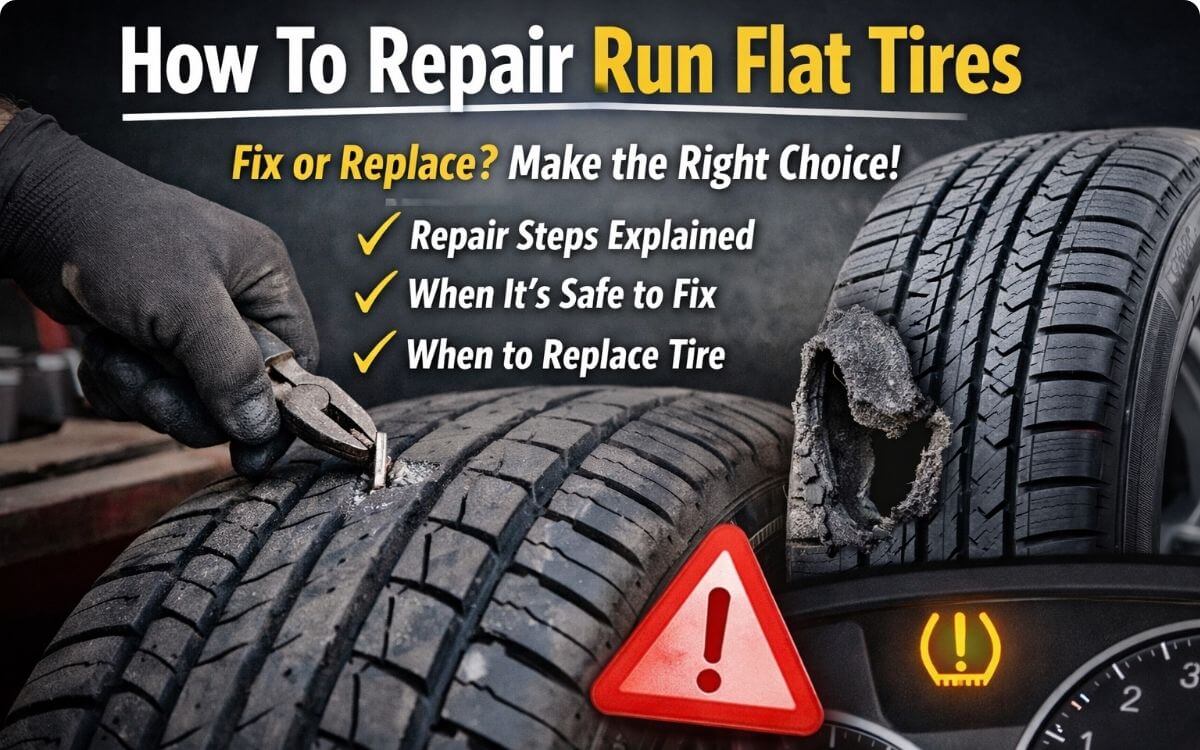
How To Repair Run Flat Tires
A run-flat tire can be confusing the first time it happens. The tire may still look usable, but the real question is whether it is still safe to drive on or repair.
That is where many drivers make the wrong call. A small puncture may seem harmless, but if the tire was driven while losing air, hidden damage can turn a simple fix into a safety risk.
In this guide, you will learn how to repair run flat tires the right way, when repair is possible, and when replacement is the safer choice. The goal is to help you make a clear decision without wasting money or taking unnecessary risks.
What Are Run-Flat Tires?
Run-flat tires are designed to keep working even after a puncture. Unlike regular tires, they don’t go completely flat right away when air pressure is lost.
They have stronger, reinforced sidewalls. This extra strength helps the tire support the weight of the car for a short distance, even without air inside.
In real-world terms, this means you can keep driving after a puncture. Usually, you can go for about 50 to 80 kilometers at a reduced speed. This gives you enough time to reach a repair shop or a safe place instead of being stuck on the roadside.
Most drivers first notice something that feels “off” rather than seeing a flat tire. The ride becomes a bit stiffer, but the tire doesn’t collapse like a normal one would.
Run-flat tires are common on cars from brands like BMW and Mercedes-Benz, mainly because they improve safety and reduce the need for a spare tire.
However, they are not perfect. The ride can feel slightly harder than regular tires, and they are usually more expensive to replace. Also, once driven without air, they are often harder—or sometimes impossible—to repair safely.
In simple terms, run-flat tires are built to give you time and control after a puncture, so you’re not forced to stop immediately in a risky situation.
Can You Repair Run-Flat Tires?
The short answer is: sometimes yes—but often no.
A run-flat tire can be repaired only in very specific situations. If the puncture is small and located in the center tread area, and the tire was not driven for long without air, repair might be possible.
But here’s the catch. If you kept driving after the tire lost pressure—even for a short distance—the inside structure may be damaged. That damage is not always visible from the outside, which makes it risky to repair.
Most professional guidelines, including those from the Tire Industry Association, recommend not repairing run-flat tires if there’s any chance they were driven while flat.
In simple terms:
- Small hole in the middle + stopped quickly → Repair may be okay
- Driven with low or no air → Replace is safer
- Damage on the sidewall → Cannot be repaired
Even when repair is possible, not every shop will agree to do it. Some avoid it completely because of safety concerns.
So while repair is not impossible, you should think of it as a limited option, not the default solution. When in doubt, getting the tire properly checked—or replaced—is the safer choice.
When Repair Is Possible
There are a few situations where repairing a run-flat tire can be considered safe. But the conditions need to be just right.
Here’s when a repair may be possible:
- The puncture is small (usually caused by a nail or screw)
- The damage is in the center of the tread, not near the edges
- The tire was not driven far after losing air
- There are no signs of internal damage when inspected from the inside
- The tire has not been repaired before
In these cases, a proper repair—done from the inside by a professional—can work.
Even then, it’s not a guaranteed yes. A mechanic will usually remove the tire and check the inside carefully before deciding. If anything looks worn, overheated, or weakened, they’ll recommend replacing it instead.
So while repair is possible, it really depends on how quickly you acted and where the damage happened.
When You Must Replace
Sometimes, repairing a run-flat tire is not just risky—it’s unsafe. In these cases, replacement is the only smart choice.
Here are clear signs you should not try to repair it:
- The tire was driven for a long distance after losing air
- There is damage on the sidewall (cuts, cracks, or bulges)
- You feel vibration or uneven driving after the puncture
- The tire looks worn out or has very low tread
- The hole is large or caused by something sharp like metal debris
One of the biggest warning signs is driving on the tire while it was flat. Even if it looks fine outside, the inside could be badly weakened. That kind of damage can lead to sudden failure later.
Sidewall damage is another deal-breaker. This part of the tire handles a lot of stress, and once it’s damaged, it can’t be safely fixed.
It might feel expensive to replace a run-flat tire, but trying to save money here can cost more in the long run—especially if it leads to a blowout or loss of control.
If you’re unsure, it’s always better to play it safe and replace the tire.
How To Repair Run Flat Tires: Step-by-Step Repair Process
Step 1: Stop driving as soon as it is safe
If you notice a puncture, slow down and pull over carefully. Do not keep driving just to “see if it is okay.”
The more you drive on a run-flat tire after it loses air, the more likely it is that the inside will be damaged. That can turn a repairable tire into one that must be replaced.
Step 2: Check the tire from the outside
Look at the tire for obvious damage. A nail, screw, or small hole in the tread area may still be repairable.
If you see a cut on the sidewall, a bulge, or a torn area, stop there. That kind of damage is usually not safe to fix.
Step 3: Remove the tire from the wheel
A proper repair cannot be done while the tire is still on the car. The tire needs to come off so the inside can be checked.
This matters because a run-flat tire can look fine from the outside but still have hidden damage inside.
Step 4: Inspect the inside carefully
This is the most important part of the whole process. A technician will look for signs that the tire was driven while flat, such as heat damage, broken inner layers, or weak spots.
If any of that is found, the tire should be replaced. A repair may save money, but not if the tire is no longer safe to use.
Step 5: Decide whether the puncture is in a safe repair area
If the damage is small and located in the center tread area, the tire may still be repairable.
If the puncture is near the edge or shoulder of the tire, the repair is usually not a good idea. That part of the tire handles too much stress.
Step 6: Clean and prepare the damaged area
If the tire passes inspection, the damaged spot is cleaned from the inside. The area around the puncture also needs to be prepared so the repair can bond properly.
This step helps make sure the fix lasts and does not start leaking again later.
Step 7: Install the repair properly
A good repair is usually done from the inside of the tire. The technician seals the puncture and patches the inner liner so air cannot escape.
This is much safer than a quick outside plug alone. A proper repair should be done carefully, not rushed.
Step 8: Reinflate the tire and check for leaks
After the repair is done, the tire is filled with air again and checked for leaks. This confirms that the fix is holding.
If the tire still leaks, or if anything looks questionable, it should not go back on the road.
Step 9: Reinstall the tire and test drive
Once everything checks out, the tire is put back on the car. The technician may take a short test drive or advise you to monitor it closely for a few days.
Even after a repair, it is smart to watch for warning signs like low pressure, vibration, or a strange ride feel.
The key thing to remember is this: repairing a run-flat tire is not a simple quick fix. It only works when the damage is small, the tire has not been abused, and the inside is still in good shape.
Costs: Repair vs Replacement
When people get a flat run-flat tire, the first question is usually about cost. Repairing looks cheaper at first, but it’s not always possible.
A repair, if the tire is safe to fix, usually costs much less. In most cases, it is a quick job and you only pay for labor and a patch.
But there’s a catch. Many run-flat tires cannot be safely repaired at all, especially if they were driven while flat.
A replacement is more expensive, but it is often the only option. Run-flat tires cost more than regular tires because of their reinforced structure and brand design.
The price difference can feel big. A repair might cost a small amount, while a new run-flat tire can be several times higher depending on the brand and size.
However, a replacement also gives you something important: peace of mind. You know the tire is fully safe and won’t fail later due to hidden damage.
In simple terms, repair is cheaper but limited. Replacement costs more, but it is often the safer and more reliable choice in real-life situations.
Expert Tips & Safety Advice
From experience, most problems with run-flat tires don’t come from the puncture itself. They come from how long the tire was driven after losing air.
If you notice low pressure while driving, don’t keep going longer than necessary. Even a short distance at low pressure can cause hidden damage inside the tire.
It also helps to check your tires regularly, even if everything feels fine. Run-flat tires don’t always look flat when they’re damaged, so small issues can be easy to miss.
When getting a repair, always ask the technician to inspect the inside of the tire, not just the outside. Real damage often hides where you can’t see it.
One honest point many drivers learn too late: not every repair shop is comfortable working on run-flat tires. If a shop refuses to repair it, it’s usually because they are avoiding safety risks, not trying to upsell you.
If you ever feel unsure about a tire’s condition, trust that doubt. It’s better to replace a questionable tire than risk a failure at high speed.
In the end, run-flat tires are about safety and control, but only if they are treated carefully after a puncture.
Read More: Bridgestone DriveGuard Plus Review
FAQs
Can run-flat tires be repaired after a puncture?
Sometimes yes, but only in limited cases. If the puncture is small and the tire was not driven while flat, repair may work. But in many real situations, replacement is the safer choice.
Is it safe to drive on a run-flat tire after a puncture?
Yes, but only for a short distance. Most run-flat tires allow you to drive carefully for about 50 to 80 km at low speed. This is just enough to reach a repair shop safely.
Why do some shops refuse to repair run-flat tires?
Many shops avoid repairing them because hidden internal damage can be hard to detect. If a tire was driven without air, it may look fine outside but still be unsafe inside.
How long do run-flat tires usually last?
They can last as long as regular tires if used normally. But once they are driven without air, their lifespan often drops, even if they look repairable.
Are run-flat tires worth it?
They are useful for safety and convenience, especially if you don’t carry a spare tire. But they are more expensive and sometimes harder to repair, so they are not ideal for every driver.
What should I do if I’m unsure about my tire damage?
The safest option is to get it checked by a professional. If there is any doubt about internal damage, replacing the tire is usually the smarter and safer decision.
Final Verdict
Run-flat tires can sometimes be repaired, but only when the damage is small and the tire has not been driven far without air. If the tire was driven while flat, or if the sidewall is damaged, replacement is usually the safer choice.
For most drivers, the key question is not just whether the tire can hold air again, but whether it can still be trusted on the road. In practice, that makes a careful inspection more important than a quick fix.
Best for: small tread punctures that were caught early.
Avoid if: the tire was driven flat, has sidewall damage, or the inside condition is unknown.
