RV Tire Size Chart: Complete Guide
Choosing the right RV tire size is one of the most important parts of keeping your motorhome safe, stable, and comfortable on the road. The correct size affects how your RV handles, how much weight it can carry, how long the tires last, and whether there is enough clearance for safe driving. A tire that looks close enough is not always the right fit, especially on a heavy RV that travels long distances.
This RV tire size chart will help you understand common RV tire sizes, read tire markings the right way, and compare the most common options used on Class A, Class B, and Class C motorhomes. It also explains how to choose a replacement tire size more carefully, so you can avoid mistakes that may affect load capacity, wheel fitment, and overall safety.
If you are replacing worn tires or trying to understand what size your RV needs, this guide gives you a practical starting point. You will learn how to read the size code, how to compare common tire sizes, and what to check before making a final decision. The goal is simple: help you choose the right RV tire size with more confidence and less guesswork.
What an RV Tire Size Means
Every RV tire has a size code printed on its sidewall. At first glance, it may look confusing, but each number and letter tells you something important about the tire’s fit and performance. Understanding this code makes it much easier to choose the right replacement tire.
Breaking Down the Tire Code
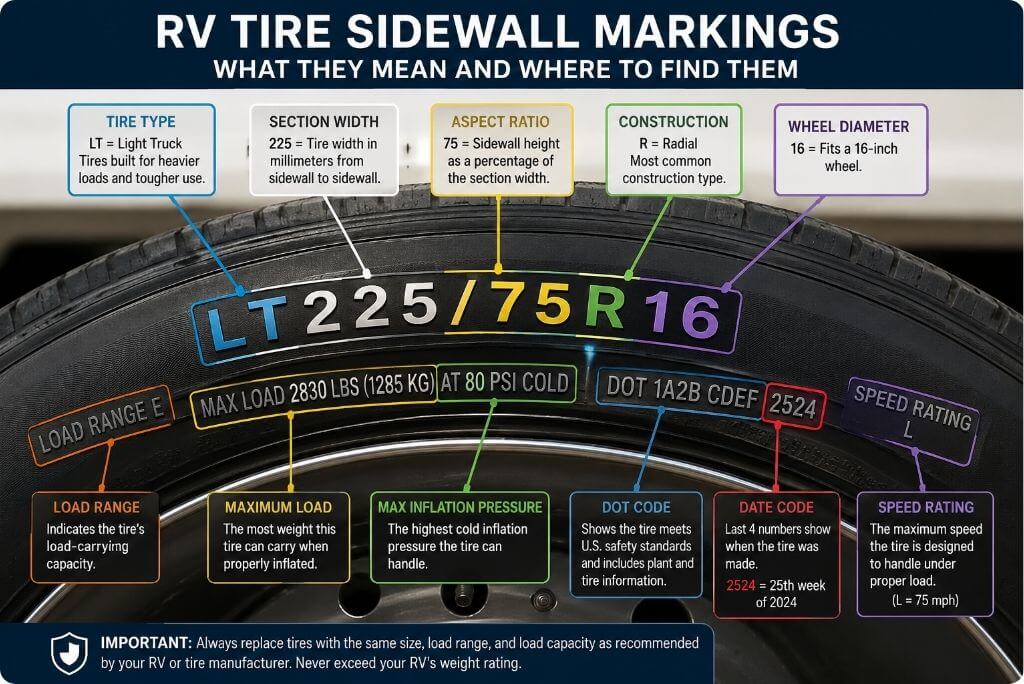
Take LT225/75R16 as an example:
- LT – Tire type. “LT” stands for Light Truck, a common choice for many motorhomes and camper vans.
- 225 – Section width. The tire is about 225 millimeters wide from one sidewall to the other.
- 75 – Aspect ratio. The sidewall height is 75% of the tire’s width.
- R – Construction type. “R” means radial construction, which is used on nearly all modern RV tires because it provides better durability and ride comfort.
- 16 – Wheel diameter. This tire fits a 16-inch wheel.
Other RV tire sizes follow the same pattern. For example, LT245/75R16 is wider than an LT225/75R16 but fits the same 16-inch wheel. A larger size like 255/80R22.5 is commonly found on heavier motorhomes and fits a 22.5-inch commercial-style wheel.
Why RV Tire Sizes Matter
The right tire size does much more than fit the wheel. It also affects how your RV performs on the road.
A properly sized tire helps carry the RV’s weight safely, improves highway stability, supports predictable braking, and promotes even tread wear. It can also influence ride comfort, fuel economy, and, on motorhomes, speedometer accuracy if the tire’s overall diameter changes.
One important point many RV owners overlook is that tire size affects how the RV behaves when it’s fully loaded for travel. Water tanks, camping gear, passengers, and supplies all add weight. A tire that seems to fit may not provide the load capacity or handling your RV needs under real travel conditions.
That’s why the safest replacement tire is one that matches your RV’s recommended size while also meeting its wheel specifications and load requirements.
Complete RV Tire Size Chart
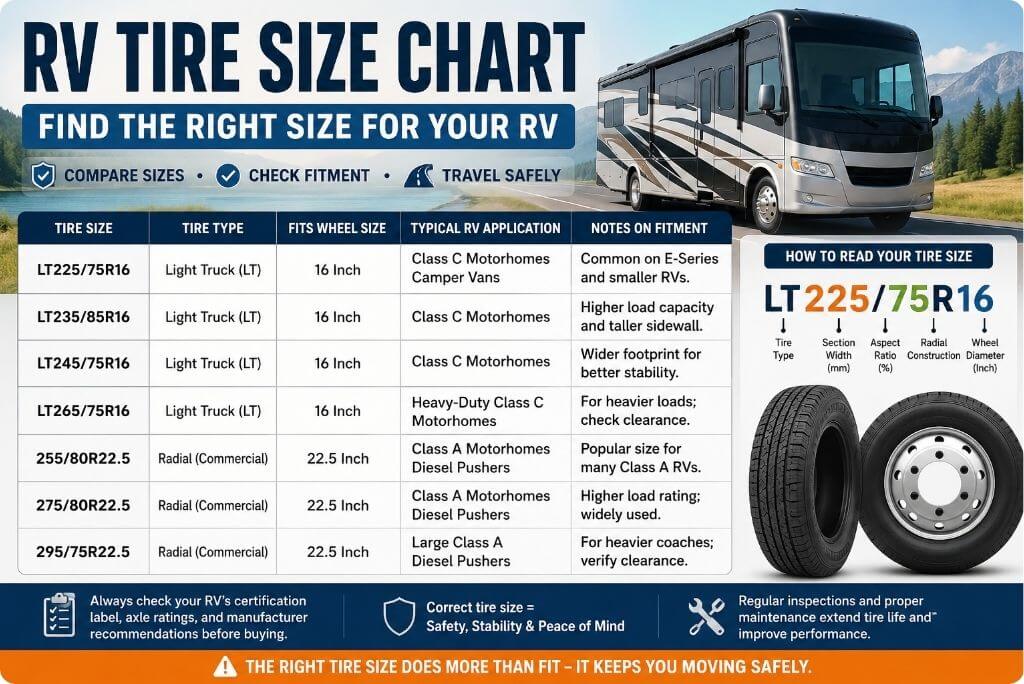
Use this chart as a starting point when comparing common RV tire sizes. The tire size tells you the basic dimensions, but final fitment still depends on wheel width, clearance, axle rating, and the RV maker’s recommendation.
| Tire Size | Tire Type | Fits Wheel Size | Typical RV Application | Notes on Fitment |
| LT225/75R16 | LT | 16-inch | Class C motorhomes, camper vans | Common RV size; often chosen for balanced load support and highway use. |
| LT235/85R16 | LT | 16-inch | Class C motorhomes, some lighter Class A rigs | Taller than LT225/75R16, so clearance should be checked carefully. |
| LT245/75R16 | LT | 16-inch | Class C motorhomes, some camper vans | Slightly wider fit; may improve road feel if the chassis allows it. |
| LT265/75R16 | LT | 16-inch | Larger camper vans, some modified RVs | Wider tire that may need more space around suspension and body panels. |
| 225/75R16 | Passenger/LT-style depending on model | 16-inch | Some smaller RVs and conversions | Always confirm load capacity before use on an RV. |
| 235/80R16 | LT | 16-inch | Some motorhomes and trailer setups | Common replacement size on heavier-duty applications; verify wheel width. |
| 255/80R22.5 | Commercial-style | 22.5-inch | Class A motorhomes, diesel pushers | Heavy-duty size for larger coaches; usually used on higher-capacity chassis. |
| 275/80R22.5 | Commercial-style | 22.5-inch | Class A motorhomes, diesel pushers | Often used on heavier rigs; wheel and axle ratings matter a lot here. |
| 295/75R22.5 | Commercial-style | 22.5-inch | Large diesel pushers, high-capacity motorhomes | Wider tire that can change handling feel and clearance requirements. |
| 245/70R19.5 | Commercial-style | 19.5-inch | Medium-duty motorhomes, some Class A rigs | Common on some motorhome chassis; good load support, but check replacement specs closely. |
| 265/70R19.5 | Commercial-style | 19.5-inch | Medium-duty motorhomes | Often used where extra load capacity is needed without moving to 22.5-inch wheels. |
| ST225/75R15 | ST | 15-inch | Travel trailers, fifth wheels | Trailer-focused size; common on towables, not usually used on motorhomes. |
| ST205/75R14 | ST | 14-inch | Smaller travel trailers | Good for lighter trailers, but load rating must match the trailer’s needs. |
| ST235/80R16 | ST | 16-inch | Larger travel trailers, fifth wheels | Popular trailer size; confirm wheel width and trailer load requirements. |
Expert note: Two RVs can use the same tire size and still need different tires. The real fit depends on wheel width, axle weight, suspension clearance, brake clearance, and the RV manufacturer’s specification. A tire that fits the wheel is not automatically the right choice for the vehicle.
RV Tire Size Chart by RV Type
Different types of RVs use different tire sizes because they are built on different chassis and carry different amounts of weight. A compact camper van doesn’t need the same tires as a 40-foot diesel motorhome, even if they look similar from a distance.
The charts below show the tire sizes most commonly found on each type of motorhome. These are general references, not fitment recommendations. Always confirm the correct size using your RV’s certification label, owner’s manual, and wheel specifications.
Class A Motorhome Tire Sizes
Class A motorhomes are the largest RVs on the road. Their heavier weight, longer wheelbase, and higher axle loads require larger tires that can safely support more weight while maintaining stability at highway speeds.
Most gasoline-powered Class A models use 19.5-inch wheels, while many larger or luxury models use 22.5-inch commercial-style wheels with higher load capacities.
| Common Tire Size | Wheel Size | Common Applications | Fitment Notes |
| 225/70R19.5 | 19.5 in | Smaller Class A motorhomes | Common on entry-level gas coaches. |
| 245/70R19.5 | 19.5 in | Gas Class A motorhomes | Popular balance of ride comfort and load capacity. |
| 245/75R19.5 | 19.5 in | Mid-size Class A models | Verify clearance before replacing with a different size. |
| 265/70R19.5 | 19.5 in | Larger gasoline Class A motorhomes | Supports higher axle loads than smaller sizes. |
| 255/80R22.5 | 22.5 in | Diesel-equipped Class A models | Common upgrade for heavier motorhomes. |
| 275/80R22.5 | 22.5 in | Large Class A motorhomes | Widely used on high-capacity chassis. |
| 295/75R22.5 | 22.5 in | Luxury Class A coaches | Requires adequate wheel and suspension clearance. |
| 315/80R22.5 | 22.5 in | Premium heavy Class A coaches | Found on some of the heaviest motorhomes. |
Class B Camper Van Tire Sizes
Class B camper vans are built on commercial van chassis such as the Mercedes-Benz Sprinter, Ford Transit, or Ram ProMaster. Because these vehicles are smaller and lighter than traditional motorhomes, they usually use smaller wheels and Light Truck (LT) tires.
Choosing the correct load capacity is still important, but maintaining the original chassis fitment is usually the highest priority.
| Common Tire Size | Wheel Size | Common Applications | Fitment Notes |
| LT215/85R16 | 16 in | Older camper van conversions | Tall, narrow tire used on some van chassis. |
| LT225/75R16 | 16 in | Ford Transit, Ram ProMaster conversions | One of the most common camper van tire sizes. |
| LT235/65R16 | 16 in | Some European-style camper vans | Used on selected compact RV platforms. |
| LT245/75R16 | 16 in | Heavy-duty camper van builds | Offers additional width where approved. |
| 235/65R16C | 16 in | European camper vans | Commercial-rated tire commonly used on imported chassis. |
| 245/75R17 | 17 in | Some newer camper van models | Check manufacturer approval before changing sizes. |
Class C Motorhome Tire Sizes
Class C motorhomes are built on truck or van chassis, so their tire sizes depend more on the original chassis than the length of the RV. That’s why two Class C motorhomes of similar size may use different tires.
When replacing tires, always follow the chassis manufacturer’s specifications rather than choosing a size based on appearance.
| Common Tire Size | Wheel Size | Common Applications | Fitment Notes |
| LT225/75R16 | 16 in | Ford E-Series Class C motorhomes | One of the most widely used Class C tire sizes. |
| LT235/85R16 | 16 in | Heavy-duty Class C models | Taller profile with higher load capability. |
| LT245/75R16 | 16 in | Larger Class C motorhomes | Common on heavier chassis packages. |
| LT215/85R16 | 16 in | Older Class C motorhomes | Found on selected legacy chassis. |
| 225/75R19.5 | 19.5 in | Super C and heavy-duty Class C models | Used where higher axle ratings are required. |
| 245/70R19.5 | 19.5 in | Super C motorhomes | Commercial-style tire for increased load capacity. |
Diesel Pusher / Heavy Motorhome Tire Sizes
Diesel pushers are among the heaviest RVs on the road. They typically use commercial-grade wheels and tires designed for buses and heavy trucks because these vehicles carry significantly higher axle weights.
In this category, wheel compatibility, axle ratings, and load capacity are just as important as the tire size itself. Even a tire with the correct dimensions may not be suitable if it doesn’t meet the required weight rating.
| Common Tire Size | Wheel Size | Common Applications | Fitment Notes |
| 255/80R22.5 | 22.5 in | Mid-size diesel pushers | Common on many Freightliner-based coaches. |
| 275/80R22.5 | 22.5 in | Large diesel pushers | One of the most widely used heavy RV sizes. |
| 295/75R22.5 | 22.5 in | Luxury diesel motorhomes | Supports higher gross vehicle weights. |
| 295/80R22.5 | 22.5 in | Premium diesel coaches | Often used on higher-capacity chassis. |
| 315/80R22.5 | 22.5 in | High-end diesel pushers | Designed for maximum load support. |
| 365/70R22.5* | 22.5 in | Select luxury motorhomes (typically front axle) | Used only on certain premium coaches with very high front axle ratings. |
Expert Tip: RV type is only the starting point for choosing a tire size. The correct replacement should always match your vehicle’s certification label, wheel dimensions, axle ratings, and the tire manufacturer’s approved fitment recommendations. Two motorhomes of the same class can require different tire sizes because they are built on different chassis or have different weight ratings.
How to Read Your Current RV Tire Sidewall
Before buying new RV tires, take a few minutes to inspect the ones already on your vehicle. The information printed on the sidewall tells you much more than just the tire size. It also helps you confirm whether a replacement tire meets your RV’s requirements.
Here are the key markings to look for:
- Tire size: This appears as a code such as LT225/75R16 or 255/80R22.5. It identifies the tire’s size and the wheel diameter it fits.
- Load range: You’ll usually see a letter such as Load Range E or Load Range G. This indicates how much weight the tire is designed to carry when properly inflated.
- Maximum load: This shows the highest weight a single tire can safely support. Make sure any replacement tire meets or exceeds your RV’s required load capacity.
- Maximum inflation pressure: This is the highest cold inflation pressure the tire is designed to handle. It is not always the pressure you should use. For everyday driving, follow the pressure recommended by your RV or tire manufacturer.
- DOT date code: Near the letters DOT, you’ll find a four-digit number. The first two digits show the week, and the last two show the year the tire was made. For example, 2524 means the tire was manufactured in the 25th week of 2024.
- Speed rating: A letter near the end of the tire specification indicates the tire’s maximum designed speed under the proper load and inflation conditions. While RVs are rarely driven at high speeds, it’s still important to use a tire that meets the manufacturer’s requirements.
If any of these markings are difficult to read because of dirt, wear, or age, clean the sidewall and inspect it in good lighting. If the information is still unreadable, check your RV’s certification label or owner’s manual before ordering replacement tires.
A quick sidewall inspection can help you avoid buying the wrong tire and gives you a chance to spot signs of aging or damage before your next trip.
How to Choose the Correct Replacement RV Tire Size
Replacing your RV tires is about more than finding a tire that looks similar to the old one. The safest choice is one that matches your RV’s design, supports its weight, and fits the wheels correctly.
Use this simple process before you buy:
- Find the original tire size printed on the current tire or listed in your owner’s manual.
- Check the vehicle certification label, usually located near the driver’s seat or entry door. It lists the tire size and other important specifications recommended by the manufacturer.
- Verify the wheel diameter. A replacement tire must match your wheel size. For example, a 16-inch tire only fits a 16-inch wheel.
- Confirm wheel width compatibility. Some tires require a wider or narrower wheel, even if the wheel diameter is correct.
- Match or exceed the required load capacity. Your replacement tire should be able to safely carry the weight of your fully loaded RV.
- Check your axle weight, if available. If you’ve had your RV weighed, compare the axle loads with the tire manufacturer’s load ratings to make sure you have enough capacity.
- Inspect the clearance after installation. Make sure the tires have enough room around the suspension, brakes, and wheel wells throughout the full range of steering and suspension movement.
Pro Tip: Never choose a replacement tire based only on overall diameter or appearance. Two tires can have similar dimensions but different load capacities, wheel requirements, or clearance needs.
For example, an LT245/75R16 may fit the same 16-inch wheel as an LT225/75R16, but its extra width could reduce clearance around the suspension or fender. Likewise, two 255/80R22.5 tires from different manufacturers may share the same size, yet have different load ratings. One may meet your RV’s requirements, while the other may not.
When in doubt, use the manufacturer’s recommended size as your starting point and confirm the final fit using your RV documentation and the tire manufacturer’s specifications. A few extra minutes of checking can help you avoid handling problems, uneven tire wear, or an expensive replacement mistake.
Can You Change RV Tire Sizes?
Yes, sometimes you can, but only when the new tire still matches the RV’s wheel size, load needs, and available space. A tire that looks close enough is not always a safe fit.
A small size change can be acceptable if the new tire has the right wheel diameter, fits the wheel width, and can carry the same load or more. That is the kind of change that may work in real life. But the change still needs to be checked carefully, not guessed.
The biggest risks are clearance and load capacity. If the tire is too wide, too tall, or the wrong shape for the wheel, it can rub against the suspension, brakes, or fender. If it cannot carry enough weight, it may wear out faster or create a safety problem on the road.
“Plus sizing” means moving to a different tire size that may be slightly larger, usually while keeping fitment within safe limits. “Minus sizing” means going smaller. Smaller tires can reduce ground clearance and may change how the RV handles, so they are not automatically better.
Overall diameter matters too. A tire that is taller or shorter than the original can change ride height and spacing around the wheel well. Even a small difference can matter on an RV, especially when the vehicle is fully loaded.
The safest rule is simple: change tire size only when the replacement still fits the wheel, clears the body and brakes, and meets the RV’s load requirement. If any of those checks fail, it is better to stay with the original size.
Common RV Tire Sizing Mistakes to Avoid
Some RV tire mistakes are simple, but they can lead to expensive or unsafe results.
One common mistake is choosing tires by appearance. A larger tire may look stronger, but that does not mean it is the correct choice.
Another mistake is ignoring wheel ratings. The tire may be capable of carrying the load, but the wheel itself also has a limit. The wheel and tire need to work together.
A lot of people also skip the vehicle certification label. That is risky because the label often gives the best starting point for the correct tire setup.
Another mistake is using the wrong load capacity. If the tire cannot safely support the RV’s weight, it is the wrong tire, even if the size looks correct.
Many owners also forget to check clearance after installation. A tire that rubs while turning or under suspension movement can damage both the tire and the vehicle.
Tire age is another issue. An older tire may still show decent tread, but aging can still make it unsafe for RV use.
Finally, do not assume all RV tires are interchangeable. Different RV types and chassis setups can need very different sizes and constructions.
Frequently Asked Questions
What is the most common RV tire size?
There is no single size that fits every RV, but LT225/75R16, LT245/75R16, and 22.5-inch commercial-style sizes are very common depending on the RV type.
How do I know what size RV tire I need?
Start with the current tire size, then confirm the vehicle certification label, wheel diameter, wheel width, and load requirements.
Can I install a wider RV tire?
Sometimes, but only if the wheel width, clearance, and load requirements all support the change.
Can I replace one RV tire with a different size?
Only if the new tire matches the vehicle’s fitment and load requirements. A random mismatch is not a safe shortcut.
Does changing tire size affect handling?
Yes. Tire size can affect steering feel, ride quality, stability, and in some cases speedometer accuracy.
How often should RV tires be replaced?
Age matters as much as wear. Many RV owners replace tires based on age, condition, and usage pattern rather than tread depth alone.
Can I mix RV tire sizes on the same axle?
It is usually not a good idea unless the vehicle maker or a qualified fitment source specifically allows it.
Should RV tires always be inflated to the maximum PSI on the sidewall?
Not always. Inflation should match the actual load and the tire manufacturer’s guidance for your setup.
Final Thoughts
Choosing the right RV tire size is about more than finding a tire that fits the wheel. The best choice should also match your RV’s recommended specifications, provide enough load capacity, and maintain proper clearance for safe driving.
Use this RV tire size chart as a starting point, then confirm the final fitment using your RV’s certification label, owner’s manual, and the manufacturer’s tire recommendations. The National Highway Traffic Safety Administration (NHTSA) also recommends using tires that meet your vehicle’s specifications to help maintain safe handling and performance.
Taking a few extra minutes to verify the correct tire size today can help improve safety, extend tire life, and give you greater confidence on every trip.
