SUV vs CUV vs LT Tires: Complete Guide
Last updated on March 28th, 2026
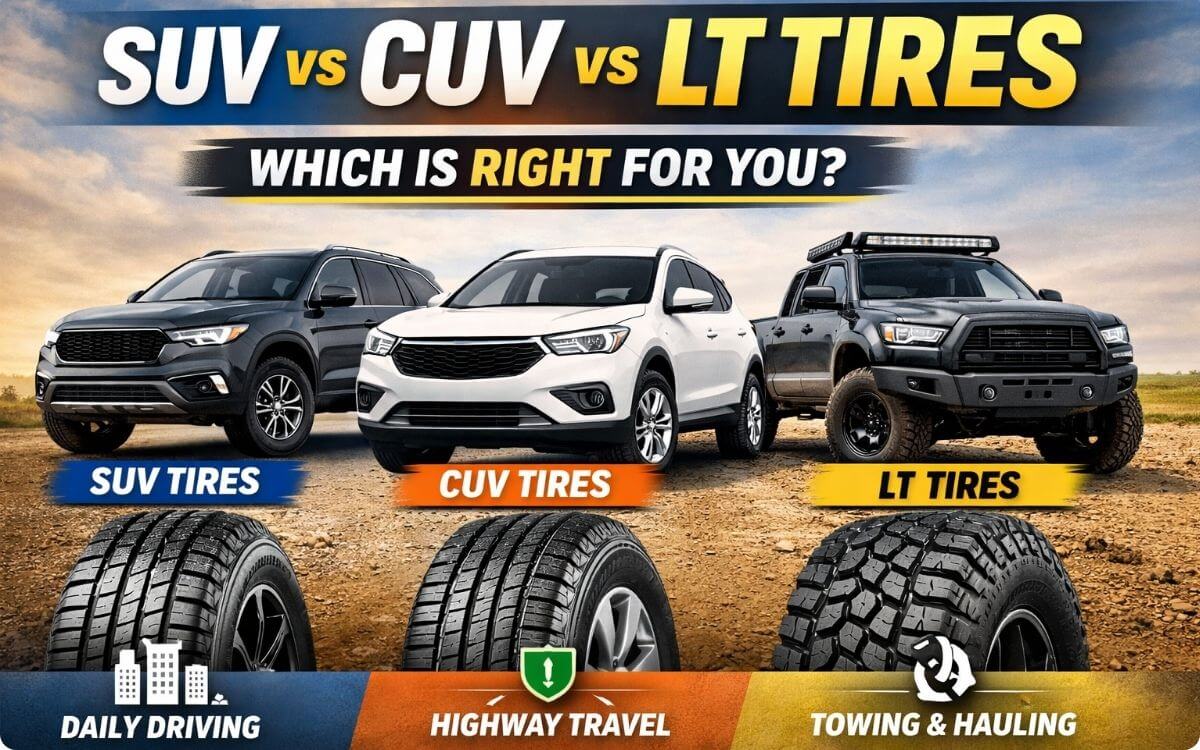
SUV, CUV, LT… confusing tire labels that actually matter. If you’ve ever walked into a tire shop or searched online, you’ve probably seen these terms and wondered what they really mean. At first, they all look similar, but they are designed for very different driving needs.
Choosing the wrong tire can lead to real problems. Your ride may feel rough or noisy, tires can wear out faster, and in some cases, handling and safety can be reduced. It’s not just about the tire—it’s about how well it matches your vehicle and driving style.
In this guide, we’ll break down SUV vs CUV vs LT tires in plain language so you can quickly understand the differences and choose the right option with confidence.
Quick Comparison Table: SUV vs CUV vs LT Tires
| Feature / Factor | CUV Tires | SUV Tires | LT Tires (Light Truck) |
| Ride Comfort | Smoothest, soft ride | Balanced comfort & firmness | Stiffest, less comfortable |
| Load Capacity | Lowest | Medium | Highest |
| Fuel Efficiency | Best | Moderate | Lowest |
| Durability | Lowest | Moderate | Strongest |
| Noise Level | Quietest | Moderate | Loudest |
| Best Use | Daily city & highway | Mixed driving (city, highway, light off-road) | Towing, hauling, off-road |
| Typical Vehicle | Crossovers (CUVs) | SUVs | Pickup trucks, heavy-duty SUVs |
| Off-Road Capability | Minimal | Light off-road | Excellent |
| Towing/Heavy Loads | Not ideal | Moderate | Excellent |
This table gives a clear, at-a-glance look at how these tires differ, helping you quickly see which type fits your vehicle and driving needs best.
What Are SUV, CUV, and LT Vehicles?
Before comparing tires, it helps to understand the vehicles themselves. Tire design starts with the kind of vehicle it will be used on, because vehicle size, weight, and purpose all affect what the tire needs to do.
What Is an SUV?
An SUV is a sport utility vehicle. In simple terms, it is built to be stronger and more versatile than a small car.
Many SUVs are heavier than crossovers, and some are built on a truck-like frame. That usually gives them more strength when carrying people, cargo, or towing a trailer. It also helps when driving on rough roads or light off-road paths.
The trade-off is that SUVs are not always as soft or fuel-friendly as smaller vehicles. They can feel a little heavier to drive, and some models use more gas than a car-based vehicle.
What Is a CUV?
A CUV is a crossover utility vehicle. It looks similar to an SUV, but it is usually built more like a car.
That car-based design is one reason CUVs often feel smoother and easier to drive. They are usually lighter than SUVs, and that often helps with fuel use and everyday comfort.
CUVs are a popular choice for city and highway driving. They work well for commuting, errands, school runs, and family travel. They are practical, but they are usually not meant for heavy hauling or serious off-road use.
What Is an LT (Light Truck)?
LT stands for light truck. These vehicles are built for tougher jobs, especially hauling and towing heavy loads.
They are often stronger than SUVs and CUVs, and many are designed to handle more weight. In practical terms, that makes them a better fit for work use, trailers, cargo, and rough conditions.
The downside is that LT vehicles and LT-style tires can feel stiffer and less comfortable for daily driving. They are built for strength first, not softness.
What Are SUV Tires?
SUV tires are made for drivers who want a good balance of comfort, strength, and everyday use. They are built to handle the extra weight of an SUV without feeling too stiff or too rough on normal roads.
These tires are a middle-ground choice. They are stronger than many car tires, but they are usually not as heavy-duty as LT tires. That makes them a practical fit for many SUV owners who drive in different conditions.
Key Features
- Built to balance comfort and durability
- Made to support the weight of an SUV
- Often designed for smooth highway driving
- Available in all-season options for year-round use
- Some models come in all-terrain versions for light off-road use
- Usually offer better stability than regular passenger tires
- Designed to handle turns, braking, and everyday road stress
- Often give a quieter ride than tougher truck-style tires
- Made for mixed use, not just one type of road
- Focus on everyday dependability
Pros and Cons of SUV Tires
Pros
- Good for everyday driving
- Work well for long trips and family use
- Can handle light off-road roads like gravel or dirt
- Usually give a nice balance between comfort and strength
- A solid choice if you want one tire that can do a little of everything
Cons
- Not as strong as LT tires for heavy hauling or towing
- Not as smooth or soft as some CUV tires
- May not be the best choice for serious off-road driving
Best For
SUV tires are a good fit for families with SUVs who use their vehicle for regular driving, weekend trips, and the occasional rough road. They also make sense for drivers who want one tire that can handle both city streets and highway travel without feeling too soft or too heavy-duty.
If you sometimes drive on dirt roads, light trails, or uneven pavement, SUV tires can give you the extra strength you need without overdoing it.
What Are CUV Tires?
CUV tires are made for crossover vehicles, which are usually lighter and more car-like than full-size SUVs. Because of that, these tires focus more on comfort, quietness, and fuel efficiency than on heavy-duty strength.
For most drivers, that is a good fit. CUV tires are built for everyday use, so they work well when the vehicle spends most of its time on paved roads.
Key Features
- Made for lighter vehicles like crossovers
- Built to feel smooth on regular roads
- Designed with comfort in mind
- Often help improve fuel economy
- Usually make less road noise than tougher tires
- Good for city driving and highway travel
- Often have tread patterns made for everyday grip
- Work well in all-season conditions
- Not designed for heavy loads
- Focus on easy, daily driving
Pros and Cons of CUV Tires
Pros
- Smooth and quiet ride
- Better fuel economy in many cases
- Easy to live with for daily driving
- Good for long commutes and family trips
- Usually more comfortable than heavier-duty tires
Cons
- Lower load capacity than SUV or LT tires
- Not ideal for heavy towing
- Not the best choice for rough roads or hard off-road use
Best For
CUV tires are best for daily commuting, city driving, and highway use. They make the most sense for drivers who want a comfortable ride and do not need extra strength for heavy work.
They are a smart choice if your crossover is mainly used for errands, school runs, weekend trips, and normal everyday driving. Since CUVs are lighter vehicles, these tires do not need the same high load ratings as LT tires. That helps keep the ride smoother and more efficient.
What Are LT Tires (Light Truck Tires)?
LT tires are built for harder work. They are designed for vehicles that carry heavy loads, pull trailers, or drive on rough roads more often than normal.
You will usually see them on pickup trucks and some larger SUVs. The main idea behind LT tires is strength and durability, even if that means giving up a bit of comfort.
Key Features
- Strong, reinforced sidewalls to handle weight and rough use
- Higher load rating than regular SUV or CUV tires
- Built to last under stress, not just for comfort
- Thicker construction to resist damage from rocks or rough roads
- Designed to stay stable when carrying heavy loads
- Often used for towing and hauling jobs
- Can handle higher air pressure for extra strength
- Made for tougher conditions, including off-road use
Pros and Cons of Light Truck Tires
Pros
- Great for towing trailers or carrying heavy loads
- More resistant to damage on rough roads
- Stronger build helps them last longer under hard use
- Better stability when the vehicle is fully loaded
- A reliable choice for work vehicles or heavy-duty use
Cons
- Ride feels stiffer, especially on normal roads
- More road noise compared to softer tires
- Can reduce fuel efficiency because they are heavier
- May feel less comfortable for daily commuting
Best For
LT tires are best for pickup trucks, work vehicles, and SUVs that are used for heavy-duty tasks. If you regularly tow, carry tools or cargo, or drive on rough terrain, these tires make a lot of sense.
They are also a good choice for off-road driving, where extra strength and durability really matter.
One important thing to understand is this: LT tires do not increase your vehicle’s towing capacity by themselves. That limit is set by the vehicle, not the tire. What LT tires do is help handle the load more safely and with better stability.
SUV vs CUV vs LT Tires: Key Differences
These three tire types may look similar at first, but they are built for different kinds of use. The main difference is how they feel on the road and what kind of work they are meant to handle.
A tire that feels comfortable for everyday driving may not be the best for towing. A tire that handles heavy loads well may not ride as softly. That is why it helps to compare them side by side.
Ride Comfort
If comfort matters most, CUV tires usually feel the smoothest. They are made for lighter vehicles and normal road use, so they tend to feel softer and easier on bumps.
SUV tires sit in the middle. They still give a comfortable ride, but they are usually a little firmer because they are built for more weight and more mixed use.
LT tires are the stiffest of the three. That firmness helps them carry heavy loads and handle rough conditions, but it can make daily driving feel less smooth.
Load Capacity
LT tires have the highest load capacity. They are built to carry more weight and handle tougher jobs, which is why they are common on trucks and work-focused vehicles.
SUV tires usually come next. They can handle more weight than CUV tires, but they are still not as heavy-duty as LT tires.
CUV tires have the lowest load capacity of the three. That is because crossovers are usually lighter vehicles and do not need the same level of strength.
Fuel Efficiency
CUV tires usually do best here. Since they are designed for lighter vehicles and everyday driving, they often help the vehicle use less fuel.
SUV tires are usually in the middle. They are made to balance comfort, strength, and efficiency, so they are not always the most fuel-saving option, but they are not the worst either.
LT tires often use more fuel. They are heavier and stronger, which helps with durability, but that extra strength can also mean more rolling resistance.
Durability
LT tires are the strongest and most durable of the three. They are built to take more stress, so they are a better choice for towing, hauling, and rough roads.
SUV tires offer moderate durability. They are strong enough for regular SUV use and light off-road driving, but they are not made for the hardest jobs.
CUV tires have the lowest durability in this comparison. That does not mean they are weak. It just means they are built for lighter use and smoother roads, not heavy work.
Noise Level
CUV tires are usually the quietest. That is one reason many drivers like them for commuting and family driving.
SUV tires are usually a bit noisier, but not in a major way. They are still comfortable for most everyday use.
LT tires tend to be the loudest. Their tougher build helps with strength, but it often creates more road noise.
Real-World Driving Scenarios
This section is where everything becomes easier to understand. Instead of focusing on technical details, think about how you actually use your vehicle every day. The right tire depends mostly on your driving habits.
Daily City Driving
For most people who drive in the city, CUV tires are usually the best choice. City driving means stop-and-go traffic, short trips, and frequent braking. In this kind of use, comfort and fuel savings matter more than heavy strength.
CUV tires feel smooth on regular roads and help the vehicle use fuel more efficiently. They also make driving easier during daily errands, school runs, and commuting.
SUV tires can also work here, but they may feel a bit firmer. LT tires are usually not a good match for city driving because they are built for heavy-duty work, not comfort.
Highway Driving
On highways, both CUV and SUV tires can perform well. The main things you want here are stability, comfort, and a quiet ride over long distances.
CUV tires often feel softer and more relaxed on smooth roads. SUV tires, on the other hand, give a bit more balance and control, especially in larger or heavier vehicles.
LT tires can handle highways, but they may feel louder and stiffer than needed for this type of driving. That can make long trips less comfortable.
Off-Road Driving
If you often drive on dirt roads, gravel, mud, or uneven paths, LT tires are usually the best option. They are built with stronger sidewalls and tougher materials, which help protect against damage in rough conditions.
This extra strength also improves traction on loose or uneven surfaces. That gives you more control when the road is not smooth or predictable.
SUV tires can handle light off-road use, like gravel roads or campsite trails. But for regular rough terrain, LT tires are more reliable.
Towing & Heavy Loads
When it comes to towing trailers or carrying heavy loads, LT tires are the clear choice. They are designed specifically for stress and weight, which makes them more stable when the vehicle is working hard.
This is important for safety. A tire that is not built for heavy loads can wear faster or feel unstable under pressure.
SUV and CUV tires are not ideal for frequent towing or heavy cargo. They may handle light loads, but they are not designed for repeated heavy-duty use like LT tires are.
Can You Use LT Tires on an SUV or CUV?
Yes, sometimes you can. But “can fit” is not the same as “best choice.” If the SUV or crossover is used for towing, hauling, or rough roads, LT tires may be worth the firmer ride. If the vehicle is mainly a family commuter, LT tires can feel unnecessarily stiff and may reduce comfort.
A good rule is to follow the vehicle maker’s recommendation first. Michelin advises choosing tires that match the manufacturer’s guidance, and Tires Plus also stresses starting with how and where you drive. That is the safest way to avoid choosing a tire that is technically compatible but wrong for your needs.
Common Mistakes to Avoid
- Choosing LT tires for comfort driving: LT tires are built for strength, not softness. If you mostly drive in the city or on highways, they can feel stiff, noisy, and less comfortable than you expect.
- Ignoring load rating: A tire has to match the weight your vehicle carries. If the load rating is too low, the tire may wear out faster or perform poorly when the vehicle is loaded.
- Mixing tire types on the same vehicle: Different tire types can behave differently on the road. Mixing them can affect handling, braking, and ride quality, especially when driving in wet or uneven conditions.
- Thinking stronger tires mean better tires for everything: A tougher tire is not always the right tire. If you do not tow, haul, or drive off-road often, you may be giving up comfort and fuel economy for no real benefit.
How to Choose the Right Tire
The easiest way to decide is to ask three simple questions.
First, where do you drive most? If it is mostly city and highway use, CUV tires are often the best fit. If your driving is mixed, SUV tires may give you the balance you need. If your time includes rough roads, job-site use, or frequent towing, LT tires start to make more sense.
Second, do you carry heavy loads or tow trailers? If the answer is yes, do not choose a tire just for comfort. Choose one that can handle the weight safely and consistently.
Third, what matters most to you: comfort, balance, or strength? Comfort points toward CUV tires. Balance points toward SUV tires. Strength points toward LT tires. That simple framework is often more useful than trying to memorize every sidewall code.
Expert Tips
Always start with the vehicle owner’s manual or the tire placard on the vehicle. Then compare the tire’s size, load rating, and intended use before buying. Bridgestone’s tire-size guidance and the federal definition of load rating both show why those details matter.
It also helps to think beyond the label on the tire. A “SUV tire” is not automatically right for every SUV, and an “LT tire” is not automatically right for every truck or SUV. Tires Plus and Michelin both point to driving style, road conditions, and manufacturer guidance as the real decision makers.
Final Verdict
If you want the simplest answer, here it is: choose CUV tires for comfort and everyday driving, SUV tires for a balanced mix of comfort and utility, and LT tires for towing, hauling, and tougher work. That is the practical takeaway from the tire makers and standards sources reviewed here.
The best tire is not the strongest tire or the most expensive tire. It is the tire that matches your vehicle, your load, and your real driving life. When you choose that way, you get better comfort, better safety, and better value over time.
