Tire Gear Ratio Chart: How to Choose the Perfect Ratio
If you are changing tire size, one of the first questions that comes up is simple: do I also need to change my gear ratio? For many drivers, the answer is yes. Bigger tires can make a vehicle feel slower, softer, and less responsive because they change the way the drivetrain works. A good tire gear ratio chart helps you match tire size to the right axle gear so your vehicle drives the way you want it to.
This guide is built to answer the practical questions most readers have: what gear ratio works best for a given tire size, why tire size matters, how to calculate a better setup, and how to choose a ratio based on the way you actually drive.
What Is a Gear Ratio?
A gear ratio describes how many times the driveshaft turns compared with the wheels. It sounds technical, but the basic idea is easy. A gear ratio helps decide whether your vehicle feels stronger off the line or more relaxed at speed.
A higher numerical ratio like 4.56, 4.88, or 5.13 gives you more torque at the wheels. That usually means better launch, better pulling power, and better control when climbing or towing. The tradeoff is that the engine may spin faster at highway speed.
A lower numerical ratio like 3.21 or 3.55 keeps the engine RPM lower at speed, which can feel calmer on the highway. The tradeoff is less wheel torque, especially after you add larger tires.
A simple way to think about it is this: if your tires get taller, they act like a longer lever. That makes the drivetrain work harder. Changing the gear ratio helps bring the balance back.
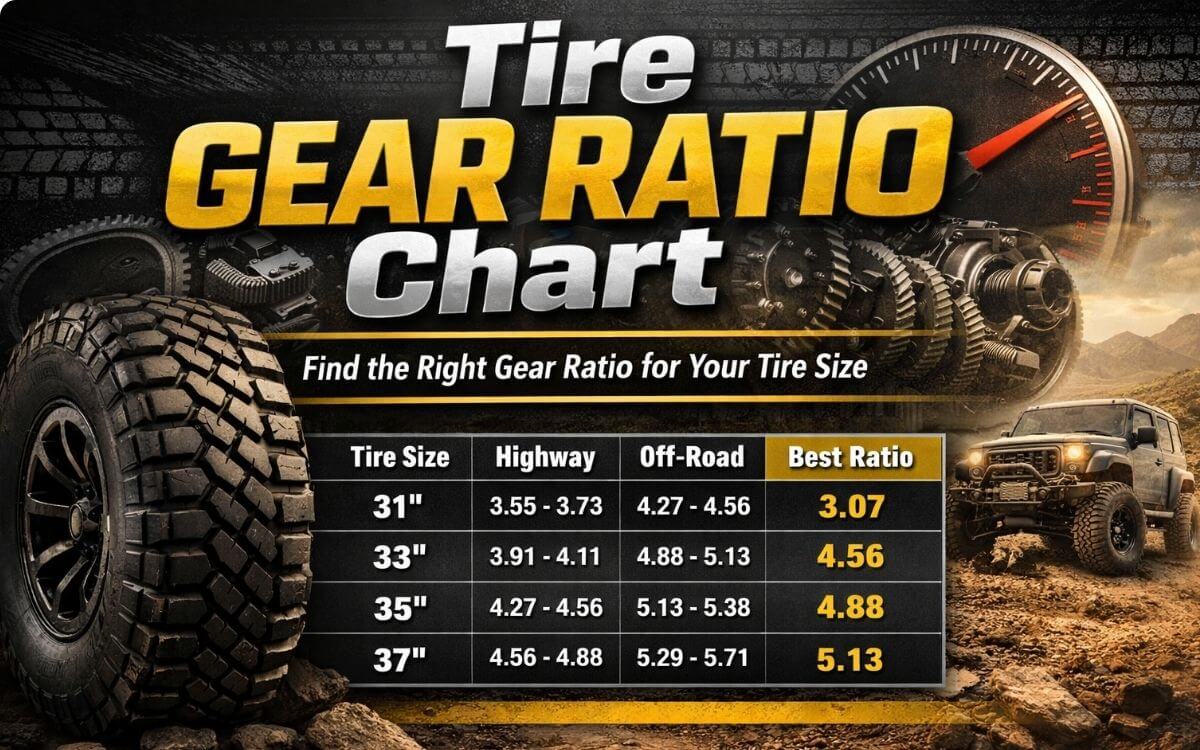
Tire Gear Ratio Chart
Use this chart as a practical starting point rather than a strict rulebook. The “best starting point” column is the one most people should look at first.
| Tire diameter | Highway-focused | Mixed daily driving | Tow / off-road / heavy load | Best starting point |
| 25″ | 2.73–2.94 | 3.07–3.21 | 3.31–3.55 | 3.07 |
| 26″ | 2.94–3.07 | 3.21–3.42 | 3.55–3.73 | 3.21 |
| 27″ | 3.07–3.21 | 3.31–3.55 | 3.73–4.11 | 3.42 |
| 28″ | 3.21–3.31 | 3.42–3.55 | 3.73–4.11 | 3.55 |
| 29″ | 3.31–3.42 | 3.55–3.73 | 3.91–4.11 | 3.73 |
| 30″ | 3.42–3.55 | 3.73–3.91 | 4.11–4.27 | 3.73 |
| 31″ | 3.55–3.73 | 3.91–4.11 | 4.27–4.56 | 4.10 |
| 32″ | 3.73–3.91 | 4.11–4.27 | 4.56–4.88 | 4.11 |
| 33″ | 3.91–4.11 | 4.27–4.56 | 4.88–5.13 | 4.56 |
| 34″ | 4.11–4.27 | 4.56–4.88 | 5.13–5.29 | 4.56 |
| 35″ | 4.27–4.56 | 4.88 | 5.13–5.38 | 4.88 |
| 36″ | 4.56 | 4.88–5.13 | 5.29–5.38 | 4.88 |
| 37″ | 4.56–4.88 | 5.13 | 5.29–5.71 | 5.13 |
| 38″ | 4.88 | 5.13–5.29 | 5.71 | 5.13 |
| 39″ | 4.88–5.13 | 5.29 | 5.38–5.71 | 5.29 |
| 40″ | 5.13 | 5.29–5.38 | 5.71–6.17 | 5.38 |
| 41″ | 5.13–5.29 | 5.38 | 5.71–6.17 | 5.71 |
| 42″ | 5.29 | 5.38–5.71 | 6.17 | 5.71 |
| 43″ | 5.38–5.71 | 5.71 | 6.17 | 6.17 |
| 44″ | 5.71 | 5.71–6.17 | 6.17 | 6.17 |
If you only remember one thing from this chart, remember this: the bigger the tire, the more gear you usually need to keep the vehicle feeling right.
How to Read the Tire Gear Ratio Chart
Reading the chart is easier than it looks. Start by finding your tire size in the left column. That tells you which row applies to your vehicle.
Next, look at the “Best starting point” column. This is usually the easiest choice for most drivers. It gives a gear ratio that balances power and drivability.
The other columns show different options depending on how you drive. If you mostly drive on the highway, look at the “Highway-focused” range. If you do a mix of city and light off-road driving, the “Mixed daily driving” range fits better. For heavy towing, off-road, or carrying extra weight, the “Tow / off-road / heavy load” range gives stronger performance.
Keep in mind, a higher gear ratio can make your vehicle feel stronger at low speeds, but it may increase engine speed on the highway. A lower ratio can be easier on fuel and quieter on the road, but the vehicle might feel slower, especially with bigger tires.
The chart is meant as a starting point. You can tweak your choice depending on your driving style and what feels right in real life.
Why Tire Size Changes Gear Choice
When you put bigger tires on your vehicle, each tire covers more ground with every turn. That sounds good, but it also means the engine has to work harder to move the vehicle.
If you keep the same gear ratio after increasing tire size, your vehicle may feel slower or less responsive. It might take longer to accelerate, climb hills, or pull heavy loads.
Smaller tires need less torque to turn, so they work fine with lower gear ratios. Bigger tires need more torque, which usually means you need a higher numerical gear ratio to keep your vehicle feeling strong.
The tradeoff is that higher gear ratios can make the engine spin faster at highway speeds, which might feel louder or slightly affect fuel efficiency. Choosing the right ratio is about balancing power, comfort, and how you drive.
How to Calculate the Correct Gear Ratio
There is a simple way to estimate a new gear ratio after a tire upgrade.
New Ratio = (New Tire Size ÷ Old Tire Size) × Old Gear Ratio
Here is a basic example.
Imagine your vehicle came with 29-inch tires and a 3.55 gear ratio. You want to move up to 35-inch tires.
The calculation would be:
(35 ÷ 29) × 3.55 = 4.28
That means a gear ratio around 4.30 would be a logical starting point. Since gear sets usually come in standard sizes, you would likely choose the nearest practical option, such as 4.10 or 4.56, depending on your driving style and vehicle use.
This formula is helpful because it gives you a starting point, but it should not be the only thing you use. Vehicle weight, transmission, engine power, and driving habits all matter too.
How to Choose the Right Gear Ratio
The easiest way to choose the right gear ratio is to start with your driving style.
If you drive mostly on the highway and want a quieter, calmer ride, you may prefer a milder ratio. That can help keep RPM lower, especially if your tire size is only a little larger than stock.
If you use the vehicle for daily driving with occasional trips off-road, a middle-ground ratio is often the best choice. It gives you better low-end power without making the engine feel too busy.
If you tow, haul, or spend a lot of time off-road, a deeper ratio is usually the smarter choice. It helps the vehicle stay in the power band and makes heavy tires easier to live with.
Before deciding, ask yourself three questions:
- What tire size am I running now?
- How do I use the vehicle most of the time?
- Do I care more about highway comfort or low-end power?
Those answers usually point to the right ratio faster than any chart alone.
FAQs
Does bigger tire size reduce gear ratio?
Yes, in effect it does. The axle gears do not change, but the taller tire makes the final drive feel taller, which reduces wheel torque.
What gear ratio is best for 35-inch tires?
A 4.88 ratio is a very common starting point for 35-inch tires. It often works well for mixed driving and light off-road use.
Do I need to re-gear for 33-inch tires?
Not always, but many vehicles benefit from it. If the vehicle feels sluggish, shifts too often, or tows poorly, a re-gear may help.
Will re-gearing fix my speedometer?
It can help if the speedometer error is related to tire size and the vehicle is recalibrated correctly after the gear change.
Is deeper gearing always better?
No. Deeper gearing helps with torque and drivability, but too much can raise RPM more than you want and reduce comfort on the highway.
Final Recommendation
The best tire gear ratio chart is the one that helps you make a real-world decision, not just stare at numbers. Tire size matters, but it is only part of the picture. Your vehicle’s weight, engine power, transmission, and driving style all play a role in choosing the right gear ratio.
If you are unsure where to start, use the chart as a baseline, then adjust based on how you actually drive. For most people, that means choosing a ratio that restores lost torque without making highway driving unpleasant.
