Toyo Open Country at3 Review: Is It Still Worth Buying?
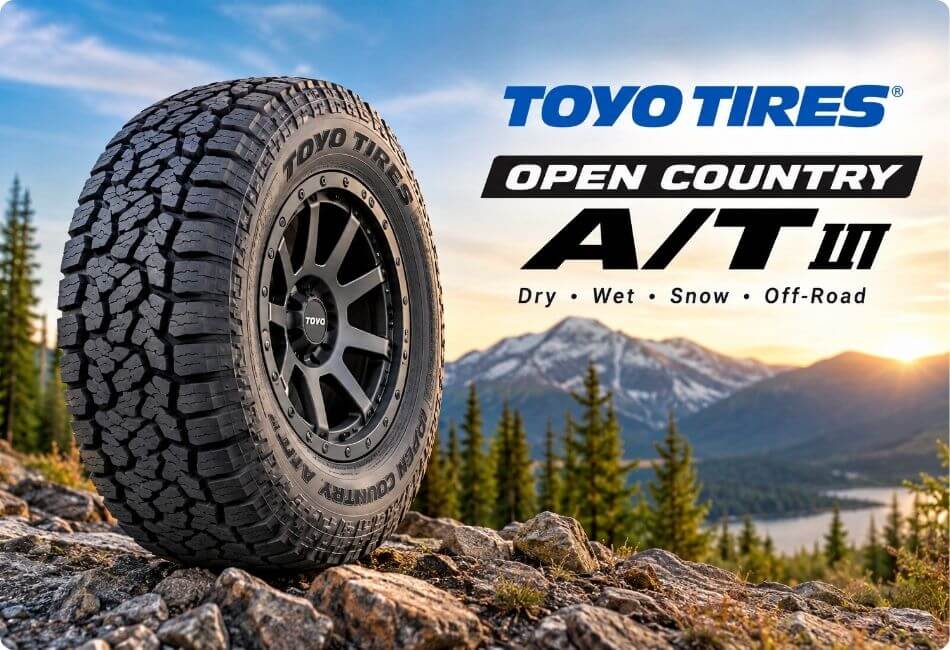
The Toyo Open Country at3 is a popular all-terrain tire designed for drivers who want a balance between highway driving and off-road capability. It combines an aggressive all-terrain tread with features aimed at improving traction on dirt, gravel, mud, and snow while maintaining predictable road manners for everyday driving.
But is the Toyo AT3 actually a good choice in 2026? Our Toyo Open Country AT3 review finds that it remains a strong all-around option, particularly for dry-road driving, off-road traction, durability, and moderate winter conditions. However, independent testing also shows that wet handling and aquaplaning resistance are not among its strongest areas, while ice performance is more limited than its 3PMSF rating might suggest.
That makes the AT3 a better fit for some drivers than others. If you spend most of your time on the highway but regularly drive gravel roads, trails, snow-covered roads, or work sites, the AT3 offers a compelling balance. If maximum wet-road grip, ice traction, or the quietest possible highway ride is your priority, another all-terrain or winter-oriented tire may make more sense.
In this review, we’ll examine the Toyo Open Country at3’s dry, wet, snow, ice, off-road, highway, comfort, noise, tread-life, and towing performance, then compare it with several popular alternatives to determine whether the AT3 is still worth buying.
Toyo Open Country at3 at a Glance
The Open Country at3 is an on/off-road all-terrain tire developed around a combination of road manners, off-road traction, winter capability and durability.

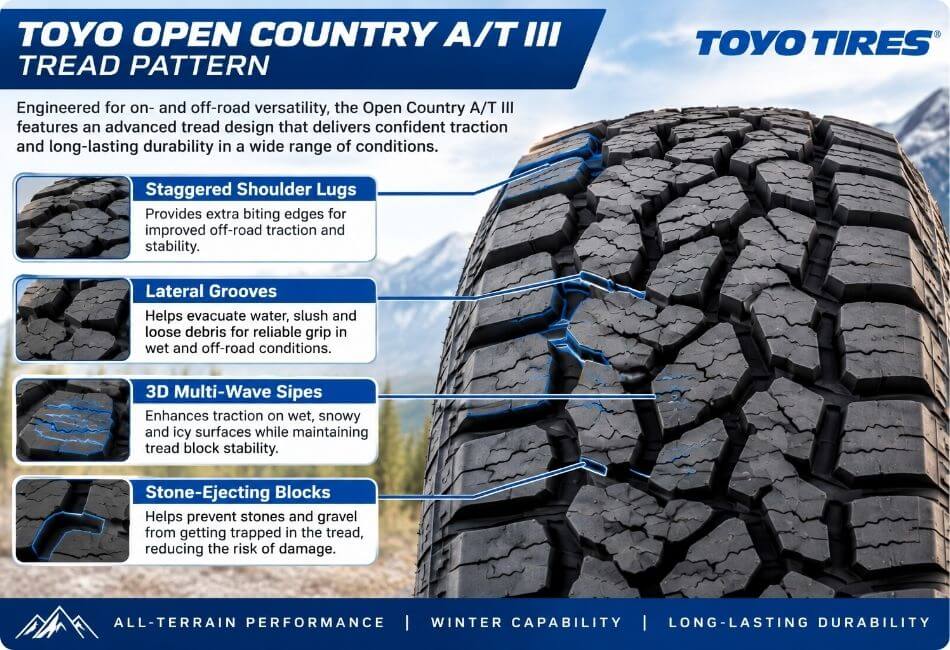
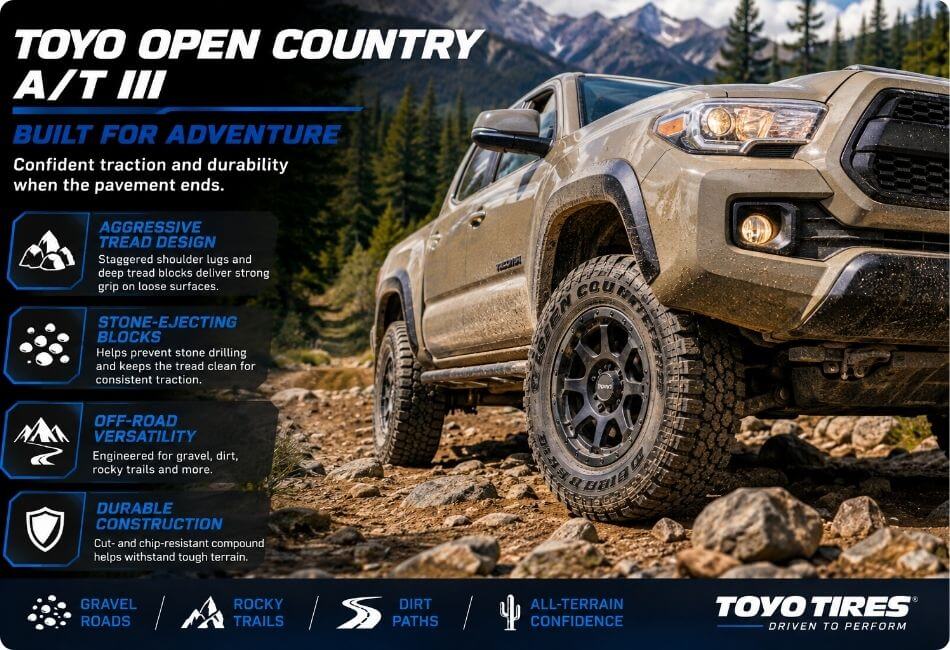
Toyo’s design incorporates features such as staggered shoulder lugs, stone-ejecting blocks, lateral grooves and 3D multi-wave sipes. The tire also carries the Three-Peak Mountain Snowflake (3PMSF) severe-snow designation. Toyo’s current specifications show that available speed ratings, load classifications and constructions vary considerably by size.
One of the AT3’s biggest practical advantages is its treadwear warranty. Toyo currently lists a 65,000-mile warranty for P/Euro-Metric sizes and a 50,000-mile warranty for LT and flotation sizes, subject to the manufacturer’s warranty terms.
| Category | Editorial Assessment |
| Dry Performance | Excellent |
| Wet Performance | Good, but not class-leading |
| Snow/Winter | Very good |
| Off-Road | Excellent for a balanced A/T |
| Highway | Very good |
| Comfort | Good |
| Noise | Acceptable, but not a standout |
| Tread Life & Durability | Excellent |
| Towing & Hauling | Very good with correct specification |
| Overall | 8.6/10 |
These are editorial scores, not official Toyo ratings and not a mathematical conversion of one laboratory test.
Toyo AT3 Dry Performance
Dry-road performance is one of the clearest strengths of the Toyo Open Country at3.
That matters because an all-terrain tire with substantial tread blocks and open grooves can easily sacrifice pavement precision in exchange for off-road traction. The at3 manages to retain a surprisingly strong level of dry-road capability.
The 2025 Tire Rack test is particularly useful here because it tested the at3 alongside eight other all-terrain tires on a Toyota Tacoma. The Toyo recorded 40.84 meters of dry braking and 6.19 points for subjective dry handling, producing a 97.7% dry-performance score. Its dry braking ranked fifth, but its subjective handling ranked third, only slightly behind the class leaders.
The 2025 ADAC test points in the same direction. The at3 recorded 46.7 meters in dry braking and received a 98.5% dry-performance score. ADAC specifically described the Toyo as an expert on dry surfaces and gave it the best dry-road grade in that test group.
The actual braking distances from these two tests should not be compared directly because the tests used different vehicles, tires, conditions and methodologies. What matters is the consistency of the conclusion: dry pavement is a genuine strength of the at3.
Steering Response
The steering character is more complicated.
The at3 does not feel like a highway-terrain or performance-oriented tire. At lower speeds, the steering can feel somewhat slower and less immediate than a road-focused tire. Tire Rack’s 2025 test specifically described the steering as rubbery and delayed at low speeds, although it improved at highway speeds.
That is a reasonable compromise for an all-terrain tire, especially one designed to retain useful off-road capability.
Once you’re traveling at highway speeds, the tire’s behavior becomes more settled and predictable.
Dry Braking
Dry braking is another area where the at3 performs well.
Its 40.84-meter result in Tire Rack’s 2025 test was not the shortest in the group, but it was competitive, and its overall dry category score was among the strongest.
The ADAC test produced a similarly strong result, giving the tire the best dry-road grade among the tested all-terrain tires.
Real-World Dry Driving
For everyday dry-road driving, the at3 offers the characteristics most truck and SUV owners actually need: predictable cornering, stable highway behavior and confident braking.
Its weakness on dry pavement is therefore not basic traction or stability. It is refinement. A driver accustomed to a highway tire may notice that the steering is less immediate and the tire feels more substantial.
For an all-terrain tire, however, the dry-road performance is one of the reasons the at3 works so well as a daily driver.
Toyo AT3 Wet Performance
Wet performance is where the Toyo at3 becomes much less straightforward.
Toyo designed the tire with wet traction in mind. Its tread incorporates lateral grooves and 3D multi-wave sipes, and Toyo specifically highlights wet braking and handling as part of the tire’s intended performance.
The independent evidence, however, shows that good wet performance and class-leading wet performance are two different things.
In Tire Rack’s 2025 test, the at3 recorded 50.00 meters in wet braking, 38.07 seconds in wet handling, and 6.31 points in subjective wet handling. Its resulting wet score was 93.3%.
Those are respectable results, but several competitors performed better.
The ADAC test reveals an even more important weakness. The Toyo received an 86% wet-performance result in the detailed test data, with a straight-line aquaplaning speed of 87.9 km/h and a curved-aquaplaning result of 2.41 m/s². ADAC specifically criticized the tire’s performance on wet asphalt, particularly in curved aquaplaning and wet handling.
What Does That Mean in Real Driving?
It does not mean the at3 is an unsafe tire in rain.
A tire can provide competent wet braking and predictable wet handling while still being weaker than its competitors when water becomes deep enough to create aquaplaning.
That distinction is important.
If you drive normally in rain, the at3 can be perfectly usable. But if wet-weather performance and hydroplaning resistance are among your highest priorities, the independent evidence gives you a legitimate reason to compare other all-terrain tires before buying.
Wet Braking vs. Hydroplaning
Wet braking and aquaplaning are related but different characteristics.
A tire may stop reasonably well on a wet road while still losing resistance to hydroplaning earlier than a competitor.
That is why simply describing the at3 as “good in rain” would be incomplete. Its wet performance is adequate for normal use, but it is not one of the tire’s strongest competitive advantages.
Owner Experience
Owner feedback adds another perspective because real-world drivers use the tire across many different vehicles, tire sizes, pressures and climates. Tire Rack currently shows a large body of consumer feedback for the at3, with the overall consumer rating remaining strong.
Owner feedback is useful for understanding long-term behavior, but controlled testing remains more useful when comparing wet braking, handling or aquaplaning between tires.
Toyo AT3 Snow & Winter Performance
The Toyo Open Country at3 is one of the more compelling all-terrain choices for drivers who regularly encounter snow but do not want to switch to a dedicated winter tire.
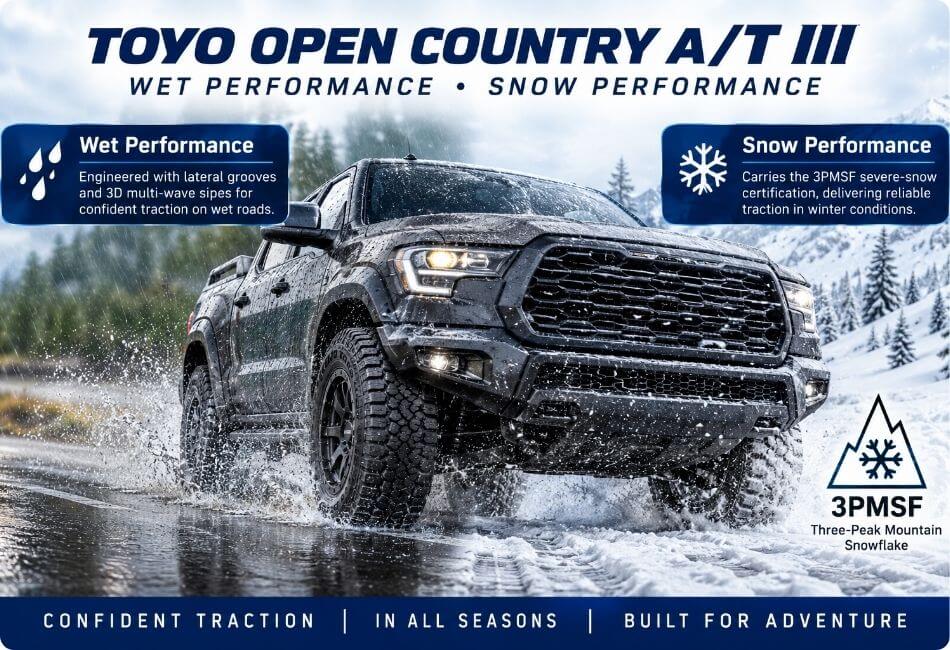
The reason is simple: the at3 carries the 3PMSF severe-snow designation. Toyo also uses lateral grooves and 3D multi-wave sipes as part of the tread design intended to provide winter traction.
But there is an important distinction that every buyer should understand.
Does 3PMSF Mean the AT3 Is a Dedicated Winter Tire?
No.
The 3PMSF symbol indicates that the tire meets the industry’s severe-snow performance requirements. It does not mean that an all-terrain tire performs identically to a dedicated winter tire in every cold-weather condition.
That distinction becomes particularly important on ice.
Snow Performance
The at3 performed well enough in the 2025 ADAC test to reinforce its winter credentials. It recorded 11.6 meters in snow braking and 1.65 seconds in snow traction, producing a 90.9% snow-performance score in the test data.
ADAC’s overall result placed the Toyo behind several competitors, but its snow performance was still clearly useful rather than merely symbolic.
For an all-terrain tire that also has to work on dry and wet pavement, that is a meaningful strength.
Snow vs. Ice
Snow and ice should not be treated as the same surface.
The at3 can be a very sensible choice for drivers who encounter ordinary winter snow, packed snow and seasonal cold-weather conditions. But if your driving regularly involves polished ice, freezing rain or severe icy mountain roads, a dedicated winter tire remains the more appropriate tool.
The difference is not simply tread pattern. Dedicated winter tires are engineered around cold-weather compounds and winter-specific tread characteristics.
Winter Driving for the Typical Truck or SUV Owner
For the typical truck or SUV owner who sees snow during winter but uses the vehicle year-round, the at3 offers a useful compromise.
You get a severe-snow-rated all-terrain tire without giving up the dry-road capability, durability and off-road versatility expected from an A/T tire.
That makes the 3PMSF rating genuinely useful rather than simply a marketing feature.
Toyo AT3 Off-Road Performance
Off-road capability is fundamental to the at3’s identity.
Toyo’s design includes staggered shoulder lugs, stone-ejecting blocks, lateral grooves and a tread compound designed with cut-and-chip resistance in mind. These features show that the tire was engineered for more than occasional pavement use.
But the important question is whether the at3 is an aggressive off-road specialist.
It isn’t. It is better described as a highly capable, balanced all-terrain tire.
That distinction matters because its tread has to work on pavement as well as off-road surfaces.
Gravel Performance
Gravel is arguably one of the at3’s most natural environments.
Its tread provides plenty of edges for loose surfaces, while the shoulder and block design provide additional traction when the road becomes rougher.
The 2025 ADAC test included a dedicated gravel assessment, where the at3 recorded 3.28 seconds in gravel traction and received a 95.4% gravel/off-road category score in the published results.
This is strong evidence for gravel performance.
It is worth being precise, however: this ADAC result is not evidence that the tire was independently tested on every type of rock, sand and mud. Those conditions require different testing and should not be conflated with the gravel result.
Dirt and Trail Performance
The at3’s design is well suited to hard-packed dirt roads, forest roads, ranch roads and recreational trails.
The staggered shoulder lugs provide additional edges as the surface becomes loose, while the tread design gives the tire more mechanical grip than a highway-terrain tire.
That makes it a sensible choice for weekend trail use where the terrain is varied but not extremely technical.
Rock Performance
The at3 can be used on rocky trails, but increasingly technical terrain places greater importance on tire pressure, wheel protection and driving technique.
Its tread and shoulder construction are designed to improve durability and traction, but no all-terrain tire should be treated as puncture-proof or immune to sidewall damage.
If your normal driving involves extreme rock crawling, you are moving beyond the application where a balanced A/T tire is the obvious choice.
Sand Performance
The at3 can be used on sand, but sand performance depends heavily on the vehicle and setup.
Tire pressure, vehicle weight, tire dimensions and driving technique can have a major influence on whether a vehicle floats over loose sand or digs into it.
For that reason, it would be misleading to promise a particular level of deep-sand performance based solely on the tire’s tread pattern.
Mud Performance
The at3 is capable in light and moderate mud, but it is not a dedicated mud-terrain tire.
When mud becomes deep, wet and sticky, a more open and aggressively self-cleaning tread can have an advantage.
That creates a useful boundary for buyers: the at3 is excellent for mixed terrain, gravel, dirt and recreational trails, but drivers who regularly encounter deep mud or extreme technical terrain should look toward a more specialized tire.
Stone Ejection and Cut/Chip Resistance
The stone-ejecting blocks are one of the more practical features of the at3 for gravel-road users.
Toyo specifically highlights this design along with cut-and-chip resistance.
That does not make the tire immune to punctures. Instead, it reflects a design priority: surviving the repeated impact and abrasion associated with rougher surfaces.
Toyo AT3 Highway Performance
Highway driving is where the at3’s balanced design becomes particularly valuable.
Toyo describes the tire as providing responsive and predictable on-road handling while retaining off-road capability.
The 2025 Tire Rack test supports much of that description. The at3 completed the emergency lane-change test consistently and was described as predictable and trustworthy within its operating limits.
Does the Aggressive Tread Ruin Highway Handling?
No.
But it does change the character of the vehicle compared with a highway-terrain tire.
The at3 can feel less immediate in its steering response, and the tire’s substantial construction and tread are more noticeable from behind the wheel. Tire Rack specifically found the steering rubbery and delayed at low speeds, although it improved at highway speeds.
That is a trade-off rather than a fundamental weakness.
The tire is giving you considerably more capability when the pavement ends, and you can feel some of that compromise when you’re driving around town.
Long Highway Trips
For long highway trips, the at3 is still a very usable tire.
Its strongest quality is predictability rather than sporty steering. A driver who regularly travels several hundred highway miles before reaching a gravel road or trail will probably appreciate that balance.
The bigger issue for long-distance drivers is refinement. Ride harshness and tread noise are more noticeable weaknesses than highway stability itself.
High-Speed Behavior
There is no single speed rating for every at3.
Toyo’s current size chart shows multiple speed ratings depending on the exact tire specification, including Q, R, S, T and H applications.
Therefore, the correct speed rating must always be checked for the exact tire size and service description rather than assumed from the at3 name.
Toyo AT3 Comfort & Ride Quality
Comfort is one area where you cannot judge the at3 simply by looking at its tread pattern.
A P-metric at3 and an LT Load Range E version can feel substantially different because tire construction, load capacity, inflation pressure, vehicle weight and suspension all influence ride quality.
The 2025 Tire Rack test gives us an important controlled reference point. The at3 received 6.0 subjective comfort points, ranking seventh of nine tires. Tire Rack described its ride as notably stiff over sharp bumps and bridge joints.
That is a genuine weakness.
However, it does not mean every AT3-equipped vehicle will feel uncomfortable.
A lighter P-metric application on a well-sprung SUV can behave differently from a heavy LT version installed on a three-quarter-ton pickup.
P-Metric AT3
P-metric versions are generally intended for vehicles and applications that do not require LT-level load capacity. When correctly matched to the vehicle, their lighter construction can provide a more compliant unloaded ride.
That makes them attractive for drivers who use their truck or SUV primarily as a daily vehicle.
LT AT3
LT versions are built for higher load requirements.
That additional structure is useful when carrying heavy payloads or towing, but it can also make the ride firmer when the truck is unloaded.
This is why simply saying “LT is better” is misleading. LT is better when the vehicle and workload require LT construction.
Why Do Owner Experiences Differ From Controlled Testing?
This is where owner data becomes useful.
Tire Rack has a large body of consumer feedback for the at3, and its overall consumer rating remains strong.
Owners are using the tire on different vehicles, in different sizes and at different pressures. A controlled test, by contrast, evaluates one specific configuration under a defined test procedure.
The most defensible conclusion is therefore that the at3 can provide good everyday comfort for an all-terrain tire, but its ride quality is highly dependent on the vehicle and construction, and independent testing identifies sharp-impact harshness as a relative weakness.
Toyo AT3 Road Noise
Road noise deserves separate attention because an A/T tire can provide acceptable ride comfort while still producing noticeable tread noise.
Toyo has designed the at3 with tread features intended to manage pattern noise, and the company positions it as a tire capable of combining off-road traction with on-road usability.
Owner experience is generally favorable, but controlled testing paints a more cautious picture.
In Tire Rack’s 2025 test, the at3 received 5.25 subjective noise points, ranking eighth out of nine tested tires. The test commentary described multiple intrusive tones across different driving conditions.
That is significant because the test specifically focused on how all-terrain tires behave on paved roads in everyday use.
Why Does Noise Vary So Much?
The noise you hear from an A/T tire depends on much more than tread design.
Pavement texture, tire size, tread depth, wear pattern, vehicle insulation, speed, inflation pressure and suspension can all influence what reaches the cabin.
A new at3 on a well-insulated SUV can therefore sound considerably different from a worn LT version on a work truck.
Does Tread Wear Increase Noise?
It can.
As tread blocks wear and irregular wear develops, the pattern of sound can change. That is one reason proper rotation, alignment and inflation are important not only for tread life but also for maintaining acceptable noise characteristics.
Is the AT3 Too Loud for Daily Driving?
For most drivers who specifically want an all-terrain tire, no.
But if your highest priority is a quiet, luxury-like highway cabin, the at3 is not the tire I would choose solely for refinement. The independent testing gives competitors a clear advantage in this area.
Toyo AT3 Tread Life & Durability
Tread life is one of the strongest reasons to consider the Toyo Open Country at3.
Unlike a claim based solely on owner impressions, the tire has a clearly stated manufacturer warranty. Toyo currently lists 65,000 miles for P/Euro-Metric sizes and 50,000 miles for LT and flotation sizes, subject to the warranty’s conditions.
That distinction is important.
It would be inaccurate to simply tell every buyer that the AT3 “has a 65,000-mile warranty.” The construction and size determine which warranty applies.
Owner Mileage Data
The at3 also has a substantial amount of real-world consumer feedback. Tire Rack currently lists hundreds of survey ratings for the tire, and the overall consumer rating remains strong.
Some individual owners report very high mileage and heavy towing use, but those reports should be treated as examples rather than promises. One owner’s mileage cannot establish how long every set will last.
Actual tread life depends heavily on alignment, inflation, rotation, vehicle weight, driving style, towing, road surface and the amount of off-road use.
Uneven Wear
Toyo’s tread design is intended to help manage irregular wear, but no tread pattern can overcome poor maintenance.
Incorrect alignment, worn suspension components, incorrect pressure and failure to rotate the tires can all cause premature or uneven wear.
This is particularly important for trucks because heavier vehicles and towing can place substantially greater demands on the tread.
Cut and Chip Resistance
Toyo also specifically identifies cut-and-chip resistance as part of the at3’s design.
That is particularly relevant to drivers who spend a lot of time on sharp gravel.
Again, this should not be interpreted as puncture protection. It means the tire has been designed with rough-surface durability as an important consideration.
Long-Term Durability
Taken together, the warranty, construction and real-world owner feedback support a strong conclusion:
The Toyo Open Country at3 is a durability-focused all-terrain tire with a strong treadwear reputation.
What the evidence does not justify is promising that every driver will achieve a particular mileage figure.
Toyo AT3 for Towing and Hauling
The Toyo at3 can be a good towing and hauling tire, but the specific tire configuration matters enormously.
An LT at3 designed for higher load requirements should not be evaluated in exactly the same way as a lighter P-metric version.
Most importantly, changing tires does not increase a truck’s legal or engineering-rated towing capacity. Your vehicle remains limited by its manufacturer-rated towing capacity, GVWR, axle ratings, hitch rating and other components.
Towing Stability
A correctly specified LT tire can provide the load capacity and structural characteristics required for heavier applications, but the tire itself does not prevent trailer sway.
Towing stability also depends on trailer loading, tongue weight, hitch setup, suspension condition, tire pressure and vehicle weight distribution.
The right way to think about the at3 is therefore that it can be an appropriate component of a properly configured towing setup—not that the tire itself creates towing stability.
Load Range E for Heavy-Duty Use
Load Range E at3 versions can make sense for heavy-duty applications when the vehicle and workload actually require that capacity.
They are particularly relevant to trucks that regularly carry heavy payloads or tow substantial trailers.
But Load Range E is not automatically better for every pickup.
If your truck does not require that level of load capacity, the additional tire weight and firmer construction may provide little practical benefit during normal unloaded driving.
Does a Heavier AT3 Affect Ride and Fuel Economy?
Potentially, yes.
A heavier LT tire can increase unsprung and rotational mass and may make the steering and ride feel heavier. It can also affect fuel consumption.
However, there is no responsible universal MPG penalty to quote because the effect depends on tire size, wheel weight, gearing, pressure, vehicle configuration and driving conditions.
For towing, the correct question is therefore not “Is the heaviest AT3 best?” but rather “Which AT3 construction meets my vehicle’s actual load requirements without unnecessary weight?”
Toyo AT3 P-Metric vs LT: Which Should You Buy?
This is one of the most important decisions when buying the at3 because the construction can significantly affect how the tire feels and performs.
P-Metric AT3
A P-metric at3 generally makes the most sense when the vehicle is designed for passenger-metric tires and the driver’s normal workload does not require LT-level capacity.
Its lighter construction can be advantageous for daily driving because it can provide a more compliant unloaded ride and may carry less rotational mass than a comparable heavy-duty LT tire.
That does not make P-metric universally better. It simply means that it is often the more appropriate construction for vehicles and workloads that do not need LT capacity.
LT AT3
LT versions are designed for applications requiring greater load capability.
They make more sense for heavier-duty pickups, frequent towing, substantial payloads and work-oriented use.
The trade-off is that the heavier construction can produce a firmer unloaded ride and add weight.
That is why buying an LT tire simply because it appears “stronger” is not necessarily the right decision.
Load Range C, D and E
Load range describes the tire’s load-carrying classification. The exact load range available depends on the specific at3 size and construction.
Toyo’s current specifications use C, D, E and F ply-rating designations on applicable sizes, with the manufacturer listing C as a 6-ply rating, D as 8-ply, E as 10-ply and F as 12-ply. These are ply-rating classifications and should not be interpreted as literally meaning the tire contains that number of physical plies.
The correct choice is the one required by the vehicle and workload—not automatically the highest available rating.
Which Is Better for Daily Driving?
If your vehicle is approved for P-metric tires and you primarily use it as a daily driver without heavy loads, P-metric is generally the more sensible choice.
It avoids paying the ride and weight penalty of a heavier construction that you may not need.
Which Is Better for Towing?
For heavier towing, the appropriate LT configuration is generally the better choice when required by the vehicle’s load demands.
The key word is appropriate. Always match the tire’s load capacity to the vehicle manufacturer’s requirements rather than selecting a load range simply because it is higher.
Toyo AT3 Sizes, Load Ratings and Fitment
The Open Country at3 is available in a wide range of sizes for trucks, SUVs and crossovers. Because the construction, load index, speed rating and load range can change from one size to another, buyers should always check the exact specification rather than assuming all at3 tires behave identically.
Popular AT3 Sizes
The tire is available for a broad range of popular applications, including vehicles from Toyota, Ford, Chevrolet, GMC, Ram and Jeep.
But vehicle fitment is determined by the exact year, trim, wheel size and approved tire specification.
A tire size that fits one Tacoma, F-150 or Wrangler does not automatically fit every version of that vehicle.
That is particularly important when moving to a larger-diameter or wider tire, because clearance, gearing, load capacity and speedometer calibration can all be affected.
How to Choose the Correct Load Index
The load index is the numerical portion of the tire’s service description.
For example, in 115T, 115 is the load index and T is the speed rating.
LT tires can also use dual load-index markings, such as 121/118S, where the two numbers correspond to single- and dual-application load ratings.
The correct load index should meet or exceed the vehicle manufacturer’s requirement for the application.
How to Choose the Correct Speed Rating
Speed ratings vary by the exact at3 size.
Toyo’s current specification chart lists ratings ranging from Q through H on applicable sizes, with Q rated to 99 mph, R to 106 mph, S to 112 mph, T to 118 mph and H to 130 mph under standardized test conditions.
These numbers are tire speed-rating limits under specified test conditions, not recommended driving speeds.
The replacement tire should meet the vehicle manufacturer’s requirements.
Check Your Vehicle’s OEM Tire Size Before Buying
The safest starting point is your vehicle’s door-jamb tire placard and owner’s manual.
If the vehicle has already been modified, do not automatically assume that the tire currently installed is the original OEM size.
Check the manufacturer’s approved specification before ordering the at3.
This becomes especially important when considering LT tires, larger sizes or different load ratings.
Toyo AT3 vs Other Popular All-Terrain Tires
There is no single all-terrain tire that is best for every truck and SUV.
The more useful question is which tire’s strengths best match the way you actually drive.
Toyo AT3 vs BFGoodrich KO3
The BFGoodrich All-Terrain T/A KO3 is one of the most obvious alternatives for buyers looking for a rugged all-terrain tire.
The comparison is less about one tire being universally superior and more about priorities.
The at3 makes a strong case for drivers who want a balanced combination of dry-road performance, snow capability, treadwear and mixed-terrain use.
The KO3 is especially attractive to buyers who put greater emphasis on rugged off-road use and BFGoodrich’s all-terrain platform.
If your truck spends most of its time commuting and highway driving but regularly ventures onto gravel and trails, the Toyo’s balance is compelling. If your use shifts more heavily toward rough terrain, the KO3 deserves serious consideration.
Toyo AT3 vs Falken Wildpeak AT4W
The Falken Wildpeak A/T4W is another major competitor in the all-terrain category.
There is useful independent evidence showing that the Wildpeak platform can be extremely competitive. However, one important detail should not be overlooked: the 2025 ADAC test used the Falken Wildpeak AT AT3WA, the European-market product, rather than simply testing a U.S.-specification A/T4W and calling the two identical. The Falken finished first in that test at 97.5%, while the Toyo at3 scored 93.2%.
Therefore, that result is evidence that Falken’s tested product was highly competitive; it should not be presented as a direct laboratory comparison between an American A/T4W and the Toyo at3.
For a buyer, both remain strong choices. The Toyo’s established balance of dry-road behavior, snow capability, off-road usability and durability makes it particularly attractive for mixed-use driving.
Toyo AT3 vs Nitto Terra Grappler G3
The Nitto Terra Grappler G3 is a more natural comparison because it is also aimed at drivers who want meaningful all-terrain capability without moving completely into a mud-terrain tire.
The choice here depends heavily on the exact vehicle, tire size, load rating, climate and road/off-road split.
The at3 has the advantage of a long-established market presence and strong treadwear reputation.
The Terra Grappler G3 is an appealing alternative for buyers who specifically prefer Nitto’s design and want a newer all-terrain option.
There is no strong reason to declare one universally superior without controlling for those factors.
Who Should Buy the Toyo AT3?
The Toyo Open Country at3 makes the most sense for the truck or SUV owner who wants one set of tires to cover several environments without becoming excessively specialized in any one direction.
It is particularly well suited to someone whose driving is mostly pavement but includes gravel roads, forest roads, recreational trails and seasonal snow. It also makes sense for owners who value durability and need an all-terrain tire that remains practical for everyday highway driving.
In other words, the ideal at3 buyer is not necessarily an extreme off-roader.
It is the driver who wants to go from highway to gravel to snow to trail and back home again without changing tires.
That is exactly where the at3’s balanced character becomes valuable.
Who Should NOT Buy It?
The at3’s compromises become more important when your needs are highly specialized.
If maximum wet-road performance is your highest priority, recent independent testing gives you reasons to consider alternatives, particularly because aquaplaning performance is not one of the Toyo’s strongest areas.
If you regularly drive on severe ice, a dedicated winter tire is a better choice. The 3PMSF symbol makes the at3 a capable severe-snow all-terrain tire, but it does not turn it into a dedicated winter tire.
The same applies to deep mud and extreme rock crawling. The at3 is capable in mixed off-road conditions, but drivers who routinely encounter highly specialized terrain may benefit from a tire designed specifically around that environment.
Finally, if your truck or SUV almost never leaves pavement and your biggest priorities are a quiet cabin and soft ride, you may be better served by a highway-terrain tire.
The at3 is designed to give you capability beyond pavement. If you never use that capability, you may be carrying compromises you do not need.
Final Verdict: Is the Toyo AT3 a Good Tire?
Yes—but its biggest strength is balance, not specialization.
The Toyo Open Country at3 is a compelling choice for the truck or SUV owner who wants:
highway capability + gravel + dirt + trails + snow + durability
without moving to an extremely aggressive tire.
Independent testing supports that conclusion, particularly on dry pavement and general all-terrain use. The 2025 ADAC test found the AT3 to be the strongest dry performer in its field, while the Tire Rack test found it predictable and trustworthy during emergency maneuvers.
But the review should not hide the weaknesses.
The AT3’s wet performance is clearly less impressive than its dry performance, especially in aquaplaning situations. Ride firmness and noise are also meaningful compromises, particularly for drivers expecting highway-tire refinement.
