BFGoodrich KO3 Review: Is This All-Terrain Tire Worth It?
The BFGoodrich KO3 is an all-terrain tire designed for drivers who want a stronger mix of highway usability and off-road capability. Introduced in 2024 as the successor to the KO2, the BFGoodrich All-Terrain T/A KO3 features an updated tread design, new all-terrain compound, full-depth 3D locking sipes and reinforced sidewall construction. It is also 3PMSF Severe Snow Rated and carries a 50,000-mile limited mileage warranty.
But is the BFGoodrich KO3 actually worth buying? Independent testing shows a tire with clear strengths and trade-offs. The KO3 performs particularly well in snow and loose-surface conditions, while dry emergency braking and ice performance are areas where some competitors have an advantage.
In this BFGoodrich KO3 review, we’ll look at its dry, wet, snow and off-road performance, highway comfort, tread life, durability, warranty and potential drawbacks. We’ll also compare it with leading all-terrain alternatives and explain who should buy the KO3—and who may be better served by another tire.
Quick Verdict
Yes—the BFGoodrich KO3 is a good all-terrain tire, but it is not the best choice for every driver.
Its strongest case is for pickup and SUV owners who regularly mix highway driving with gravel, dirt, trails or snow. The KO3 has produced strong results in independent snow and dirt testing and offers construction specifically designed around rough-terrain durability.
The trade-off is on-road performance. In the latest 2026 independent comparison, the KO3 had the longest dry-braking distance of the tested group, while its 2025 ice results were last for both ice braking and ice traction.
Our take: The KO3 makes the most sense when off-road capability, snow traction, durability and mixed-terrain versatility matter more than having the sharpest road manners or strongest ice performance.
Best for: Mixed highway, gravel, dirt, trail and snow driving.
Less ideal for: Mostly-highway use, ice-heavy winters, or drivers who prioritize maximum dry-road braking performance.
BFGoodrich KO3 at a Glance
The BFGoodrich All-Terrain T/A KO3 is an all-terrain tire designed for CUVs, SUVs and pickups. BFGoodrich classifies it as All-Weather and Severe Snow Rated (3PMSF) and currently lists a 50,000-mile mileage warranty and 60-day satisfaction guarantee.
| Specification | BFGoodrich KO3 |
| Tire Type | All-Terrain |
| Manufacturer Classification | All-Weather |
| 3PMSF Severe Snow Rated | Yes |
| Designed For | CUVs, SUVs & Pickups |
| Mileage Warranty | 50,000 miles |
| Satisfaction Guarantee | 60 days |
| Standard Limited Warranty | 6 years, subject to warranty terms |
| Load Range | Size-specific |
| Load Index | Size-specific |
| Speed Rating | Size-specific |
| Maximum Inflation Pressure | Size-specific |
| Tire Weight | Size-specific |
Specifications such as load index, load range, speed rating, maximum inflation pressure and weight vary by tire size and construction. For that reason, those figures should always be checked against the exact KO3 size being purchased rather than treated as universal specifications. BFGoodrich’s current product listings show different service configurations across the range.
Important: The 50,000-mile figure is a limited mileage warranty, not a guarantee that every KO3 will deliver 50,000 miles of actual tread life.

What Is the BFGoodrich All-Terrain T/A KO3?
The BFGoodrich All-Terrain T/A KO3 is the third-generation tire in BFGoodrich’s All-Terrain line, introduced in 2024 as the successor to the KO2. It was developed to balance everyday road use with more demanding surfaces such as gravel, dirt, trails and snow.
The KO3 uses a new all-terrain tread compound and tread pattern, an optimized footprint and full-depth 3D locking sipes. BFGoodrich also uses a serrated shoulder design and Mud-Phobic Bars to support traction and tread clearing in mud and snow.
For durability, the KO3 incorporates CoreGard Technology, including split- and bruise-resistant sidewall rubber and an Advanced Deflection Design intended to help reduce the risk of sidewall damage from protruding objects.
BFGoodrich says the KO3 provides 15% better wear performance, 20% better gravel-road durability and improved snow traction compared with the KO2. Those are manufacturer claims and should not be confused with independently measured improvements in every driving condition.
Bottom line: The KO3 is best understood as a durability-focused all-terrain tire designed to balance everyday road use with genuine mixed-terrain capability, rather than as a dedicated highway, winter or mud-terrain tire.
How We Evaluate the BFGoodrich KO3
A useful tire review should not treat manufacturer claims, controlled testing and real-world driving impressions as the same type of evidence.
For this review, we separate BFGoodrich’s published specifications and product claims from independent comparative testing and documented real-world testing. Independent testing is particularly useful for braking, handling, snow and ice because those categories can reveal trade-offs that specifications alone cannot show.
Where BFGoodrich reports an improvement—such as better wear, gravel-road durability or snow traction—we identify it as a manufacturer claim rather than presenting it as independently proven performance.
We also consider real-world testing where it provides useful context. MotorTrend, for example, tested the KO3 on wet pavement, gravel, rocky and rutted roads, mud and sand in Alaska. Because that was a specific vehicle, tire size and test environment, we use it as real-world evidence rather than treating every observation as universal.
The goal is simple: distinguish what the KO3 is designed to do, what independent testing shows it can do, and where the available evidence has limitations.
BFGoodrich KO3 Performance
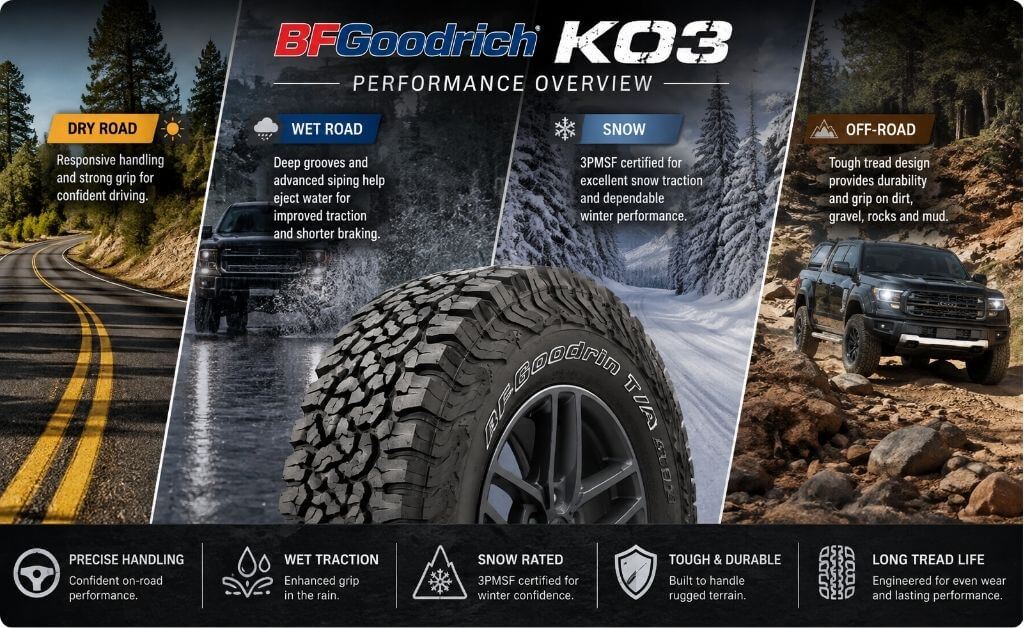
The BFGoodrich KO3 is designed to balance everyday road use with genuine off-road capability, so its performance depends heavily on the surface. Independent testing shows a clear pattern: the KO3 is particularly strong in snow and loose terrain, while dry emergency braking and ice performance are more significant compromises. Real-world testing also supports its ability in mud, sand, gravel and wet conditions, although some terrains have not been tested extensively enough to justify broad claims.
Dry-Road Performance
The KO3 is capable on dry pavement, but dry emergency braking is one of its clearest weaknesses. In the latest 2026 independent all-terrain comparison, it recorded a 47.06-meter dry-braking distance from 100 to 10 km/h, the longest stopping distance among the eight competing tires tested. Its subjective dry-handling score was 9 out of 10, placing it in the middle of a closely grouped field rather than at the front.
That result should not be interpreted as proof that the KO3 has poor dry traction. The test measures specific aspects of road performance, and the KO3 remains an all-terrain tire designed around a broader range of conditions. The more useful takeaway is that it does not match the best tires in this test when the priority is maximum dry-road braking performance.
For normal highway and everyday driving, that distinction matters. The KO3 can still provide predictable road manners, but drivers who place a high priority on the shortest possible emergency stopping distance or more road-focused handling may find better-suited options in less aggressive all-terrain or highway-oriented tires.
Our take: Dry pavement is not a reason to rule out the KO3, but it is not where this tire makes its strongest case. Its value becomes more apparent when dry-road driving is combined with snow, gravel, dirt and other demanding surfaces.
Wet-Road Performance
The KO3’s wet-road performance is more balanced than its dry-braking result suggests. In the 2026 independent test, it stopped from 100 to 10 km/h in 40.23 meters, ranking third among the eight competing tires. Its wet-handling time was 129.16 seconds, placing it fourth, while its subjective wet-handling score was 8 out of 10.
The same test also recorded 102.1 km/h in straight-line aquaplaning, good enough for third place. That means the KO3 was not simply an underperformer in wet conditions; its results varied by the type of wet-road test being measured.
Real-world testing provides additional context. During MotorTrend’s Alaska test, the KO3 spent about an hour on very wet highway pavement before moving onto gravel and trails. The testers reported strong grip even when deliberately trying to break traction. However, that was a real-world driving assessment rather than a controlled wet-braking or wet-handling test, so it should be viewed as supporting evidence rather than a replacement for instrumented testing.
Our take: The KO3 is wet-road capable and competitive, but it is not consistently class-leading across every wet-performance measurement. For mixed highway and off-road use, wet performance is not a major reason to avoid it. Drivers who spend almost all their time on wet pavement may still benefit from a more road-focused tire.
Snow Performance
Snow is one of the KO3’s strongest performance areas. In the 2025 independent winter A/T test, it recorded the best snow traction result at 3.55 seconds, finished second in snow handling at 101.09 seconds, and third in snow braking at 22.63 meters. It also received the test’s highest subjective snow-handling score.
The 2026 all-terrain comparison produced a similarly strong result, although the KO3 did not lead every snow category. It placed third in snow traction, fourth in snow braking and fourth in snow handling, remaining close to the leading tires in each measurement.
That performance is consistent with the tire’s design. BFGoodrich uses a new all-terrain compound, full-depth 3D locking sipes, an updated serrated shoulder and Mud-Phobic Bars, and the KO3 carries the 3PMSF Severe Snow Rating. BFGoodrich says these changes were developed to improve snow traction compared with the KO2.
Still, 3PMSF does not make the KO3 a dedicated winter tire. The certification indicates that the tire meets a defined severe-snow traction requirement; it does not mean the KO3 will provide the same level of grip as a specialized winter tire in every winter condition, particularly on ice.
Our take: Snow is a genuine strength of the KO3. It is a strong option for drivers who regularly encounter snow-covered roads, winter backroads and mixed snow-and-dirt conditions. The picture changes when winter driving is dominated by ice, where the KO3’s performance is considerably less convincing.
Ice Performance
Ice exposes one of the KO3’s biggest limitations. In the 2025 independent winter A/T test, the KO3 finished last among the five tires tested for both ice braking and ice traction. It required 13.14 meters to stop on ice and recorded 2.11 seconds in the ice-traction test.
The contrast with snow performance is particularly important. In that same winter test, the KO3 recorded the best snow-traction time, while its ice results were last in both measured categories. This shows why a 3PMSF-rated all-terrain tire should not automatically be treated as an alternative to a dedicated winter tire.
The distinction is also supported by real-world winter testing. OVR Mag found the KO3 capable in the snow encountered during its British Columbia testing but noted that dedicated winter tires would be a better choice for the icy section. That experience was not a controlled laboratory comparison, so it should be treated as contextual rather than definitive testing evidence.
Our take: The KO3 makes more sense for drivers who regularly encounter snow and mixed winter surfaces than for those who routinely drive on persistent or polished ice. If ice is a major part of your winter driving, a dedicated winter tire is the better direction.
Gravel and Dirt Performance
Gravel and dirt are among the KO3’s strongest use cases. In the 2026 independent all-terrain comparison, it finished third in measured dirt handling at 74.87 seconds and also received an 8.4/10 subjective dirt-handling score. That places it near the front of the tested group and supports the KO3’s positioning as a serious mixed-terrain tire.
The KO3’s construction is also specifically designed around this type of use. BFGoodrich uses an updated tread pattern and all-terrain compound, an optimized footprint, full-depth 3D locking sipes and reinforced sidewall construction. The company says these changes are intended to improve durability and performance on gravel and other rough surfaces.
BFGoodrich specifically claims 20% better gravel-road durability than the KO2. That figure should remain clearly attributed to the manufacturer; it is not the same thing as an independent test demonstrating a measured 20% improvement.
MotorTrend’s real-world Alaska testing adds useful context. The KO3 was driven over graded gravel roads and rocky, rutted shelf roads, where the testers noted relatively little gravel being thrown into the vehicle’s wheel wells. They also observed good performance as the terrain became rougher.
Our take: Gravel and dirt are areas where the KO3’s design makes practical sense. The independent dirt results and real-world testing support its ability on loose surfaces, while BFGoodrich’s durability improvement remains a manufacturer claim rather than an independently verified percentage.
Mud Performance
The KO3 is capable in mud for an all-terrain tire, but it is not a mud-terrain tire. Its updated serrated shoulder design and Mud-Phobic Bars are intended to help the tread resist packing with mud while maintaining usable traction. BFGoodrich specifically identifies these features as improvements aimed at mud and snow performance.
MotorTrend’s Alaska test provides useful real-world evidence. The KO3 was driven through deep, sloppy mud on a loaded Toyota Tacoma, and the testers found that it continued to move the truck forward despite conditions that would normally favor a more specialized mud-terrain tire. They also noted that the Mud-Phobic Bars helped the tread clear sticky mud instead of becoming heavily packed.
The same test is important for understanding the KO3’s limits. MotorTrend did not conclude that it matched a mud-terrain tire; instead, the testers specifically described the KO3 as an all-terrain tire and noted that it performed admirably despite the muddy conditions.
Our take: The KO3 is well suited to muddy trails, wet dirt and mixed off-road conditions, especially for drivers who still need to spend significant time on pavement. If deep, sticky mud is a primary part of your driving, a dedicated mud-terrain tire remains the more appropriate choice.
Rock and Sand Performance
The KO3 has demonstrated useful capability on sand, rocky backroads and uneven loose terrain, but the evidence does not justify presenting it as an extreme rock-crawling tire. In MotorTrend’s Alaska test, the tire was driven across rocky, rutted shelf roads and through a sandy area containing deep puddles and steep loose climbs. The testers reported that the tread cleared loose, wet sand effectively and provided ample forward traction.
Its construction is also aimed at protecting the tire when conditions become rough. BFGoodrich uses CoreGard Technology and an Advanced Deflection Design intended to resist sidewall splitting and help deflect objects away from vulnerable areas of the sidewall.
There is, however, an important limitation to the available evidence: MotorTrend specifically noted that its Alaska test did not include much sharp-rock or shale driving. That means we should not use this test to claim that the KO3 has been independently proven in extreme rock-crawling conditions.
Our take: The KO3 is a strong fit for sand, rocky backroads and general off-road terrain, particularly when forward traction and sidewall durability matter. For frequent extreme rock crawling or sharp-rock terrain, however, the available evidence is not strong enough to make a broader performance claim.
Highway Ride, Comfort, Noise and Handling
For an aggressive all-terrain tire, the KO3 offers a reasonably usable highway experience, but buyers should understand that road refinement is not its primary design goal.
Independent testing gives the KO3 a strong subjective comfort impression, while measured noise is less impressive. In the latest 2026 comparison, its measured noise level was 57.72 dB, the highest of the eight tires tested.
Ride Comfort
The KO3’s ride is best described as firm but controlled. Its construction is built around durability and off-road use, so it does not have the soft, cushioned character of a highway-focused tire.
Still, its subjective comfort performance in independent testing was competitive. That makes the KO3 easier to live with on pavement than its rugged tread appearance might suggest.
Road Noise
The KO3’s noise performance requires some nuance. Its 57.72 dB measured result was last in the 2026 comparison, but subjective noise assessment was considerably more favorable.
That difference matters because measured sound level and perceived cabin noise are not identical. We would therefore describe the KO3 as acceptable for highway use rather than exceptionally quiet.
Highway Handling
The KO3’s road character is better described as predictable and progressive than sporty. Its all-terrain construction is intended to maintain stability and traction across changing surfaces rather than deliver the immediate steering response of a road-focused tire.
Our take: The KO3 is reasonably easy to live with on the highway, particularly considering its off-road focus. Ride comfort is a strength, while noise is not class-leading. If highway refinement is your top priority, a road-focused tire remains the better choice.
KO3 Tread Life, Durability and Warranty
Durability
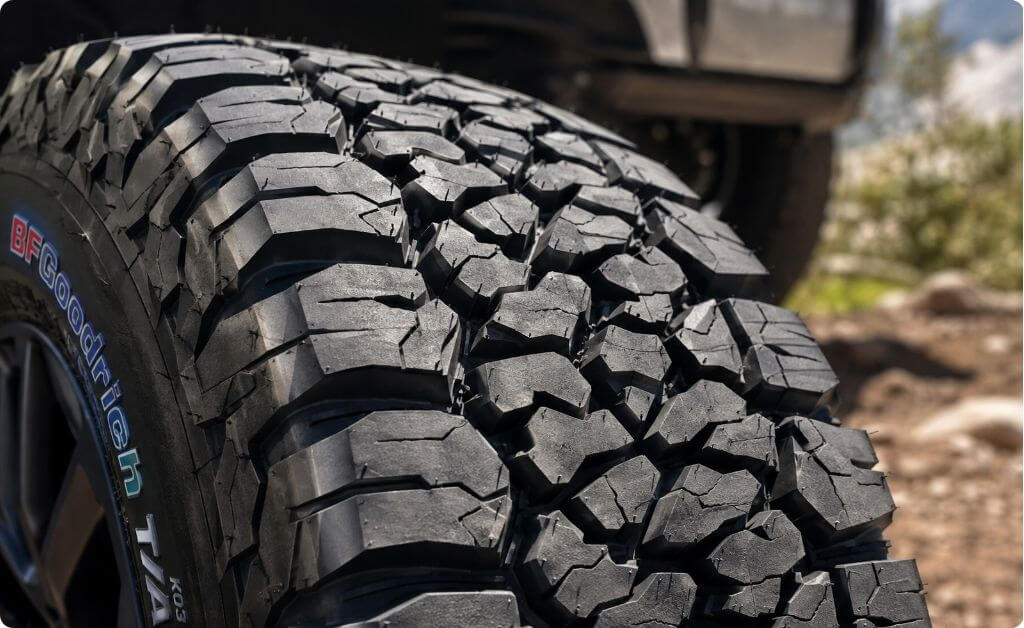
Durability is one of the KO3’s main design goals. BFGoodrich says the KO3 provides 15% better wear performance and 20% better gravel-road durability than the KO2. These are manufacturer claims, not independent guarantees for every vehicle or driving condition.
The tire uses an optimized footprint, full-depth 3D locking sipes and a new all-terrain tread compound designed to promote more even wear. CoreGard construction is also intended to improve resistance to sidewall splitting and bruising.
Tread Life
The KO3’s 50,000-mile figure should not be interpreted as guaranteed tread life.
Actual tread wear depends on factors such as vehicle weight, tire size and load, inflation pressure, wheel alignment, tire rotation, driving style and road conditions. A KO3 used primarily on highways can therefore have a very different wear pattern from one regularly driven over gravel, rocks or trails.
For that reason, we would not give the KO3 a universal “expected lifespan” without specifying the tire size, vehicle and operating conditions.
Warranty
BFGoodrich currently backs the KO3 with a 50,000-mile limited mileage warranty and a 60-day satisfaction guarantee. Its standard limited warranty also covers eligible workmanship and material defects for the original usable tread life or six years from purchase, subject to the applicable terms and conditions.
The distinction is important:
The KO3 carries a 50,000-mile limited mileage warranty; it is not guaranteed to last 50,000 miles.
Our take: The KO3 has a strong durability proposition, especially for drivers who regularly encounter gravel and rough terrain. BFGoodrich’s wear and gravel-durability improvements are encouraging, but actual tread life will depend on the vehicle, tire configuration, maintenance and operating conditions.
BFGoodrich KO3 Problems and Downsides
The KO3 is a capable all-terrain tire, but its strengths come with trade-offs. Independent testing identifies dry emergency braking and ice performance as its clearest performance weaknesses, while measured noise and value also deserve consideration.
Dry and Ice Performance Are Not Its Strongest Areas
The biggest measurable limitation is dry braking. In the 2026 independent comparison, the KO3 recorded the longest dry-braking distance among the eight tires tested. Its ice performance was also last in both braking and traction in the 2025 winter test.
That does not make the KO3 incapable on pavement. It means drivers who prioritize maximum dry emergency braking or frequent ice performance have stronger alternatives.
Highway Noise Is Not Class-Leading
The KO3 recorded 57.72 dB, the highest measured noise level in the 2026 comparison. Its subjective noise assessment was considerably better, so the practical experience may not feel as extreme as the measured figure suggests.
The sensible conclusion is not that the KO3 is excessively noisy, but that buyers expecting highway-tire levels of refinement should keep their expectations realistic.
Price Can Be a Consideration
The KO3 is positioned as a premium all-terrain tire. In the 2026 independent comparison, its value ranking was 7th out of 8, although price comparisons are highly dependent on tire size and market pricing.
That premium makes more sense if you will actually use the tire’s snow, gravel and off-road capabilities. For a vehicle that spends almost all of its time on pavement, a less aggressive tire may offer better road-focused performance for the money.
Our take: The KO3’s disadvantages are mostly trade-offs rather than deal-breakers. Its dry braking and ice performance are weaker than its snow and loose-surface capability, while measured noise is not class-leading. Those compromises matter more for a pavement-focused driver than for someone who regularly uses the KO3 beyond paved roads.
KO3 vs. the Competition
The KO3 competes with several established all-terrain tires, including the Falken Wildpeak A/T4W, Toyo Open Country A/T III and General Grabber A/TX. Rather than treating these tires as interchangeable, the better comparison is to match each one to the driver’s priorities.
| If you prioritize… | Better direction |
| Balanced highway, gravel and trail use | BFGoodrich KO3 |
| Snow + mixed trail use | KO3 / compare A/T alternatives |
| Dry-road braking | Falken Wildpeak A/T4W deserves consideration |
| Highway refinement | Compare road-biased alternatives |
| Mixed road/off-road capability | KO3 / A/T4W / A/T III |
| Gravel-road durability | KO3 |
| Lower purchase price | Compare current price for your exact size |
BFGoodrich KO3 vs. Falken Wildpeak A/T4W
The Falken Wildpeak A/T4W is a particularly relevant alternative for drivers who spend substantial time on pavement. In the 2026 independent test, the Falken recorded a shorter dry-braking distance than the KO3, while the KO3 performed better in several wet and snow measurements. The Falken also produced a lower measured noise figure.
That makes the choice fairly straightforward: the KO3 has a stronger argument when mixed-terrain and snow capability are central, while the A/T4W deserves closer consideration when road behavior and highway refinement carry more weight.
BFGoodrich KO3 vs. Toyo Open Country A/T III
The Toyo Open Country A/T III is another established all-terrain alternative with a strong reputation for mixed road and off-road use. It remains a legitimate option for drivers who want an all-terrain tire capable of handling winter and loose surfaces.
Because the A/T III was not part of the same 2026 KO3 comparison used throughout this review, we would not present an older head-to-head result as a direct current ranking. The better approach is to compare the exact size, load rating, vehicle application and current test evidence before choosing between them.
BFGoodrich KO3 vs. General Grabber A/TX
The General Grabber A/TX is another balanced all-terrain alternative. Earlier independent testing has shown the tire performing strongly across both on-road and off-road categories, but that testing predates the KO3 and does not constitute a direct KO3-vs-A/TX comparison.
That distinction matters. We would not claim that the General is universally better or worse than the KO3 based on an older test using a different tire group.
Our take: The KO3 is especially compelling for the buyer who wants a durable, snow-capable all-terrain tire with strong loose-surface performance. The Falken A/T4W deserves attention from drivers placing greater emphasis on road manners, while the Toyo and General remain credible alternatives worth comparing at the exact size and price required for your vehicle.
Pricing should always be compared at the specific tire-size level, because load range, size and retailer can substantially change the purchase price.
Read More: BF Goodrich KO2 vs KO3
Who Should Buy the BFGoodrich KO3?
The KO3 makes the most sense for drivers who need one tire to handle both pavement and regular off-road use. Its strongest independent-test results come in snow and dirt, while its construction is designed around durability on rough surfaces.
Best For
- Pickup and SUV owners who regularly drive gravel, dirt or trails
- Drivers who encounter snow but do not need a dedicated winter tire
- Drivers who want stronger off-road capability without moving to a dedicated mud-terrain tire
- Owners who prioritize durability and mixed-terrain versatility
- Drivers who want one all-terrain tire for daily use and weekend off-road trips
The KO3 is particularly compelling when your driving includes highway commuting during the week and gravel roads, trails or snowy backroads on weekends. Its 3PMSF rating and strong independent snow results make it more versatile in winter than a conventional all-terrain without severe-snow certification.
Who Should Consider Another Tire?
The KO3 is less compelling for drivers whose priorities are almost entirely road-focused.
If you spend nearly all of your time on paved highways and city streets, a more road-oriented tire may deliver better dry-road braking, sharper handling and greater refinement. The latest independent testing specifically identified dry braking and measured noise as KO3 weaknesses.
It is also not the ideal choice if ice is your dominant winter condition. The KO3 can perform strongly in snow, but its ice results show why a dedicated winter tire remains the better tool for persistent icy conditions.
And if your vehicle regularly faces deep mud or extreme rock crawling, a specialized tire may be a better match. BFGoodrich positions the KO3 as an all-terrain tire, while its KM3 is specifically designed for mud and boulder-oriented off-road use.
Our take: Buy the KO3 if you genuinely need all-terrain versatility, snow capability and off-road durability without giving up everyday road usability. Consider another tire if your priorities are almost entirely highway refinement, maximum road braking, persistent ice traction or extreme off-road specialization.
BFGoodrich KO3 Final Verdict
The BFGoodrich All-Terrain T/A KO3 is a strong all-terrain tire for drivers who genuinely need versatility. Its biggest strengths are snow capability, dirt and loose-surface performance, off-road durability and usable highway manners. Independent testing supports that overall picture, while also showing clear compromises in dry emergency braking and ice performance.
The KO3 is therefore not a tire I would recommend simply because it is a well-known BFGoodrich product. It makes sense when your driving actually matches what the tire is designed to do: highway commuting mixed with gravel roads, trails, dirt and regular snow. BFGoodrich also backs it with a 50,000-mile limited mileage warranty and a 60-day satisfaction guarantee.
Buy the KO3 If
- You regularly drive on gravel, dirt or trails as well as pavement.
- You want an all-terrain tire with strong snow capability and 3PMSF certification.
- Off-road durability matters as much as highway usability.
- You prefer one versatile tire rather than switching between highway and specialized off-road tires.
- You can accept some compromise in dry emergency braking and ice performance.
Consider Another Tire If
- Your driving is overwhelmingly highway or city pavement.
- Shortest dry-road braking distances are a top priority.
- You regularly drive on ice, where a dedicated winter tire is more appropriate.
- You need a tire specifically optimized for extreme mud or rock crawling.
- Highway refinement matters more to you than off-road versatility.
Our final take: The KO3 is best viewed as a capable, durable all-terrain tire with a strong bias toward mixed-terrain and winter versatility, not as the outright winner in every performance category.
Overall verdict: Recommended for mixed road/off-road use—especially for drivers who regularly encounter gravel, dirt and snow.
FAQs About BFGoodrich KO3 Review
Is the BFGoodrich KO3 a good tire?
Yes, for the right type of driver. The KO3 is a strong all-terrain option for drivers who regularly combine pavement with gravel, dirt, trails or snow. Independent testing shows particularly good snow and loose-surface capability, although dry emergency braking and ice performance are notable compromises.
Is the BFGoodrich KO3 good in snow?
Yes. Snow is one of the KO3’s stronger areas. Independent winter testing has shown strong snow traction, handling and braking, while the tire also carries the 3PMSF Severe Snow Rating. However, 3PMSF certification does not make it equivalent to a dedicated winter tire in every winter condition.
Is the BFGoodrich KO3 good on ice?
Ice is one of the KO3’s weaker areas. In the 2025 independent winter test, it finished last among the tested all-terrain tires for both ice braking and ice traction. If frequent ice is your primary winter concern, a dedicated winter tire is a better choice.
How long do BFGoodrich KO3 tires last?
There is no universal mileage figure for actual tread life. BFGoodrich provides a 50,000-mile limited mileage warranty, but that is not a promise that every KO3 will physically last 50,000 miles. Actual wear depends on vehicle, load, inflation, alignment, rotation, driving style and road conditions.
Does the KO3 come with a mileage warranty?
Yes. The KO3 carries a 50,000-mile limited mileage warranty and a 60-day satisfaction guarantee.
Is the KO3 good for highway driving?
It is usable and reasonably comfortable on the highway, but it is not the best choice if highway refinement is your only priority. Independent testing found competitive subjective comfort, while measured noise was comparatively high and dry braking was a clear weakness.
Is the KO3 good for off-road driving?
Yes. The KO3 is designed as an all-terrain tire, and independent testing supports its capability on dirt, gravel, snow and other loose surfaces. It is best understood as a versatile all-terrain tire rather than an extreme rock- or mud-specific tire.
Is the KO3 good in mud?
The KO3 is capable in mud for an all-terrain tire, but it is not a dedicated mud-terrain tire. Its tread design includes features intended to help maintain traction and resist mud packing. For regular deep-mud use, a dedicated mud-terrain tire is more appropriate.
Is the KO3 a good choice for daily driving?
It can be, particularly if your daily driving includes gravel roads, rural roads, trails or winter conditions. If virtually all of your driving is on smooth pavement, a less aggressive road-oriented tire may provide better braking, steering response and refinement.
