Toyota Tacoma Lug Nut Torque: Specs by Year and Wheel Type
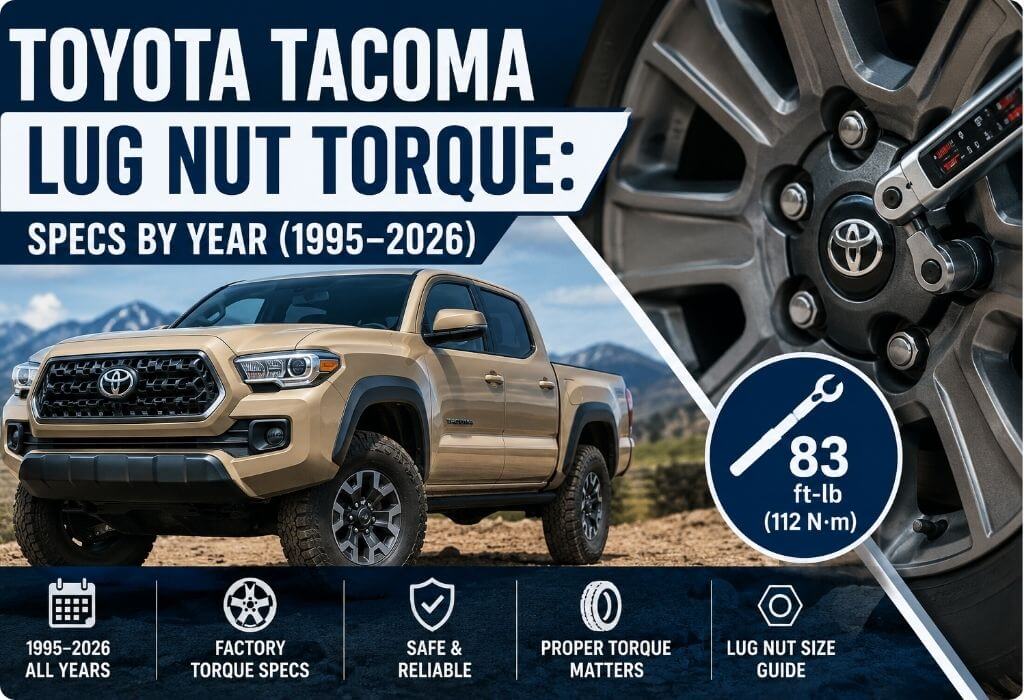
The correct Toyota Tacoma lug nut torque depends on the model year and, on the fourth-generation Tacoma, the wheel configuration. Toyota documentation for verified 1995–2023 applications generally centers around 83 ft-lbf, while the 2024 Tacoma introduced a much higher, wheel-specific specification: 97 ft-lbf (131 N·m) for applicable aluminum-wheel configurations and 154 ft-lbf (209 N·m) for applicable steel-wheel configurations.
Do not automatically use the older 83 ft-lbf specification on a 2024 or newer Tacoma. Check the exact model year, wheel type and Toyota specification before tightening the wheel nuts.
Toyota Tacoma Lug Nut Torque at a Glance
| Tacoma generation | Model years | Factory wheel-nut torque |
| 1st Generation | 1995–2004 | 110 N·m / Toyota-listed 83 ft-lbf on verified factory documentation |
| 2nd Generation | 2005–2015 | 113 N·m / Toyota-listed about 83–85 ft-lbf depending on the manual section |
| 3rd Generation | 2016–2023 | 83 ft-lbf / about 112–113 N·m for verified factory wheel applications |
| 4th Generation | 2024 | 97 ft-lbf (131 N·m) aluminum; 154 ft-lbf (209 N·m) applicable steel |
| 2025–2026 | 4th Generation | Verify the exact Toyota manual and wheel configuration before installation |
Toyota’s 2024 Tacoma Owner’s Manual is especially important because it lists separate torque values for aluminum and steel wheels rather than giving one universal number.
Toyota Tacoma Lug Nut Torque Chart by Year
The historical values below are based on Toyota owner’s-manual or Toyota service/installation documentation reviewed during our fact-checking process. Where Toyota’s metric and imperial figures differ slightly because of rounding, the manufacturer’s stated specification is preserved rather than creating a false-precision conversion.
| Model year | Generation | Lug nut torque |
| 1995 | 1st Gen | Verify exact manual |
| 1996 | 1st Gen | 110 N·m (83 ft-lbf) |
| 1997 | 1st Gen | 110 N·m (83 ft-lbf) |
| 1998 | 1st Gen | 110 N·m (83 ft-lbf) |
| 1999 | 1st Gen | Verify exact manual |
| 2000 | 1st Gen | 110 N·m (83 ft-lbf) |
| 2001 | 1st Gen | 110 N·m (83 ft-lbf) |
| 2002 | 1st Gen | 110 N·m (83 ft-lbf) |
| 2003 | 1st Gen | 110 N·m (83 ft-lbf) |
| 2004 | 1st Gen | 110 N·m (83 ft-lbf) |
| 2005 | 2nd Gen | 113 N·m (85 ft-lbf) |
| 2006 | 2nd Gen | 113 N·m (85 ft-lbf) |
| 2007 | 2nd Gen | 113 N·m (85 ft-lbf) |
| 2008 | 2nd Gen | 113 N·m (85 ft-lbf) |
| 2009 | 2nd Gen | 113 N·m (85 ft-lbf) |
| 2010 | 2nd Gen | 113 N·m (85 ft-lbf) |
| 2011 | 2nd Gen | 113 N·m |
| 2012 | 2nd Gen | 113 N·m (83 ft-lbf) |
| 2013 | 2nd Gen | 113 N·m (83 ft-lbf) |
| 2014 | 2nd Gen | 113 N·m (83 ft-lbf) |
| 2015 | 2nd Gen | 113 N·m (83 ft-lbf) |
| 2016 | 3rd Gen | about 112 N·m (83 ft-lbf) |
| 2017 | 3rd Gen | 112 N·m (83 ft-lbf) |
| 2018 | 3rd Gen | 83 ft-lbf |
| 2019 | 3rd Gen | 83 ft-lbf |
| 2020 | 3rd Gen | 83 ft-lbf |
| 2021 | 3rd Gen | 83 ft-lbf |
| 2022 | 3rd Gen | 83 ft-lbf |
| 2023 | 3rd Gen | 83 ft-lbf |
| 2024 | 4th Gen | 97 ft-lbf aluminum / 154 ft-lbf applicable steel |
| 2025 | 4th Gen | Verify exact configuration |
| 2026 | 4th Gen | Verify exact configuration |
The key takeaway
For most Tacoma owners, the important distinction is not simply whether the truck is “a Tacoma.” It is which generation and wheel configuration you have.
The older Tacoma generations generally use a wheel-nut torque in the 83 ft-lbf range, while Toyota’s 2024 documentation establishes a different specification for fourth-generation wheels. The 2024 manual lists 97 ft-lbf (131 N·m) for the applicable aluminum-wheel configurations and 154 ft-lbf (209 N·m) for the applicable steel-wheel configurations.
For 2025 and 2026, Toyota provides official Tacoma Owner’s Manuals—OM04011U for 2025 and OM04051U for 2026—but the exact wheel-nut specification should be checked in the applicable manual and configuration rather than assumed from an earlier model year.
Important: A factory torque specification also assumes the correct wheel and lug-nut combination. Aftermarket wheels, replacement lug nuts, spacers, or other wheel hardware can require different application-specific instructions.
2024–2026 Tacoma Lug Nut Torque
The fourth-generation Tacoma introduced a different wheel-nut specification from the earlier Tacoma generations. For the 2024 Tacoma, Toyota lists:
| Wheel type | Lug nut torque |
| Aluminum wheels | 97 ft-lbf (131 N·m) |
| Steel wheels | 154 ft-lbf (209 N·m) |
Toyota lists these values in its 2024 Tacoma Owner’s Manual for the applicable wheel configurations. The manual gives the steel-wheel value as 154 ft-lbf and the aluminum-wheel value as 97 ft-lbf.
That difference matters because using the older 83 ft-lbf figure from earlier Tacoma generations on a 2024 configuration would be incorrect.
What About the 2025 and 2026 Tacoma?
The 2025 and 2026 Tacoma remain fourth-generation models, but the safest approach is not to assume a torque value solely from the model year or from a 2024 specification. Toyota provides separate model-year owner’s manuals, and the exact wheel configuration should be checked before installation. Toyota’s official manual portal provides model-specific manuals for current Tacomas.
For a 2025 or 2026 Tacoma, verify the specification in the owner’s manual for the exact vehicle and wheel configuration before tightening the lug nuts.
Why the 2024 Specification Is Easy to Get Wrong
Many older Tacoma torque charts group large ranges of model years around the familiar 83 ft-lbf figure. That approach worked reasonably well for earlier generations, but it becomes misleading when extended to the fourth-generation truck.
The 2024 Toyota manual does not provide one universal wheel-nut torque. It identifies the wheel type and specifies 97 ft-lbf for aluminum wheels versus 154 ft-lbf for steel wheels.
Bottom line: If you have a 2024 or newer Tacoma, don’t use an older Tacoma torque chart without first checking the Toyota specification for your wheel. The correct value can depend on whether the applicable wheel is aluminum or steel.
Tacoma Lug Nut Thread and Socket Size
The fourth-generation Tacoma (2024–2026) uses M14 × 1.5 wheel studs, while earlier 1995–2023 Tacomas use the smaller M12 × 1.5 wheel-stud size. The fourth-generation Tacoma’s lug nuts use a 21 mm hex/socket in the factory application.
| Tacoma model years | Wheel-stud thread | Factory lug-nut socket |
| 1995–2023 | M12 × 1.5 | Verify exact application |
| 2024–2026 | M14 × 1.5 | 21 mm |
Thread size and socket size are not the same thing. M14 × 1.5 describes the threaded connection between the wheel stud and lug nut; 21 mm describes the hex size that the socket engages.
The Lug Nut Seat Must Match the Wheel
Thread compatibility alone is not enough when installing wheels. The lug nut must also have the correct seat design for the wheel.
Factory fourth-generation Tacoma applications use wheel-specific lug nuts, while aftermarket wheels may require a different seat style. Toyota specifically states that only wheel nuts designed for the particular wheel should be used.
That means you should not assume that an M14 × 1.5 lug nut is automatically compatible just because it threads onto a 2024–2026 Tacoma stud.
For aftermarket wheels, follow the wheel manufacturer’s lug-nut and torque requirements and confirm the thread, seat type, and nut-to-wheel fit before installation.
One Important Rule
Never choose a Tacoma lug nut based on thread size alone. The correct combination is:
Thread size + seat type + wheel compatibility + specified torque.
That distinction becomes especially important when moving from factory wheels to aftermarket wheels.
How to Torque Toyota Tacoma Lug Nuts Correctly
Changing a Tacoma wheel is straightforward, but the final tightening step matters. The safest approach is to start the lug nuts by hand, tighten them progressively in Toyota’s specified sequence, and finish at the exact torque for your Tacoma and wheel configuration. Toyota’s manuals also warn against using oil or grease on the wheel studs or nuts because it can contribute to over-tightening and damage.
1. Confirm the Correct Torque
Before tightening, verify the specification for your exact Tacoma and wheel. This is especially important on the 2024+ Tacoma, where Toyota specifies different torque values for applicable aluminum and steel wheels.
2. Inspect the Wheel and Lug-Nut Hardware
Make sure the wheel’s mounting surface is clean and free of corrosion or debris, and check the studs and lug nuts for damage. Toyota notes that poor metal-to-metal contact at the wheel mounting surface can allow the wheel nuts to loosen.
3. Start Every Lug Nut by Hand
Install the wheel and thread each lug nut by hand first. This helps prevent cross-threading and ensures the nut is properly engaged before tightening.
4. Tighten in the Specified Sequence
Snug the lug nuts gradually in the cross/star pattern shown in the Toyota manual, rather than fully tightening one nut before moving to the next. Toyota’s wheel-installation instructions call for tightening each nut a little at a time in the illustrated sequence until all are tight.
5. Finish With a Torque Wrench
Once the wheel is properly seated, use a torque wrench set to the factory specification and tighten each lug nut to the required value.
Do not guess based on the feel of a standard lug wrench or reuse an old 83-ft-lbf figure simply because it applies to many earlier Tacomas.
6. Don’t Lubricate the Wheel Studs Unless Toyota or the Hardware Manufacturer Specifically Requires It
Do not apply oil or grease to the Tacoma wheel studs or lug-nut threads as a routine step. Toyota specifically warns that lubrication can cause over-tightening and damage to the bolts, and says contaminated hardware should be cleaned.
Important: The torque number is only one part of a correct wheel installation. The wheel, lug nuts, threads, and seat must also be compatible and properly seated.
This procedure keeps the section focused on what a Tacoma owner actually needs: correct specification → clean mounting surfaces → hand-start → progressive cross-pattern tightening → final torque with a torque wrench.
Why Correct Tacoma Lug Nut Torque Matters
Correct lug nut torque is about achieving the proper clamping force that secures the wheel to the vehicle. Too little torque can allow the wheel nuts to loosen, while excessive torque can damage or overstress wheel hardware. Toyota therefore specifies a precise wheel-nut torque rather than simply recommending that the nuts be tightened “as much as possible.”
Under-Torquing
If the lug nuts are not tightened enough, the wheel may not be clamped securely against the hub. That can allow movement between the wheel and mounting surface and may eventually contribute to loose wheel nuts.
Over-Torquing
More torque is not automatically better. Excessive tightening can overstress the wheel studs, nuts, or wheel and can make future wheel removal unnecessarily difficult. Toyota specifically provides a defined torque value for each applicable wheel configuration.
Uneven Torque
The lug nuts should be tightened progressively and in the specified sequence so the wheel seats evenly against the hub. Using the correct torque on one nut while leaving the others significantly different does not provide the same result as properly tightening the complete set.
Bottom line: Use a calibrated torque wrench and the exact Toyota specification for your Tacoma and wheel. For the 2024 Tacoma, for example, Toyota specifies 97 ft-lbf (131 N·m) for applicable aluminum wheels and 154 ft-lbf (209 N·m) for applicable steel wheels—so using a generic Tacoma torque number can be wrong.
Aftermarket Wheels: Don’t Automatically Use the Factory Tacoma Torque
Installing aftermarket wheels on a Toyota Tacoma requires more than matching the bolt pattern and thread size. The wheel, lug nut, seat design, and manufacturer’s torque specification all need to be compatible. Toyota itself specifies that the wheel nuts used must be designed for the particular wheel, and its manuals distinguish between different wheel/nut seating arrangements.
Factory Wheels vs. Aftermarket Wheels
For an OEM Tacoma wheel, use the torque specification Toyota provides for that specific vehicle and wheel configuration. For example, Toyota’s 2024 Tacoma manual specifies 154 ft-lbf (209 N·m) for applicable steel wheels and 97 ft-lbf (131 N·m) for applicable aluminum wheels.
With an aftermarket wheel, however, do not assume that the factory torque value automatically applies. Check the wheel manufacturer’s installation instructions and make sure the supplied lug nuts have the correct seat design and are specifically compatible with the wheel.
Thread Size Is Not Enough
A lug nut can have the correct thread and still be wrong for the wheel. The nut’s seat shape and contact with the wheel also matter. Toyota’s 2024 Tacoma instructions, for example, show different seating arrangements for steel and aluminum wheels.
Before installing aftermarket wheels, verify:
- Wheel fitment
- Lug-nut thread compatibility
- Lug-nut seat type
- Proper nut-to-wheel engagement
- Wheel manufacturer’s torque specification
Bottom line: Don’t choose a lug nut simply because it threads onto the Tacoma’s studs. The lug nut must be designed for the specific wheel, and the final torque should follow the applicable vehicle and wheel manufacturer’s instructions.
How to Find Your Exact Toyota Tacoma Lug Nut Torque Specification
If you are unsure which torque value applies to your Tacoma, do not rely on a generic torque chart alone. Check the owner’s manual for your exact model year and wheel configuration first. Toyota provides model-specific Tacoma manuals through its official Owners site, including separate manuals for the 2025 and 2026 Tacoma.
Check These Three Things
1. Model year and generation
A torque value that applies to an earlier Tacoma may not apply to a newer generation.
2. Wheel type
This is particularly important for the 2024+ Tacoma. Toyota’s documentation distinguishes between applicable aluminum and steel wheels, so there is no safe reason to assume that one torque value fits every configuration.
3. Wheel and lug-nut combination
If you have aftermarket wheels, check the wheel manufacturer’s installation instructions as well. Toyota specifically warns that the wheel nuts must be designed for the particular wheel.
Use Toyota’s Manual as the Final Reference
For a factory-wheel Tacoma, the Toyota Owner’s Manual for your vehicle is the primary reference. Toyota’s official manuals portal provides downloadable manuals by model year, including the 2026 Tacoma Owner’s Manual (OM04051U).
If the wheel or lug nuts have been changed from factory equipment, verify the replacement hardware and wheel manufacturer’s requirements before applying the factory specification.
Bottom line: Identify your Tacoma year + wheel type + wheel/lug-nut setup first, then use the applicable Toyota specification. Never choose a torque value simply because it appears on a generic Tacoma chart.
Toyota Tacoma Lug Nut Torque FAQs
What is the lug nut torque on a Toyota Tacoma?
It depends on the model year and wheel configuration. A 1999 Tacoma factory manual specifies 110 N·m (83 ft-lbf), while the 2005 manual specifies 113 N·m (85 ft-lbf). The 2024 Tacoma uses 97 ft-lbf (131 N·m) for applicable aluminum wheels and 154 ft-lbf (209 N·m) for applicable steel wheels.
Is 83 ft-lb correct for every Tacoma?
No. Toyota’s published manuals demonstrate that the specification changed between generations. For example, the 1999 manual lists 110 N·m (83 ft-lbf), while the 2005 manual lists 113 N·m (85 ft-lbf).
What is the 2024 Toyota Tacoma lug nut torque?
Toyota specifies 97 ft-lbf (131 N·m) for applicable aluminum wheels and 154 ft-lbf (209 N·m) for applicable steel wheels.
Should I use the factory torque with aftermarket Tacoma wheels?
Not automatically. Verify the aftermarket wheel and lug-nut manufacturer’s instructions, including seat type and required torque.
Should I put anti-seize or grease on Tacoma lug nuts?
Do not routinely lubricate the wheel studs or lug-nut threads. Toyota warns that oil or grease can cause over-tightening and damage to the bolts.
Do Tacoma lug nuts need to be rechecked after a wheel change?
Yes. Toyota’s manuals instruct owners to have wheel nuts checked/tightened with a torque wrench after changing wheels. Some model-year manuals also specify a particular retorque interval, so follow the procedure for your exact Tacoma rather than applying one universal interval.
What should I do if an online Tacoma torque chart disagrees with Toyota?
Use the applicable Toyota Owner’s Manual or service documentation as the primary reference. Online charts can contain rounded, outdated or generalized values.
Final Verdict
The correct Toyota Tacoma lug nut torque is not one universal number.
For first-generation Tacomas, Toyota documentation shows 110 N·m (83 ft-lbf) on verified applications. The 2005 Tacoma uses 113 N·m (85 ft-lbf), demonstrating why simply copying an “83 ft-lb for all Tacomas” chart is too broad.
The biggest change comes with the fourth-generation Tacoma. Toyota’s 2024 specifications distinguish between wheel types, with 97 ft-lbf (131 N·m) for applicable aluminum wheels and 154 ft-lbf (209 N·m) for applicable steel wheels.
For factory wheels: use the Toyota specification for your exact Tacoma and wheel.
For aftermarket wheels: verify the wheel and lug-nut manufacturer’s requirements.
If you’re unsure: don’t guess from a generic chart. Check the applicable Toyota documentation first.
Bottom line: The right Tacoma lug nut torque is the specification for the exact vehicle-and-wheel combination, not simply the number that appears most frequently online.
