Trailer Tire Load Range Chart: How to Choose the Right Tire Safely
If you own a trailer, you know that picking the right tire isn’t just about getting from point A to point B—it’s about safety, performance, and peace of mind. Trailer tires come with confusing markings, load ranges, and charts that can make even experienced haulers pause. One wrong choice, and you risk blowouts, uneven wear, or worse, accidents on the road.
This guide breaks down the trailer tire load range chart in plain language, so you can understand what each rating means, how to read the chart step by step, and how to choose the right tire for your trailer’s weight. Whether you’re towing a boat, RV, utility trailer, or horse trailer, by the end of this post, you’ll know exactly what tire load range fits your trailer safely—and why it matters.
What Is a Trailer Tire Load Range?
When you look at a trailer tire, you’ll see a letter stamped on its side. That letter is the load range — it tells you how much weight that tire can safely carry.
Think of it like a strength label for the tire. A tire with a higher letter can carry more weight than one with a lower letter, even if they’re the same size.
- Load range letters go in order: B, C, D, E, and so on.
- A C tire carries less weight than a D tire.
- Load range doesn’t stand alone — the tire’s size and how much air it’s filled with also matter for the actual weight it can handle.
The most common load range you’ll see on trailer tires is C, D, or E, with higher letters meaning the tire is built to carry heavier trailers.
This number helps you match the tire to your trailer’s weight. If you pick a tire with too low of a load range, it can get too hot, wear out fast, or even fail while you’re towing — which can be dangerous.
Trailer Tire Load Range Chart (With Explanation)
Below is a simple chart showing common trailer tire load ranges, what they generally mean in terms of strength, how much weight they can support per tire, and typical uses. These are approximate figures — actual capacity can vary by tire size and brand, so always check the tire’s sidewall or manufacturer specs.
| Load Range | Ply Rating (Equivalent) | Approx Max Load per Tire | Typical Max Air Pressure | Common Use |
| B | 4-ply | ~1,100–1,500 lbs | ~35 psi | Small utility or lightweight trailers |
| C | 6-ply | ~1,760–2,270 lbs | ~50 psi | Light-to-medium boat trailers, campers |
| D | 8-ply | ~2,200–3,000 lbs | ~65 psi | Larger utility, cargo, medium travel trailers |
| E | 10-ply | ~2,470–3,400 lbs | ~80 psi | Heavy utility, larger travel trailers, RVs |
| F | 12-ply | ~3,500–3,960 lbs | ~95 psi | Commercial or heavy-load trailers |
| G | 14-ply | ~3,960–4,400 lbs | ~110 psi | Very heavy loads, industrial trailers |
| H & above | 16-ply+ | ~4,800 lbs+ | ~125 psi+ | Specialized heavy-duty applications |
How to Use This Chart
Here’s how to read and use the information:
- Load Range Letter: This is the main thing you’re looking for on a trailer tire’s sidewall (e.g., Load Range C). It’s a quick shorthand for how strong the tire is.
- Ply Rating (Equivalent): Older tires listed physical plies; today’s tires use stronger materials, so “6-ply” or “8-ply” refers to strength level, not actual layers.
- Max Load per Tire: This is roughly how much weight that one tire can support when inflated to the correct pressure. Multiply this by the number of tires on an axle to estimate total axle capacity.
- Air Pressure: Higher load ranges typically require higher air pressure to support the weight safely. Always follow the maximum pressure shown on the tire sidewall.
Putting It Into Practice
Imagine your trailer weighs a total of 4,000 lbs and has two tires on one axle:
- If each tire is Load Range C (~2,000 lbs capacity), together they support ~4,000 lbs — just enough, but no extra margin.
- If you choose Load Range D or E, you get extra strength and safety margin, reducing risk of tire heat build-up or failure while towing.
Using a tire with too low a load range can cause tire overheating, faster wear, or blowouts — especially on long trips or hot days. Always match or exceed the trailer’s recommended load range.
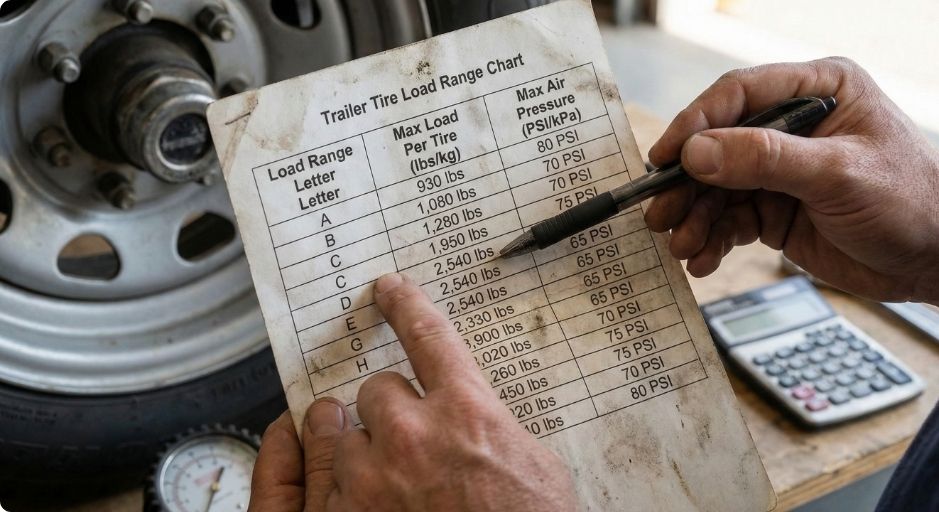
How to Read the Trailer Tire Load Range Chart (Step-by-Step)
At first glance, a trailer tire load range chart can look overwhelming. It’s not. You only need a few pieces of information to use it correctly.
Step 1: Find the Load Range Letter
Start by looking at the load range letter in the chart.
- This is the letter (C, D, E, etc.) shown in the left column.
- It tells you the general strength level of the tire.
You don’t need to understand how it’s built. Just know that higher letters handle more weight.
Step 2: Look at the Weight Per Tire
Next, move across the row to find the maximum load per tire.
- This number shows how much weight one tire can safely support.
- Remember: trailers usually split weight across multiple tires.
If your trailer has two tires, both tires share the load.
Step 3: Match the Chart to Your Trailer Setup
Now think about how your trailer is set up.
- Count how many tires are actually carrying weight.
- Divide the trailer’s total loaded weight by that number.
The load number in the chart should be higher than your result, not right on the edge.
Step 4: Check the Air Pressure Column
The chart also lists air pressure for each load range.
- Higher load ranges usually need higher air pressure.
- The tire can only carry its rated weight if it’s inflated correctly.
This is where people get into trouble—strong tires don’t help if they’re under-inflated.
Step 5: Leave a Little Safety Margin
Try not to choose a tire that’s just barely enough.
- Extra capacity helps with heat, bumps, and long drives.
- The downside is a slightly firmer ride on lighter trailers.
Most people prefer a small buffer rather than running tires at their limit.
Load Range C vs D vs E: What’s the Difference?
Load Range C, D, and E are the most common choices for trailer tires. The main difference between them is how much weight they’re built to handle and how much air pressure they need.
Load Range C
This is usually found on lighter trailers.
- Works well for small utility, boat, or pop-up trailers
- Requires lower air pressure than D or E
- Rides a bit smoother on lighter loads
Drawback: Not much room for extra weight. If you overload it, problems show up fast.
Load Range D
This sits in the middle and fits many everyday trailers.
- Handles more weight than C without going overboard
- Common on cargo trailers and medium campers
- Good balance between strength and ride comfort
Drawback: Needs higher air pressure, so tires must be checked more often.
Load Range E
This is meant for heavier trailers or frequent towing.
- Built for higher weight and tougher conditions
- Common on larger travel trailers and RVs
- Holds up better on long trips and hot roads
Drawback: On lighter trailers, it can feel stiff and cost more than necessary.
comparison table (C vs D vs E)
| Load Range | Approx Ply Rating | Max Load per Tire | Typical Air Pressure | Best For |
| C | 6‑ply | ~1,760–2,270 lbs | ~50 psi | Small utility trailers, light boat trailers, occasional towing |
| D | 8‑ply | ~2,200–3,000 lbs | ~65 psi | Medium cargo trailers, campers, regular towing |
| E | 10‑ply | ~2,470–3,400 lbs | ~80 psi | Larger travel trailers, RVs, heavy loads, frequent trips |
Quick Way to Choose
If you’re deciding between them:
- C → light trailer, occasional use
- D → medium trailer, regular towing
- E → heavy trailer, long trips or full loads
When in doubt, stepping up one level is usually safer than cutting it close — as long as your wheels can handle the pressure.
How to Choose the Right Load Range for Your Trailer
Start by weighing your trailer fully loaded — include gear, water, and the tongue weight.
Knowing the real, loaded weight is the only way to pick a tire that won’t be overloaded.
Find the trailer’s GVWR (gross vehicle weight rating) and each axle’s GAWR (gross axle weight rating) on the VIN/sticker.
Don’t assume the axle or tire can handle more than what the sticker and the tire sidewall say.
Work out the weight each tire must carry: divide the loaded weight on an axle by the number of tires on that axle.
That per-tire number is what you’ll compare to the tire’s “max load” in the chart.
Read the tire sidewall and chart for max load and max inflation pressure.
A tire only reaches its rated capacity at the correct cold inflation pressure — check the sidewall for the exact numbers.
Choose a tire with extra capacity, not one that exactly matches your calculated load.
A safety buffer (many pros suggest roughly 10–15%) reduces heat, wear, and risk on long trips or hot roads.
Make sure the tire’s max pressure works with your wheel and the trailer’s design.
Higher load ranges need higher pressure; your rim and valve gear must be compatible with that pressure.
Pick ST (Special Trailer) tires unless the trailer maker specifies otherwise.
ST tires are built for trailer loads and have stiffer sidewalls to help control sway and handle vertical load.
Think about how you use the trailer:
- Short, light trips → a lower load range can be fine.
- Frequent, long hauls or heavy loads → step up a load range for durability and safety.
Higher load ranges can cost more and feel firmer on empty runs — that’s the trade-off.
If you’re still unsure, have a pro check your math and choices (tire shop, axle manufacturer, or trailer dealer).
They can confirm rim compatibility, recommend specific tires, and help avoid costly mistakes.
Common Mistakes to Avoid
Even people who tow often make these mistakes. Most come from guessing instead of checking a few key details.
Choosing a Tire That’s “Just Enough”
A tire that barely meets your trailer’s weight limit leaves no room for error.
- Heat, bumps, and long trips add stress
- Small overloads add up faster than you think
It might work for short trips, but it shortens tire life.
Ignoring Air Pressure
A strong tire won’t help if it’s not inflated properly.
- Low pressure reduces how much weight the tire can carry
- It also causes extra heat, which leads to failure
This is one of the most common causes of blowouts.
Assuming All Tires of the Same Size Are Equal
Two tires can look identical and still handle very different loads.
- Size alone doesn’t tell the full story
- The load range matters just as much
Always check the load range letter, not just the tire size.
Using the Wrong Type of Tire
Some people use passenger or light-truck tires because they’re cheaper or easier to find.
- These tires aren’t built for trailer loads
- They flex differently and wear faster on trailers
They may work short-term, but it’s not a good long-term choice.
Forgetting About the Wheels
Higher load range tires often need higher air pressure.
- Not all wheels can handle that pressure
- Old valve stems can fail under higher PSI
Upgrading tires sometimes means upgrading hardware too.
Not Rechecking After Loading Changes
Adding gear, water, or equipment changes the load on your tires.
- What worked last year may not be enough now
- Seasonal use can change trailer weight more than expected
A quick recheck can prevent expensive problems later.
FAQs: Trailer Tire Load Range Chart
1. What does the load range letter on a trailer tire mean?
The load range letter (C, D, E, etc.) shows how much weight the tire can safely carry. Higher letters mean the tire can handle heavier loads. It’s like a “strength rating” for your tire.
2. Can I use a lower load range tire if my trailer is light?
You can, but it’s safer to have a tire with a slightly higher load range than needed. Lower load range tires have less margin for heat and bumps, which can shorten tire life or cause problems on long trips.
3. How do I know what load range my trailer needs?
Check the trailer’s GVWR (gross vehicle weight rating) and divide the total weight on each axle by the number of tires. Then pick a tire with a max load above that number, ideally with a 10–15% safety margin.
4. Does tire size affect load capacity?
Yes, but tire size alone doesn’t tell the full story. Two tires of the same size can have different load ranges, so always check the load range letter on the sidewall and use a chart to confirm capacity.
5. How often should I check my trailer tires?
Check tires before every trip for proper inflation and signs of wear or damage. Also, recheck whenever you add heavy gear, water, or other changes that increase trailer weight. Proper air pressure is just as important as the right load range.
Conclusion
Choosing the right trailer tire load range doesn’t have to be confusing. A few simple steps make a big difference in safety and tire life.
- Know your trailer’s weight — fully loaded, including gear and water.
- Check the chart and tire sidewall — pick a tire with a load range that comfortably handles your weight.
- Maintain proper air pressure — even the strongest tire won’t work if it’s underinflated.
- Leave a safety margin — a little extra capacity helps prevent overheating and wear.
The right tire keeps your trailer stable, reduces the risk of blowouts, and makes towing smoother. Taking the time to choose carefully is worth it, and it can save money and stress in the long run.
Remember, small mistakes like overloading or underinflating are common, but easy to avoid with proper checks. Safe towing starts with the right tire.
