How to Read Tire Size: A Complete Guide to Tire Size Numbers and Letters
Last updated on August 12th, 2026
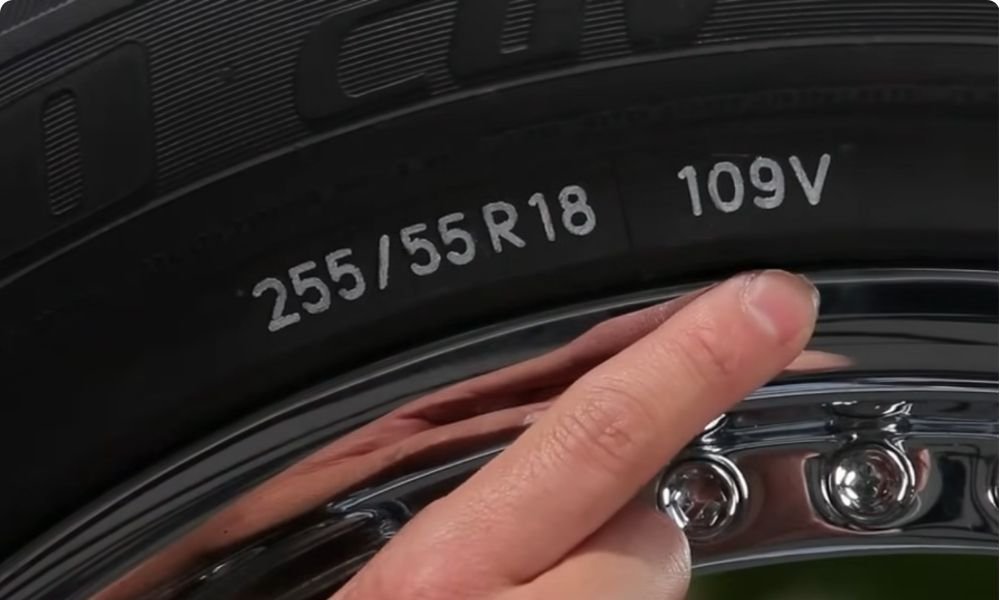
Reading a tire size can look confusing at first, but the numbers and letters on a tire sidewall follow a consistent format. Once you know what each part means, you can quickly identify a tire’s width, aspect ratio, construction, wheel diameter, load index, and speed rating.
For example, P225/65R17 102H contains seven important pieces of information. This guide explains how to read that marking from left to right, how different tire-size formats work, how to calculate basic tire dimensions, and what to check before replacing your tires.
Quick Answer: How to Read Tire Size
A tire size is generally read from left to right. For example, P225/65R17 102H can be broken down into seven parts:
| Marking | Meaning |
| P | P-Metric passenger tire |
| 225 | Nominal section width in millimeters |
| 65 | Aspect ratio |
| R | Radial construction |
| 17 | Wheel diameter in inches |
| 102 | Load index |
| H | Speed rating |
So, P225/65R17 102H identifies a P-Metric passenger tire with a 225 mm nominal section width, a 65% aspect ratio, radial construction, a 17-inch wheel diameter, load index 102, and H speed rating.
The tire size printed on the sidewall tells you the specification of that tire. However, when choosing a replacement, use the vehicle manufacturer’s recommended tire size and specifications as your starting point. You can usually find them on the driver’s door-jamb placard or in the owner’s manual.
Where to Find Your Vehicle’s Tire Size
Before trying to decode a tire size, you need to know which size your vehicle is supposed to use. There are several places to find this information.
Driver-Side Door Jamb
Check the tire and loading information placard on the driver’s side door jamb or door frame. It commonly lists the vehicle’s recommended tire size and the recommended cold tire inflation pressure.
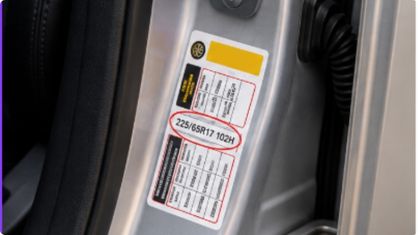
This is one of the best places to check the manufacturer’s specification because the tire currently installed on the vehicle may not be the original size.
Owner’s Manual
Your owner’s manual may list the recommended tire sizes for different configurations, wheel sizes, or load conditions.
If your vehicle has multiple factory-approved tire sizes, make sure you identify the specification that applies to your particular vehicle.
Tire Sidewall
The current tire’s sidewall shows its size in a format such as:
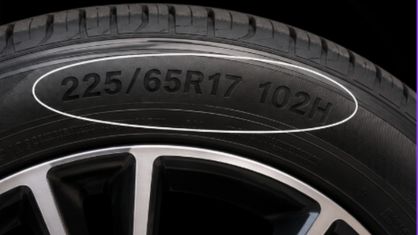
225/65R17 102H
This is useful for identifying the tire currently installed. However, don’t automatically assume the current tire is the factory-recommended size, especially on a used vehicle.
For replacement tires, verify the size against the vehicle’s door-jamb placard or owner’s manual.
How to Read a Tire Size: P225/65R17 102H
A tire size combines information about the tire’s type, width, aspect ratio, construction, wheel diameter, load capacity, and speed rating. Reading the code from left to right makes it easier to understand what each number and letter represents.
For example:
P225/65R17 102H
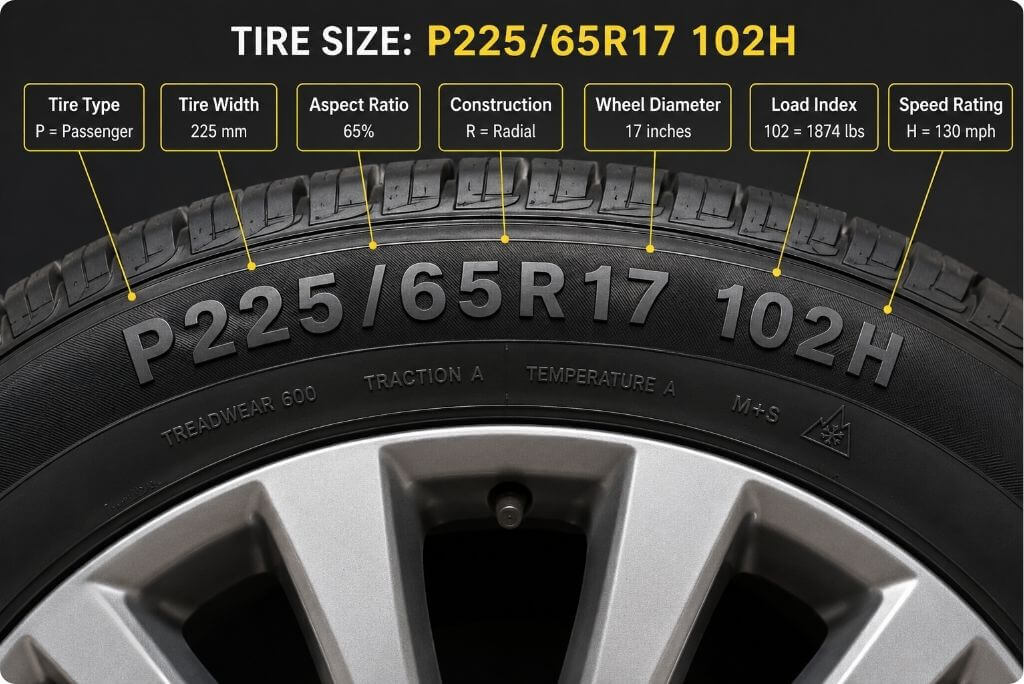
Let’s break it down one part at a time.
P — Passenger Tire
The P at the beginning identifies the tire as a P-Metric passenger tire. P-Metric tires are commonly used on passenger vehicles such as cars, minivans, SUVs, and light-duty pickups.
A tire size can also begin with other designations, such as LT for Light Truck, while a size with no prefix may use the Euro-Metric system. These formats are covered later in this guide.
225 — Tire Width
The 225 represents the tire’s nominal section width, measured in millimeters from one sidewall to the other.
So, a tire marked 225 has a nominal section width of approximately 225 mm.
This is not the width of the tread alone. The actual measured dimensions can vary somewhat depending on the tire model and the wheel on which it is mounted. Michelin and Bridgestone both describe this portion of the size as the tire’s section width.
65 — Aspect Ratio
The 65 is the tire’s aspect ratio.
It means the sidewall height is 65% of the tire’s nominal section width.
For a 225 mm-wide tire:
225 × 0.65 = 146.25 mm
So the calculated sidewall height is approximately 146 mm.
A lower aspect ratio generally means a shorter sidewall, while a higher aspect ratio means a taller sidewall.
R — Radial Construction
The R indicates radial construction.
Radial tires use radial construction in which the internal cord structure is arranged across the tire toward the centerline, with belts supporting the tread area. Radial construction is standard on most modern passenger tires.
You may occasionally encounter other construction letters, particularly on specialty or older tire types, but R is by far the most common designation you’ll see on modern passenger-vehicle tires.
17 — Wheel Diameter
The 17 indicates the diameter of the wheel the tire is designed to fit, measured in inches.
Therefore:
P225/65R17 → 17-inch wheel
This number refers to the wheel diameter, not the tire’s overall diameter.
That distinction is important because the complete tire is much larger than 17 inches once the sidewalls are included.
102 — Load Index
The 102 is the tire’s load index.
Load index is a standardized numerical code that corresponds to the maximum load capacity of a single tire under specified conditions. It is not simply the number of pounds or kilograms the tire can carry. You use a load-index table to determine the corresponding capacity.
For example, load index 102 corresponds to 1,874 lb (850 kg) per tire under the applicable rating conditions.
When replacing tires, the replacement should meet or exceed the vehicle manufacturer’s required load specification.
H — Speed Rating
The H is the tire’s speed rating.
It identifies the maximum speed capability assigned to the tire under specified test conditions and when carrying the load associated with its rating.
An H-rated tire is rated for up to 130 mph (210 km/h) under the applicable standardized conditions.
Speed rating should not be interpreted as a recommended driving speed. Your actual safe driving speed depends on road conditions, weather, vehicle condition, traffic, and applicable speed limits.
Putting It All Together
P225/65R17 102H means:
P = P-Metric passenger tire
225 = 225 mm nominal section width
65 = sidewall height is 65% of section width
R = radial construction
17 = designed for a 17-inch wheel
102 = load index
H = speed rating
Once you understand this pattern, you can use the same left-to-right approach to decode many other passenger tire sizes.
What Does P, LT, and T Mean on a Tire?
The letters at the beginning of a tire size can identify the tire’s sizing system or intended application. Not every tire size begins with a letter: for example, 225/65R17 has no prefix and generally uses the Euro-Metric sizing system, while P225/65R17 is P-Metric.
P-Metric: P225/65R17
A P prefix identifies a P-Metric passenger tire. P-Metric tires are commonly used on passenger vehicles, including cars, minivans, SUVs, and light-duty pickups.
The important point is that P-Metric is a tire classification, not simply another way of writing the tire’s width or diameter.
No Prefix: 225/65R17
When a tire size begins directly with the numbers, such as 225/65R17, it generally uses the Euro-Metric passenger-tire sizing system.
The basic size components still represent width, aspect ratio, construction, and wheel diameter, but the sizing system is different from P-Metric.
This is why two tires with otherwise similar-looking size markings should not automatically be assumed to have identical load specifications.
LT-Metric: LT265/70R17
An LT prefix identifies an LT-Metric light-truck tire.
For example:
LT265/70R17
Here:
- LT = Light Truck
- 265 = 265 mm nominal section width
- 70 = 70% aspect ratio
- R = radial construction
- 17 = 17-inch wheel diameter
The dimensional numbers are read in much the same way as a passenger tire, but LT identifies a different tire classification designed for light-truck applications.
If your vehicle’s manufacturer specifies an LT tire, don’t assume that a P-Metric tire with the same dimensional numbers is an equivalent replacement. Tire type, load capacity, and vehicle requirements all need to be considered.
T: Temporary Spare
A T at the beginning of a tire size identifies a temporary spare tire.
For example:
T125/70D16
The T identifies the tire as a temporary spare, while the remaining markings describe its size and construction.
Temporary spare tires are designed for temporary use rather than normal everyday driving. Always follow the restrictions printed on the spare tire and in the vehicle owner’s manual.
ST: Special Trailer
You may also encounter ST at the beginning of a tire size.
ST means Special Trailer and identifies tires intended specifically for trailer applications.
ST tires should not be treated as passenger-vehicle replacements simply because their dimensions appear similar.
Key Takeaway
| Example | Type |
| P225/65R17 | P-Metric passenger tire |
| 225/65R17 | Euro-Metric passenger tire |
| LT265/70R17 | LT-Metric light-truck tire |
| T125/70D16 | Temporary spare |
| ST225/75R15 | Special trailer tire |
When replacing a tire, use the vehicle manufacturer’s specified tire type and size as your starting point. A tire with similar dimensions is not automatically an equivalent replacement.
What Do XL, SL, and Load Range Mean?
Tire sidewalls can include markings such as SL, XL, or a Load Range designation. These markings describe different aspects of a tire’s load-carrying specification and should not be confused with the numerical load index.
SL — Standard Load
SL means Standard Load. It identifies a tire designed to carry the standard load associated with its size at the applicable inflation pressure.
SL is not a load-index number. The tire’s load index separately identifies its rated load capacity.
XL — Extra Load
XL means Extra Load. An XL tire is designed to carry a higher load than a standard-load tire of the same basic size when operated at the appropriate inflation pressure.
XL tires may also be identified by markings such as Extra Load or Reinforced, depending on the tire and market.
An XL tire should not be selected simply because it has a higher load capacity. The replacement tire should still meet the vehicle manufacturer’s required size, load, speed, and fitment specifications.
Load Range
Load Range is primarily used with LT and other specialty tires and indicates the tire’s load-carrying capability within a standardized load-range system.
You may see designations such as:
- Load Range C
- Load Range D
- Load Range E
These are commonly associated with light-truck tires and should not be interpreted as equivalent to a passenger-tire load index.
For example, Load Range E does not mean “load index E.” They are two different tire specifications.
XL vs. SL vs. Load Range
| Marking | What it indicates | Common application |
| SL | Standard Load | Passenger tires |
| XL | Extra Load | Passenger and crossover/SUV applications |
| Load Range C/D/E | Load-carrying classification | LT and specialty tires |
Important: SL, XL, and Load Range are not interchangeable terms. When replacing a tire, check the vehicle manufacturer’s recommended tire size and required load specification rather than choosing a tire based on one marking alone.
How to Read Different Tire Size Formats
Not all tires use the same size format. Most passenger tires use a metric format such as 225/65R17, while light-truck tires may use an LT-Metric format and some truck and off-road tires use a flotation format such as 33×12.50R17.
The basic numbers still describe tire dimensions, but the way those dimensions are written can differ.
Metric Tire Size: 225/65R17
A metric tire size gives the tire’s section width, aspect ratio, construction type, and wheel diameter.
For example:
225/65R17
- 225 = 225 mm nominal section width
- 65 = aspect ratio of 65%
- R = radial construction
- 17 = 17-inch wheel diameter
Unlike P225/65R17, this size has no letter before the width. It generally uses the Euro-Metric passenger-tire sizing system.
LT-Metric Tire Size: LT265/70R17
An LT-Metric tire adds LT before the dimensional portion of the size:
LT265/70R17
Here:
- LT = Light Truck
- 265 = 265 mm nominal section width
- 70 = 70% aspect ratio
- R = radial construction
- 17 = 17-inch wheel diameter
The dimensional numbers are interpreted in the same basic sequence, but LT identifies a different tire classification designed for light-truck applications.
Do not assume that an LT tire and a passenger tire with similar dimensions are interchangeable. Always verify the tire type, load requirements, wheel compatibility, and vehicle manufacturer’s specifications before changing tire type.
Flotation Tire Size: 33×12.50R17
Flotation sizes use inches rather than the metric width/aspect-ratio format.
For example:
33×12.50R17
This can be read as:
- 33 = approximate overall tire diameter in inches
- 12.50 = approximate tire width in inches
- R = radial construction
- 17 = wheel diameter in inches
Unlike a metric size such as 265/70R17, a flotation size does not directly state the aspect ratio.
The first number represents the tire’s approximate overall diameter, not its wheel diameter.
For example, the 33 in 33×12.50R17 does not mean a 33-inch wheel. The wheel diameter is 17 inches, shown by the final number.
Metric vs. Flotation Size
| Format | Example | Width | Aspect Ratio | Overall Diameter | Wheel Diameter |
| Metric | 265/70R17 | 265 mm | 70% | Calculated | 17 in |
| Flotation | 33×12.50R17 | 12.50 in | Not directly stated | ~33 in | 17 in |
Because the two formats describe dimensions differently, you should not compare the numbers directly. A 265 mm-wide metric tire and a 12.50-inch flotation tire may have similar widths, but their overall dimensions and fitment can differ.
Key Takeaway
- 225/65R17 → metric passenger-tire format
- LT265/70R17 → LT-Metric light-truck format
- 33×12.50R17 → flotation format
Once you identify the format, read each number according to that system rather than assuming every tire size follows the same pattern.
How to Calculate Tire Sidewall Height and Overall Diameter
The numbers in a metric tire size can be used to calculate two useful dimensions: sidewall height and overall tire diameter.
These calculations help you understand the physical dimensions represented by a tire size.
Calculating Sidewall Height
For a metric tire size, multiply the tire’s section width by its aspect ratio.
Formula:
Sidewall height = Section width × Aspect ratio
For example, consider 225/65R17:
225 × 0.65 = 146.25 mm
So, the calculated sidewall height is approximately 146 mm (5.76 inches).
This is the height of one sidewall, measured from the wheel rim to the outer edge of the tire.
Calculating Overall Tire Diameter
To estimate the tire’s overall diameter, add the two sidewalls to the wheel diameter.
First, convert the wheel diameter from inches to millimeters:
17 × 25.4 = 431.8 mm
Then:
Overall diameter = (Sidewall height × 2) + Wheel diameter
For 225/65R17:
(146.25 × 2) + 431.8 = 724.3 mm
Convert that result back to inches:
724.3 ÷ 25.4 ≈ 28.5 inches
So, a 225/65R17 tire has a calculated overall diameter of approximately 28.5 inches.
Why Overall Diameter Matters
Overall diameter represents the approximate height of the complete mounted tire from the ground to the top of the tread.
Changing overall diameter can affect:
- Speedometer readings
- Vehicle gearing
- Ground clearance
- Available clearance
- Vehicle behavior
However, the calculated diameter is an estimate. Actual tire dimensions can vary slightly between tire models and manufacturers.
For detailed tire-size comparisons, including different wheel sizes and overall diameters, see our Tire Size Chart.
Can You Change Your Tire Size?
Yes, you may be able to use a different tire size, but the change must be compatible with your vehicle, wheels, and operating requirements.
A different size is not automatically a suitable replacement just because it has a similar overall diameter.
Before changing tire size, verify:
- Wheel compatibility: The tire must be approved for your wheel’s width and diameter.
- Overall diameter: A substantial change can affect speedometer accuracy, gearing, clearance, and vehicle behavior.
- Load capacity: The replacement tire must meet the vehicle’s required load specification.
- Clearance: Make sure the tire does not interfere with the fender, suspension, brakes, or steering components.
- Manufacturer specifications: Use the vehicle manufacturer’s recommended sizes and specifications as your primary reference.
What Happens When You Change Tire Size?
A larger or smaller tire can change more than the vehicle’s appearance. Depending on the amount and direction of the change, it can affect ground clearance, speedometer readings, gearing, ride characteristics, handling, and available clearance.
For that reason, don’t choose a different size based on diameter alone. Use a tire size chart to compare dimensions and a Tire Size Calculator to check the numerical difference, then verify the final size against the vehicle manufacturer’s fitment requirements.
Common Mistakes When Reading Tire Size
Understanding the basic tire-size format is only the first step. These common mistakes can lead to confusion when identifying or replacing tires.
1. Confusing Tire Size With Recommended Tire Pressure
A marking such as 225/65R17 describes the tire’s size and construction; it does not tell you the recommended inflation pressure for your vehicle.
Use the driver-side door-jamb placard or owner’s manual to find the vehicle manufacturer’s recommended cold tire pressure.
The maximum pressure printed on the tire sidewall is a different specification and should not be treated as the vehicle’s normal recommended pressure.
2. Confusing Wheel Diameter With Overall Tire Diameter
The 17 in 225/65R17 refers to the wheel diameter, not the complete height of the tire.
The tire’s overall diameter includes the wheel plus both sidewalls.
This distinction becomes especially important when comparing different tire sizes because two tires designed for the same wheel can have different overall diameters.
3. Ignoring Load Index or Speed Rating
A tire size is more than the first four measurements.
The load index and speed rating are also part of the tire’s specification.
For example, in 225/65R17 102H, 102 is the load index and H is the speed rating.
When replacing tires, make sure these ratings meet the requirements specified for your vehicle rather than choosing a tire based only on its physical dimensions.
4. Assuming the Current Tire Is the Factory-Recommended Size
The tire currently installed on a used vehicle may not be the original factory specification. A previous owner may have changed the tires, wheels, or both.
Before ordering replacement tires, verify the recommended size and specification using the driver-side door placard or owner’s manual.
5. Choosing a Tire Based Only on Width and Wheel Diameter
A tire’s width and wheel diameter do not provide the complete specification.
You also need to consider:
- Aspect ratio
- Tire type
- Load index
- Speed rating
- Wheel compatibility
- Vehicle fitment
For example, two tires may both fit a 17-inch wheel and have similar widths but still differ in overall diameter, load capability, or intended application.
Always compare the complete tire specification before treating two sizes as equivalent.
Frequently Asked Questions About Tire Size
How do I read the tire size?
Read the tire size from left to right.
For example, P225/65R17 102H identifies the tire type, section width, aspect ratio, construction, wheel diameter, load index, and speed rating.
What does 225/65R17 mean?
225/65R17 means the tire has a nominal section width of 225 mm, an aspect ratio of 65%, radial construction, and is designed to fit a 17-inch wheel.
What does the R mean in a tire size?
The R indicates radial construction, which is the most common tire construction used on modern passenger vehicles.
What does the number after the tire size mean?
In a marking such as 225/65R17 102H, the 102 is the load index. It corresponds to a specific maximum load capacity under the applicable rating conditions.
The following H is the speed rating.
What does the H mean in a tire size?
The H is the tire’s speed rating. It identifies the tire’s standardized speed capability under specified test conditions.
An H-rated tire is rated for up to 130 mph (210 km/h).
This is not a recommended driving speed; always follow posted speed limits and consider road and weather conditions.
Can I use a different tire size on my vehicle?
Sometimes, but you should not choose a different size based only on overall diameter or appearance.
The replacement must be compatible with the vehicle’s required tire type, load capacity, speed rating, wheel dimensions, and available clearance.
Check the manufacturer’s specifications before changing tire size.
Conclusion
Reading a tire size becomes much easier once you know what each number and letter represents.
A marking such as P225/65R17 102H tells you the tire type, section width, aspect ratio, construction, wheel diameter, load index, and speed rating.
Before replacing your tires, don’t rely on the size printed on the current tire alone. Confirm the vehicle manufacturer’s recommended size and specifications using the driver-side door-jamb placard or owner’s manual.
Once you understand how tire sizes are structured, you can read tire sidewalls more confidently, compare tire dimensions, and use tire-size charts or calculators more effectively.
