
Why Is My Tire Pressure Light Still On After Filling Tires?
Last updated on February 22nd, 2026
You just filled your tires, but the tire pressure light is still on. That can be confusing and a little frustrating, but it doesn’t always mean there’s a serious problem.
Most of the time, the light stays on because one tire isn’t fully inflated. Other times, it could be a sensor acting up, a temperature change that lowers the air pressure, or a tiny leak you can’t see.
In this guide, we’ll walk you through why the light might stay on, how to fix it step by step, and how to know when it’s time to get a professional to take a look. By the end, you’ll know what to do to get the warning light off and keep your tires in good shape.
What the Tire Pressure Light Actually Means
Imagine this: you just finished filling your tires at the gas station, you hop back in the car, and that little yellow light on the dash is still glowing. Annoying, right? Here’s the short, simple version of what that light is trying to tell you — told like a quick story you can follow.
Your car has a small system called TPMS — Tire Pressure Monitoring System — that watches your tires for dangerously low air. It isn’t judging your driving skills; it’s doing a safe job. When the TPMS sees a tire is much lower than it should be, it lights up on your dash to say: “Hey — check your tires.” This is a safety alert, because low tire pressure can make your car handle poorly, wear out tires faster, or even cause a blowout.
There are two common ways TPMS works. One type uses tiny sensors inside each tire to report the actual air pressure. The other type doesn’t have pressure sensors — it watches wheel speed and figures out if a tire is probably low. Both methods are meant to catch serious under-inflation, not every small change. The rules and design behind these systems are explained in the NHTSA standards.
A few quick facts that explain why the light might stay on after you pumped the tires: many systems only trigger when pressure drops a lot (often around 25% below the recommended level), and the light can take a few minutes of driving to reset after you’ve added air. Also, most cars made since about 2007 came with TPMS as standard equipment, so this is a common feature you’ll see on newer vehicles.
What to do next (short checklist):
- Use a good tire gauge to check all four tires (and the spare if your car monitors it).
- Inflate each tire to the PSI listed on your door jamb (not the number on the tire).
- If the light doesn’t go out after a short drive, try the car’s TPMS reset procedure (check your owner’s manual).
- If the light still stays on, a sensor could be failing or a tire could be leaking — have a shop diagnose it.
That’s it — simple and safe: the light is a helper, not a mystery. If you want, I can write the short reset instructions next (what the common reset button does, how long to drive, and how to know if a sensor is bad).
Common Reasons Your Tire Pressure Light Stays On
So, you’ve filled your tires, but that little yellow light on your dashboard just won’t go away. Don’t worry — it doesn’t always mean something serious. Here are the most common reasons it’s still glowing, explained in plain language.
1. Uneven Tire Pressure
Sometimes the problem is as simple as one tire not getting quite enough air.
Maybe the air hose you used at the gas station wasn’t accurate, or one tire was missed. Your car’s system checks all four tires — if even one is lower than the others, the light might stay on.
👉 What to do: Double-check each tire with your own pressure gauge. Make sure all are filled to the pressure listed on the sticker inside your driver’s door.
2. Temperature Drop
Ever notice how your tire light pops on during a cold morning? That’s because air shrinks when it’s cold.
Even a 10-degree temperature drop can lower your tire pressure by about one pound per square inch (PSI). So, your tires might have been fine yesterday, but a chilly night can make them seem underinflated today.
👉 What to do: Add a little air when it’s cold outside to bring your tires back to the correct pressure.
3. Slow Leak or Puncture
If your light comes back on a day or two after you’ve filled your tires, you could have a slow leak.
This might be from a tiny nail, a bad valve, or a worn-out tire. Slow leaks can drop pressure little by little until the TPMS senses it again.
👉 What to do: Check for nails or damage on the tread or sidewalls. If you’re not sure, visit a tire shop — they can test for leaks and patch it safely.
4. Faulty TPMS Sensor
Every tire has a small sensor that sends pressure information to your car’s computer.
Over time, these sensors can wear out or lose battery power, especially if your vehicle is a few years old. When this happens, the system may think there’s a pressure issue even when your tires are fine.
👉 What to do: If you’ve checked all your tires and the light still won’t turn off, a mechanic can scan the TPMS and replace any faulty sensors.
5. Recently Replaced Tires or Battery
If you recently got new tires or your car battery was replaced, the TPMS system might just need a reset.
Sometimes, the sensors lose their connection after maintenance and need to be recalibrated to start reading correctly again.
👉 What to do: Follow your owner’s manual for the reset steps — or ask the tire shop to reset it for you. Usually, it only takes a few minutes.
That tire pressure light isn’t trying to scare you — it’s just your car’s way of saying, “Check on your tires.”
Most of the time, the fix is quick: a little more air, a short drive, or a simple reset.
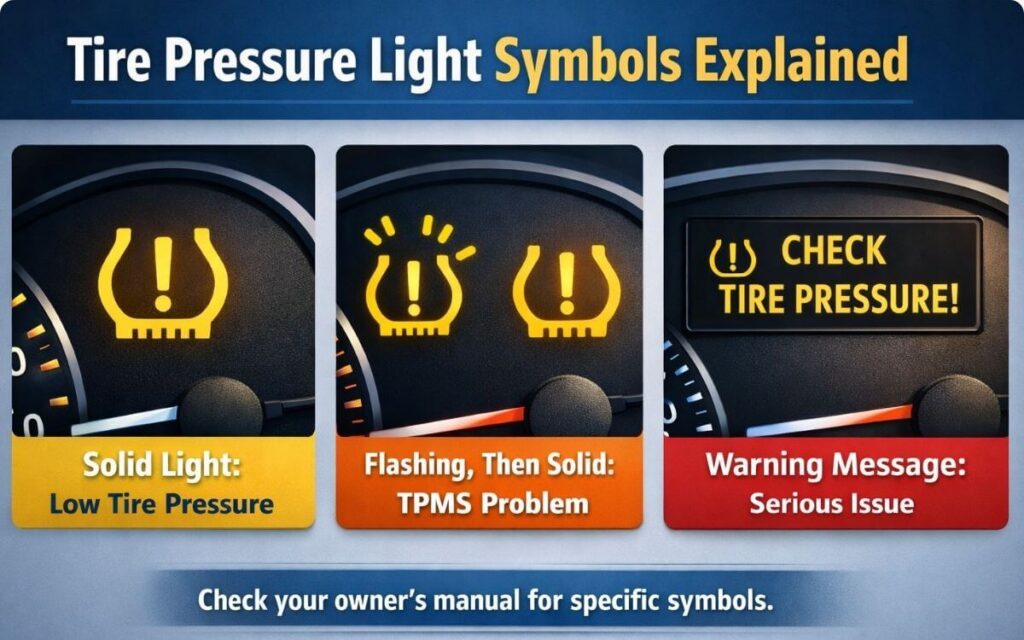
Tire Pressure Light Symbols Explained
The little tire symbol on your dash can mean different things depending on how it’s behaving. Pay attention to whether it’s steady, flashing, or showing a message — each one points to a different problem. National Highway Traffic Safety Administration explains that the light is meant to tell you when tire pressure is unsafe.
Solid light: A steady (solid) tire light usually means one or more tires are under-inflated. In plain terms: a tire has lost enough air that the system thinks it’s unsafe. Stop when it’s safe, check the pressure with a gauge, and add air to reach the number on your door jamb.
Flashing for about 60–90 seconds, then staying solid: If the light flashes for a minute or so and then stays on, that often means the TPMS system itself has a problem — a sensor isn’t talking to the car, or a sensor battery is dead. This isn’t something that always fixes itself; you’ll usually need a shop to scan or replace the faulty sensor.
Light plus a message on the dash: When the light comes on with a text message or a specific warning, treat it as more serious. That message can point to the exact issue or tell you to get the car checked right away. Don’t ignore it — some messages warn of conditions that make driving unsafe.
A quick note: some newer cars show which tire is low or the exact PSI on the display, while older models only show the basic light. Symbols and behavior can vary by make and model, so it’s a good idea to check your owner’s manual for your car’s exact meanings.
If you’re unsure after checking pressures, a short visit to a tire shop or dealer can quickly tell you whether it’s a low tire, a faulty sensor, or something that needs more work.
Direct vs Indirect TPMS Systems
Some cars watch tire pressure one way, others use a different trick. Knowing which type your car has makes it easier to figure out why the warning light came on and what to try next.
Direct systems put a small sensor inside each tire. Those sensors tell the car the actual PSI for every wheel, so the reading is accurate. The downside: each sensor has a battery and can fail or cost money to replace.
Indirect systems don’t have batteries in the tires. Instead, the car’s existing wheel-speed sensors compare how fast each wheel spins. If one wheel spins faster, the system assumes that tire is low. It’s cheaper and simpler, but it only estimates pressure and can be confused by different tire sizes or heavy loads. Indirect systems often need a manual reset after you add air.
If you’re not sure which type your car uses, a quick search for your make and model or a call to a local shop will tell you. That helps you pick the right fix: sensor repair for direct systems, or a reset and inspection for indirect ones.
How to Reset the Tire Pressure Light (Step-by-Step)
So, you’ve filled your tires, checked the air pressure, and yet that stubborn tire pressure light is still on. Don’t worry — it doesn’t always mean something serious. Sometimes the light just needs a little nudge to reset. Here’s a simple, step-by-step guide to help you turn it off safely and get back on the road.
Step 1: Turn the Ignition to the “On” Position
Start by sitting in your car with the engine off, but turn the key to the “On” position (or press the start button once without pressing the brake).
This turns on your vehicle’s electrical systems — including the dashboard lights — but keeps the engine off.
You’ll know you’ve done it right when all the dashboard lights briefly light up, including the tire pressure symbol.
💡 Why this matters: The TPMS (Tire Pressure Monitoring System) needs power from your car’s electronics to reset properly.
Step 2: Find and Hold the TPMS Reset Button
Look for the TPMS reset button, which is usually located under the steering wheel, near the pedals, or inside the glove box. It might be labeled “SET” or have a small tire icon.
Once you find it, press and hold the button until you see the tire pressure light blink three times on your dashboard.
💡 If you can’t find the button: Some newer cars use the settings menu on the dashboard screen instead. You might find it under “Vehicle Settings” or “Tire Pressure.”
Step 3: Wait for the Light to Blink, Then Release
After holding the button for a few seconds, the tire pressure light should blink slowly three times. This means the reset signal has been sent to the TPMS.
Once you see it blink, let go of the button and turn the ignition completely off. This tells your car’s computer to start recalibrating the tire sensors the next time you drive.
💡 Tip: If the light doesn’t blink, try holding the button for a few extra seconds. Some vehicles take up to 10 seconds to register the command.
Step 4: Drive the Car to Recalibrate the System
Now, take your car for a short drive — about 10 to 15 minutes at 50 mph (80 km/h) or higher.
This helps the sensors communicate with the car’s computer and recognize the correct tire pressures.
After the drive, the light should turn off on its own.
💡 If you’re driving in a city with lower speed limits: That’s okay — just extend your drive a bit longer so the sensors have time to update.
Step 5: Check the Tires Again If the Light Stays On
If the tire pressure light is still on after driving, don’t panic. It could mean:
- One tire still isn’t inflated to the right level.
- There’s a slow leak that’s lowering the pressure again.
- One or more TPMS sensors need to be replaced.
Use a reliable tire gauge to recheck all your tires, including the spare if your car monitors it. If everything looks good and the light won’t go away, it’s best to visit a tire shop or mechanic. They can use a scanner to read the TPMS and reset it for you in minutes.
How Long Does It Take for the Tire Pressure Light to Turn Off After Filling Tires?
Usually, the light turns off within a few minutes of driving after your tires reach the proper pressure.
However, some cars need a little more time to recognize the change — especially if you’ve filled the tires when they were very low or in cold weather.
If the light stays on for more than 15–20 minutes of driving, it’s likely that one of the following is happening:
- The system hasn’t fully reset yet.
- The pressure in one tire is still off.
- A TPMS sensor is faulty.
💡 Pro tip: Always check tire pressure when the tires are cold (before driving). This gives the most accurate reading and helps avoid false TPMS alerts.
Can You Drive With the Tire Pressure Light On?
Yes, you can usually keep driving for a short distance when the tire pressure light comes on — but don’t ignore it. Think of it as a warning, not a suggestion. It means something isn’t quite right and should be checked soon.
It’s generally okay to drive slowly to a nearby gas station or safe spot if the tires look normal, the steering feels steady, and the light is not flashing. In many cases, it’s just low air and an easy fix.
Stop driving as soon as it’s safe if the light starts flashing, a tire looks low or flat, the car feels wobbly, or you hear a hissing sound. Those signs can mean a fast leak or another problem that could damage the tire.
Driving too long with the wrong tire pressure can wear out tires faster and, in rare cases, lead to a blowout. It doesn’t happen every time, but it’s not worth the risk. Checking the tires right away is always the safest move.
When to See a Mechanic
Let’s imagine this: you’ve filled your tires, followed the reset steps, even taken your car for a good drive — but that tire pressure light just won’t go away. At this point, it might be more than a simple low-pressure issue. Here’s how to know when it’s time to call in the professionals.
1. The Light Stays On After You’ve Tried Everything
If you’ve checked all your tires, inflated them to the right level, and followed the reset steps, yet the light still glows — that’s your car telling you it needs a little more help.
Sometimes, a faulty sensor or an issue in the system can make the light stay on even when everything seems fine. This is a good time to let a mechanic take a look.
💡 Simple tip: The TPMS (Tire Pressure Monitoring System) sensors inside your tires can wear out over time — usually after several years. A mechanic can test and replace them if needed.
2. The Car Feels Different When You Drive
Pay attention to how your car feels on the road.
If you notice vibration in the steering wheel or your car pulls to one side, it could mean that one tire still doesn’t have the same pressure as the others. Uneven tire pressure can make the ride feel rough or unsteady.
Driving like this for too long can wear out your tires faster and even affect your fuel economy.
👉 What to do: If your car feels off or unstable, it’s best to stop by a tire shop before the problem gets worse.
3. You Notice Air Loss Overnight
If you wake up to a low tire every morning, even after filling it, you might have a slow leak.
It could be something as small as a nail or screw stuck in the tread, or a tiny crack around the valve stem.
You might not see or hear the air escaping, but your tire pressure light will catch it every time.
💡 What helps: A mechanic can submerge the tire in water or use a special tool to find exactly where the leak is coming from and repair it safely.
4. When It’s Time to Rely on the Experts
If you’ve done everything right — checked the air, reset the system, looked for leaks — and the light still won’t turn off, it’s time to visit a certified tire shop or dealership.
Professional mechanics have special diagnostic tools that can test each TPMS sensor individually. They can see which tire is causing the problem, reset the system properly, and make sure your car’s warning system is working as it should.
🧰 Trust tip: You don’t have to guess. A professional can tell you in minutes whether it’s a sensor issue, a small leak, or something else entirely.
Read More: Best Tire Pressure for SUV
How Much Does It Cost to Fix a TPMS Issue?
Fixing a tire pressure warning system can cost very little — or a bit more — depending on what’s causing the problem. Sometimes it’s just a quick reset. Other times, a small part inside the tire needs to be replaced.
Most drivers spend a modest amount, especially if they catch the issue early. Waiting too long can make it more expensive, since small problems can turn into bigger repairs.
Here’s a simple idea of typical costs:
| Problem | Typical Cost |
| System reset | Free – $50 |
| Small air leak repair | $20 – $40 |
| Sensor battery issue | $50 – $100 |
| New sensor replacement | $100 – $250 per tire |
Prices can vary by location, vehicle type, and shop rates. Luxury or newer cars sometimes cost more because their parts are more advanced. If more than one sensor fails at the same time, the total bill can add up quickly.
If you’re unsure what’s wrong, many tire shops will check the system for free or for a small fee. That quick check can save money by catching the real problem early.
Which Cars Require Manual TPMS Reset?
Some cars reset their tire-pressure system on their own after you drive a short distance. Others need you to tell the car to reset. Knowing which group your vehicle falls into saves time and guesswork.
Cars that commonly need a manual reset include older models, many vehicles that use the simpler wheel-speed method, and some imported or budget models with less automatic electronics. This doesn’t mean every car in those groups will need a reset, but it’s more likely.
Watch for these signs that a manual reset may be needed:
- The light stays on after you’ve driven 10–15 minutes.
- Your tire pressures are correct, but the warning still appears.
If you see those signs, check your owner’s manual for the reset procedure or the location of a reset button (often near the dash, glove box, or under the steering wheel). The usual quick steps are: confirm pressures, press and hold the reset button until the dash light blinks, then drive for about 10–15 minutes.
Be honest: a manual reset won’t fix a dead sensor or a real leak. If the light won’t go off after a proper reset, have a shop scan the system — they can tell whether it’s a sensor, wiring, or another issue.
Tips to Prevent the Tire Pressure Light from Coming Back
Picture this: it’s a clear morning, you start the car, and the tire pressure light is off. Feels good, right? Here are simple, everyday habits that keep it that way — told like a short, useful story so it’s easy to remember.
Check tire pressure once a month (use a digital gauge)
A quick monthly check is the easiest way to stay ahead of problems. Think of it like checking the oil — a small habit that prevents bigger headaches.
How to do it:
- Do the check when the tires are cold (before you drive, or after the car has sat for a few hours).
- Take off the valve cap, press the digital gauge onto the valve stem, and read the number.
- If the reading is below the number on your door jamb (see next tip), add air. If it’s too high, let a bit out until it matches.
Why a digital gauge? They’re fast and more accurate than many free air hoses at gas stations. A good one costs a little but will save you time and worry.
Inflate tires to the manufacturer’s PSI (check the door jamb)
Every car has a recommended tire pressure — usually on a sticker inside the driver’s door (not the number stamped on the tire). That sticker tells the exact PSI your vehicle maker recommends for safe, efficient driving.
Quick story-style reminder:
- Picture the door jamb sticker as your car’s “recipe card.” Use the PSI there, not the number on the tire sidewall.
- Fill each tire to that PSI and re-check with your gauge. Small differences between tires add up, so check all four.
Watch for temperature changes — especially in fall and winter
Air inside tires gets smaller when it’s cold. If the weather drops, your tire pressure can fall too — sometimes by about 1 PSI for every 10°F (about 5–6°C) of temperature change. That’s enough to trigger the tire light.
What to do:
- When seasons change, check your tires more often for the first few weeks.
- If a cold snap hits, add a little air to bring tires back to the door-jamb PSI.
Have TPMS sensors checked every 5 years (or when you get new tires)
TPMS sensors have small batteries and can wear out over time. A good rule: ask a technician to check the sensors every 5 years or whenever you replace tires or the car battery.
Why this helps:
- Sensors that are weak or out of sync can make the light come on even when tire pressure is fine.
- A shop can test each sensor, replace worn ones, and make sure the system is properly calibrated.
Quick preventive checklist (one-minute read)
- Check all tires monthly with a digital gauge.
- Use the PSI from the sticker on the driver’s door.
- Check again when the weather gets colder.
- Have TPMS sensors checked at the 5-year mark or when you replace tires.
- Keep a spare valve cap on hand — a missing cap can let dust and moisture cause leaks.
Common Mistakes Drivers Make
Even careful drivers sometimes keep the tire pressure light on without realizing it. A few small mistakes are often the cause, and fixing them is usually simple.
- Not checking the recommended pressure: Filling tires without looking at the car’s suggested PSI can leave them too low or too high. Always check the sticker on the door jamb or the owner’s manual.
- Resetting before inflating: If you press the reset button before topping up the air, the system records the wrong pressure. Always inflate first, then reset.
- Ignoring temperature changes: Cold weather can lower tire pressure, making the light come on even if the tires seemed fine the day before. Check pressures more often in winter.
- Using inaccurate gauges: Some gas station air gauges aren’t reliable. A small hand-held digital gauge is cheap and much more accurate.
Avoiding these mistakes keeps the warning light from coming back and helps your tires last longer. It’s an easy way to save money and stay safe.
Quick Troubleshooting Checklist
Use this quick checklist to find the problem fast. Do the steps in order — it saves time and helps you avoid unnecessary repairs.
- Check tire pressure. Use a reliable gauge when the tires are cold. Compare each tire to the number on your door jamb and add air where needed.
- Inspect the tires. Look for nails, cuts, cracks, or bulges. Press around the tread and sidewall and listen for any hissing sounds.
- Reset the TPMS. Inflate the tires correctly first, then perform your car’s reset procedure (button, menu, or driving method). If you’re not sure how, check the owner’s manual.
- Drive for about 10 minutes. A short drive lets many systems relearn the correct pressure. Recheck the dash when you stop.
- Scan the sensors if the light stays on. Many shops and some auto stores can read TPMS sensors and show faults. This step finds dead sensors or wiring problems.
If the warning light still won’t go off after these steps, have a professional inspect it. It might be a faulty sensor, a slow leak you missed, or an electrical issue — and fixing those usually needs shop tools.
Quick Recap: Fixing the Tire Pressure Light Made Simple
Here’s a quick summary to keep in mind when your tire pressure light comes on:
- Check all tires: Make sure every tire — including the spare if your car monitors it — is at the correct pressure.
- Reset the TPMS properly: Follow your car’s reset steps and take a short drive to let the system recalibrate.
- Inspect for leaks or faulty sensors: Look for nails, cracks, or worn-out TPMS sensors that could trigger the light.
Friendly reassurance:
“In most cases, a little patience and a quick reset are all you need to clear that tire pressure light.”
With these simple steps, you can usually get back on the road safely and confidently.
FAQs
1: Why is my tire pressure light still on after I filled my tires?
It could be due to uneven tire pressure, cold weather, a slow leak, or a faulty TPMS sensor. Sometimes the system just needs a short drive to reset.
2: How long does it take for the tire pressure light to turn off?
Usually a few minutes of driving. In colder weather or after very low pressure, it may take 10–15 minutes for the light to go off.
3: Can I reset the tire pressure light myself?
Yes! Most cars have a TPMS reset button. Turn the ignition on, hold the button until the light blinks, then drive for a short distance to recalibrate.
4: When should I see a mechanic?
If the light stays on after resetting, you notice vibrations, your car pulls while driving, or your tires lose air overnight, it’s time for a professional check.
5: How can I prevent the tire pressure light from coming back?
Check your tire pressure monthly with a digital gauge, inflate tires to the recommended PSI, watch for temperature changes, and have TPMS sensors checked every 5 years.
6: Why is my tire pressure light on but tires are fine?
A faulty sensor or system calibration issue is usually the cause.
7: Why does my TPMS light turn on in the morning?
Cold temperatures reduce tire pressure overnight.
8: Do all cars have TPMS reset buttons?
No. Some reset automatically while others require manual recalibration.
