5 Lug Bolt Pattern Chart: Vehicle Guide and Fitment Tips
Buying new wheels should be exciting, not frustrating. Yet many vehicle owners order wheels online only to discover they don’t fit their car. In most cases, the problem comes down to one simple specification: the bolt pattern.
A 5 lug bolt pattern chart helps you identify the bolt pattern used by your vehicle and determine which wheels may fit. It also helps you avoid costly mistakes when shopping for replacement wheels, aftermarket rims, or potential wheel swaps.
In this guide, you’ll learn what a 5 lug bolt pattern means, how to measure it correctly, common 5 lug patterns, and the other fitment measurements you should never ignore.
What Is a 5 Lug Bolt Pattern?
A 5 lug bolt pattern is the way a wheel attaches to a vehicle using five lug holes. These holes are placed in a circle, and that circle has a specific size. That size is what people are talking about when they say a wheel has a certain bolt pattern.
For example, a pattern like 5×114.3 means the wheel has 5 lug holes and the circle they form measures 114.3 mm across. If the bolt pattern does not match your vehicle, the wheel will not fit properly.
This matters because even a small mismatch can cause vibration, poor fitment, or unsafe installation. A 5 lug bolt pattern chart helps you check the right match before buying wheels, so you do not end up with the wrong set.
How to Measure a 5 Lug Bolt Pattern
Measuring a 5 lug bolt pattern is slightly different from measuring wheels with an even number of lug holes. Since there isn’t a lug hole directly across from another one, you have to measure at an angle.
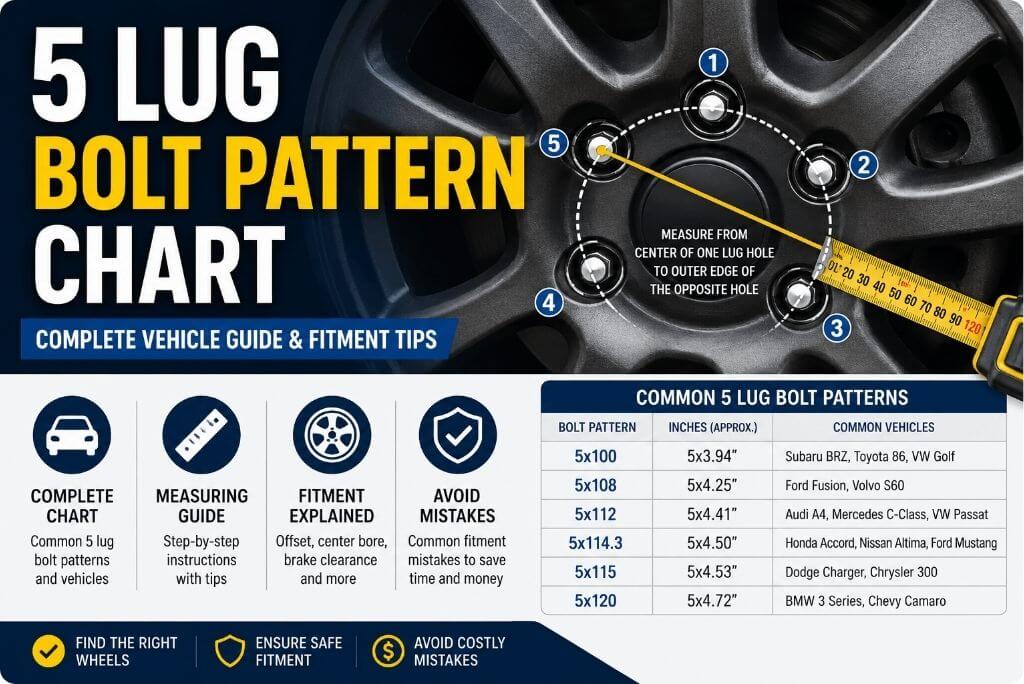
Start by finding any lug hole on the wheel. Place your tape measure at the center of that lug hole. Then measure to the outer edge of the lug hole that is farthest away.
For example, if the measurement is close to 114.3 mm, the wheel has a 5×114.3 bolt pattern.
Simple Measuring Steps
- Count the lug holes and confirm there are five.
- Pick any lug hole as your starting point.
- Measure from the center of that hole to the outer edge of the farthest hole.
- Compare your measurement with a bolt pattern chart to find the correct size.
A ruler or tape measure usually works fine, but a caliper gives more accurate results. If your measurement is slightly off, measure again. Being off by only a few millimeters can lead to choosing the wrong wheels.
Illustration idea for this section: Show a line starting from the center of one lug hole and ending at the outside edge of the opposite lug hole. Label both points clearly so readers can easily see where the measurement begins and ends.
Complete 5 Lug Bolt Pattern Chart
The table below covers the most common 5 lug bolt patterns and examples of vehicles that use them. Always verify your exact year and trim level before buying wheels, as some models offer multiple bolt patterns depending on the generation or performance package.
| Bolt Pattern | Inches (Approx.) | Common Vehicles | Notes |
| 5×98 | 5×3.86″ | Fiat 500X, Alfa Romeo Giulia, Alfa Romeo Stelvio | Mainly used on Alfa Romeo and Fiat vehicles. |
| 5×100 | 5×3.94″ | Subaru BRZ, Toyota 86, Subaru Impreza, Subaru Crosstrek, Volkswagen Golf, Volkswagen Jetta | Popular among compact cars and sports coupes. |
| 5×10⁵ | 5×4.13″ | Chevrolet Sonic, Chevrolet Trax, Buick Encore | Found mostly on smaller GM vehicles. |
| 5×10⁸ | 5×4.25″ | Ford Fusion, Ford Escape, Volvo S60, Volvo XC60, Lincoln MKZ | Common on Ford and Volvo vehicles. |
| 5×110 | 5×4.33″ | Chevrolet Malibu, Chevrolet Cobalt SS, Pontiac G6, Saturn Aura | Used on several older GM sedans and performance models. |
| 5×112 | 5×4.41″ | Audi A4, Audi Q5, Mercedes-Benz C-Class, Volkswagen Passat, Porsche Macan | One of the most widely used European bolt patterns. |
| 5×114.3 | 5×4.50″ | Honda Accord, Honda CR-V, Toyota Camry, Toyota RAV4, Nissan Altima, Ford Mustang, Mazda CX-5, Hyundai Sonata, Kia Telluride | The most common 5 lug pattern worldwide. |
| 5×115 | 5×4.53″ | Dodge Charger, Dodge Challenger, Chrysler 300, Chevrolet Impala, Buick LaCrosse | Often confused with 5×114.3 but not exactly the same size. |
| 5×118 | 5×4.65″ | Ram ProMaster, Fiat Ducato, Citroën Jumper, Peugeot Boxer | Primarily used on vans and commercial vehicles. |
| 5×120 | 5×4.72″ | BMW 3 Series, BMW X5, Chevrolet Camaro, Cadillac CTS, Land Rover Discovery | Common on BMW, GM performance vehicles, and SUVs. |
| 5×120.65 | 5×4.75″ | Chevrolet Corvette (C4-C7), Pontiac Firebird, Chevrolet Camaro (older generations) | Also known as 5×4.75 inches in imperial measurements. |
| 5×127 | 5×5.00″ | Jeep Wrangler JK, Jeep Gladiator JT, Ram 1500 (older models), Dodge Durango | Popular among trucks and off-road vehicles. |
| 5×130 | 5×5.12″ | Porsche 911, Porsche Cayenne, Audi Q7, Bentley Bentayga | Mostly found on premium SUVs and sports cars. |
| 5×135 | 5×5.31″ | Ford F-150 (1997-2003), Ford Expedition, Lincoln Navigator | Used on older full-size Ford trucks and SUVs. |
| 5×139.7 | 5×5.50″ | Suzuki Jimny, Suzuki Samurai, Older Dodge Ram 1500 | Common on older trucks and compact off-road vehicles. |
Important: Sharing the same bolt pattern does not automatically mean wheels are interchangeable. Wheel offset, center bore, brake clearance, and lug nut seat design also need to match for a safe fit.
Most Common 5 Lug Bolt Patterns Explained
5×100
The 5×100 pattern is common on many compact cars and performance-oriented models. It is often seen on Subaru and Toyota platforms, as well as some Volkswagen vehicles. People often look for this pattern when searching for lightweight aftermarket wheels or sporty fitment options.
A wheel with this pattern may fit several vehicles, but you still need to check center bore and offset. A wheel that clears the bolt pattern can still rub on suspension parts or stick out too far from the fender.
5×10⁸
The 5×10⁸ pattern shows up often on Ford and Volvo vehicles. It is a popular European and North American fitment size, and many drivers use it when replacing factory wheels or upgrading to a different style.
Because this pattern is common on family sedans and crossovers, many people want a simple swap. That is where the rest of the fitment check matters. Even when the bolt pattern matches, the wheel still has to fit the hub and brake setup.
5×110
The 5×110 pattern appears on a range of General Motors and European vehicles. It is less common than 5×114.3 or 5×120, but still widely used. If your vehicle uses this pattern, it is especially important to verify the exact wheel specs before ordering, since fewer wheel choices may match directly.
5×112
The 5×112 pattern is very common on many German vehicles, especially Audi, Mercedes-Benz, and Volkswagen models. Because it is so widely used, there are many aftermarket wheel choices available.
Even so, not every 5×112 wheel will fit every 5×112 vehicle. Offset and center bore can vary a lot between brands and models. This is one of the most common mistakes buyers make when they assume the bolt pattern alone is enough.
5×114.3
The 5×114.3 pattern is one of the most common five lug patterns in the world. You will find it on many Japanese, American, and Korean vehicles. Because it is so common, aftermarket wheel options are usually easier to find.
This pattern is often seen on cars like the Honda Accord, Nissan Altima, Toyota Camry, and Ford Mustang. It is also one of the most searched bolt patterns because many people want to know whether different brands can share wheels. The answer is sometimes yes, but only after checking all the fitment details.
5×115
The 5×115 pattern is commonly associated with Chrysler, Dodge, and some General Motors vehicles. It is close to 5×114.3, which is why people often ask whether they are interchangeable.
They are not the same. The difference may seem small, but it matters. If you are comparing wheels between 5×114.3 and 5×115, do not rely on “close enough.” Always use the exact pattern.
5×120
The 5×120 pattern is well known in BMW applications and also appears on some Chevrolet and other performance models. It is a popular pattern in the aftermarket world because there are many wheel choices available.
Still, the same warning applies: the bolt pattern only confirms that the wheel can bolt up. It does not guarantee perfect fitment. You still need to check offset, center bore, and brake clearance.
Can Wheels With the Same Bolt Pattern Fit Different Vehicles?
Yes, sometimes they can. But the bolt pattern alone does not tell the full story.
Two vehicles may both use a 5 lug pattern, but still need different wheels because of:
- Center bore — the hole in the middle of the wheel may be too small or too large
- Offset — the wheel may sit too far in or too far out
- Brake clearance — the wheel may hit the caliper or rotor
- Lug seat type — the lug nuts may not match the wheel’s seat style
- Load rating — the wheel may not support the vehicle’s weight properly
This is why a wheel that “matches” on paper may still not be a true fit in real life. A good example is a 5×114.3 wheel from one vehicle and a 5×114.3 wheel from another. They may share the same bolt pattern, but one may have a different center bore or offset that makes it unsuitable without additional adjustments.
When people run into fitment problems, it is usually because they checked only the bolt pattern and ignored the rest of the wheel specs.
Common Wheel Fitment Mistakes
Many wheel problems happen because someone checks only one detail and ignores the rest. Here are the most common mistakes people make when using a 5 lug bolt pattern chart.
Assuming all 5 lug wheels are interchangeable
This is the biggest mistake. Five lug does not mean universal. The pattern must match exactly, and the wheel still needs the correct offset, center bore, and brake clearance.
Confusing similar bolt patterns
Some patterns are very close, such as 5×114.3 and 5×115. They are not the same. Even a small difference can create fitment problems.
Ignoring the center bore
A wheel can have the right bolt pattern and still not sit correctly on the hub. That can lead to vibration, wobble, or poor balance.
Forgetting about offset
Offset affects how the wheel sits in the wheel well. A wheel that looks like it should fit may rub the fender or suspension if the offset is wrong.
Buying based on appearance alone
A nice-looking wheel is not useful if it does not fit safely. It is always better to confirm specs first and style second.
Not checking the lug seat style
Even when the wheel pattern matches, the wrong lug nuts can cause installation issues. Always confirm the wheel’s seat type before mounting.
A simple checklist can save a lot of time and money. Before you buy, verify the bolt pattern, center bore, offset, brake clearance, and lug nut type. That small habit can prevent a costly mistake.
Frequently Asked Questions
How do I know my vehicle’s 5 lug bolt pattern?
You can find your bolt pattern in the owner’s manual, on the manufacturer’s website, or by measuring it yourself. Count the five lug holes and measure from the center of one lug hole to the outer edge of the farthest hole.
Are all 5 lug wheels interchangeable?
No. Two wheels may have five lug holes but use different bolt patterns. Even if the bolt pattern matches, you still need to check offset, center bore, brake clearance, and lug nut style.
Can I use 5×115 wheels on a 5×114.3 vehicle?
It is generally not recommended. The two patterns are very close in size but are not identical. Using the wrong pattern can cause improper wheel seating and may lead to vibration or safety issues.
Can I change my vehicle’s bolt pattern?
Yes, but it usually requires wheel adapters or custom modifications. While adapters can work in some situations, they add complexity and should only be used if they are high quality and installed correctly.
What happens if I buy wheels with the wrong bolt pattern?
The wheels either won’t mount at all or won’t sit correctly on the hub. Trying to force them to fit can damage the wheel, lug nuts, or studs and may create serious safety risks while driving.
Final Thoughts
A 5 lug bolt pattern chart is one of the most useful tools you can have when shopping for wheels, but it should never be used alone. The bolt pattern tells you whether the wheel can bolt to the vehicle, but the full fit depends on several other details too.
If you remember just one thing, make it this: matching the lug count is not enough. You also need the correct bolt circle, center bore, offset, and brake clearance to get a safe and proper fit.
Used the right way, this guide can help you avoid mistakes, save money, and choose wheels with confidence. It does not matter whether you are replacing factory rims or upgrading to a new look. A careful fitment check is always worth the time.
