Wheel Offset Chart: How to Read Offset and Choose the Right Wheel Fitment
Last updated on July 9th, 2026
If you’re planning to change your wheels, one of the most important things you’ll come across is wheel offset. At first, it may look like a confusing number like ET35 or +45, but it actually tells you something very simple: where your wheel will sit inside the wheel arch.
Understanding offset is important because it affects how your vehicle looks, how it drives, and whether your new wheels will even fit without rubbing or sticking out too far.
This guide will walk you through everything in a clear and practical way, including a wheel offset chart, real examples, and simple explanations you can actually use when buying wheels.
What Is Wheel Offset?
Wheel offset is the distance between the center of a wheel and the surface that bolts to your vehicle’s hub. It determines how far the wheel sits inward or outward once it is installed.
If you’ve ever wondered why some wheels sit flush with the fender while others stick out farther, offset is one of the main reasons.
To understand offset, it helps to know two simple parts of a wheel.
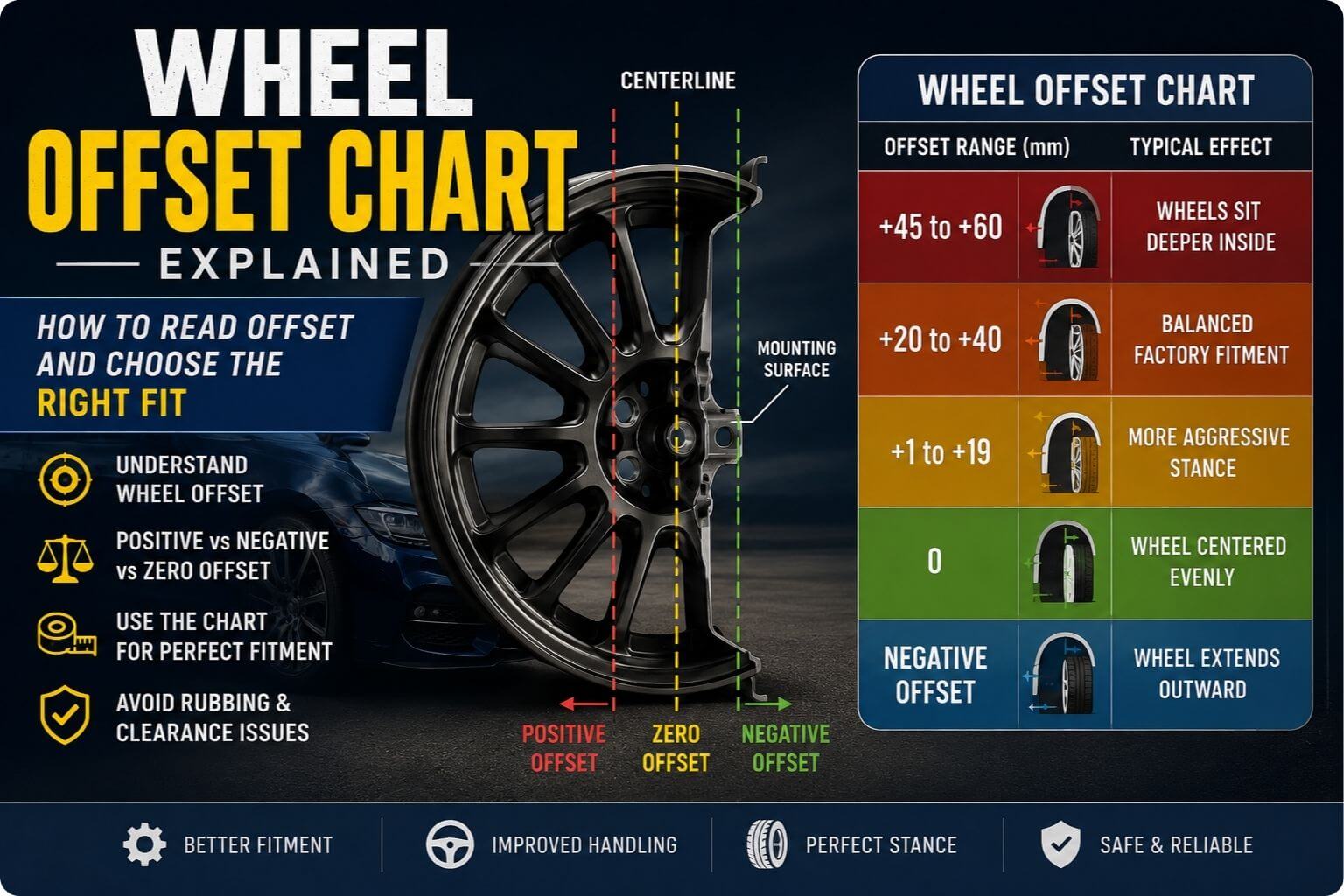
The wheel centerline is an imaginary line running through the exact middle of the wheel’s width. Think of it as the wheel’s halfway point.
The hub mounting surface is the flat area on the back of the wheel that connects to the vehicle’s hub. This is where the wheel is bolted onto the car, truck, or SUV.
Offset is simply the distance between these two points.
Manufacturers measure wheel offset in millimeters (mm) because it provides a precise way to compare different wheel designs. Even a small change of 5 to 10 millimeters can noticeably change how a wheel fits inside the wheel well.
When looking at wheel specifications, you will often see a number starting with ET, such as ET35, ET45, or ET0.
The letters ET come from the German word Einpresstiefe, which translates to “insertion depth” or wheel offset. The number that follows tells you the offset in millimeters.
For example:
- ET45 means the wheel has a 45 mm offset.
- ET35 means the wheel has a 35 mm offset.
- ET0 means the wheel has zero offset.
The ET number is one of the most important wheel specifications because it affects how the wheel will sit on your vehicle. Before buying new wheels, it’s always worth checking the offset to make sure the fitment is correct.
Positive vs Zero vs Negative Offset
Wheel offset can be positive, zero, or negative. The difference comes down to where the wheel’s mounting surface sits compared with the middle of the wheel.
Positive Offset
A wheel has positive offset when the mounting surface is closer to the front of the wheel. In simple terms, the wheel sits farther inward under the vehicle.
This is the most common type on modern cars and many SUVs. It usually gives a cleaner factory look, but too much positive offset can sometimes make the wheel sit too far inside the wheel well.
Zero Offset
Zero offset means the mounting surface sits right in the middle of the wheel. The wheel is centered evenly, so it does not lean inward or outward.
This setup is less common on newer passenger vehicles, but it is still used on some older trucks, off-road builds, and custom wheels. It gives a balanced look, though it may not be the best choice for every vehicle because fitment still depends on wheel width and tire size.
Negative Offset
Negative offset means the mounting surface sits closer to the inside of the wheel. As a result, more of the wheel sits outward, past the hub area.
This is common on trucks, lifted vehicles, and off-road setups where extra space is needed around suspension parts or brakes. It can create a more aggressive look, but going too far negative may cause the wheels to stick out too much or create rubbing issues.
The main thing to remember is this: offset changes where the wheel sits, which affects both appearance and fitment. A small change can be useful, but a large change can create clearance problems if it is not matched to the vehicle.
How Wheel Offset Affects Fitment
Wheel offset is not just about looks. It directly affects how the wheel fits inside your vehicle and how safely everything clears when you drive.
A small change in offset can be fine, but larger changes can create rubbing, steering issues, or clearance problems.
Inner Suspension Clearance
If the offset is too high (more positive), the wheel sits closer to the suspension parts inside the wheel well.
This can cause rubbing against shock absorbers, control arms, or other components. It might not show up when parked, but it can happen when turning or hitting bumps.
Fender Clearance
If the offset is too low (more negative), the wheel moves outward toward the fender.
This can lead to the tire rubbing the fender edge, especially when turning or going over uneven roads. In some cases, it may even damage the fender if the fitment is too aggressive.
Wheel Poke and Stance
Offset also controls how far the wheel sits outside the body of the vehicle, often called “poke.”
A lower or negative offset pushes the wheel outward, giving a wider and more aggressive stance. This can look good, but if overdone, the tire may stick out too far, which can be illegal in some areas or cause dirt and debris to be thrown onto the body.
Steering and Handling Effects
Changing offset also changes how the wheel behaves when you drive.
A big offset change can make steering feel heavier or slightly different. In some cases, it can increase stress on suspension parts over time. Small changes usually feel normal, but large changes may affect comfort and control.
Brake Clearance Considerations
Not all wheels clear the brake system properly, especially larger brake calipers.
If the offset is wrong, the wheel may sit too close to the brakes or not fit at all. This is more common when upgrading to aftermarket wheels or performance brakes.
Even if everything looks fine from the outside, brake clearance should always be checked before final installation.
Complete Wheel Offset Chart (ET Value Guide)
| Offset (ET) | Offset Type | Wheel Position | Fender Clearance | Suspension Clearance |
| ET -100 to -81 | Extreme Negative | Very far outward | Very High rubbing risk | Excellent |
| ET -80 to -61 | Extreme Negative | Huge poke | Very High | Excellent |
| ET -60 to -51 | Very Negative | Large poke | High | Excellent |
| ET -50 | Very Negative | Aggressive | High | Excellent |
| ET -45 | Very Negative | Aggressive | High | Excellent |
| ET -44 | Very Negative | Aggressive | High | Excellent |
| ET -38 | Very Negative | Aggressive | High | Excellent |
| ET -35 | Negative | Wide stance | Moderate-High | Excellent |
| ET -30 | Negative | Wide | Moderate | Excellent |
| ET -25 | Negative | Wide | Moderate | Excellent |
| ET -20 | Negative | Slight poke | Moderate | Excellent |
| ET -18 | Negative | Slight poke | Moderate | Excellent |
| ET -15 | Negative | Slight poke | Moderate | Excellent |
| ET -12 | Negative | Popular aftermarket | Moderate | Excellent |
| ET -10 | Slight Negative | Mild poke | Low-Moderate | Excellent |
| ET -8 | Slight Negative | Mild poke | Low | Excellent |
| ET -6 | Slight Negative | Slight poke | Low | Excellent |
| ET -5 | Slight Negative | Slight poke | Low | Excellent |
| ET -3 | Slight Negative | Near neutral | Very Low | Excellent |
| ET -2 | Slight Negative | Near neutral | Very Low | Excellent |
| ET -1 | Slight Negative | Almost centered | Very Low | Excellent |
| ET 0 | Zero Offset | Centerline | Low | Good |
| ET +1 | Positive | Slight inward | Very Low | Good |
| ET +2 | Positive | Slight inward | Very Low | Good |
| ET +3 | Positive | Slight inward | Very Low | Good |
| ET +5 | Positive | Slight inward | Very Low | Good |
| ET +6 | Positive | Mild tuck | Very Low | Good |
| ET +8 | Positive | Mild tuck | Very Low | Good |
| ET +10 | Positive | Mild tuck | Very Low | Good |
| ET +12 | Positive | Mild tuck | Very Low | Good |
| ET +15 | Positive | Light tuck | Very Low | Moderate |
| ET +18 | Positive | Light tuck | Very Low | Moderate |
| ET +20 | Positive | Balanced | Very Low | Moderate |
| ET +22 | Positive | Balanced | Very Low | Moderate |
| ET +25 | Positive | Balanced | Very Low | Moderate |
| ET +27 | Positive | Balanced | Very Low | Moderate |
| ET +30 | Positive | OEM style | Very Low | Moderate |
| ET +32 | Positive | OEM style | Very Low | Moderate |
| ET +35 | Positive | Factory fit | Very Low | Moderate |
| ET +38 | Positive | Factory fit | Very Low | Moderate |
| ET +40 | Positive | Factory fit | Very Low | Moderate |
| ET +42 | Positive | Factory fit | Very Low | Moderate |
| ET +45 | Positive | Common OEM | Very Low | Moderate |
| ET +48 | High Positive | Inward | Very Low | Moderate-High |
| ET +50 | High Positive | Inward | Very Low | Moderate-High |
| ET +52 | High Positive | Inward | Very Low | Moderate-High |
| ET +55 | High Positive | Deep tuck | Very Low | High |
| ET +58 | High Positive | Deep tuck | Very Low | High |
| ET +60 | High Positive | Deep tuck | Very Low | High |
| ET +62 | Very High Positive | Deep tuck | Very Low | High |
| ET +65 | Very High Positive | Deep tuck | Very Low | High |
| ET +70 | Very High Positive | Deep tuck | Very Low | Very High |
| ET +75 | Extreme Positive | Very tucked | Very Low | Very High |
| ET +80 to +100 | Extreme Positive | Maximum tuck | Very Low | Extremely High |
How to Read Wheel Offset Specifications
When shopping for wheels, you’ll usually see several numbers listed together. At first glance, they can look confusing, but each number has a specific meaning.
A common wheel specification might look like this:
18×8.5 ET35
Here’s what it means:
- 18 = Wheel diameter in inches
- 8.5 = Wheel width in inches
- ET35 = Wheel offset in millimeters
The offset is usually shown as ET followed by a number. This number is one of the most important measurements because it tells you where the wheel will sit once installed.
You can often find the offset in:
- The wheel’s product description
- Manufacturer specifications
- Markings stamped or cast on the back of the wheel
For example, if a wheel is marked 18×8 ET45, it means the wheel is 18 inches in diameter, 8 inches wide, and has a 45 mm offset.
When comparing wheels, pay attention to the offset number, not just the wheel size. Two wheels can have the same diameter and width but fit very differently if their offsets are not the same.
As a quick check, look for the ET number whenever you’re researching wheel fitment. It’s usually the fastest way to determine whether a wheel is likely to sit closer to the suspension or farther toward the fender.
How to Measure Wheel Offset
If you cannot find the wheel’s offset specification, you can measure it yourself with a few basic tools. The process takes a little time, but it is fairly straightforward.
You will need:
- A tape measure or ruler
- A straight edge (such as a level or metal ruler)
- A flat surface
Start by placing the wheel face down on a flat surface with the tire removed if possible. This gives the most accurate measurement.
Measure the wheel’s total width from one bead seat to the other. Divide that number by two to find the wheel’s centerline.
Next, lay the straight edge across the back of the wheel. Measure the distance from the mounting surface—the flat area that touches the hub—to the straight edge. This measurement is called backspacing.
To calculate offset:
Offset = Backspacing − Wheel Centerline
If the result is positive, the wheel has positive offset. If the result is zero, it has zero offset. If the result is negative, it has negative offset.
For example, if a wheel has a centerline of 4 inches and a backspacing measurement of 5 inches, the offset is positive because the mounting surface sits 1 inch beyond the centerline.
Keep in mind that offset is normally expressed in millimeters, so you may need to convert your final measurement if you measured in inches. Even a small measuring error can affect the result, so take measurements carefully and double-check your numbers before making wheel fitment decisions.
Wheel Offset vs Backspacing
Wheel offset and backspacing are two different ways of describing wheel fitment. Both help determine where a wheel will sit, but they measure different things.
Backspacing is the distance from the wheel’s mounting surface to the inner edge of the wheel. It is usually measured in inches and is commonly used when checking clearance around suspension parts and wheel wells.
Offset, on the other hand, measures the position of the mounting surface relative to the center of the wheel. It is typically measured in millimeters and is the specification most wheel manufacturers use today.
The biggest difference is that offset tells you how the wheel is designed, while backspacing tells you how much space the wheel takes up on the inside.
For most wheel buyers, offset is the number you’ll use most often because it appears on wheel specifications and product listings. Backspacing becomes more important when you’re dealing with custom fitment, lifted trucks, or situations where every bit of clearance matters.
Neither measurement is better than the other. They simply provide different ways to understand how a wheel will fit your vehicle.
How to Use a Wheel Offset Chart for Wheel Selection
A wheel offset chart is most useful when you compare your current wheel setup to the one you want to buy. Before looking at any chart, find your vehicle’s factory wheel offset. This gives you a reliable starting point and helps you avoid fitment surprises.
Next, compare the factory offset to the offset of the new wheel. The difference between the two numbers tells you how much the wheel position will change.
As a general rule:
- Lower offset = wheel moves outward
- Higher offset = wheel moves inward
For example, if your factory wheel is ET45 and the new wheel is ET35, the wheel will sit about 10 mm farther outward. If you move from ET35 to ET45, the wheel will sit about 10 mm farther inward.
Small offset changes are usually easier to work with. Larger changes can affect clearance around the suspension, brakes, or fenders. This is especially important if you are also changing wheel width or tire size.
A good approach is to stay as close as possible to the factory offset unless you have a specific reason to change it. If you want a wider stance, compare the offset change carefully and make sure there is enough room on both the inside and outside of the wheel.
The chart helps you understand where the wheel will move, but it should be used alongside your wheel width and tire size. Looking at all three measurements together gives the most accurate picture of how the new wheels will fit.
Common Wheel Offset Changes Explained
Small changes in offset can make a noticeable difference in how a wheel sits on your vehicle. The examples below show what actually happens when you move from one offset to another.
+45 mm to +35 mm
When you go from ET45 to ET35, the wheel moves about 10 mm outward.
This usually gives the vehicle a slightly wider stance. In most cases, this change is still safe for daily driving, but it may bring the tire a little closer to the fender edge depending on your wheel width and tire size.
+35 mm to +20 mm
Dropping from ET35 to ET20 pushes the wheel about 15 mm further outward.
This creates a more noticeable change in stance. The wheel starts to sit closer to the fender line, which looks more aggressive. The downside is that you should check for rubbing when turning or going over bumps, especially on lowered cars.
+20 mm to 0 mm
Moving from ET20 to zero offset shifts the wheel about 20 mm outward.
At this point, the wheel is clearly more centered and starts to look wide and flush. It can work well on some trucks and older vehicles, but on many modern cars it may reduce inner clearance and increase the chance of fender contact.
0 mm to -12 mm
Going from zero offset to -12 mm pushes the wheel another 12 mm outward past the hub.
This is a common setup for trucks and off-road builds. It gives a strong, wide stance and extra clearance on the inside. The trade-off is that the tire may stick out beyond the fender, and road dirt or debris can be more noticeable.
In general, the bigger the offset drop, the more the wheel moves outward—and the more carefully you need to check clearance before making the change.
Common Problems Caused by Incorrect Offset
Choosing the wrong wheel offset doesn’t always show up right away, but it can cause real issues once the vehicle is on the road.
One of the most common problems is tire rubbing. This happens when the tire is too close to the suspension or inner body parts. You might hear a scraping sound when turning or going over bumps, which usually means there is not enough space.
Another issue is fender interference. If the wheel sits too far outward, the tire can touch the fender. This is more noticeable when the suspension moves, like when carrying passengers or driving over uneven roads.
Incorrect offset can also create brake clearance problems. Some wheels may look like they fit, but still touch the brake caliper inside. This is one of the reasons test fitting or checking full specs is important before buying wheels.
There can also be extra stress on suspension parts and wheel bearings. When the wheel sits too far out or too far in, it changes how weight is distributed. Over time, this can lead to faster wear on parts that were not designed for that setup.
Finally, you may notice changes in handling. The steering can feel heavier or less stable, especially if the offset change is large. The car may not respond the same way it did with factory wheels, which can make daily driving feel different.
Most of these problems don’t happen with small offset changes, but they become more likely as the difference from stock gets bigger. That’s why it’s important to match offset carefully with your vehicle setup, not just the look you want.
How to Choose the Right Wheel Offset
Choosing the right wheel offset is mostly about balance. You want a wheel that looks good, fits properly, and doesn’t cause rubbing or clearance issues.
A good starting point is to stay close to your vehicle’s recommended offset range. Car makers design suspension and wheel space around specific measurements, so going too far away from factory specs can quickly create fitment problems.
It’s also important to look at wheel width and tire size together with offset. A wider wheel with the same offset will sit differently than a narrow one. This is something many people overlook, and it can lead to wheels sticking out more than expected or sitting too close to suspension parts.
If your vehicle has suspension changes like a lift kit or lowering springs, you need to account for that. These modifications change how much space is available inside the wheel well, so the same offset that worked before may not work the same way now.
Before buying wheels, it is always better to double-check fitment. This can be done by comparing specs carefully or using a test fit if possible. It takes a little extra time, but it helps avoid costly mistakes like rubbing, poor alignment, or returning wheels that don’t fit.
In simple terms, the right offset is not just about looks. It is about making sure the wheel works with your vehicle without causing problems later.
Frequently Asked Questions
What is the best wheel offset?
There is no single “best” offset. The correct offset depends on your vehicle, wheel width, and how you want the wheels to sit.
Can I change wheel offset safely?
Yes, but only within a reasonable range. Small changes are usually safe, but large changes require careful fitment checks.
How much offset difference is acceptable?
In most cases, a change of 5–10 mm is safe. Larger changes should be tested for clearance.
Does wheel offset affect handling?
Yes. Offset changes can affect steering feel, stability, and suspension geometry.
Do wheel spacers change offset?
Yes. Spacers effectively reduce offset by pushing the wheel outward.
Is lower offset always better?
No. Lower offset can improve appearance but may cause rubbing or handling issues if overdone.
Conclusion
Wheel offset plays a much bigger role in fitment than most people realize. It affects how your wheels sit, how your vehicle handles, and whether your setup will work safely.
A wheel offset chart is a helpful guide, but the real key is understanding how offset works with wheel width and tire size. Once you understand that relationship, choosing the right wheels becomes much easier and safer.
If you take your time, compare specifications carefully, and stay close to factory recommendations, you can achieve the perfect balance of style, performance, and safety.
