How to Check Tire Pressure: A Step-by-Step Guide
Last updated on September 12th, 2026
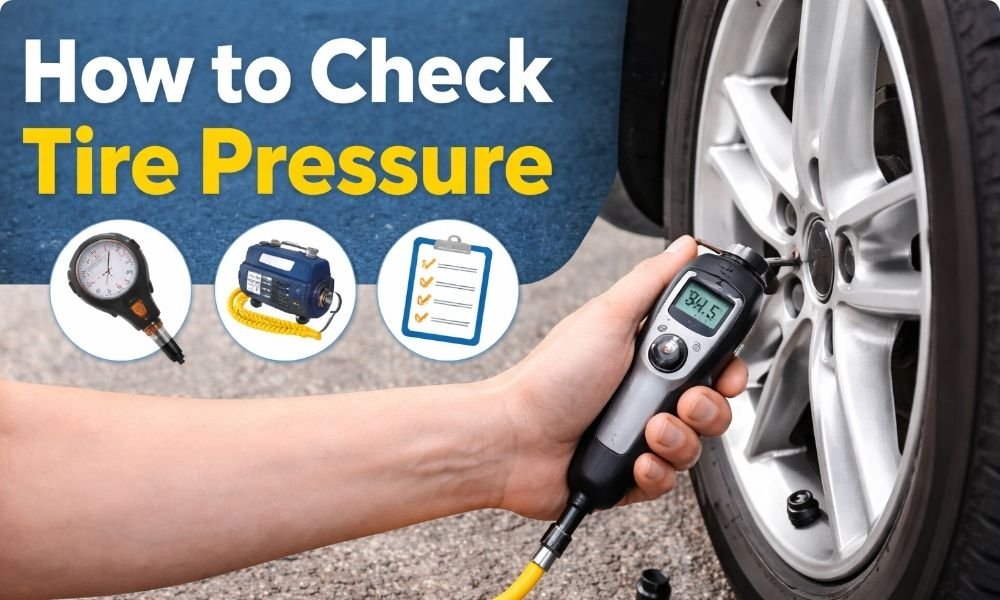
Checking tire pressure is simple: start with cold tires, find the vehicle manufacturer’s recommended PSI, and use a tire pressure gauge to measure each tire. If the reading is below or above the recommended pressure, adjust the air and check it again.
The correct tire pressure is usually listed on the driver’s door-jamb placard or in the owner’s manual. Do not use the PSI printed on the tire sidewall as the vehicle’s recommended pressure; that marking serves a different purpose.
Checking tire pressure regularly helps you catch underinflation, overinflation, and slow leaks before they become bigger problems. The steps below show how to check tire pressure correctly and what to do with the reading.
What You Need to Check Tire Pressure
You only need a few basic items to check your tire pressure:
- Tire pressure gauge: A digital, dial, or stick gauge can measure the air pressure in PSI.
- Your vehicle’s recommended PSI: Find the correct cold-tire pressure on the driver’s door-jamb placard or in the owner’s manual. Check whether the front and rear tires have different specifications.
- Air pump or compressor: You’ll need one if any tire needs more air.
Optional: Keep the valve-stem caps handy so you can replace them after checking.
You do not need special tools or equipment. A reliable gauge and the correct vehicle-specific PSI are enough to check your tires accurately.
Find Your Vehicle’s Recommended Tire Pressure
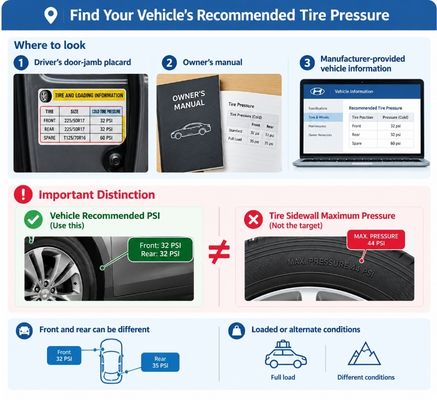
Before checking your tires, find the pressure recommended specifically for your vehicle. The most common places to find it are:
- Driver’s door-jamb placard: Look for the tire and loading information label on the driver’s door or door frame. It typically lists the recommended cold tire pressure.
- Owner’s manual: Check the tire or maintenance section for the manufacturer’s recommended pressure.
- Manufacturer-provided vehicle information: Some vehicles provide the specification in another vehicle information label or through official manufacturer resources.
Use the vehicle’s recommended PSI, not the number molded into the tire sidewall. The sidewall marking identifies a pressure limit or other tire-specific information; it is not normally the target pressure for your vehicle.
Also check each axle separately. Some vehicles specify different pressures for the front and rear tires. The recommended pressure can also vary for certain loading conditions, so follow the vehicle manufacturer’s instructions when a different pressure is specified.
Always use the recommended cold-tire pressure when taking your measurement.
How to Check Tire Pressure Step by Step
Once you know your vehicle’s recommended cold tire pressure, you can check the tires in a few simple steps.
1. Check the Tires When Cold
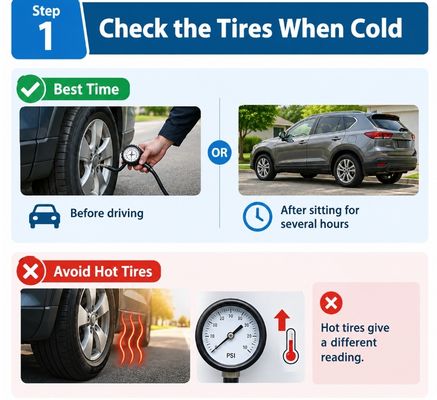
For the most useful reading, check tire pressure when the tires are cold. The best time is before driving, or after the vehicle has been parked long enough for the tires to cool down.
Driving heats the tires and can temporarily increase the pressure reading. Do not release air from a hot tire simply because the gauge shows a higher number. When possible, wait until the tires are cold and then measure them.
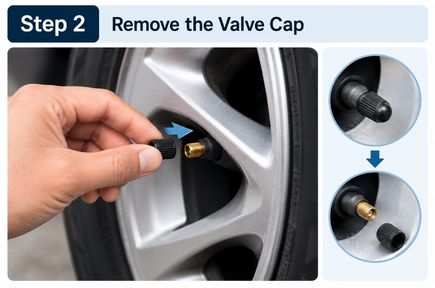
2. Remove the Valve Cap
Unscrew the valve-stem cap from the tire you are checking and set it somewhere clean. The cap helps keep dirt and moisture away from the valve, so avoid leaving it off longer than necessary.
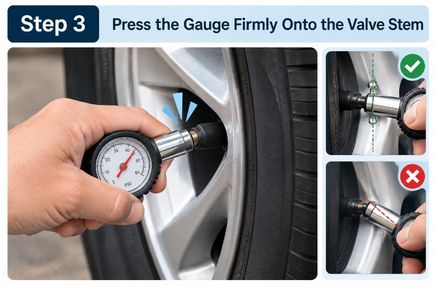
3. Press the Gauge Firmly Onto the Valve Stem
Place the gauge straight onto the valve stem and press firmly enough to create an air-tight seal. A brief hiss of air may occur as the gauge connects, but it should stop once the gauge is seated properly.
Keep the gauge steady and wait for the reading to stabilize. If air continues escaping or the reading does not settle, reposition the gauge and try again.
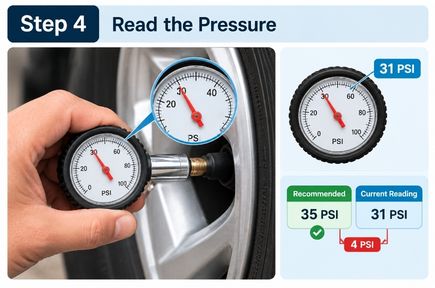
4. Read the Pressure
Look at the gauge and note the pressure in PSI.
For example:
Recommended pressure: 35 PSI
Gauge reading: 31 PSI
The tire is 4 PSI below the vehicle’s recommended pressure and needs additional air.
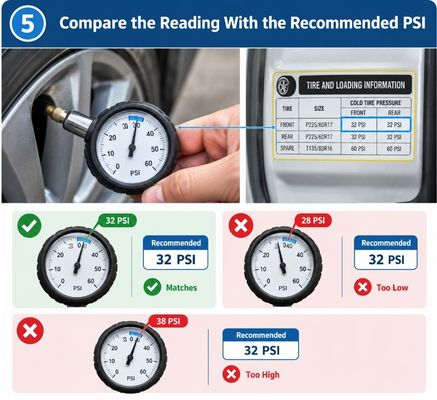
5. Compare the Reading With the Recommended PSI
Compare the gauge reading with the pressure listed on your vehicle’s tire placard or in the owner’s manual.
Do not use the pressure printed on the tire sidewall as the target for normal inflation. Also check the specification for the correct axle because some vehicles require different pressures for the front and rear tires.
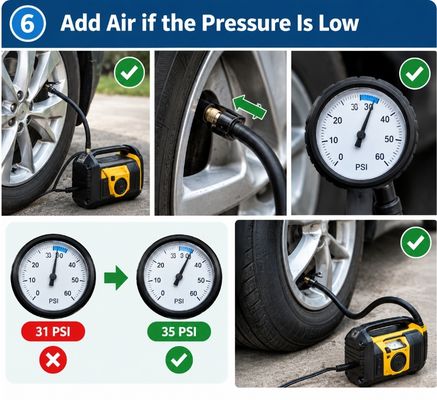
6. Add Air if the Pressure Is Low
If the reading is below the recommended pressure, add air with a pump or compressor.
Add air gradually and check the pressure again rather than adding a large amount at once. Stop when the tire reaches the vehicle manufacturer’s recommended cold pressure.
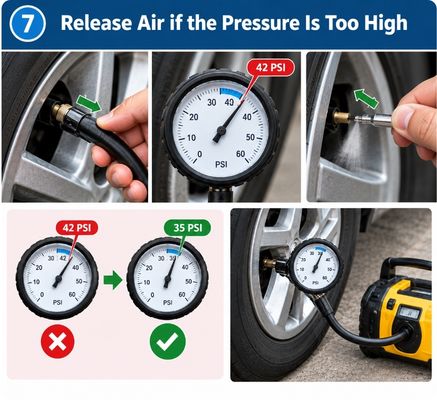
7. Release Air if the Pressure Is Too High
If the tire is above the recommended pressure, release a small amount of air at a time. Many gauges or inflators have a pressure-release feature; otherwise, briefly press the valve-stem pin with an appropriate tool.
Check the pressure again after each adjustment until it reaches the recommended level.
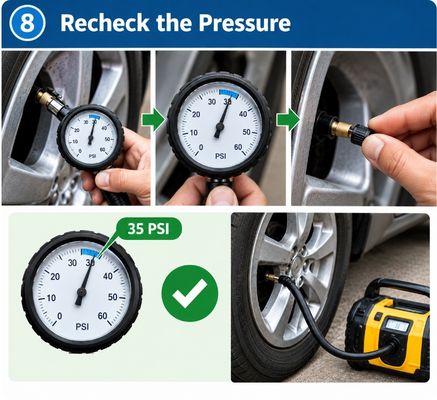
8. Recheck the Pressure
Always measure the tire again after adding or releasing air. This confirms that the final pressure is correct and helps prevent over- or underinflation.
Make the final check with the tire in the same cold condition used for the vehicle’s recommended pressure.
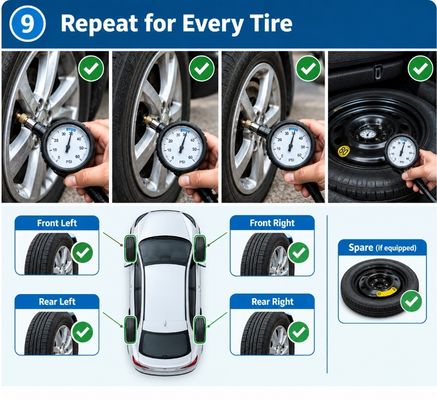
9. Repeat for Every Tire
Check each tire individually, including:
- Front tires
- Rear tires
- Any tire with a different specified pressure
- The spare tire, if your vehicle has one and it is accessible
Do not assume that one tire’s reading represents the others. A single tire may have a slow leak or another problem even when the remaining tires have the correct pressure.
After checking, replace each valve-stem cap securely.
What to Do If Your Tire Pressure Is Low
If a tire is below your vehicle’s recommended cold pressure, add air until it reaches the specified PSI. Use a reliable tire pressure gauge to check the pressure as you add air, rather than relying only on the compressor’s display.
After adding air, recheck the tire with the gauge to confirm the final pressure. If the tires are cold, compare the reading with the cold pressure listed on the vehicle’s door-jamb placard or in the owner’s manual.
If the same tire keeps losing pressure after you inflate it, the problem may be more than normal air loss. Possible causes include:
- A puncture: A nail, screw, or other object may be causing a slow leak.
- A valve problem: The valve stem or valve core may not be sealing properly.
- A bead or seal problem: Air may be escaping where the tire seals against the wheel.
A tire that loses pressure rapidly or has visible damage should be inspected rather than repeatedly topped up. Once the cause is identified and repaired, check the tire again and set it to the vehicle manufacturer’s recommended cold pressure.
What to Do If Your Tire Pressure Is Too High
If your tire pressure is above the vehicle manufacturer’s recommended cold PSI, release a small amount of air and measure it again.
- Remove the valve-stem cap.
- Briefly release a small amount of air using the valve stem or the pressure-release feature on your gauge or inflator.
- Check the pressure again with the gauge.
- Repeat the process if necessary until the tire reaches the recommended PSI.
- Reinstall the valve-stem cap securely.
Release air gradually rather than letting out a large amount at once. If the tire was recently driven and is still warm, avoid adjusting it based only on the higher warm reading. Whenever possible, make the final pressure check with the tire cold and use the vehicle’s recommended cold PSI as your target.
How Often Should You Check Tire Pressure?
Check your tire pressure at least once a month and before a long road trip. Regular checks can help you catch gradual pressure loss before it affects tire performance or safety.
You should also check the pressure when:
- The TPMS warning light comes on: Check all tires with a pressure gauge rather than relying only on the warning light.
- Temperatures change significantly: Seasonal or sudden temperature changes can affect tire pressure.
- A tire looks low: A visibly underinflated tire should be checked as soon as possible.
- You notice repeated pressure loss: A tire that keeps losing air may have a leak or another problem.
- The vehicle hits a pothole, curb, or other significant impact: Check the tire and wheel for pressure loss or visible damage.
For routine maintenance, monthly checks provide a good baseline, but these situations call for an additional check rather than waiting for the next scheduled inspection.
Common Tire Pressure Checking Mistakes
Even a simple tire-pressure check can give misleading results if you use the wrong reference or skip an important step. Avoid these common mistakes:
1. Checking Immediately After Driving
Driving heats the tires and can change the pressure reading. Whenever possible, check pressure before driving or after the tires have cooled.
2. Using the Tire Sidewall Pressure as the Target
The pressure printed on the tire sidewall is not normally the vehicle’s recommended inflation pressure. Use the PSI listed on the vehicle’s door-jamb placard or in the owner’s manual.
3. Assuming Front and Rear Tires Use the Same PSI
Some vehicles specify different pressures for the front and rear tires. Check the vehicle-specific recommendation instead of applying one number to every tire.
4. Waiting for the TPMS Light to Check Pressure
TPMS is a warning system, not a replacement for regular pressure checks. Check your tires routinely, even when the warning light is off.
5. Checking Only One Tire
A single tire can lose air while the others remain properly inflated. Check every tire individually.
6. Not Rechecking After Adding or Releasing Air
Always use the gauge again after adjusting the pressure. This confirms that the tire is actually at the recommended PSI.
7. Ignoring a Tire That Repeatedly Loses Pressure
Repeated pressure loss can indicate a puncture, valve problem, or another leak. Do not simply keep adding air without investigating the cause.
8. Forgetting the Spare Tire
If your vehicle has a spare, check its pressure according to the vehicle manufacturer’s specification. A spare may require a different pressure from the tires normally fitted to the vehicle.
Can You Check Tire Pressure Without a Gauge?
You may notice that a tire looks visibly low, but you cannot reliably determine its exact PSI by looking at it or pressing on the sidewall by hand. Visual inspection can help identify severe underinflation, but a tire can lose a meaningful amount of pressure without looking obviously flat.
Your vehicle’s TPMS (Tire Pressure Monitoring System) can also provide a warning when pressure is too low. Some vehicles display individual tire-pressure readings, while others only provide a warning light. Either way, TPMS should not replace regular pressure checks with a gauge.
For an accurate measurement, use a tire pressure gauge and compare the reading with your vehicle manufacturer’s recommended cold PSI. If you do not have a gauge and a tire appears significantly underinflated, avoid relying on appearance alone—check the pressure with a proper gauge before driving normally.
Related Topic: Best Tire Pressure for SUV
What Does the Tire Pressure Warning Light Mean?
The tire pressure warning light means the vehicle’s Tire Pressure Monitoring System (TPMS) has detected a tire-pressure issue or, depending on the vehicle, a possible TPMS system problem.
When the warning light comes on, check all four tires with a tire pressure gauge rather than checking only the tire that looks low. Compare each reading with the vehicle manufacturer’s recommended cold PSI and add or release air as needed.
Do not wait for the TPMS light to check your tires regularly. The system is designed to alert you when pressure reaches a warning threshold, while a pressure gauge gives you the actual PSI reading.
If all tires have the correct pressure but the warning light remains on, the vehicle may require a TPMS-specific reset, relearn procedure, or system inspection. Follow the instructions in your owner’s manual for your specific vehicle.
Should You Check the Spare Tire?
Yes. If your vehicle has a spare tire, check its pressure regularly as well. A spare can sit unused for months while slowly losing air, leaving you without a properly inflated replacement when you need it.
Do not assume the spare uses the same PSI as the tires currently mounted on the vehicle. Temporary spares, full-size spares, and other spare-tire setups may have different pressure requirements.
Use the pressure specified by the vehicle manufacturer, usually listed in the owner’s manual or on the vehicle’s tire-information label. Check the spare periodically and before a long trip so it is ready when needed.
Trusted Safety Guidance
NHTSA recommends checking your vehicle’s tire pressure at least once a month, including the spare tire when equipped, and measuring pressure when the tires are cold for an accurate reading. The agency also advises using the vehicle manufacturer’s recommended PSI listed on the driver’s door placard or in the owner’s manual—not the pressure shown on the tire sidewall.
Frequently Asked Questions
What PSI should my tires be?
Use the tire pressure recommended by your vehicle manufacturer. Check the driver-side door-jamb placard or owner’s manual for the correct cold PSI. Front and rear tires may require different pressures.
Should I check tire pressure when the tires are cold?
Yes. Check tire pressure when the tires are cold, preferably before driving or after the vehicle has been parked long enough for the tires to cool. Driving heats the tires and can temporarily increase the pressure reading.
Is the PSI on the tire sidewall the correct pressure?
No. The PSI shown on the tire sidewall is not normally the vehicle’s recommended inflation pressure. Use the pressure listed on the vehicle’s door-jamb placard or in the owner’s manual.
Why does one tire keep losing air?
Repeated pressure loss can indicate a puncture, leaking valve, bead/seal problem, or other tire or wheel issue. Do not keep adding air without finding the cause. Have the tire inspected if it continues to lose pressure.
Should I check my spare tire?
Yes. A spare tire can lose pressure even when it is not being used. Check it periodically and use the vehicle manufacturer’s specified pressure, since the spare may require a different PSI from the tires mounted on the vehicle.
Conclusion
Checking tire pressure is a simple maintenance task when you follow the right process. Check your tires when they are cold, use the vehicle manufacturer’s recommended PSI, and measure each tire individually. If the pressure is too low or too high, adjust it and recheck the reading with a reliable gauge. Regular pressure checks can also help you spot slow leaks before they become a bigger problem. Taking a few minutes to check your tires regularly helps keep them properly inflated and ready for the road.
