Tire Size Comparison Calculator (Free & Accurate Tool)
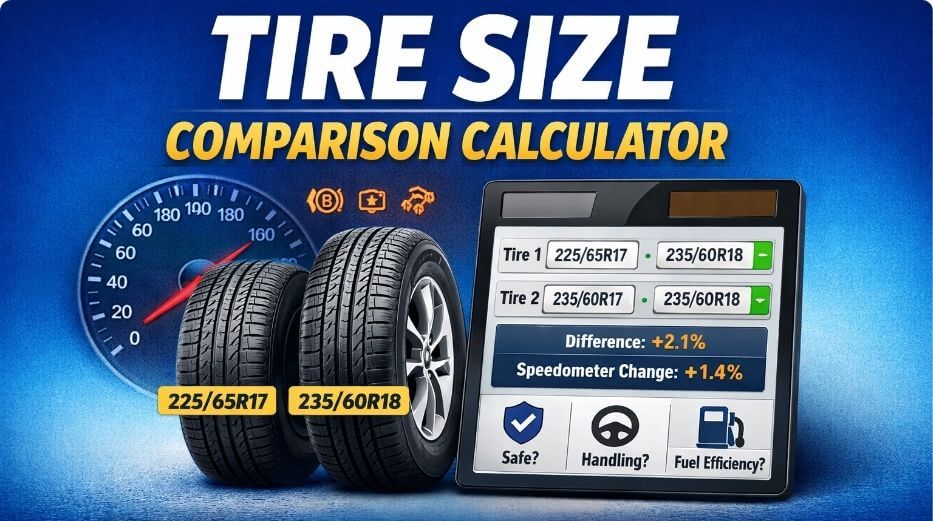
Choosing the right tire size isn’t just about looks — it affects safety, comfort, and speed accuracy. Our Tire Size Comparison Calculator helps you quickly compare two tire sizes and see the real differences in diameter, speedometer reading, and clearance. Enter your current size and your new size to find out if the change is safe before you buy.
Tire Size Comparison Calculator
Compare your current tire size with a new size to see the exact difference in diameter, width, and speedometer accuracy.
Tire 1 (OEM)
Tire 2 (New)
| Measurement | Tire 1 | Tire 2 | Difference |
|---|
Speedometer Reading
Visual Size Comparison
How to Use the Tire Size Comparison Calculator
Using the calculator is simple. You don’t need any technical knowledge. Just enter the numbers from your tire and let the tool do the math.
Here’s how to do it.
Step 1 – Enter Your Current Tire Size
Start with the tires that are currently on your vehicle. You can find the size printed on the tire sidewall. It looks something like this: 255/70R17.
Each part means something simple:
- 255 – This is the tire’s width in millimeters. It’s how wide the tire is from side to side.
- 70 – This is the aspect ratio. It tells you how tall the sidewall is compared to the width. In this case, the sidewall height is 70% of 255.
- 17 – This is the wheel diameter in inches. It tells you what size wheel the tire fits.
Enter these three numbers into the “Tire 1 (OEM)” section.
If you’re not sure your current tires are factory size, check the sticker inside the driver’s door. That usually shows the original size.
Step 2 – Enter the New Tire Size You Want
Now enter the size you’re thinking about switching to in the “Tire 2 (New)” section.
This could be:
- A wider tire
- A taller tire
- A different wheel size
- Or a cheaper size you found online
Make sure you enter the numbers exactly as they appear. Even small changes can make a noticeable difference.
Step 3 – Click “Calculate Comparison”
Once both sizes are entered, click the Calculate Comparison button.
The calculator will instantly show you the differences between the two tire sizes. No manual math needed.
Step 4 – Review the Results
Now comes the important part — understanding what the results actually mean.
You don’t need to analyze everything deeply. Focus on these four areas:
Diameter difference
This tells you how much taller or shorter the new tire is overall.
A small change (under 3%) is usually safe. Bigger changes may affect how the vehicle drives.
Speedometer change
If the new tire is taller, your speedometer may show a lower speed than you’re actually driving.
If it’s shorter, it may show a higher speed. Even a small difference can matter over time.
Clearance difference
This shows whether the new tire sits higher or lower.
A taller tire gives slightly more ground clearance. But too tall can cause rubbing inside the wheel well.
Revolutions per mile
This tells you how many times the tire spins in one mile.
If this number changes a lot, it can affect odometer accuracy and, in some cases, AWD systems.
What the Calculator Results Mean
When the calculator shows the results, it’s easy to focus only on the green and red percentages.
But those numbers actually tell you how your vehicle will feel and behave on the road.
Here’s what each section really means in practical terms.
Tire Diameter Comparison
The overall diameter is the total height of the tire from top to bottom.
This matters because your vehicle was designed around a specific tire height. When you change that height, even slightly, you change how the vehicle sits and drives.
If the new tire is 2% taller, your vehicle will sit a little higher off the ground. The difference isn’t dramatic, but you may notice a slight lift.
A taller tire also turns fewer times per mile. That can lower engine RPM slightly at highway speeds. It’s not a huge change, but it can make cruising feel a bit more relaxed.
If the tire is much taller, though, you risk rubbing inside the wheel well or putting extra strain on suspension parts.
Small changes are usually fine. Bigger jumps need more thought.
Speedometer Difference Explained
Your speedometer works by counting how fast your tires spin.
When you install larger tires, each rotation covers more distance. That means you’re going faster than the speedometer thinks you are.
For example, if the calculator shows that at 60 MPH actual speed your speedometer reads 58.6 MPH, your vehicle is moving slightly faster than what you see on the dashboard.
Smaller tires do the opposite. They spin more times per mile, so your speedometer may show a higher speed than you’re actually driving.
Even a small difference can matter over time. It affects:
- Speed accuracy
- Odometer mileage
- In some areas, vehicle inspection rules
Most small differences are manageable. Large ones can become a safety or legal issue.
Sidewall Height Difference
The sidewall is the part of the tire between the wheel and the tread.
More sidewall usually means a softer ride. The tire absorbs bumps better, which makes daily driving more comfortable.
Less sidewall means a firmer ride. The steering may feel sharper, but you’ll notice road imperfections more.
If you’re upgrading for looks, remember this tradeoff. Bigger wheels with thin sidewalls may look great, but comfort can suffer.
There’s no “right” choice — it depends on what matters more to you.
Tire Width Change
Wider tires usually provide more grip, especially in dry conditions.
That can improve handling and braking. Many drivers like the planted feel of a wider setup.
But there are trade-offs.
Wider tires can reduce fuel economy slightly because more rubber touches the road. They may also follow road grooves more, which can affect steering feel.
And if you go too wide, the tire can rub against suspension parts or the fender.
A modest width increase is often fine. A large jump should be measured carefully.
Revolutions Per Mile
This number shows how many times the tire spins to travel one mile.
If that number changes significantly, your odometer may become inaccurate. Over thousands of miles, small differences add up.
On AWD vehicles, this matters even more. All four tires must rotate at nearly the same speed. Large differences in revolutions per mile can stress the drivetrain over time.
That doesn’t mean you can’t change tire size on AWD vehicles. It just means you need to stay within a safe range.
Is It Safe to Change Tire Size? (The 3% Rule Explained)
One of the most common questions I hear is, “How much can I change my tire size without causing problems?”
A simple guideline many mechanics use is the 3% rule. It’s not random. It’s based on how vehicles are designed and how sensitive modern systems are to tire size changes.
Here’s a quick reference:
| Diameter Difference | Recommendation |
| 0–3% | Safe for most vehicles |
| 3–5% | Check clearance & speedometer |
| 5%+ | Not recommended |
0–3% Difference
In most cases, this range is safe.
The vehicle will drive almost the same as stock. Speedometer changes are small, and electronic systems usually adapt without issue.
This is the range most people aim for when upgrading wheels or switching tire sizes.
3–5% Difference
This is where you need to slow down and double-check things.
At this level, the speedometer error becomes more noticeable. You may also run into clearance issues, especially when turning or hitting bumps.
It doesn’t mean it won’t work. It just means you should measure carefully and understand the trade-offs before buying.
5% or More
This is generally not recommended for daily driving.
At this point, you’re significantly changing how the vehicle was engineered to operate. Problems become more likely, especially with modern safety systems.
Why Staying Close to OEM Size Matters
Your vehicle was designed around a specific tire diameter. When engineers set that size, they also calibrated important systems to match it.
For example, ABS (anti-lock braking system) relies on wheel speed sensors. If tire size changes too much, the system may read speed differently than intended.
The same goes for traction control. It compares wheel speeds to detect slip. Large tire differences can confuse that system.
If you drive an AWD vehicle, tire size becomes even more important. AWD systems expect all four tires to rotate at nearly the same rate. Bigger changes in diameter can put stress on the drivetrain over time.
That stress doesn’t always show up immediately. But long-term wear can increase if the difference is too large.
Real Example Comparison (From the Calculator)
Let’s look at a real example from the calculator to see how this works in everyday terms.
We’re comparing:
Tire 1 (Current): 255/70R17
Tire 2 (New): 285/55R20
At first glance, these sizes look very different. One is on a 17-inch wheel, the other on a 20-inch wheel. But what really matters is the overall diameter.
+2.32% Diameter Difference
The new tire is about 2.32% taller than the original.
That means your vehicle will sit slightly higher off the ground. The change isn’t dramatic, but you may gain a small amount of ground clearance.
Since it’s under the 3% guideline, this size change is generally considered safe for most vehicles.
+17.95% Sidewall Difference
The sidewall height changes noticeably because you’re moving to a larger wheel with a different tire profile.
In simple terms, the ride feel will change. You may notice a slightly firmer feel compared to the original setup.
It’s not extreme, but it won’t feel exactly the same as stock.
-2.29% Revolutions Per Mile
The new tire spins fewer times to travel one mile.
Because of that, your speedometer will read slightly lower than your actual speed. For example, when you’re driving at 60 MPH, your speedometer might show just under that.
This difference is small and usually not a problem, but it’s good to be aware of it.
What This Means in Real Driving
With a 2.32% increase in diameter:
- You get a slight increase in ride height.
- Engine RPM may be a little lower at highway speeds.
- Speedometer error is minor.
Most importantly, this change stays under the 3% rule. That means it’s likely safe without major issues, assuming there’s enough physical space for the wider tire.
The key takeaway is this: even though the wheel size jumped from 17 inches to 20 inches, the overall tire height stayed close to factory spec. That’s what keeps this upgrade reasonable.
Always check clearance, but based on the numbers alone, this is a sensible size change.
Visual Tire Size Comparison Explained
Numbers are helpful, but sometimes they don’t fully click until you see the tires side by side.
That’s why the visual comparison matters. It shows the difference in height and width in a way that’s easy to understand at a glance.
When you look at two tires next to each other, you can quickly see which one is taller and which one is wider. Even a small change becomes easier to picture.
This is especially helpful if you’re worried about rubbing or clearance. A visual difference makes it easier to imagine how the tire will sit inside your wheel well.
Understanding Width and Profile Differences
The visual also shows how the width changes.
A wider tire spreads out more from side to side. That can look more aggressive, but it also takes up more space.
You’ll also notice changes in the sidewall, which is the height of the tire between the wheel and the tread. A taller sidewall looks thicker. A shorter one looks slimmer and sportier.
Seeing both together helps you understand how the overall setup will look on your vehicle.
Why Small Percentage Changes Can Look Bigger
Sometimes the calculator shows only a 2% difference, but the visual makes it look larger.
That’s because your eyes notice height and width changes more clearly than percentages. A small increase in diameter may only be a fraction of an inch, but when shown side by side, it stands out.
The visual can exaggerate the difference slightly because both tires are aligned at the bottom. That makes the top height difference more noticeable.
This isn’t a bad thing. It actually helps you judge whether the change feels acceptable to you.
The goal of the visual comparison isn’t just to show numbers. It helps you see what those numbers mean in real life before you spend money on new tires.
How to Read a Tire Size (Quick Guide)
When you look at a tire, you’ll see a code like 255/70R17 on the sidewall. It may look confusing at first, but it’s just a way to show the tire’s size in a standard format.
Here’s how to read it.
Start with the first number, 255. This is the tire’s width in millimeters — how wide the tire is from side to side. A higher number means a wider tire.
Next comes 70. This number represents the aspect ratio. In simple terms, it’s how tall the tire’s sidewall is compared to its width. A 70 ratio means the sidewall height is 70% of the width. Lower numbers usually mean a sportier, firmer feel.
The R in the middle stands for “radial,” which is the most common type of tire construction today. You don’t need to worry much about this unless you’re comparing very old or specialty tires.
Finally, 17 is the wheel diameter in inches. It tells you what size wheel the tire is made to fit. Tires must match the wheel size exactly.
Understanding this code will help you enter the right numbers into the comparison tool and make better decisions when choosing new tires.
OEM vs Aftermarket Tire Size Differences
Your vehicle came from the factory with a specific tire size. That size wasn’t chosen randomly. It was selected to balance comfort, handling, fuel economy, and safety.
When you switch to an aftermarket size, you’re moving away from that original setup. Sometimes the change is small and works perfectly fine. Other times, it can affect how the vehicle feels and performs.
Staying close to the factory size helps keep everything working as intended. Steering response, braking behavior, and ride comfort are all based on that original specification.
That doesn’t mean you can’t upgrade. It just means the closer you stay to stock measurements, the fewer surprises you’ll have.
Load Rating Matters
Every tire has a load rating. This tells you how much weight the tire can safely carry.
If you choose a tire with a lower load rating than the factory recommendation, it may not safely support your vehicle — especially when fully loaded with passengers or cargo.
Going higher is usually fine. Going lower is not a good idea.
Always check that the new tire meets or exceeds the original load rating.
Speed Rating Is Also Important
Tires also have a speed rating. This indicates the maximum speed the tire is designed to handle safely.
Even if you never drive at high speeds, the rating still matters. It reflects the tire’s construction and heat resistance.
Choosing a lower speed rating than factory spec can affect stability and safety. Matching or exceeding the original rating is the safer choice.
Final Recommendation
If you’re unsure what to do after using the calculator, keep it simple.
If the diameter difference is under 3%, you’re generally safe for daily driving. In most cases, you won’t notice major changes in performance or safety. Just double-check that the tire physically fits your wheel and wheel well.
If the difference is between 3% and 5%, slow down before buying. Measure the space around your current tires. Turn the steering wheel fully left and right and check for tight areas. A small clearance issue can turn into rubbing over bumps.
If the difference is over 5%, it’s usually better to choose a closer size. At that point, you’re moving far enough from factory specs that speed accuracy, handling, and system calibration can be affected.
If you drive an AWD vehicle, be extra cautious. AWD systems are more sensitive to tire size differences. Even small changes should stay as close to factory size as possible, and all four tires must match.
The goal isn’t to avoid upgrades. It’s to make smart ones. Stay within a safe range, measure when needed, and don’t push the limits just for looks.
Tire Size Comparison Calculator FAQs
What is the 3% tire size rule?
The 3% rule means your new tire’s overall diameter should stay within 3% of the original size.
Staying within this range keeps speedometer readings, braking systems, and driving feel close to factory settings.
How much speedometer error is acceptable?
A small error under 2–3% is usually manageable for daily driving.
Larger differences can make your speed reading noticeably inaccurate and may cause issues during inspections.
Can I mix different tire sizes?
It’s not recommended for regular driving.
Different sizes can affect balance, handling, and especially AWD systems. All four tires should usually match.
Does changing tire size affect ABS?
Yes, it can.
ABS relies on wheel speed readings. Large changes in tire diameter may affect how accurately the system responds.
How do I know if my tires will rub?
Check the diameter and width increase carefully.
If the new tire is much taller or wider, it may rub when turning or hitting bumps. Measuring clearance before buying is the safest approach.
