Tire Treadwear Rating Chart: Understand Your Tire’s Lifespan
When shopping for new tires, it’s easy to get lost in the numbers and letters on the sidewall. One of the most important numbers is the treadwear rating, which tells you how long a tire is expected to last compared to a reference tire. To make this simple, we’ve created a tire treadwear rating chart that helps you quickly see which tires last longer and which are designed for performance. This guide will explain how to use the chart, what the numbers mean, and how to pick the best tire for your needs.
What Is a Tire Treadwear Rating?
A tire’s treadwear rating is part of the Uniform Tire Quality Grading (UTQG) system, developed to help drivers compare the durability of different tires. The number itself is a relative score. For example, a tire with a treadwear rating of 400 is expected to last twice as long as a tire rated 200 under standard testing conditions.
It’s important to remember that treadwear ratings are estimates. Real-life tire life depends on how you drive, the roads you travel, and how well you maintain your tires. Even so, the rating is a helpful starting point when comparing options.
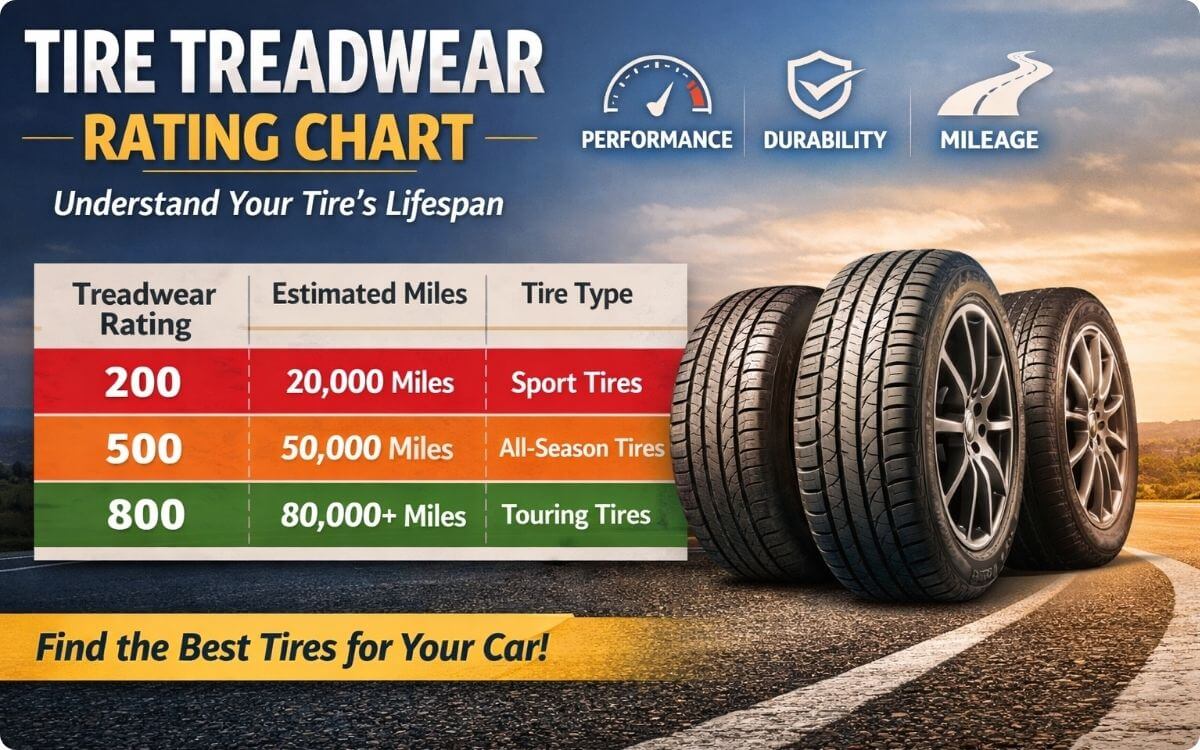
Tire Treadwear Rating Chart
How to use this chart: Find the treadwear number on a tire’s spec sheet or sidewall and match it to the row that best fits your needs. The mileage ranges are estimates — actual life depends on maintenance, roads, and driving style.
| Treadwear Rating | Estimated Mileage Range | Performance Type | Best For |
| 100 | ~20,000–30,000 miles | Ultra-high performance | Sports cars, aggressive driving |
| 200 | ~30,000–40,000 miles | High performance | Performance sedans, sporty SUVs |
| 300 | ~40,000–50,000 miles | Balanced performance | Daily driving with good grip |
| 400 | ~50,000–60,000 miles | Touring | Sedans, crossovers, SUVs |
| 500 | ~60,000–70,000 miles | Long-lasting touring | Highway commuting |
| 600 | ~70,000–80,000 miles | Durable touring | Long-distance drivers |
| 700+ | 80,000+ miles | Eco / long-life tires | Maximum longevity |
Note: These are broad estimates to help comparison-shopping. Two tires with the same treadwear number can still perform differently because each manufacturer’s compound and design differ.
How to Use the Tire Treadwear Rating Chart
Using the chart is straightforward. First, identify the type of driving you do most often. If you drive mostly around the city, a tire with a treadwear rating of 400–600 is usually sufficient. If you drive long distances on highways, consider tires with higher treadwear ratings for longer life.
Keep in mind the trade-off between longevity and performance. Tires with lower treadwear ratings generally provide better grip and handling, which is ideal for sports cars or performance vehicles. Higher treadwear tires last longer but may not perform as well in cornering or braking.
By using the chart, you can compare tires side by side, understand how long they’re likely to last, and choose the one that fits your driving style without guessing.
Real-Life Tire Examples With Treadwear Ratings
To make this even more practical, here are some real tires and their ratings:
| Tire Model | Treadwear | Notes |
| Michelin Pilot Sport 4S | 300 | High-performance sports tire |
| Continental ExtremeContact DWS06 | 560 | All-season performance |
| Michelin Defender T+H | 820 | Touring / long-life tire |
Seeing actual tire models alongside their ratings helps you translate the chart into real-world decisions. For example, if you like the comfort and long life of a touring tire, the Defender T+H with its 820 rating might be perfect. On the other hand, for a sports car that needs grip, the Pilot Sport 4S is more suitable despite its shorter lifespan.
Treadwear vs Grip: Understanding the Trade-Off
One of the most common questions drivers have is about the relationship between treadwear and grip. Tires with lower treadwear ratings often have softer rubber compounds. This provides better traction and performance, especially in corners or wet conditions. However, these tires wear faster.
Higher treadwear tires use harder compounds for longevity, which makes them last longer but sacrifices a bit of grip. The key is finding the right balance for your driving. If safety and long-term value are more important than extreme performance, choose a tire with a moderate to high treadwear rating.
How to Use the Chart to Choose Tires (Quick Guide)
- Identify your priority: mileage, comfort, or performance?
- Find typical treadwear ranges above and match to your use case.
- Check sample models in that range and compare reviews/test data. (Third-party testing is helpful — see below.)
- Factor in conditions: winter driving, heavy loads, or aggressive driving will shorten tire life.
Limitations — Why the Chart Isn’t a Guarantee
- UTQG is comparative: different manufacturers may test differently.
- Real-world variables: driving style, alignment, inflation, road surfaces, and climate change actual mileage.
- Not a safety rating: treadwear doesn’t indicate wet-braking performance or overall tire quality.
For independent test data and comparative reviews, consult trusted testers such as Tire Rack and Consumer Reports.
Tips to Maximize Tire Life Using the Chart
Even the best tire won’t last if it isn’t maintained properly. Here are some practical tips to help your tires reach the lifespan indicated in the chart:
- Rotate your tires regularly to ensure even wear.
- Keep tires inflated to the manufacturer’s recommended pressure.
- Avoid aggressive driving, such as sudden acceleration or hard cornering.
- Inspect tires for damage or uneven wear and address issues promptly.
Following these simple steps can help you get the most out of any tire, regardless of its treadwear rating.
FAQs
Q: Is a higher treadwear rating always better?
A: Not always. Higher numbers mean a tire is designed to wear more slowly, but that often comes with slightly reduced grip and sportiness. Choose based on your priorities.
Q: Does a 600 treadwear tire always last 60,000 miles?
A: No. UTQG is an index, not a mileage guarantee. A 600 tire may be paired with a 60k warranty by the maker, but actual miles depend on how the tire is used and maintained.
Q: Can two tires with the same treadwear number wear differently?
A: Yes. Different compounds, constructions, and regional testing differences can cause the same UTQG number to perform differently in real life.
Final Thoughts on the Tire Treadwear Rating Chart
Understanding tire treadwear can save you money, improve safety, and make choosing new tires much simpler. The tire treadwear rating chart gives you a clear reference for comparing tire durability, while real-world examples help you apply it to actual tire models.
By using this guide, you can make an informed decision that matches your driving style, whether you prioritize long-lasting tires, performance, or a balance of both. Next time you shop for tires, check the treadwear rating, refer to the chart, and select the option that best fits your needs.
