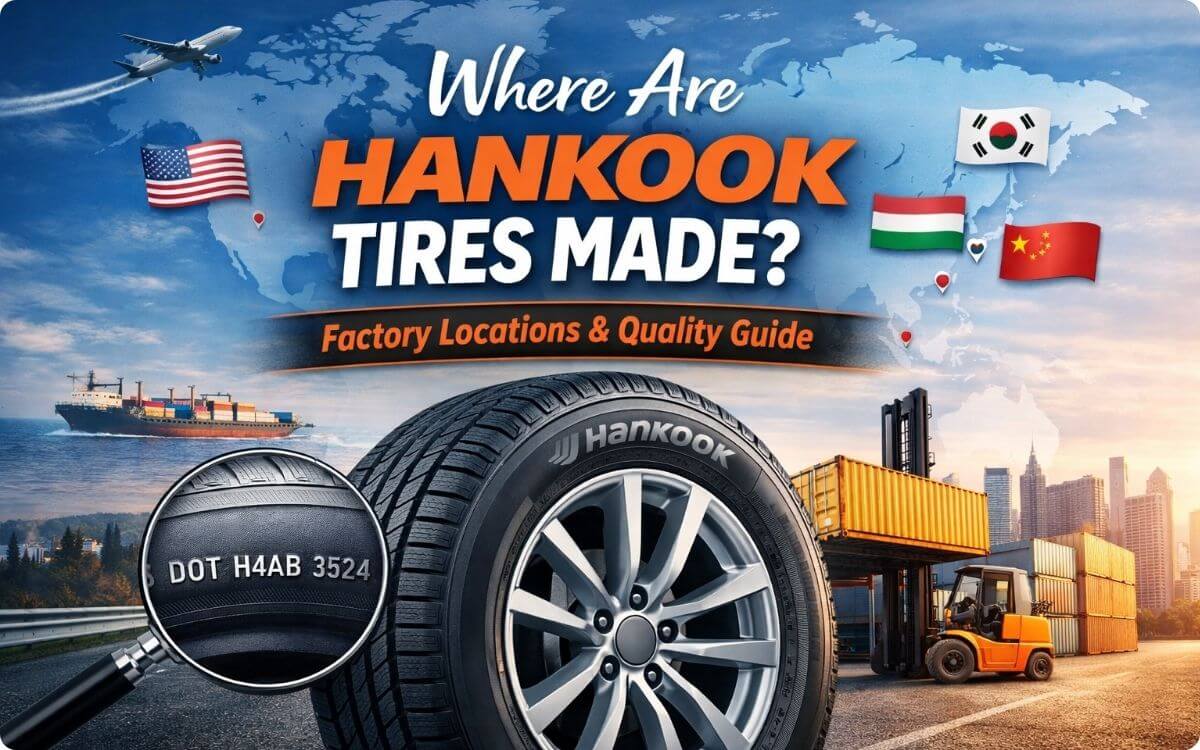
Where Are Hankook Tires Made?
If you’ve ever wondered where are Hankook tires made, you’re not alone. Many drivers want to know whether their tires come from South Korea, the United States, or somewhere else entirely. Knowing the origin of a tire can help you feel confident about its quality and reliability, especially if you’re making a purchase online or at a local dealer.
In this guide, we’ll explore Hankook’s global manufacturing locations, explain how to check where your tire was made, and share practical tips for buying with confidence.
Quick Summary (Who Want the Fast Answer)
Quick answer: Hankook Tire & Technology makes tires in several countries around the world. If you want the short, scannable list, here it is:
- South Korea
- United States
- Hungary
- China
- Indonesia
Different factories usually supply nearby markets — that keeps shipping costs down and delivery times fast. The company says its plants follow the same global production and safety standards, so a tire’s design and testing matter more than the country stamp.
Quick takeaway: where your Hankook tire was made mostly depends on the market it was sold for. If you want to know exactly, check the code on the tire sidewall — that will show the factory and production week.
Hankook Company Overview
Hankook Tire & Technology is a global tire company that started in 1941. It began in Seoul, the capital of South Korea, where the company’s main headquarters is still located today.
Over the decades, Hankook grew from a local tire maker into one of the largest tire manufacturers in the world. Today, its tires are sold in many countries and used on millions of vehicles every year.
The company produces tires for a wide range of vehicles. This includes everyday passenger cars, SUVs, pickup trucks, commercial vehicles, and even racing cars used in motorsports.
Hankook also works closely with major car manufacturers. Some vehicles from brands like BMW, Audi, and Hyundai come with Hankook tires as original equipment when they leave the factory. This type of partnership usually means the tire company meets strict performance and safety standards.
Like most global tire brands, Hankook builds factories in different parts of the world. This helps the company supply tires faster and avoid the high cost of shipping products across continents.
There is also a practical reason for this. Tire demand is different in each region. For example, some markets need more winter tires, while others mostly use all-season models. Having factories closer to customers helps companies adjust production more easily.
Of course, being a large global manufacturer also means Hankook competes with very strong premium brands. Some drivers still prefer companies like Michelin or Bridgestone, especially for high-end performance tires. But Hankook has built a reputation for offering solid performance at a more affordable price.
Why Tire Companies Manufacture Tires Around the World
Large tire brands like Hankook Tire & Technology don’t rely on just one factory. Instead, they build manufacturing plants in different parts of the world. This isn’t just about expansion — it helps the company supply tires faster and keep prices competitive.
One simple reason is regional demand. Cars in different areas need different types of tires. By having factories closer to customers, companies can produce and deliver tires more quickly. It also helps reduce delays when demand suddenly increases.
Shipping is another big factor. Tires are large and heavy, which makes long-distance transportation expensive. If a company had to ship every tire from one country, the cost would rise quickly. Building factories in several regions helps keep those costs under control.
Trade rules also play a role. Some countries charge high import taxes on products made overseas. By manufacturing tires locally, companies can avoid those extra costs and keep prices more reasonable for buyers.
Another benefit is a faster supply chain. If demand increases in one region, nearby factories can adjust production more easily. This flexibility helps prevent shortages during busy seasons.
For example, a tire sold in the United States or North America may come from a factory located in the U.S. Meanwhile, drivers in Europe often receive tires produced in Hungary.
Of course, having factories around the world also makes production more complex. Managing quality, logistics, and supply chains across several countries requires careful oversight. But for global brands, this approach helps them stay competitive and meet demand in many markets.
Hankook Tire Global Factory Map
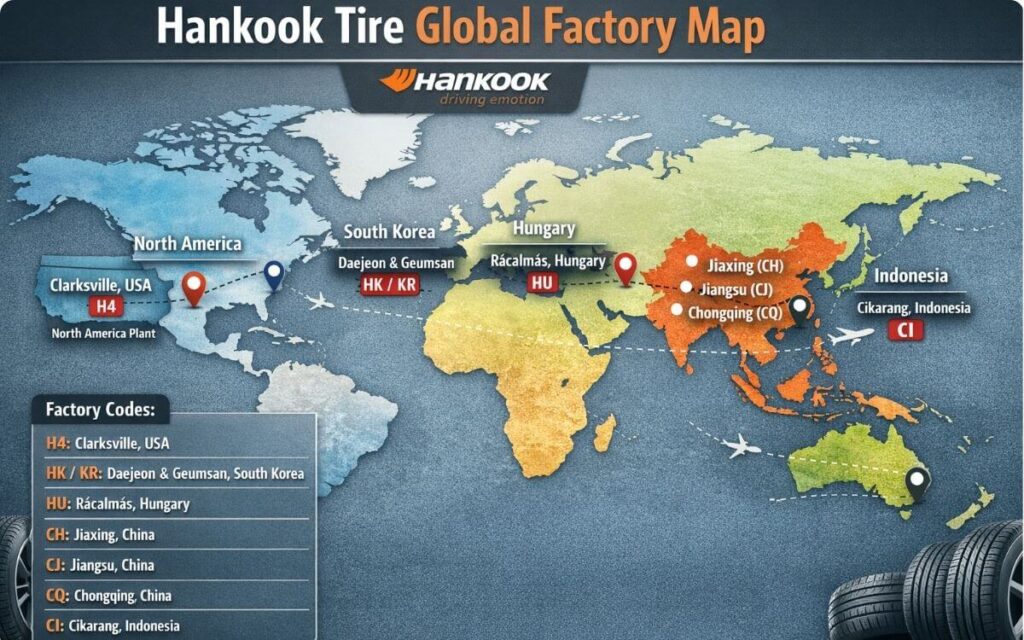
Hankook Manufacturing Locations: Global Breakdown
South Korea – The Brand’s Home Base
The main home of Hankook Tire & Technology is in Seoul, located in South Korea. This is where the company’s leadership, research teams, and major decision-making operations are based.
Hankook also runs large manufacturing facilities in Daejeon and Geumsan. These plants are important because they focus heavily on research, testing, and advanced tire development.
Many of the company’s new tire technologies were first designed and tested in South Korea. Engineers develop prototypes, run safety tests, and refine performance before the designs are produced in other factories around the world.
Because of this, South Korea plays a major role in innovation. Many of Hankook’s high-performance or flagship tires begin their life here before moving into global production.
United States – Clarksville, Tennessee Plant
Hankook also operates a major manufacturing plant in Clarksville, in the state of Tennessee, United States.
This facility is one of the company’s newer factories and uses modern production systems. It mainly produces tires for passenger cars and light trucks that are sold across North America.
Building a factory in the United States helps Hankook deliver tires to American customers faster. It also reduces shipping costs compared with transporting tires from overseas.
Another benefit is that it supports the local auto industry. Many vehicles built in North America need tires for factory installation, and having a nearby plant helps supply those manufacturers quickly.
Hungary – European Manufacturing Hub
For the European market, Hankook operates a large factory in Rácalmás, located in Hungary.
This facility supplies tires to many countries across Europe. The location is useful because it allows the company to distribute products to different European markets without long shipping times.
The plant produces a wide range of tires, including models designed for passenger cars and SUVs. Many of these are built to meet European driving conditions and regulations.
The factory also uses modern automated production systems. These systems help maintain consistent manufacturing quality while producing large volumes of tires.
China – High-Volume Production Facilities
Hankook runs several large factories in China. Major production sites are located in:
- Jiaxing
- Jiangsu
- Chongqing
These plants handle high-volume production. They help meet demand across Asian markets and also support global supply when needed.
Some drivers worry about tires made in China, but large international brands maintain strict production standards across all factories. The same design specifications and testing procedures are applied regardless of where the tire is produced.
That said, public perception can still influence buyer opinions, even when the manufacturing standards are the same.
Indonesia – Southeast Asian Production
Another important manufacturing location is in Cikarang, an industrial area in Indonesia.
This factory mainly serves customers in Southeast Asia. Producing tires in the region helps reduce transportation costs and shortens delivery times to nearby markets.
The plant focuses on tires for passenger vehicles as well as some commercial applications. Having a factory in Indonesia also helps the company respond more quickly to growing demand in Asian markets.
Like other global facilities, the goal is to keep production efficient while maintaining consistent quality standards.
Summary Table of Hankook Manufacturing Locations
Here’s a clean, scannable summary table of where Hankook tires are made. It lists the country, main facility locations, the primary market each site serves, and the plant’s main role.
Quick note: Hankook Tire & Technology runs these factories to serve different regions efficiently.
| Country | Facility location(s) | Primary market | Main roles |
| South Korea | Daejeon; Geumsan | Global R&D and regional supply | R&D, prototype testing, high-performance tire engineering |
| United States | Clarksville | North America | Passenger & light-truck production, faster local delivery, supports OEM supply |
| Hungary | Rácalmás | Europe | Europe-focused production, SUV & passenger tires, automated lines for volume |
| China | Jiaxing; Jiangsu; Chongqing | Asia | High-volume manufacturing to meet regional and global demand |
| Indonesia | Cikarang | Southeast Asia | Regional production for passenger & commercial tires, reduces shipping costs |
Does Country of Manufacture Affect Tire Quality?
Many drivers wonder if a tire’s quality depends on the country where it was made. It’s a fair question. People often assume that tires produced in certain countries are better than others.
In reality, large tire companies like Hankook Tire & Technology use the same production standards across all their factories. The design, materials, and testing process are controlled by the company’s engineering teams, not by the location of the plant.
Tires also have to meet strict safety rules before they can be sold. In the United States, for example, manufacturers must follow regulations from the National Highway Traffic Safety Administration and the U.S. Department of Transportation. These agencies require tires to pass specific performance and safety tests.
Because of these rules, companies can’t simply produce lower-quality tires in one factory and better ones in another. The products must meet the same standards regardless of where they are made.
That said, some drivers still prefer tires made in certain countries. Sometimes this comes down to personal trust or past experiences with specific products. But for most major tire brands, the manufacturing process is tightly controlled across all locations.
In practical terms, the design of the tire and the company’s quality standards matter far more than the country printed on the sidewall. If the tire model itself performs well in testing and real-world use, the factory location usually isn’t the deciding factor.
How to Check Where Your Hankook Tire Was Made
If you want to know exactly where your Hankook Tire was manufactured, you don’t need special tools or paperwork. The information is already printed on the tire itself. You just need to look for a small code on the sidewall.
Step 1: Find the DOT Code
Start by locating the DOT code on the side of the tire. DOT stands for the U.S. Department of Transportation, and this code appears on all tires sold in the United States.
The code is usually stamped in small letters near the rim edge of the tire. You may need to rotate the tire or move the car slightly to see the full marking.
A typical example looks like this:
DOT H4AB CDHR 3524
This string of letters and numbers tells you where and when the tire was made.
Step 2: Read the Plant Code
The first part of the DOT code identifies the factory that produced the tire. In the example above, H4 is the plant code.
Manufacturers use these short codes to mark each factory. By checking the code, you can trace the tire back to its production plant.
The last four numbers show the production date.
In this example:
- 3524 means the tire was made in the 35th week of 2024.
This date can be helpful when buying new tires. Even unused tires can age over time, so it’s usually best to choose ones that were produced recently.
One small drawback is that plant codes are not always easy to decode without a reference list. But once you know where to look, the DOT code gives you a quick way to check a tire’s origin and age.
Common Hankook Plant Codes Decoder
| Plant Code | Factory Location | Notes |
| H4 | Clarksville, Tennessee, USA | Main North American plant; produces passenger and light truck tires. |
| HK | Daejeon, South Korea | One of the original South Korean factories; focuses on R&D and high-performance tires. |
| KR | Geumsan, South Korea | Specializes in advanced tire technologies and testing; some flagship tires originate here. |
| HU | Rácalmás, Hungary | Supplies European markets; produces passenger and SUV tires. |
| CH | Jiaxing, China | Large-scale production for Asian markets and global demand; follows same quality standards as other plants. |
| CJ | Jiangsu, China | Supports high-volume production for Asia; used for standard passenger tires. |
| CQ | Chongqing, China | Focused on regional supply and global distribution; produces mid-range tires. |
| CI | Cikarang, Indonesia | Serves Southeast Asia; produces passenger and commercial tires. |
How to use the decoder:
- Locate the DOT code on your tire sidewall.
- Identify the first two characters after “DOT” – that’s the plant code.
- Match it to the table above to see where the tire was manufactured.
Tip: The rest of the DOT code tells you the production date (week and year), which is also useful when checking tire age.
Practical Buying Tips (short checklist)
To buy Hankook tires confidently:
- Check the manufacture date. Newer is generally better — look for tires produced within the last 12–24 months.
- Buy from authorized dealers. They’re more likely to have proper storage and will honor warranties.
- Request an invoice or confirmation of origin if it matters to you. Some dealers will note the country or plant.
- Match the tire model to your climate and driving style. A popular model in one region may be tailored to that region’s roads and weather.
- Watch for signs of counterfeit or poor storage. Odd labels, uneven sidewall finish, or dry/crumbled rubber are red flags.
FAQ
Are Hankook tires made in China?
Yes — some Hankook models are produced in China. That production is part of a global supply strategy and doesn’t automatically mean lower quality; check the specific model and plant details if you’re concerned.
Are Hankook tires made in the USA?
Yes — Hankook has manufacturing capacity aimed at the North American market. Locally made tires can help with faster availability and easier warranty handling.
Does Hankook use the same specs in each plant?
Hankook sets global specifications, but production focus can vary by plant. Premium models may be assigned to certain factories while high-volume models go to others.
How can I find the plant code on my tire?
Look at the DOT code on the sidewall. The plant identifier is part of that string; the final four digits show week and year of production.
Do country differences affect the warranty?
Warranty terms are usually set by the brand and the dealer. The country of manufacture does not directly change the warranty, but getting service may be easier if you buy locally produced tires from an authorized dealer.
How long do Hankook tires typically last?
Lifespan depends on the model, driving habits, and care. Many Hankook models offer competitive treadwear ratings; check the specific product page and real-world reviews for realistic expectations.
Final Conclusion
Hankook manufactures tires in multiple countries to meet different market needs — South Korea, the United States, Hungary, China, and Indonesia are the main locations. Country alone doesn’t determine quality. If you want to confirm where a specific tire was made, check the DOT code on the sidewall and buy from reputable dealers. That simple habit will keep you better informed and more confident at purchase.
