Laufenn Tires Review: Are They Good and Worth Buying?
Are Laufenn tires good? Yes, they can be a smart value choice for the right driver. Laufenn is a value-focused tire brand associated with Hankook, offering tires for passenger cars, SUVs, light trucks, highway driving, all-terrain use, and winter conditions.
However, the best Laufenn tire depends heavily on the specific model and how you drive. A comfortable all-season tire for daily commuting should not be judged the same way as an all-terrain tire for gravel roads or a dedicated winter tire for snow and ice.
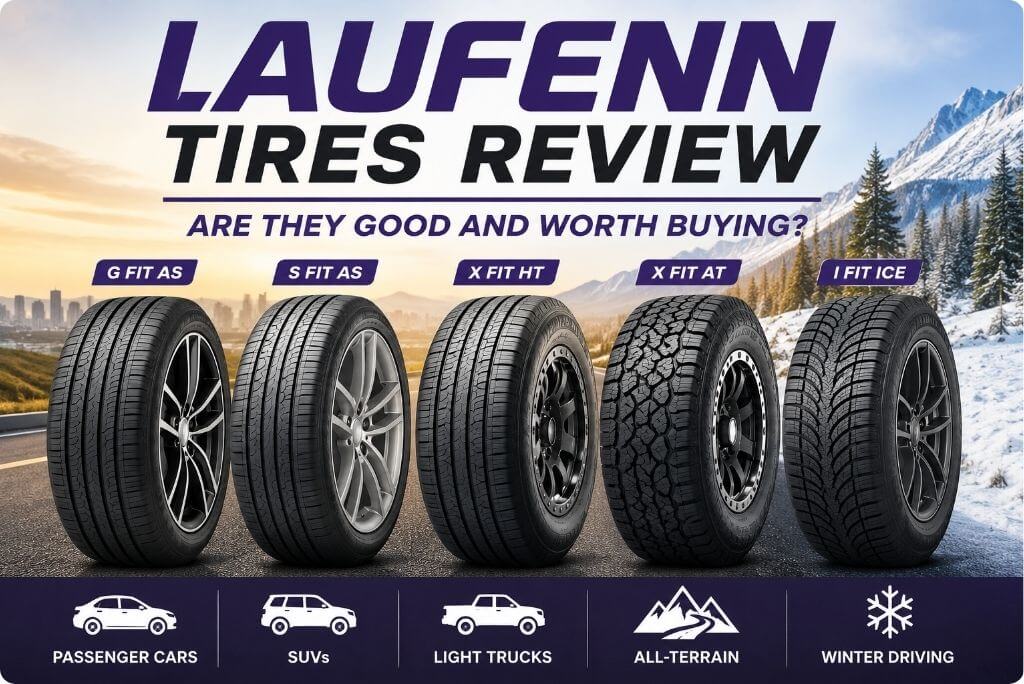
In this Laufenn Tires Review, we compare the brand’s main models, including the G FIT AS, S FIT AS, X FIT HT, X FIT AT, and I FIT Ice. We’ll look at their strengths, limitations, performance, value, and ideal use cases so you can decide which Laufenn tire is right for your vehicle—and whether the brand is a good fit for your needs.
Who Makes Laufenn Tires?
Laufenn is a global tire brand developed and backed by Hankook Tire & Technology. Hankook lists Laufenn as one of its global tire brands, with product lines covering passenger cars, SUVs, light trucks, and winter driving.
Laufenn is positioned around value. The brand is designed for drivers who want dependable everyday performance without necessarily paying premium-brand prices. Its lineup includes different tire types, such as the G FIT for general passenger-car use, S FIT for performance driving, X FIT for SUVs and light trucks, and I FIT for winter conditions.
However, being part of the Hankook family does not mean every Laufenn tire performs exactly like a premium Hankook tire. The two brands have different market positions, and each tire model has its own design, compound, construction, and performance goals. That is why a Laufenn tire should be judged on its specific performance and intended use—not simply on its connection to Hankook.
Are Laufenn Tires Good?
Yes, Laufenn tires can be a good choice for many drivers, especially those looking for reasonable everyday performance at a lower price. However, the answer depends heavily on the specific Laufenn model and how you use your vehicle.
A tire designed for daily commuting should not be judged by the same standards as an all-terrain or winter tire. The right question is not simply whether Laufenn tires are good, but whether the specific model matches your driving needs.
Where Laufenn Tires Perform Well
Laufenn tires make the most sense for everyday driving. Many drivers use their vehicles for commuting, errands, city traffic, and regular highway trips, and this is where value-focused tires can offer a practical balance of price and performance.
The lineup also gives buyers different options for different vehicles and driving conditions. Passenger-car drivers can choose from touring or more performance-focused models, while SUV and light-truck owners can look at highway-terrain or all-terrain options.
For budget-conscious buyers, Laufenn can be appealing because it offers a way to replace worn tires without automatically moving into the highest price range. That does not mean every model will match a premium tire in every area, but it can provide the performance many drivers need for normal daily use.
Where Laufenn Tires May Not Be the Best Choice
The biggest mistake is assuming that any Laufenn tire will work equally well in every condition. For example, an all-season tire is not the right choice for someone who regularly drives on severe snow and ice. In those conditions, a dedicated winter tire is usually the better option.
The same applies to serious off-road driving. An all-terrain Laufenn tire may be suitable for gravel roads, dirt roads, and light trails, but drivers who regularly face deep mud, rocks, or demanding trails may need a more specialized tire.
Drivers who prioritize maximum cornering performance or highly demanding heavy-duty use may also find better options elsewhere. In these situations, the tire’s specific design matters more than the Laufenn name on the sidewall.
Bottom line: Laufenn tires can be a smart value choice for normal driving, but the model must match the job. Check the tire’s intended use, your local weather, the roads you drive on, and your vehicle’s requirements before buying.
Best Laufenn Tires Reviews
1. Laufenn G FIT AS
The Laufenn G FIT AS is a touring all-season tire designed for everyday passenger cars. It is aimed at drivers who want a comfortable, quiet ride and reasonable performance without paying premium-tire prices.
On dry roads, the G FIT AS should feel predictable and easy to drive. Its tread design is built to provide stable handling for normal city driving, commuting, and highway travel. It is not designed to deliver the sharp steering response of a performance tire, but that is not its main purpose.
In wet conditions, four wide grooves help move water away from the tread. This can improve stability on rainy roads, although wet grip will still depend on the tire’s condition, tread depth, inflation pressure, and your driving speed. Laufenn also uses a long-mileage compound designed to balance tread life with wet-road grip.
Comfort is one of the G FIT AS’s main strengths. Its tread design is intended to reduce vibration and road noise, making it a good fit for drivers who spend a lot of time commuting or traveling on highways. It is better suited to relaxed daily driving than aggressive cornering.
The G FIT AS is an all-season tire, but that does not make it a substitute for a dedicated winter tire. It may be suitable for normal cold weather and light winter conditions, but drivers who regularly deal with heavy snow or icy roads should consider a proper winter tire instead.
Laufenn also focuses the G FIT AS on long tread life and even wear. However, actual mileage depends heavily on tire pressure, wheel alignment, rotation, road conditions, and driving habits. Regular maintenance is just as important as the tire’s tread compound when it comes to getting good service life.

Pros
- Comfortable and quiet for everyday driving
- Good fit for commuting and highway use
- Designed to balance dry, wet, and light winter performance
- Value-focused alternative to more expensive touring tires
- Available in a wide range of passenger-car sizes
Cons
- Not designed for aggressive performance driving
- Not a replacement for a dedicated winter tire in severe snow and ice
- Actual tread life depends heavily on maintenance and driving conditions
Who should buy it: The G FIT AS makes the most sense for budget-conscious drivers who want a comfortable all-season tire for commuting, city driving, and normal highway use.
Who should consider another tire: Choose a different tire if you need strong performance in severe winter conditions, serious off-road capability, or sharper handling for performance driving.
2. Laufenn S FIT AS
The Laufenn S FIT AS is designed for drivers who want a more responsive feel from an all-season tire. Compared with a comfort-focused touring tire, its main appeal is sharper steering and more confident handling on paved roads.
Steering response is one of its key strengths. The tire is designed to respond more directly to steering inputs, which can make the car feel more controlled during lane changes, on winding roads, and during everyday cornering.
On dry pavement, the S FIT AS is best suited to drivers who enjoy a more connected driving feel. It can provide good cornering confidence for normal road use, although it is still an all-season tire rather than a dedicated high-performance summer tire.
Wet-road performance is also important for an all-season tire. The S FIT AS uses a tread pattern designed to maintain grip in rain and help move water away from the contact area. However, drivers should still expect performance to change as the tire wears, especially if tread depth becomes low.
At highway speeds, the tire’s more responsive design can help provide a stable, controlled feel. The trade-off is that a handling-focused tire may not feel as soft or quiet as a touring tire designed primarily for comfort.
The S FIT AS can handle normal cold-weather driving, but it should not be treated as a dedicated winter tire. If you regularly drive through heavy snow or on icy roads, a proper winter tire is the safer choice.

Pros
- More responsive steering than a comfort-focused touring tire
- Good choice for everyday drivers who enjoy sharper handling
- Confident dry-road cornering for normal road use
- Suitable for city and highway driving
- Provides a balance between handling and all-season usability
Cons
- May not ride as softly as a comfort-focused touring tire
- Not designed for maximum performance driving
- Not a substitute for a dedicated winter tire in severe snow and ice
Who should buy it: The S FIT AS is a good fit for drivers who want an all-season tire with a more responsive, controlled feel for daily driving, highway travel, and occasional winding roads.
Who should consider another tire: Choose a different tire if your top priority is the softest, quietest ride, maximum performance handling, or dependable traction in severe winter conditions.
3. Laufenn X FIT HT
The Laufenn X FIT HT is a highway-terrain tire designed for SUV and light-truck owners who spend most of their time on paved roads. Its focus is everyday road manners, highway stability, and a comfortable driving experience rather than serious off-road traction.
On the highway, the X FIT HT is designed to provide a stable and controlled feel. That makes it a practical choice for commuting, road trips, and drivers who regularly spend long hours behind the wheel.
Ride comfort is another important part of its design. Compared with a more aggressive all-terrain tire, a highway-focused tread is generally better suited to smooth, quiet pavement driving. It can also be a better choice for drivers who want their SUV or truck to feel more like a comfortable daily vehicle.
The X FIT HT is also designed for normal wet-road driving. Its tread pattern helps channel water away from the contact area, but wet-road grip still depends on factors such as tire condition, tread depth, inflation pressure, and speed.
For long-distance driving, the X FIT HT makes the most sense when comfort and predictable highway behavior matter more than off-road ability. It is designed for paved roads, so drivers should not expect it to behave like a dedicated all-terrain tire on loose surfaces.
Light-truck owners should also check the tire’s size, load rating, and speed rating before buying. The correct fit is not determined by tire size alone, especially when the vehicle regularly carries heavy loads or is used for towing.
The main limitation is its intended use. The X FIT HT may handle occasional gravel or unpaved roads, but it is not the right choice for regular mud, rocky trails, or demanding off-road driving.

Pros
- Well suited to SUVs and light trucks used mainly on pavement
- Stable feel for highway driving and long trips
- More road-focused and comfortable than an aggressive all-terrain tire
- Suitable for everyday commuting and normal wet-road conditions
- A practical choice for drivers who rarely leave paved roads
Cons
- Limited capability for serious off-road driving
- Not designed for deep mud or rough trails
- Buyers must carefully check load and speed ratings for their vehicle
Who should buy it: The X FIT HT is a good choice for SUV and light-truck owners who spend most of their time on city streets, highways, and other paved roads.
Who should consider another tire: Choose an all-terrain or more specialized tire if you regularly drive on gravel, dirt, mud, rocky trails, or other challenging surfaces.
4. Laufenn X FIT AT
The Laufenn X FIT AT is designed for SUV and truck owners who need more versatility than a highway tire can provide. It is aimed at drivers who spend most of their time on pavement but also regularly travel gravel roads, dirt roads, and mild trails.
On paved roads, the X FIT AT is designed to maintain a reasonable balance between comfort and off-road traction. It may not be as quiet or smooth as a highway-terrain tire, but that is the trade-off for having a more aggressive tread that can handle loose surfaces better.
Highway stability is important for drivers who use their truck or SUV every day. The X FIT AT can be a practical choice for commuting and road trips, although drivers who spend almost all of their time on smooth pavement may prefer the quieter road manners of a highway tire.
On gravel and dirt, the tire’s more aggressive tread provides extra grip compared with a typical highway tire. This makes it better suited to unpaved roads, campsites, construction areas, and mild trails where a normal road tire may be more vulnerable to losing traction.
The X FIT AT can also be useful in light snow and wet conditions, but drivers should not confuse all-terrain capability with dedicated winter performance. If you regularly drive on deep snow or ice, a proper winter tire is usually the better choice.
Its biggest limitation is extreme terrain. Deep mud, large rocks, and demanding off-road trails require a more specialized tire. The X FIT AT is best understood as a balanced all-terrain tire for mixed driving, not a dedicated mud or rock-crawling tire.

Pros
- Good balance between pavement and light off-road use
- Better gravel and dirt traction than a highway tire
- Suitable for daily driving, road trips, and mild trails
- More versatile for trucks and SUVs that regularly leave paved roads
- Useful in wet conditions and light snow
Cons
- Usually noisier and less smooth than a highway-terrain tire
- Not designed for deep mud or extreme off-road terrain
- Dedicated winter tires are better for regular snow and ice driving
Who should buy it: The X FIT AT is a good fit for truck and SUV owners who drive on pavement during the week but regularly use gravel roads, dirt roads, or mild trails.
Who should consider another tire: Choose a highway tire if you rarely leave paved roads, or a more specialized off-road tire if you regularly drive through deep mud, rocky terrain, or challenging trails.
5. Laufenn I FIT Ice
The Laufenn I FIT Ice is a dedicated winter tire designed for drivers who regularly deal with snow, ice, and very cold temperatures. Unlike an all-season tire, it is built specifically for winter conditions rather than trying to cover a wide range of weather throughout the year.
Its winter-focused tread is designed to provide better grip on snow-covered roads. This can help with starting, braking, and cornering when roads are covered with packed or loose snow.
Ice is even more demanding. The I FIT Ice is designed to maintain grip in cold winter conditions, but drivers should still remember that no tire can eliminate the need for slower speeds and careful driving on ice.
The tire’s winter compound is designed to remain flexible in cold temperatures. This matters because some all-season tires become harder as temperatures drop, which can reduce their ability to grip the road.
The trade-off appears when temperatures rise. A dedicated winter tire may feel less responsive on dry, warm pavement and can wear faster if used through hot weather. For that reason, it is generally best to use winter tires during the cold season and switch back when winter conditions are over.

Pros
- Designed specifically for snow and cold-weather driving
- Better suited to winter conditions than a standard all-season tire
- Designed to maintain flexibility in low temperatures
- Provides a more appropriate choice for regular winter driving
Cons
- Not ideal for warm-weather, year-round use
- May feel less responsive on dry roads than a summer or all-season tire
- Can wear faster in hot conditions
- Ice traction still depends on road conditions and careful driving
Who should buy it: The I FIT Ice is a good choice for drivers who regularly face snow, icy roads, and consistently cold winter temperatures.
Who should consider another tire: Choose an all-season tire if your winters are generally mild and you rarely drive on snow or ice. If you need a tire for warm weather as well, a dedicated winter tire should be used seasonally rather than year-round.
Laufenn Tires Comparison: Which Model Is Right for You?
Here is the simplest way to compare the lineup.
| Laufenn Tire | Best For | Main Strength |
| G FIT AS | Everyday passenger-car driving | Comfort and value |
| S FIT AS | More responsive all-season driving | Steering feel and handling |
| X FIT HT | Highway SUVs and light trucks | On-road comfort |
| X FIT AT | Pavement plus light off-road use | Versatility |
| I FIT Ice | Snow and icy conditions | Winter traction |
That table is really the heart of the buying decision. Laufenn is not trying to make one tire do everything. It offers separate categories so drivers can choose based on how they use the vehicle, and that is exactly how you should shop for the brand.
Laufenn Tire Performance: What Buyers Should Expect
Dry Performance
Dry-road grip is where most drivers first notice how a tire feels, and Laufenn’s lineup shows clear differences by tire type. A touring tire is usually the calmest and most predictable on dry pavement. It is built for steady commuting, easy steering, and a relaxed feel in normal traffic. That makes it a good fit for drivers who want comfort first and do not push hard through corners.
A performance all-season tire feels different. It is made to respond more quickly when you turn the wheel, which can make the car feel sharper and more controlled on dry roads. That does not make it a sports tire in the strict sense, but it usually feels more direct than a comfort-focused touring tire. Drivers who like a more connected road feel will usually notice that difference right away.
Highway tires are tuned for stability rather than quick reactions. They should feel planted and easy to live with at higher speeds, especially on long trips. All-terrain tires are more of a compromise. On dry pavement, they can still work well, but their more aggressive tread usually means less refinement than a highway tire. Winter tires are the least suited to warm dry roads, because their soft winter compound is designed for cold weather, not hot pavement.
Wet Performance
Wet performance matters because a tire that feels fine in the dry can become much less confident once the road is covered in rain. The most important things here are wet braking, water evacuation, and resistance to hydroplaning. In simple terms, the tire needs to keep touching the road instead of letting water build up under it.
Touring tires often do well in this area because they are designed for everyday driving and predictable behavior. Performance all-season tires usually aim for stronger wet grip and more secure cornering in rain, especially when the driver wants quicker steering response. Highway tires also need to stay stable in wet conditions because SUV and truck drivers often cover long highway miles in changing weather.
All-terrain tires are usually more mixed. Their tread can help them deal with loose ground, but that same tread often creates a different feel on wet pavement. They can still be safe and useful in the rain, but they may not feel as smooth or quiet as a road-focused tire. Winter tires, on the other hand, are built to stay flexible in cold weather and keep working in rain, slush, and melting snow. Their wet-road strength is often tied to cold-weather use, not warm-weather comfort.
Tread condition matters just as much as tire design. A worn tire has less room to move water away, so even a good tire can lose wet-road confidence if it is near the end of its life.
Ride Comfort and Road Noise
Ride comfort and road noise are where tire type can make a big difference in daily use. Touring tires are usually the best at keeping the ride smooth and calm. They are built for drivers who spend a lot of time commuting, running errands, or cruising on the highway. On rough pavement, they usually feel less busy than more aggressive tire types.
Performance all-season tires can still ride well, but they often trade a little comfort for a more responsive feel. That means the steering may feel sharper, but the ride may not be as soft or quiet as a touring tire. For some drivers, that trade-off is worth it. For others, especially those who want a quiet cabin on long drives, it may not be.
All-terrain tires usually create more road noise than highway tires because of their more open tread pattern. That extra pattern helps them bite into gravel and dirt, but it can also make a humming or rumbling sound on smooth pavement. Some drivers do not mind that at all, but it is important to expect it instead of being surprised by it.
Winter tires can also feel different from all-season tires. Their soft compound and winter-focused tread help in cold weather, but they may sound different and feel less settled on warm, dry roads. That is not a flaw so much as a sign that the tire is doing the job it was built to do.
Winter Performance
Winter performance should be separated into three groups, because not every tire handles cold weather the same way. All-season tires can manage light winter use in some places, but they are not the best answer when snow and ice become a regular part of driving. They are a compromise tire, so they can work in a wide range of weather, but they do not specialize in winter grip.
All-terrain tires can be helpful in mixed conditions, especially if the vehicle also sees gravel or dirt roads. Their tread may give extra bite in light snow compared with a basic road tire, but they still are not a replacement for a true winter tire. In other words, they can help in some winter situations, but they are not built for the hardest ones.
A dedicated winter tire is different. It uses a compound that stays flexible in cold weather and a tread pattern designed for snow and ice. That is why a winter tire can feel much more secure when temperatures drop and roads become slippery. It is not just about snow; it is also about how the tire behaves in freezing weather, slush, and packed snow.
This is why drivers should match the tire to the season and the road conditions they actually face. A tire that feels fine in mild winter weather may not be the right choice once the roads stay cold for weeks at a time.
Off-Road Performance
Off-road performance matters most for the Laufenn X FIT AT, since that is the tire in the lineup meant to handle more than just pavement. On gravel roads, it should offer more confidence than a highway tire because its tread is designed to work with loose surfaces. The same is true on dirt roads, where a more open tread can help the tire hold on better than a smoother road tire.
For light trails, the X FIT AT is meant to give SUV and truck owners more flexibility. That could mean farm roads, campsite access, forest roads, or unpaved routes that are not especially rough. In those situations, the tire can be a practical middle ground for drivers who want one tire that still feels acceptable on pavement.
The limit comes when the terrain becomes more demanding. Deep mud, sharp rocks, steep ruts, and serious off-road trails are beyond what most all-terrain tires are meant to handle comfortably. The X FIT AT is best understood as a balanced option, not a hardcore off-road tire. That is an important distinction because it helps buyers avoid choosing the wrong tire for the way they drive.
For many truck and SUV owners, that balance is exactly the point. They need something that can handle weekday pavement and weekend unpaved roads without feeling completely out of place on either one.
How Long Do Laufenn Tires Last?
There is no single mileage number that applies to every Laufenn tire. Tread life depends on the specific model and, just as importantly, how the tire is used and maintained.
A tire on a calm daily commuter will usually last longer than the same tire on a heavy vehicle, rough roads, or a car driven hard every day. Tire pressure matters too. If pressure is too low or too high, the tire can wear unevenly and lose tread faster than it should.
Wheel alignment and rotation also make a big difference. Poor alignment can pull a tire out of shape and wear it down unevenly. Regular rotation helps the tires wear more evenly from front to back, which can extend useful life. Vehicle weight matters as well, since heavier vehicles put more stress on the tires. Road conditions also play a role, especially if you drive on rough pavement, potholes, gravel, or hot roads often.
The easiest way to judge tire life is to watch the wear pattern, not just the odometer. A tire can still look usable from a distance but already be close to replacement.
Look for these signs:
- Tread depth getting low: Less tread means less grip, especially in rain and snow.
- Wear indicators showing: These built-in bars help tell you when the tire is near the end of its usable tread.
- Uneven wear: One side wearing faster than the other can point to alignment or inflation problems.
- Shoulder wear: Fast wear on the edges often means the tire pressure or alignment needs attention.
- Cupping: A scalloped or bumpy wear pattern can mean suspension, balance, or alignment issues.
The short answer is that Laufenn tire life depends more on how the tire is treated than on the brand name alone. With the right tire, proper pressure, regular rotation, and good alignment, buyers can usually get much better value from the set.
Laufenn Tire Warranty: What Buyers Should Check
Laufenn warranty coverage can vary by tire model, market, and purchase date, so buyers should always check the current warranty information for the exact tire they are considering. The official Laufenn warranty page is the best place to confirm the latest terms.
The main things to check are treadwear coverage, workmanship and materials coverage, and any limitations. Some Laufenn models carry a limited treadwear warranty, but the mileage and conditions can differ between products. For example, the official product pages show different warranty coverage across models.
Warranty claims may also depend on proper tire maintenance, such as correct inflation, regular rotation, and proper alignment. Damage caused by road hazards, misuse, mechanical problems, or other exclusions may not be covered.
Finally, do not assume that warranty terms are identical everywhere. Coverage can differ between the United States and other markets, so check the official warranty document that applies to your location before buying. That small step can prevent surprises if you ever need to make a claim.
How to Choose the Right Laufenn Tire
Start with the vehicle label or owner’s manual. NHTSA says the correct tire inflation pressure is listed on the Tire and Loading Information Label on the driver’s side door area or in the owner’s manual, and that is also the right place to confirm fitment details before buying.
Then match the tire to your real driving. If you mostly commute in a car, the G FIT AS makes the most sense. If you want a sportier all-season feel, look at the S FIT AS. If you drive an SUV or light truck mostly on pavement, the X FIT HT is the cleanest fit. If your roads regularly include gravel or light trails, the X FIT AT is the better fit. If winter is the real problem, the I FIT Ice is the most honest answer.
Finally, check the load index and speed rating. A tire can be the right size and still be the wrong fit if it does not meet the vehicle’s requirements. This is one of the easiest ways to avoid buying a tire that looks right online but is not right for your vehicle in the real world.
Laufenn Tires Pros and Cons
Pros
- Value-focused pricing
- A broad range of tire categories
- Options for passenger cars, SUVs, trucks, and winter driving
- Good choices for many everyday drivers
- Separate models for comfort, handling, highway use, off-road versatility, and winter conditions
Cons
- Performance varies significantly by model
- All-season models are not substitutes for dedicated winter tires in severe conditions
- All-terrain tires involve compromises in noise and pavement refinement
- Premium brands may still offer advantages in specialized performance and refinement
- Buyers need to match the tire carefully to their vehicle and driving conditions
Laufenn vs Other Tire Brands: How Does It Compare?
Laufenn vs Michelin
The biggest difference is usually value versus premium positioning. Laufenn is aimed at drivers who want a practical tire at a more accessible price, while Michelin offers a broad premium lineup with products designed for buyers willing to pay more for particular levels of performance, comfort, or specialized capability.
That does not mean every Michelin tire is automatically the right choice. If you mainly commute, drive on normal roads, and want to keep the purchase price under control, a Laufenn tire may make more sense. If you place a higher value on premium refinement or specialized performance, Michelin deserves consideration.
Laufenn vs Hankook
This is one of the most important comparisons because Laufenn is a Hankook brand. However, the two should not be treated as identical tires with different names.
Hankook operates a broader portfolio that includes premium product families, while Laufenn is positioned toward more economical driving. The parent-company relationship gives Laufenn access to Hankook’s wider technical background, but each tire still has its own design, construction, compound, and performance target.
In simple terms, choose Laufenn when value is the priority. Consider Hankook when you are willing to move higher in the price range for a different level of product or a more specialized tire.
Laufenn vs Cooper
Cooper is especially relevant to SUV and truck owners because its lineup includes a wide range of road-focused and all-terrain tires. A Laufenn X FIT HT or X FIT AT should therefore be compared with a Cooper tire designed for a similar type of driving.
If you mainly drive on pavement, compare highway comfort, wet-road performance, road noise, and expected value. If you regularly drive on gravel or mild trails, compare the all-terrain models instead. The important point is to compare the job the tire is designed to do, not just the brand name.
Read More
Who Should Buy Laufenn Tires?
Laufenn is a good fit for drivers who want sensible pricing, drive mostly on normal roads, and are willing to choose the right model for the job. It also makes sense for owners of older vehicles, family vehicles, workaday SUVs, and light trucks that do not need premium-brand performance to do their daily work well.
Who Should Consider Other Tires?
You should look elsewhere if you need maximum performance, frequent severe-winter traction from an all-season tire, or serious off-road capability beyond what an all-terrain road tire is built to do. Buyers who want the softest ride, the quietest cabin, or the most specialized capability in harsh conditions may be happier spending more on a tire that is built for that exact job.
FAQs About Laufenn Tires
Are Laufenn tires safe?
A tire’s safety depends on more than the brand name. Correct fitment, proper inflation, adequate tread depth, regular maintenance, and driving for the conditions are all important.
Are Laufenn tires good in rain?
Several Laufenn models receive generally positive wet-performance feedback, but performance varies by model. A tire’s condition and tread depth also have a major effect on wet traction.
Are Laufenn tires good in snow?
The answer depends on the tire. All-season models may work in light snow, while the I FIT Ice is designed specifically for snow and icy winter conditions. A dedicated winter tire is generally the better choice for frequent severe winter driving.
Are Laufenn tires noisy?
Noise varies by model. Touring and highway tires are generally designed with road comfort in mind, while all-terrain tires may produce more tread noise because of their more aggressive tread patterns.
Are Laufenn tires good for SUVs and trucks?
Yes. The X FIT HT is designed for highway-focused SUV and light-truck use, while the X FIT AT is better suited to drivers who regularly travel on gravel, dirt roads, and mild trails.
Are Laufenn tires worth the money?
They can be. Laufenn tires make the most sense for buyers who want a value-focused tire and choose the model that matches their driving conditions. The value is less convincing if the tire is used outside its intended purpose.
Final Verdict: Are Laufenn Tires Worth Buying?
Laufenn tires are worth considering if you want a sensible mix of price, comfort, and everyday performance. The brand’s real strength is not one single tire; it is the way its lineup covers different needs clearly and honestly. The G FIT AS is the everyday touring pick, the S FIT AS is the sportier all-season option, the X FIT HT suits highway-focused SUVs and trucks, the X FIT AT serves drivers who need more off-road flexibility, and the I FIT Ice is the winter specialist.
For most buyers, that is exactly what makes Laufenn a smart value brand: it gives you a clear path to the right tire without forcing you into a premium price bracket. The key is to buy the model that matches your real driving needs, not just the lowest price on the shelf.
Check Out Our Other Tire Brand Reviews
Want to compare Laufenn with other tire brands? Explore our related tire reviews to learn more about performance, value, durability, and the best use cases for different drivers.
