
Kenda Tires Review: Are Kenda Tires Good?
Last updated on July 22nd, 2026
If you are shopping for new tires, you have probably come across Kenda. The brand is known for offering tires at a lower price than many premium names, but that naturally raises an important question: Are Kenda tires actually good?
The short answer is yes, Kenda makes several good-value tires—but the exact model matters a lot.
A Kenda touring tire designed for daily commuting will have very different strengths from a Kenda all-terrain tire built for trucks and off-road driving. Some models focus on comfort and long tread life, while others are designed for snow, towing, or rough terrain.
That is why judging the entire brand by one Kenda tire can be misleading.
In this Kenda Tires review, we look at the brand’s strengths, weaknesses, major tire categories, real-world performance, tread life, warranty coverage, popular models, and the situations where Kenda tires make sense. We will also explain when spending more on a premium competitor may be the better choice.
Quick Verdict: Are Kenda Tires Good?
Yes, Kenda tires can be a good choice for drivers who want dependable performance at a competitive price.
Kenda is especially appealing if you mainly drive on paved roads, want to keep your tire costs under control, and choose a model that matches your vehicle and driving conditions.
The biggest advantage is value. Many Kenda models offer useful everyday performance without the price of a premium tire. Some newer models also offer features that make them more competitive in areas such as wet traction, winter capability, highway comfort, and tread life.
However, Kenda is not automatically the best choice for every driver. A premium tire may still be worth the extra money if you want the quietest ride, the strongest wet braking performance, the highest level of refinement, or the most predictable performance in severe conditions.
Kenda tires are a good fit if you:
- Want a lower upfront purchase price
- Mainly drive to work, school, shopping, and on highways
- Want a reasonable balance of comfort, traction, and durability
- Are willing to choose the tire based on your actual driving needs
- Want a truck or SUV tire that can handle both pavement and light off-road use
You may want to look elsewhere if you:
- Regularly drive in severe winter conditions
- Want maximum performance from a sports car
- Expect premium-level ride comfort and noise control
- Need the highest possible wet braking performance
- Regularly tow heavy loads or drive on demanding off-road terrain without choosing a tire specifically designed for that use
The most important point in this Kenda tire review is simple: the model matters more than the brand name.
What Are Kenda Tires?
Kenda is a long-running tire company that started in 1962 in Yuanlin, Taiwan, making bicycle tires. Over time, it grew into a global brand that now makes tires for cars, light trucks, motorcycles, trailers, powersports, bicycles, and other specialty uses. Kenda says its focus is performance and value, which is a good clue about where it sits in the market.
Kenda’s official history shows a broad global footprint, with factories and operations built over time in Taiwan, China, Vietnam, Indonesia, and a technical center in Akron, Ohio. In simple terms, this is not a small local brand. It is a global tire maker with a wide product range and a lot of manufacturing experience.
Kenda also has real OEM experience. In 2025, Honda in North America recognized Kenda as an OEM supplier, which supports its credibility as a brand trusted by major vehicle makers.
Is Kenda a good tire brand?
Yes, for many everyday drivers, Kenda is a good tire brand. It is usually a smart choice if you want decent quality without paying premium-brand prices. That said, Kenda is not always the best pick if you want the very quietest ride, the highest-end performance, or the longest tread life in every category. For most buyers, the best way to think about Kenda is solid value with broad coverage, not “top-tier luxury tire.”
Kenda Tire Categories Explained
Kenda makes several types of tires, and each one is built for a different kind of driving. That is why the best Kenda tire for one driver may be the wrong choice for another.
Touring / All-Season
These are the everyday tires most drivers need. They are best for commuting, school runs, city driving, and normal highway travel.
Their main strength is balance. They usually give a comfortable ride, easy handling, and decent wet and dry-road performance without feeling too harsh.
Their main weakness is that they are not made for rough roads, deep snow, or aggressive driving. If you need extra grip for trails or bad weather, this category is too basic.
UHP / Performance
UHP stands for ultra-high performance. These tires are best for drivers who want sharper steering and a more responsive feel on paved roads.
Their main strength is handling. They usually feel more direct in corners and more stable when driving at higher speeds.
Their main weakness is comfort. They can ride firmer and may make more road noise than touring tires. They are also not the best choice for snow or rough use.
All-Terrain
All-terrain tires are best for SUVs and trucks that split time between pavement and light off-road use.
Their main strength is versatility. They can handle gravel, dirt, and light trails better than regular road tires while still working for daily driving.
Their main weakness is that they usually are not as quiet or smooth as a touring tire. You give up some comfort to get more traction off the pavement.
Rugged-Terrain
Rugged-terrain tires are best for drivers who spend more time on rough roads, job sites, or tougher off-road surfaces.
Their main strength is stronger off-road grip and a tougher tread design that handles abuse better than a standard all-terrain tire.
Their main weakness is everyday comfort. They often make more noise and can feel less refined on long highway drives.
Trailer Tires
Trailer tires are best for travel trailers, utility trailers, and other tow-behind uses. They are built to carry heavy loads and stay stable under towing stress.
Their main strength is load support. They are designed for the demands of a trailer, not passenger comfort.
Their main weakness is simple: they are not made for cars, SUVs, or trucks as regular drive tires. They should only be used where the trailer calls for them.
Simple rule: choose touring for daily driving, UHP for sharper handling, all-terrain for mixed use, rugged-terrain for tougher ground, and trailer tires only for towing.
How We Evaluated Kenda Tires
A tire review should be based on more than brand reputation or a list of specifications. To evaluate Kenda tires fairly, we looked at the factors that matter most in everyday driving and compared how different Kenda tire categories are designed to perform.
Our assessment considers dry-road handling, wet-weather grip, ride comfort, road noise, expected tread life, winter capability, off-road performance where applicable, and overall value. We also consider the differences between individual models because a Kenda touring tire is designed for a very different job than a Kenda all-terrain or rugged-terrain tire.
We also reviewed manufacturer information, tire specifications, warranty details, independent feedback, and real-world owner experiences. This helps provide a more balanced view of what Kenda tires do well and where they may fall short compared with more premium competitors.
The most important point is that Kenda is a broad tire brand, not a single tire design. Performance can vary significantly by model, tire size, vehicle, road conditions, maintenance, and driving style. For that reason, our recommendations focus on matching the right Kenda tire to the right driver rather than treating every model as the same.
Kenda Tire Performance

Dry Road Performance
Kenda’s road-focused tires generally provide the level of dry-road performance most everyday drivers expect.
A touring tire is designed to provide predictable steering, stable handling, and comfortable daily driving. A UHP tire is designed with a different goal and may provide sharper steering response and stronger cornering ability.
Truck and SUV tires also behave differently. An all-terrain tire usually has larger tread blocks and a more aggressive design, which can reduce the precise steering feel of a road-focused tire.
For normal commuting, the difference may not be important. But if you enjoy driving quickly on winding roads, a performance-oriented Kenda model is likely a better fit than an all-terrain tire.
Our assessment: Good for everyday driving, but exact dry-road performance varies significantly by model.
Wet Road Performance
Wet traction is one of the most important areas to consider when buying tires.
Kenda’s newer road-focused products use tread designs and grooves intended to move water away from the contact area. For example, the Vezda Touring A/S KR205 uses four circumferential grooves and is designed to provide wet-road traction as part of its touring-focused performance package.
However, wet performance should never be judged by brand reputation alone.
The exact tire compound, tread pattern, size, vehicle, and remaining tread depth all affect wet-road grip. A tire that performs well when new can lose a significant amount of wet traction as the tread wears.
For drivers who regularly experience heavy rain, look for a model with a strong wet-performance focus rather than simply choosing the cheapest Kenda tire available.
Our assessment: Generally adequate to good for normal road use, with meaningful differences between models.
Snow and Winter Driving
Kenda’s winter capability depends heavily on the tire.
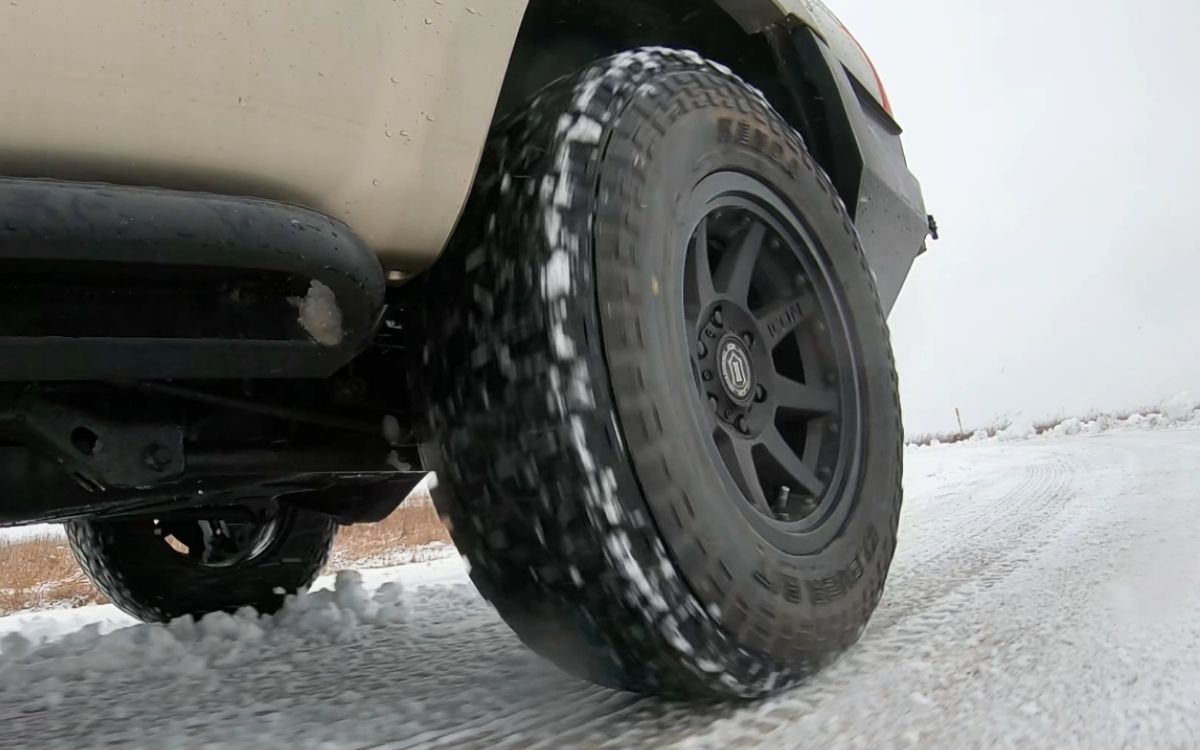
Some all-season tires are designed for light snow and cold-weather driving, while certain all-terrain products carry the Three-Peak Mountain Snowflake certification for severe snow conditions.
For example, the standard Klever A/T2 is listed as 3PMSF certified in all sizes, while the Klever A/T2 Heavy Duty sizes are specifically noted as not 3PMSF certified.
This difference is important.
If you live in an area with occasional light snow, a suitable all-season tire may be enough. If you regularly drive through deep snow, ice, or severe winter conditions, a dedicated winter tire is usually the better solution.
Do not assume that every Kenda all-season or all-terrain tire has the same winter capability. Check the exact model.

Off-Road Performance
Kenda’s Klever range is where the brand becomes more attractive to truck and SUV owners.
The Klever A/T2 is designed to combine all-terrain capability with daily road use. Kenda describes it as a tire for SUVs, light trucks, and 4×4 vehicles that need performance on pavement, in snow, and in many off-road environments.
The Klever R/T is aimed at drivers who want more aggressive rough-terrain capability without completely giving up the ride qualities associated with an all-terrain tire.
The trade-off is simple: as a tire becomes more aggressive, it generally becomes less refined on pavement.
If you spend most of your time on asphalt, a touring or highway tire may provide a quieter and more comfortable experience. If you regularly drive on gravel, dirt, mud, or rough trails, an all-terrain or rugged-terrain tire may be worth the additional noise.
Ride Comfort
Comfort depends strongly on the tire category.
Touring tires are generally the best choice for drivers who want a smooth daily ride. Larger, heavier, and more aggressive truck tires can feel firmer, particularly when fitted to a vehicle with stiff suspension or when inflated to pressures required for heavy loads.
Kenda’s road-focused products are designed with comfort in mind. The Vezda Touring A/S, for example, uses a tread design and pitch sequencing intended to reduce road noise and improve ride quality.
However, no tire can completely overcome a harsh suspension, oversized wheels, incorrect tire pressure, or an unsuitable tire size.
Our assessment: Road-focused Kenda tires can offer good comfort. Aggressive truck tires naturally give up some refinement for durability and traction.
Road Noise
Road noise is another area where the exact model matters.
A touring tire with a smooth tread pattern will usually be quieter than a large all-terrain or rugged-terrain tire. Even if two tires have similar price tags, they may sound very different on the highway.
Kenda’s Klever A/T2, for example, is specifically designed to balance all-terrain traction with reduced road noise and a comfortable ride.
Still, drivers who spend several hours every week on the highway should think carefully about tire type. Aggressive tread may look good on a truck, but it can produce more sound inside the cabin.
Tread Life: How Long Do Kenda Tires Last?
There is no single mileage figure that applies to every Kenda tire. A commuter-focused touring tire, a high-performance tire, and an aggressive all-terrain tire are designed for different types of driving, so their tread life can vary significantly.
As a general rule, Kenda touring and all-season tires are usually better suited to drivers who want dependable everyday use and reasonable tread life. Performance-focused tires may wear faster because their softer compounds and handling-focused tread designs prioritize grip over maximum longevity. Kenda all-terrain and rugged-terrain tires can also wear differently depending on how much time they spend on pavement, gravel, dirt, or rough trails.
Your maintenance habits can make just as much difference as the tire model. Incorrect tire pressure, poor wheel alignment, infrequent rotation, aggressive acceleration, hard cornering, and heavy vehicle loads can all accelerate uneven or premature wear.
The best way to judge a Kenda tire’s remaining life is to inspect its tread condition rather than rely only on a mileage estimate. If the tread is worn near the legal limit, showing uneven wear, or the tire has developed cracks or other damage, it may need replacement even if the tire has not reached an expected mileage figure.
Bottom line: Kenda tire life depends heavily on the specific model and how it is used. Choose the right tire for your driving conditions, maintain the correct pressure, rotate it regularly, and keep the wheels properly aligned to get the most life from your investment.
Value for Money
Value is Kenda’s strongest overall advantage.
The brand can make sense when you want a tire that performs well enough for your normal driving without paying premium-brand prices.
But value does not mean choosing the cheapest tire automatically.
The best value comes from buying the right tire for the job. A cheap touring tire may be a poor purchase if you need serious off-road traction. An aggressive truck tire may be a waste of money if you only drive on highways.
The best-value Kenda tire is the one that matches your vehicle and driving conditions.
Kenda Tire Warranty Explained
Kenda’s warranty is not the same for every tire, so the exact model matters. For passenger and light truck tires, Kenda says its limited warranty covers failures caused by defective material and workmanship for four years from the tire’s manufacture date, subject to the warranty rules. Some Kenda models also include limited mileage coverage, but not all of them do.
The main thing to check is whether your tire has a treadwear warranty and how many miles it covers. For example, Kenda lists a 65,000-mile warranty on the Vezda Touring A/S and a 50,000-mile warranty on the Vezda UHP A/S, while other models may have different terms or no mileage warranty at all.
Warranty coverage also has limits. Wear from normal use is expected, and a tire is considered worn out when the tread reaches 2/32 inch, which means it will not qualify for replacement under treadwear coverage. Damage from improper inflation, misalignment, or other maintenance problems can also hurt a claim, so keeping the tires properly maintained matters.
The bottom line is simple: do not judge Kenda’s warranty by the brand alone. Check the exact tire model, because that is where the real coverage details are written.
Popular Kenda Tire Models Reviewed
Kenda makes tires for very different types of drivers, so there is no single “best Kenda tire” for everyone. A commuter tire, an all-terrain tire, a rugged-terrain tire, and a performance tire can deliver very different experiences on the road.
The five models below represent different use cases in Kenda’s lineup. The best choice depends less on the Kenda name and more on where you drive most of the time.
1. Kenda Klever A/T2 (KR628)
The Klever A/T2 is the most versatile choice for drivers who split their time between pavement and light off-road terrain. It makes sense for an SUV or light truck that handles daily commuting during the week but also sees gravel roads, dirt trails, camping areas, or rough back roads on weekends.
On pavement, it offers a reasonable balance between everyday manners and all-terrain traction. The trade-off is the typical one for this category: it will generally be noisier and less sharp than a highway or touring tire. If most of your driving is on asphalt, that compromise may not be worthwhile.

Best for: Drivers who want one tire for daily roads, gravel, and light trail use.
Buy it if: You regularly leave paved roads but still want a tire that remains usable for normal commuting and highway trips.
Skip it if: You almost never drive off pavement and your priorities are the quietest ride, smoothest handling, or maximum highway refinement.
2. Kenda Kenetica Touring A/S (KR217)
The Kenetica Touring A/S is aimed at drivers who want a straightforward everyday tire rather than a sporty or aggressive driving experience. Its strengths are comfort, predictable road manners, and value for regular city and highway driving.
It is a better match for a commuter or family vehicle than for someone who wants sharp steering response or serious traction in snow and off-road conditions. Its appeal is simplicity: for normal paved-road driving, you do not need to pay for capabilities you will rarely use.

Best for: Daily commuters and drivers who prioritize comfort and value.
Buy it if: Most of your driving involves city streets, suburban roads, and regular highway travel.
Skip it if: You want sporty handling, serious snow traction, or off-road capability.
3. Kenda Klever R/T KR601
The Klever R/T KR601 is the more aggressive choice for truck and SUV owners who regularly deal with gravel, dirt, mud, job-site roads, or other rough surfaces. Compared with a touring or highway tire, its stronger off-road focus gives it a more rugged character.
The trade-off is more noticeable on pavement. Aggressive tread designs typically bring more road noise, a firmer ride, and less precise steering than road-focused tires. That makes the KR601 a poor choice for a driver who spends nearly all of their time on smooth highways.

Best for: Truck and SUV owners who frequently drive on rough or unpaved surfaces.
Buy it if: Off-pavement traction and a rugged tire design matter more to you than quiet highway comfort.
Skip it if: Your truck is primarily a daily highway commuter and you do not need additional off-road capability.
4. Kenda Vezda Touring A/S KR205
The Vezda Touring A/S KR205 is the road-focused option in this group. It is designed around the needs of drivers who spend most of their time on paved roads and want a comfortable, uncomplicated all-season tire.
Compared with Kenda’s more aggressive truck tires, its road-oriented design makes more sense for sedans, crossovers, and other everyday vehicles. It is not intended to deliver the sharper response of a performance tire or the traction of an all-terrain tire, but that is not its purpose.

Best for: Drivers who want comfortable, value-focused everyday road performance.
Buy it if: Your normal driving is limited to city streets, highways, and other paved roads.
Skip it if: You need serious off-road traction or want a more responsive performance-oriented tire.
5. Kenda Vezda UHP A/S (KR400)
The Vezda UHP A/S KR400 is the performance-focused option among these five models. It is aimed at drivers who want quicker steering response and a more engaging feel than a typical touring tire can provide.
The main compromise is comfort. A tire designed to feel more responsive can also feel firmer and generate more road noise than a comfort-focused touring tire. It is therefore best suited to drivers who value handling response more than a soft, quiet ride.

Best for: Drivers who want a sportier all-season tire for everyday road use.
Buy it if: You want sharper steering and more responsive handling without moving to a more specialized performance tire.
Skip it if: Your top priorities are maximum ride comfort, minimal road noise, or dedicated winter traction.
Which Kenda Tire Should You Buy?
The right Kenda tire depends on how you actually use your vehicle. Start with your normal driving conditions, not the tire’s appearance or the lowest price.
For daily commuting: Choose a touring or all-season tire. This is usually the best fit for city streets, suburban roads, and regular highway driving.
For frequent highway driving: A touring or highway-focused tire is usually the better choice. It should give you a more comfortable and quieter ride than an aggressive truck tire.
For sporty driving: Choose a UHP or performance-focused tire if you want quicker steering response and a more engaging feel on paved roads. The trade-off is usually a firmer ride.
For gravel roads and light trails: An all-terrain tire is the better match. It gives you more traction away from pavement without being as aggressive as a rugged-terrain tire.
For frequent rough off-road use: Choose a rugged-terrain tire if you regularly drive on rough trails, dirt roads, job sites, or other challenging surfaces. Expect more noise and a less refined highway ride.
For towing: Use a trailer-specific tire when your trailer requires one. Do not choose a passenger or truck tire simply because it has a similar size.
The simplest rule is this: buy the Kenda tire that matches the roads you drive most often. If you spend 90% of your time on pavement, an aggressive off-road tire may give you capabilities you rarely use while making your daily drive noisier and less comfortable.
Kenda Tires Pros and Cons
Pros
- Good value for the money
- Wide range of tire categories
- Practical choice for daily driving
- Useful option for budget-minded buyers
- Strong brand focus on performance and value
Cons
- Exact performance depends heavily on the model
- Premium-brand refinement may be better in some categories
- Wet, winter, and noise performance need careful model-by-model comparison
- No tire performs well if it is poorly maintained
Kenda Tires vs Competitors
Kenda vs Michelin
Michelin is the safer pick if your priority is premium refinement, quietness, fuel efficiency, and long tread life. Michelin’s U.S. lineup leans hard into “performance made to last,” low rolling resistance, and a quiet ride, while Kenda’s own product pages position many of its tires as value-focused, which in practice usually means less polish but lower cost.
Kenda vs Continental
Continental is the better choice for drivers who care most about braking confidence, wet-road security, and overall comfort. Continental’s SUV/passenger messaging emphasizes aquaplaning protection, braking performance, noise reduction, and longevity, so on a rainy highway run the Continental tire is usually the more confidence-inspiring option. Kenda makes more sense if you want a lower entry price and can accept a step down in refinement.
Kenda vs Maxxis
Maxxis sits closer to Kenda on price/value positioning, but its U.S. and international lines show a broader premium lean in touring, UHP, and light-truck categories. In real use, that usually means Maxxis is the better “step-up” brand if you want more balanced handling and road manners, while Kenda is often the simpler budget buy.
Kenda vs Goodyear
Goodyear is stronger if you want a mainstream brand with broader all-weather, touring, and truck coverage, plus a more polished highway feel. Goodyear’s product pages highlight responsive handling, wet/dry grip, and rugged toughness, so it is usually the better pick for mixed city-highway drivers and heavier SUVs. Kenda is best when price matters more than premium feel.
Read More: Falken Tires Review (2026): Are They Good?
What Kenda Tire Owners Say
Owner feedback on Kenda tires is generally mixed but often positive when the tire is matched to the right vehicle and driving conditions. The strongest common theme is value: many buyers choose Kenda because they want a reasonable tire without paying premium-brand prices.
For everyday driving, owners commonly appreciate the predictable performance, comfortable ride, and affordable purchase price of road-focused models. Drivers who mainly commute on city streets and highways often find that Kenda tires provide the performance they need for normal use.
The main complaints are more model-specific. Some owners report more road noise from aggressive all-terrain and rugged-terrain tires, while others notice differences in wet-road grip between individual models. Tread life can also vary considerably depending on the tire, vehicle, road conditions, tire pressure, alignment, and driving habits.
That is why it is important not to judge every Kenda tire by the experience of one owner. A touring tire used mainly on highways can provide a very different experience from an aggressive truck tire used on rough roads.
The overall takeaway from owner feedback is simple: Kenda tires can offer good value for everyday driving, but the exact model matters. Before buying, look at reviews for the specific Kenda tire that fits your vehicle rather than relying only on the brand’s overall reputation.
Are Kenda Tires Safe?
Kenda tires can be a safe choice when you buy the right size and load rating for your vehicle. Tires are designed to match the stresses and performance needs set by the vehicle maker, so the safest tire is the one that fits the car, truck, or SUV the way it should.
Proper inflation matters just as much. Even a small loss of air pressure can reduce tread life, fuel economy, and overall performance, and a tire pressure warning can trigger when pressure is 25% or more below the recommended cold setting.
Tread depth and damage are the next big checks. NHTSA says tires should be replaced when tread reaches 2/32 of an inch, and you should inspect them at least once a month and before long trips for cuts, punctures, bulges, scrapes, cracks, or bumps. Older tires also deserve extra attention, especially on vehicles that do not get driven much.
The simple answer is this: Kenda tires are safe when they are the correct fit, properly inflated, not worn out, and free from damage. If any of those checks fail, the brand name matters a lot less than the tire’s actual condition.
Who Should Buy Kenda Tires?
Kenda tires are not the best choice for every driver, but they are an excellent fit for many people. The key is choosing them for the right type of driving.
Buy Kenda tires if you mostly drive on paved roads, such as city streets and highways. They are a good option for daily commuting, school runs, weekend trips, and regular family driving. If you want dependable performance without paying premium-brand prices, Kenda offers solid value.
They’re also a smart choice if you have a moderate budget. Instead of paying extra for features you may never notice in everyday driving, you can get reliable tires that handle normal road conditions well.
You may want to consider another brand if you regularly drive through heavy snow or icy roads. In those conditions, a dedicated winter tire—or a premium all-weather option—will usually provide better grip and more confidence.
The same applies if you need maximum handling for spirited driving, tow heavy loads on a regular basis, or spend a lot of time on rough off-road trails. While Kenda has tires for many of these uses, premium brands often deliver better performance in demanding conditions.
For the average driver, though, Kenda strikes a good balance between price, comfort, and everyday reliability. If your goal is dependable transportation rather than top-level performance, it’s a brand that’s well worth considering.
Related Topic: Yokohama Tires Review: Are Yokohama Tires Good?
FAQs about Kenda Tires Review
Are Kenda tires good quality?
Kenda presents itself as a performance-and-value brand with a wide range of tire applications, so the answer is yes for many everyday buyers, provided the tire line matches the vehicle and use case. Quality also depends on the exact model and how well the tire is maintained.
Are Kenda tires noisy?
Noise depends on the tread design and the specific model. More aggressive tread patterns usually make more road noise than smoother touring tires. Vehicle type and wear also matter.
Are Kenda tires worth the money?
For many drivers, yes. Kenda is clearly aimed at value-conscious buyers who still want solid everyday performance. If you do not need top-shelf refinement and you choose the right tire family, the brand can be a smart purchase.
Do Kenda tires come with a warranty?
Kenda’s official site includes warranty information in its tire-tech area, so buyers should always check the exact model’s warranty terms before purchasing. Warranty coverage can vary by product line.
Which Kenda tire is best for SUVs?
That depends on how you drive. A highway tire is usually better for mostly paved use, while an all-terrain tire makes more sense if you split time between pavement and rough roads.
Are Kenda tires suitable for highway driving?
Yes, many Kenda tires are designed for road use, and the brand specifically markets tires for car, light truck, van, and UHP applications. The key is picking the right line for highway comfort and load needs.
Final Verdict
Kenda is a solid brand for drivers who want practical value. It is not trying to be the most expensive tire on the market, and that is part of its appeal. The brand’s own positioning shows a clear focus on performance and value across multiple vehicle categories, which makes it a reasonable choice for many daily drivers.
The biggest lesson in any Kenda tires review is that the brand should be judged by the right standard: not “Is it the best tire ever made?” but “Is it the right tire for this vehicle, this driver, and this budget?” If the answer is yes, Kenda can deliver very good value. If your needs are more demanding, especially in winter, wet braking, or refinement, it may be worth stepping up to a premium line.
