Toyota Corolla Bolt Pattern by Year: Complete Wheel Fitment Chart
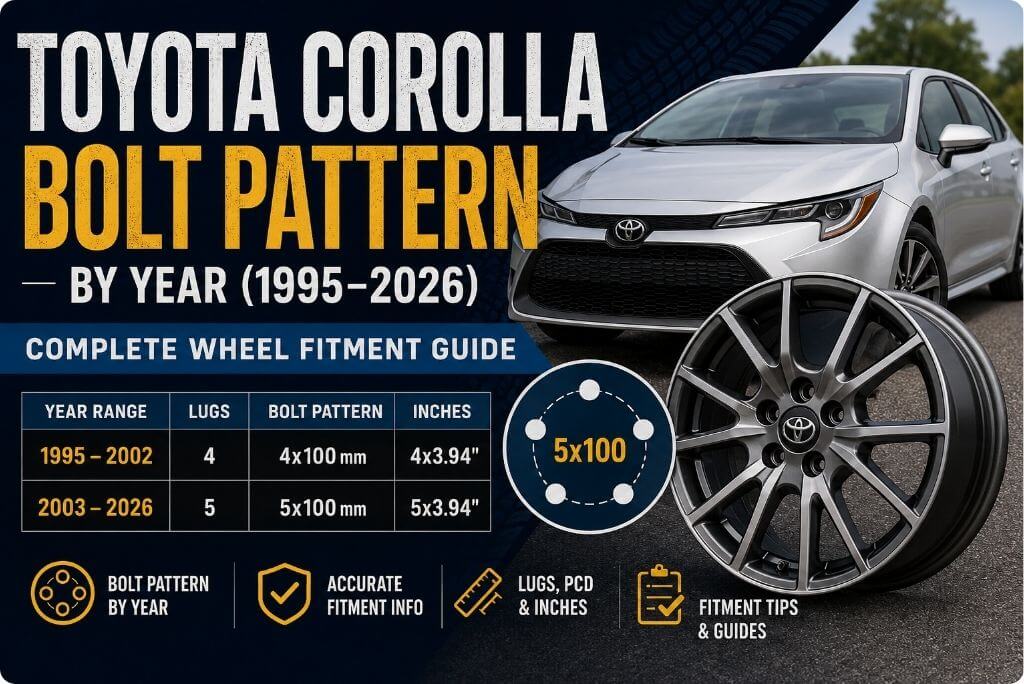
If you are looking for the Toyota Corolla bolt pattern, the correct answer depends on the model year and the specific Corolla variant. For most North American-market regular Corollas from 1995 through 2026, the main changes are from 4×100 on older models to 5×100 on newer generations.
However, the bolt pattern is only the starting point when choosing replacement or aftermarket wheels. Center bore, offset, wheel width, brake clearance, and lug nut compatibility also matter.
Use the chart below to find your Corolla’s bolt pattern, then read the fitment information to make sure a replacement wheel will actually fit safely.
What Does a Toyota Corolla Bolt Pattern Mean?
A bolt pattern is usually written in a format such as 5×100.
The first number tells you the number of lug holes. The second number tells you the diameter of the imaginary circle that passes through the center of those lug holes.
So:
5×100 means five lug holes arranged on a 100 mm bolt circle.
Likewise:
4×100 means four lug holes arranged on a 100 mm bolt circle.
The bolt pattern may also be called the:
- Lug pattern
- PCD
- Pitch Circle Diameter
These terms refer to the same basic wheel-mounting measurement.
One common mistake is thinking that the “100” in 5×100 refers to the diameter of the wheel’s center hole. It does not. The center hole is called the center bore, and it is a separate measurement.
That distinction matters when shopping for aftermarket wheels. A wheel can have the correct 5×100 bolt pattern but still have the wrong center bore or offset.
Toyota Corolla Bolt Pattern Chart by Year
The following chart covers regular North American-market Toyota Corolla models. Special models, such as the GR Corolla, and some international-market Corollas can use different wheel specifications.
| Model Year | Corolla Generation | Lugs | Bolt Pattern | Bolt Pattern (inches) |
| 2026 | 12th Gen (E210) | 5 | 5×100 mm | 5×3.94″ |
| 2025 | 12th Gen (E210) | 5 | 5×100 mm | 5×3.94″ |
| 2024 | 12th Gen (E210) | 5 | 5×100 mm | 5×3.94″ |
| 2023 | 12th Gen (E210) | 5 | 5×100 mm | 5×3.94″ |
| 2022 | 12th Gen (E210) | 5 | 5×100 mm | 5×3.94″ |
| 2021 | 12th Gen (E210) | 5 | 5×100 mm | 5×3.94″ |
| 2020 | 12th Gen (E210) | 5 | 5×100 mm | 5×3.94″ |
| 2019 | 11th Gen (E170) | 5 | 5×100 mm | 5×3.94″ |
| 2018 | 11th Gen (E170) | 5 | 5×100 mm | 5×3.94″ |
| 2017 | 11th Gen (E170) | 5 | 5×100 mm | 5×3.94″ |
| 2016 | 11th Gen (E170) | 5 | 5×100 mm | 5×3.94″ |
| 2015 | 11th Gen (E170) | 5 | 5×100 mm | 5×3.94″ |
| 2014 | 11th Gen (E170) | 5 | 5×100 mm | 5×3.94″ |
| 2013 | 10th Gen (E140) | 5 | 5×100 mm | 5×3.94″ |
| 2012 | 10th Gen (E140) | 5 | 5×100 mm | 5×3.94″ |
| 2011 | 10th Gen (E140) | 5 | 5×100 mm | 5×3.94″ |
| 2010 | 10th Gen (E140) | 5 | 5×100 mm | 5×3.94″ |
| 2009 | 10th Gen (E140) | 5 | 5×100 mm | 5×3.94″ |
| 2008 | 9th Gen (E120/E130) | 5 | 5×100 mm | 5×3.94″ |
| 2007 | 9th Gen (E120/E130) | 5 | 5×100 mm | 5×3.94″ |
| 2006 | 9th Gen (E120/E130) | 5 | 5×100 mm | 5×3.94″ |
| 2005 | 9th Gen (E120/E130) | 5 | 5×100 mm | 5×3.94″ |
| 2004 | 9th Gen (E120/E130) | 5 | 5×100 mm | 5×3.94″ |
| 2003 | 9th Gen (E120/E130) | 5 | 5×100 mm | 5×3.94″ |
| 2002 | 8th Gen (E110) | 4 | 4×100 mm | 4×3.94″ |
| 2001 | 8th Gen (E110) | 4 | 4×100 mm | 4×3.94″ |
| 2000 | 8th Gen (E110) | 4 | 4×100 mm | 4×3.94″ |
| 1999 | 8th Gen (E110) | 4 | 4×100 mm | 4×3.94″ |
| 1998 | 8th Gen (E110) | 4 | 4×100 mm | 4×3.94″ |
| 1997 | 7th Gen (E100) | 4 | 4×100 mm | 4×3.94″ |
| 1996 | 7th Gen (E100) | 4 | 4×100 mm | 4×3.94″ |
| 1995 | 7th Gen (E100) | 4 | 4×100 mm | 4×3.94″ |
Important Fitment Note
The chart above is designed as a practical reference for North American-market regular Corolla models. Corolla specifications can vary by market, body style, and special model. For example, international-market Corolla fitment data can show different patterns from the North American sedan, and the GR Corolla uses different performance-oriented wheel specifications. Always verify the exact vehicle before buying wheels, especially if it is imported or modified.
Related Topic: Best Tires for Toyota Corolla
Toyota Corolla Bolt Pattern Changes by Generation
The Corolla has not used one universal bolt pattern throughout its history. The most useful way to understand the changes is to look at the major generations.
1995–2002: 4×100
Older Corolla models from this period use a 4×100 bolt pattern. The first number means the wheel has four lug holes, while the second number represents a 100 mm bolt circle.
This means a wheel designed for a 4×100 Corolla has four mounting holes arranged around a 100 mm circle.
These wheels are not direct-fit replacements for a five-lug Corolla. Even if the wheel diameter and tire size appear similar, the wheel cannot properly mount to a five-lug hub.
2003–2008: 5×100
The Corolla moved to a 5×100 bolt pattern for this generation in the North American-market fitment covered by this guide.
This is an important change because the wheel now has five lug holes instead of four. A 5×100 wheel cannot be directly installed on an older 4×100 Corolla, and a 4×100 wheel cannot be directly installed on a 5×100 Corolla.
The key lesson is simple: wheel diameter is not the same thing as wheel fitment. A 15-inch wheel, for example, can be available in several different bolt patterns.
2009–2013: 5×100 for North American-Market Regular Corollas
For the North American-market regular Corolla, this period continues with a 5×100 bolt pattern. Fitment databases list the U.S.-market 2009 and 2014 Corolla with a 5×100 PCD, while some international-market Corolla versions from similar years use different specifications.
This is one of the reasons year-only bolt-pattern charts can be misleading. A Corolla built for one market may not have the same wheel fitment as a Corolla with the same model year sold elsewhere.
If you are buying used wheels for a 2009–2013 Corolla, confirm the exact vehicle and market the wheels came from rather than relying only on the seller’s description.
2014–2026: 5×100
The regular North American-market Corolla continues with a 5×100 bolt pattern through the modern Corolla generations covered by this chart. The 2014 U.S.-market Corolla and 2020 U.S.-market Corolla are both listed with 5×100 PCD, 54.1 mm center bore, and M12x1.5 thread specifications in fitment references.
That does not mean every 2014–2026 Corolla wheel is automatically interchangeable. The wheel’s diameter, width, offset, center bore, and brake clearance still need to be checked.
4×100 vs. 5×100 vs. 5×114.3: What’s the Difference?
Here is the basic comparison:
| Bolt Pattern | Number of Lugs | Approximate Inch Equivalent |
| 4×100 mm | 4 | 4×3.94″ |
| 5×100 mm | 5 | 5×3.94″ |
| 5×114.3 mm | 5 | 5×4.50″ |
The most important point is that these patterns are not interchangeable.
A 4×100 wheel has four lug holes. A 5×100 wheel has five. They cannot be directly swapped.
The difference between 5×100 and 5×114.3 is less obvious because both have five lug holes. However, the lug holes are arranged on different bolt circles.
That means a 5×100 wheel does not directly fit a 5×114.3 hub, and a 5×114.3 wheel does not directly fit a 5×100 hub.
This is why simply counting the lugs is not enough when buying wheels.
Bolt Pattern Is Only One Part of Toyota Corolla Wheel Fitment
Finding the correct bolt pattern is an important first step, but it is not a complete fitment check.
A wheel must also work with the vehicle’s hub, suspension, brakes, and tire requirements.
Center Bore
The center bore is the hole in the middle of the wheel that fits over the vehicle’s hub.
For example, fitment references list a 54.1 mm center bore for several North American-market Corolla applications, including the 2014 and 2020 models.
A wheel with a center bore that is too small will not fit over the hub.
A wheel with a larger center bore may physically fit over the hub, but it may need the correct hub-centric ring to properly center the wheel, depending on the wheel and application.
The important rule is:
The center bore must be compatible with the vehicle hub.
Wheel Offset
Offset describes where the wheel’s mounting surface sits in relation to the centerline of the wheel.
A higher positive offset generally moves the wheel farther inward. A lower offset moves it farther outward.
The wrong offset can create problems such as:
- Contact with suspension components
- Fender rubbing
- Excessive wheel poke
- Changes in steering feel
For example, two wheels can both be 17 inches wide and both use a 5×100 bolt pattern, but a large difference in offset can place one wheel much farther inside or outside the fender.
That is why “the bolt pattern matches” should never be the only reason you buy a wheel.
Wheel Width and Diameter
Wheel width and diameter also affect fitment.
A wider wheel can reduce clearance between the inner side of the wheel and the suspension. It can also move the outer edge closer to the fender.
A larger-diameter wheel may provide more space for brake components, but it usually requires a lower-profile tire to maintain a similar overall tire diameter.
Changing wheel size can also affect:
- Ride comfort
- Road noise
- Steering response
- Pothole protection
- Tire availability
There is no universal “best” wheel size for every Corolla owner. The right choice depends on whether you prioritize comfort, appearance, handling, or cost.
Lug Nut Compatibility
The wheel must also be compatible with the lug nuts used to secure it.
Important details include:
- Thread size
- Thread pitch
- Lug seat shape
A factory lug nut may not be suitable for every aftermarket wheel. The lug nut must properly match the wheel’s seat design.
This is an easy detail to overlook, especially when buying used wheels without the original hardware.
How to Check If a Wheel Fits Your Toyota Corolla
Before buying a replacement or aftermarket wheel, use a complete fitment check rather than matching only the bolt pattern.
Step 1: Identify the Exact Vehicle
Start with the:
- Model year
- Trim
- Body style
- Market of origin
This matters because the same Corolla name can cover different specifications in different countries.
Step 2: Confirm the Bolt Pattern
Match the wheel’s bolt pattern exactly.
For example, a wheel listed as 5×100 should be matched to a Corolla hub that uses 5×100.
Do not assume that a five-lug wheel will fit simply because your Corolla also has five lugs.
Step 3: Check the Remaining Fitment Specifications
After confirming the bolt pattern, check:
- Center bore
- Wheel offset
- Wheel width
- Wheel diameter
- Brake clearance
- Lug nut compatibility
These measurements determine whether the wheel actually fits within the available space.
Step 4: Confirm the Tire Size
If you are changing the wheel diameter, make sure the replacement tire is appropriate for the new wheel.
The replacement tire should also have the correct:
- Load capacity
- Speed rating
- Overall diameter for the application
A larger wheel with a much shorter sidewall can also make the ride harsher and leave the wheel more vulnerable to pothole damage.
Step 5: Verify Before Installation
When buying expensive wheels, verify the specifications before mounting the tires.
Useful sources include:
- The vehicle owner’s manual
- Factory wheel information
- Markings stamped or cast into the wheel
- Reputable fitment databases
- The wheel manufacturer’s specifications
If you are buying used wheels, ask the seller for the exact wheel size and offset rather than accepting only “they came off a Toyota Corolla.”
Common Toyota Corolla Wheel Fitment Mistakes
Mistake 1: Matching Only the Number of Lugs
A five-lug wheel is not automatically compatible with every five-lug Corolla.
The bolt circle measurement must also match.
Mistake 2: Confusing 5×100 With 5×114.3
These are different bolt patterns.
Even though both have five lug holes, the lug-hole spacing is different.
Mistake 3: Ignoring Offset
A wheel can bolt onto the hub and still rub against the suspension or fender if the offset is unsuitable.
Mistake 4: Forgetting Center Bore
A wheel with the wrong center bore may not fit over the hub or may require the correct hub-centric solution.
Mistake 5: Assuming Every Corolla Has the Same Fitment
Corolla specifications can vary by generation, market, body style, and special model.
The GR Corolla, for example, should be treated as a separate fitment application rather than assumed to use the same wheel specifications as a regular Corolla.
Mistake 6: Reusing the Wrong Lug Nuts
The thread and seat type must be compatible with both the vehicle studs and the wheel.
Toyota Corolla Bolt Pattern Exceptions
The standard chart is useful for regular Corolla models, but a few situations deserve special attention.
GR Corolla
The GR Corolla is a high-performance model and should not be treated as a regular Corolla for wheel fitment.
It uses different performance-oriented wheel specifications, including a different bolt pattern from the regular Corolla. Wheels for the standard 5×100 Corolla should not be assumed to fit a GR Corolla.
Brake clearance is also especially important on performance models.
Corolla iM and Other Special Models
If you own a Corolla iM, a special-edition model, or another Corolla variant that is not the standard sedan, verify the exact fitment for that vehicle.
The model name alone is not always enough to identify the correct wheel specifications.
Imported or International-Market Corollas
This is one of the most important exceptions.
Corolla models sold in other countries can use different wheel specifications from North American-market models with similar model years.
For example, international-market fitment references show different Corolla generations and markets using both 5×100 and 5×114.3 patterns.
If your Corolla was imported, check the vehicle’s exact specifications before ordering wheels.
Toyota Corolla Bolt Pattern FAQs
Is the Toyota Corolla 5×100 or 5×114.3?
It depends on the exact Corolla.
For the regular North American-market models covered here, 5×100 is the primary fitment for newer Corollas. Some international-market Corolla versions and special performance models can use different specifications, including 5×114.3.
What is the bolt pattern on a 2026 Toyota Corolla?
The regular North American-market 2026 Toyota Corolla uses a 5×100 bolt pattern according to the fitment pattern carried forward for the E210 Corolla application. Always verify the exact trim and vehicle market before purchasing wheels.
What is the bolt pattern on a 2010 Toyota Corolla?
The North American-market regular 2010 Toyota Corolla uses a 5×100 bolt pattern. International-market Corolla versions from a similar model year can have different specifications, so imported vehicles should be checked separately.
Are 5×100 and 5×114.3 wheels interchangeable?
No. They are different bolt patterns and are not direct-fit replacements for one another.
Both patterns use five lug holes, but the diameter of the bolt circle is different.
Final Toyota Corolla Wheel Fitment Checklist
Before buying replacement or aftermarket wheels, confirm all of the following:
- Correct Corolla model year
- Correct trim and body style
- Correct market of origin
- Correct bolt pattern
- Compatible center bore
- Suitable offset
- Appropriate wheel width
- Appropriate wheel diameter
- Adequate brake clearance
- Correct lug nut thread and seat type
- Correct tire size and load rating
The most important thing to remember is that the Toyota Corolla bolt pattern is only the first step in choosing a wheel.
Start by finding the correct PCD for your exact Corolla. Then check the rest of the wheel specifications before buying. That extra few minutes of research can help you avoid expensive fitment problems, rubbing, incompatible hardware, or a set of wheels that simply cannot be installed safely.
