
Toyota Corolla Tire Size with Chart – Find the Right Fit Fast
Last updated on January 13th, 2026
Choosing the right Toyota Corolla tire size is essential for safety, performance, and comfort. Whether you’re replacing worn tires, upgrading to a different style, or just checking your car’s specifications, knowing the correct tire size for your Corolla can save you time, money, and potential headaches.
In this guide, we’ll break down Toyota Corolla tire sizes by year, trim, and generation, explain how to read tire markings, and share expert tips for selecting the best tires for your driving needs. By the end, you’ll have all the information you need to confidently choose the right tires for your Corolla.
Why Tire Size Matters for Your Toyota Corolla
Tires are the only point of contact between your car and the road. Using the wrong size can lead to:
- Reduced fuel efficiency
- Poor handling or ride comfort
- Inaccurate speedometer readings
- Uneven tire wear
- Potential safety issues
Toyota designs each Corolla trim with specific tire dimensions to balance comfort, efficiency, and performance. Sticking close to OEM (Original Equipment Manufacturer) specifications ensures your car performs as intended.
How to read a Toyota Corolla tire size
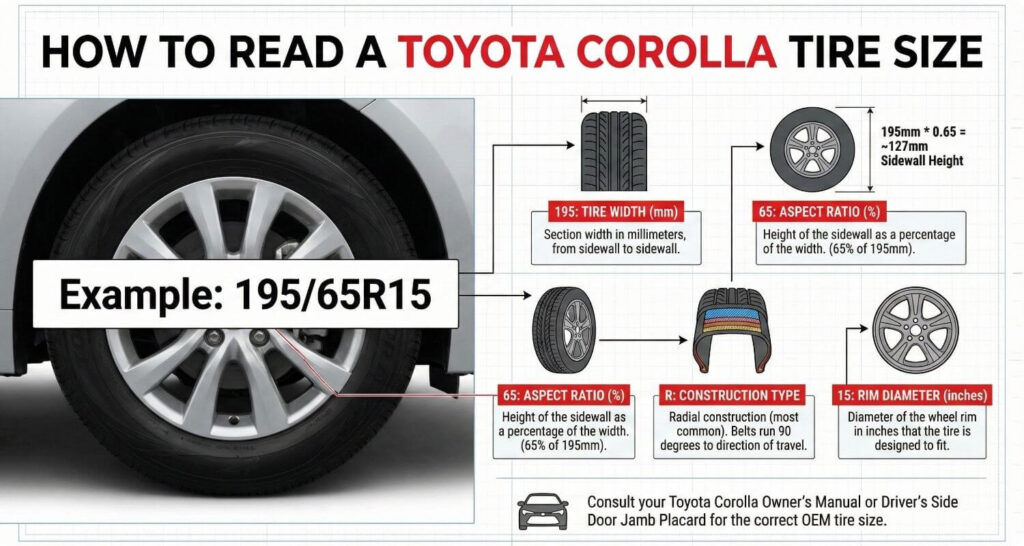
Here’s a simple, step-by-step way to understand a tire size. Use the example 195/65R15 — it’s written the same way on the side of a tire.
195 / 65 / R / 15
- 195 — Tire width (mm)
This number is how wide the tire is from sidewall to sidewall, measured in millimetres. A bigger number = a wider tire. Wider tires can give more grip, but they may use a little more fuel. - 65 — Aspect ratio (percent)
This is the height of the tire’s sidewall shown as a percent of the width. If the number is 65, the sidewall height is 65% of 195 mm. A smaller percent (like 40 or 45) means a shorter sidewall and a firmer ride; a larger percent (like 65 or 70) gives a softer, more comfortable ride. - R — Construction type (Radial)
The letter tells you how the tire is built. Almost all modern car tires are “R” for radial. You don’t need to worry about this for a Corolla — just know “R” is the normal one. - 15 — Wheel diameter (inches)
This is the size of the wheel (rim) the tire fits, measured in inches. A tire marked 15 fits a 15-inch wheel. Make sure the tire’s wheel diameter matches your car’s wheel.
Load index and speed rating — what they mean (in plain language)
On the sidewall you’ll often see two more items, like 91V or 94T. Those are the load index (numbers) and speed rating (letter).
- Load index (the number)
This shows how much weight each tire can carry. Higher numbers mean the tire can carry more weight. When you buy tires, pick a load index that is the same or higher than what Toyota recommends for your Corolla. - Speed rating (the letter)
This indicates the highest safe speed the tire can handle under ideal conditions. Common letters you’ll see on everyday cars are things like T, H, V. You don’t need a very high speed rating unless you drive fast regularly — but again, choose the same or higher rating than what Toyota specifies.
Why these numbers matter for your Corolla
- Safety: The correct size and load rating keep the car stable and able to carry weight safely.
- Speedometer accuracy: If the overall tire diameter changes a lot, your speedometer and odometer can show wrong numbers.
- Fuel and ride comfort: Wider or lower-profile tires change fuel use and how smooth the ride feels.
- Fit and clearance: The right wheel diameter and tire size make sure the tire clears the wheel well and suspension parts.
Quick practical tips
- Check your car first: Look at the sticker on the driver’s door jamb or in the owner’s manual for the official tire size and ratings.
- Match or exceed: When buying, match the tire size and choose equal-or-higher load index and speed rating than the sticker shows.
- If you change size, keep diameter close: If you want a different look, keep the overall tire diameter within about ±3% of the original so things like speedometer and clearance stay safe.
- Ask a pro if unsure: Your local tire shop or dealer can confirm fitment and safety.
Toyota Corolla Tire Size Chart (OEM Specifications)
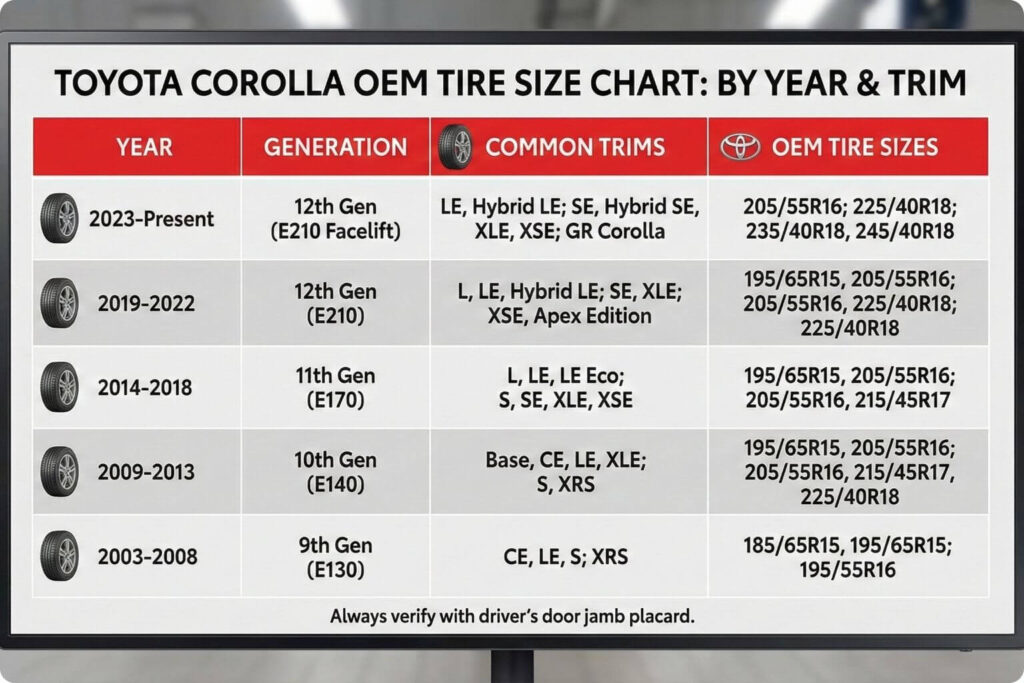
2020–2024 Toyota Corolla (12th Generation – E210)
| Year | Trim Level | Front Tire Size | Rear Tire Size | Wheel Size |
| 2020–2024 | L / LE / Hybrid LE | 195/65R15 | 195/65R15 | 15″ |
| 2020–2024 | SE | 205/55R16 | 205/55R16 | 16″ |
| 2020–2024 | SE Nightshade | 205/55R16 | 205/55R16 | 16″ |
| 2020–2024 | XLE / Hybrid XLE | 215/45R17 | 215/45R17 | 17″ |
| 2020–2024 | XSE | 225/40R18 | 225/40R18 | 18″ |
2014–2019 Toyota Corolla (11th Generation – E170/E180)
| Year | Trim Level | Front Tire Size | Rear Tire Size | Wheel Size |
| 2014–2019 | L / LE / Eco | 195/65R15 | 195/65R15 | 15″ |
| 2014–2019 | LE Plus | 205/55R16 | 205/55R16 | 16″ |
| 2014–2019 | SE | 215/45R17 | 215/45R17 | 17″ |
| 2014–2019 | XSE | 215/45R17 | 215/45R17 | 17″ |
2009–2013 Toyota Corolla (10th Generation – E140/E150)
| Year | Trim Level | Front Tire Size | Rear Tire Size | Wheel Size |
| 2009–2013 | Base / LE | 195/65R15 | 195/65R15 | 15″ |
| 2009–2013 | S | 205/55R16 | 205/55R16 | 16″ |
| 2009–2013 | XRS | 215/45R17 | 215/45R17 | 17″ |
2003–2008 Toyota Corolla (9th Generation – E120/E130)
| Year | Trim Level | Front Tire Size | Rear Tire Size | Wheel Size |
| 2003–2008 | CE / LE | 185/65R15 | 185/65R15 | 15″ |
| 2003–2008 | S | 195/60R15 | 195/60R15 | 15″ |
| 2003–2008 | XRS | 205/55R16 | 205/55R16 | 16″ |
1998–2002 Toyota Corolla (8th Generation – E110)
| Year | Trim Level | Front Tire Size | Rear Tire Size | Wheel Size |
| 1998–2002 | Base / CE / LE | 175/65R14 | 175/65R14 | 14″ |
| 1998–2002 | VE | 185/65R14 | 185/65R14 | 14″ |
Quick Reference: Most Common Toyota Corolla Tire Sizes
| Tire Size | Common Usage |
| 175/65R14 | Older base models |
| 185/65R15 | Early 2000s models |
| 195/65R15 | LE & base trims (most common) |
| 205/55R16 | Sport trims |
| 215/45R17 | SE/XSE trims |
| 225/40R18 | Performance-oriented trims |
Tire size differences by Corolla trim level
Here’s a clear, easy-to-understand section you can drop into your blog. It explains how different Corolla trims affect tire size, why sporty models use different tires, the trade-offs between handling and comfort, and common mistakes to avoid.
How trim affects tire size
Toyota offers several Corolla trims (like LE, SE, XSE). Each trim can come with different wheels and tire sizes from the factory. That means two Corollas from the same year can have different tires depending on the trim level.
Always check the sticker on the driver’s door or the owner’s manual for the exact sizes for your car.
LE vs SE vs XSE — what’s the difference?
- LE (economy / comfort trim): These usually come with smaller wheels and taller sidewalls. That makes the ride softer and more comfortable for daily driving.
- SE (sport trim): SE often has wider tires and a lower sidewall than LE. That gives better cornering and a firmer feel.
- XSE (sportier / premium sport trim): XSE commonly comes with the largest wheels and lowest-profile tires of the group. These tires are tuned for sharper handling and a sportier look.
In short: LE = comfort, SE/XSE = sportier handling and looks.
Hybrid vs gas models
Hybrid Corollas often use tires chosen to save fuel. That usually means narrower tires and higher sidewalls that reduce rolling resistance.
Gas (non-hybrid) sport trims are more likely to have wider, low-profile tires for better grip. If your car is a hybrid, expect OEM tire sizes that favor efficiency over sporty handling.
Why sport trims use wider, lower-profile tires
Sport trims use wider tires with shorter sidewalls because:
- Wider tires give more contact with the road, which improves grip when turning.
- Lower-profile tires (shorter sidewalls) flex less in corners, so the car feels more responsive.
That improves handling, but it also makes the ride firmer and can transmit more road bumps into the cabin.
Handling vs comfort — what you’re trading off
- Better handling (sport tires): sharper steering, better cornering, more road feel. Downside: firmer ride and sometimes louder road noise.
- Better comfort (taller sidewalls): softer ride, smoother over bumps, quieter. Downside: less precise handling and slightly less grip in aggressive cornering.
Decide what matters more to you: a smoother daily ride or sharper handling.
Common misunderstandings about trim compatibility
- “All Corollas use the same tire size.” Not true — trim and year matter.
- “I can put any larger wheel on mine.” Not always. Bigger wheels can rub on the wheel well, affect speedometer accuracy, and change ride quality.
- “Sport tires are always better.” They may be better for cornering but worse for comfort and fuel economy.
- “If a tire fits the rim, it fits the car.” Fit on the rim is only one part — you also need to check clearance, speed/load ratings, and overall diameter.
Toyota Corolla Tire Sizes by Generation
Toyota has been making the Corolla for decades. Over time, the car has changed—its shape, features, and even the size of its wheels and tires. Understanding these changes helps explain why a 2005 Corolla doesn’t use the same tires as a brand-new one.
Let’s walk through the Corolla’s generations in a simple, story-style way.
The Early 2000s: Simple, Comfortable, and Practical (E120)
In the early 2000s, Corolla models focused on comfort and reliability. Most of these cars came with smaller wheels and taller tires.
- Typical wheel sizes: 14 or 15 inches
- Tires had taller sidewalls
- Ride felt soft and forgiving over bumps
At the time, drivers cared more about smooth rides and long tire life than sporty handling. These tire sizes were perfect for everyday commuting.
Late 2000s to Mid-2010s: A Balance Between Comfort and Style (E140 & E150)
As years passed, drivers started expecting more from their cars. Corollas became slightly larger, and so did their wheels.
- Typical wheel sizes: 15 to 16 inches
- Tires became a little wider
- Handling improved, while comfort stayed reasonable
Toyota was aiming for balance here—still easy to drive, but with a bit more confidence on the road.
Late 2010s: Sportier Looks and Better Road Feel (E170)
By this point, the Corolla began to look and feel more modern. Sport trims became more popular, and that influenced tire sizes.
- Wheel sizes ranged from 15 to 17 inches
- Sport trims used wider tires
- Sidewalls became shorter on SE and XSE models
Drivers noticed sharper steering and better cornering, but also a firmer ride on rough roads.
Today’s Corolla: Modern, Confident, and Tech-Focused (E210)
The latest Corolla generation reflects modern driving expectations. These cars are designed to feel stable, responsive, and stylish.
- Wheel sizes now reach 18 inches on sport trims
- Tires are wider with lower sidewalls
- Ride is more connected to the road
This setup gives the car a sportier look and better handling, especially at highway speeds.
Why Newer Corollas Use Larger Wheels and Lower-Profile Tires
Over time, a few things changed:
- Roads improved
- Drivers expected better handling
- Safety and suspension systems advanced
- Styling trends favored bigger wheels
Larger wheels allow for better braking and handling, while lower-profile tires help the car feel more stable during turns. The trade-off is a slightly firmer ride compared to older models.
Can Tire Sizes Be Shared Between Generations?
This is where many owners get confused.
Even if two Corollas look similar, their tire sizes may not be interchangeable. Differences in:
- Suspension design
- Wheel clearance
- Speedometer calibration
mean that a tire from an older generation may not be a good fit for a newer one.
Simple rule: Always choose tires based on your exact year and trim, not just the generation name.
Optional & Alternate Tire Sizes: What’s Safe and What’s Not
Sometimes, people want to change their Corolla’s tire size—maybe to make the car look sportier or improve handling. But it’s important to know what’s safe and what could cause problems.
Can You Use a Different Tire Size Than OEM?
Yes, you can use a slightly different tire size, but only within safe limits. The tires should still fit the wheels, clear the wheel wells, and match the car’s load and speed requirements.
Acceptable “Plus” and “Minus” Sizing
- Plus-sizing: Using a wider tire or a slightly larger wheel than the factory size. This can improve handling, but the overall diameter of the tire should stay close to the original.
- Minus-sizing: Using a narrower tire or smaller wheel. This can make the ride softer and improve fuel efficiency, but handling may feel less precise.
Rule of thumb: Keep the overall tire diameter within about ±3% of the original size. Bigger differences can cause problems.
How Changing Tire Size Affects Your Car
- Speedometer accuracy: Bigger or smaller tires can make your speedometer read too fast or too slow.
- Fuel economy: Wider or heavier tires can reduce gas mileage slightly.
- Ride quality: Low-profile tires (short sidewalls) feel firmer and can make bumps more noticeable. Taller tires give a softer ride.
- Suspension components: Tires that are too big or too heavy can strain your car’s suspension over time.
When Upsizing Tires Is Not Recommended
- If the tires rub against the wheel well or suspension parts.
- If the new tire makes your speedometer inaccurate by more than a few percent.
- If it exceeds the load rating or speed rating recommended for your Corolla.
- If you want a radical change in appearance or performance without consulting a professional.
Best Toyota Corolla Tire Size Based on Your Driving Needs
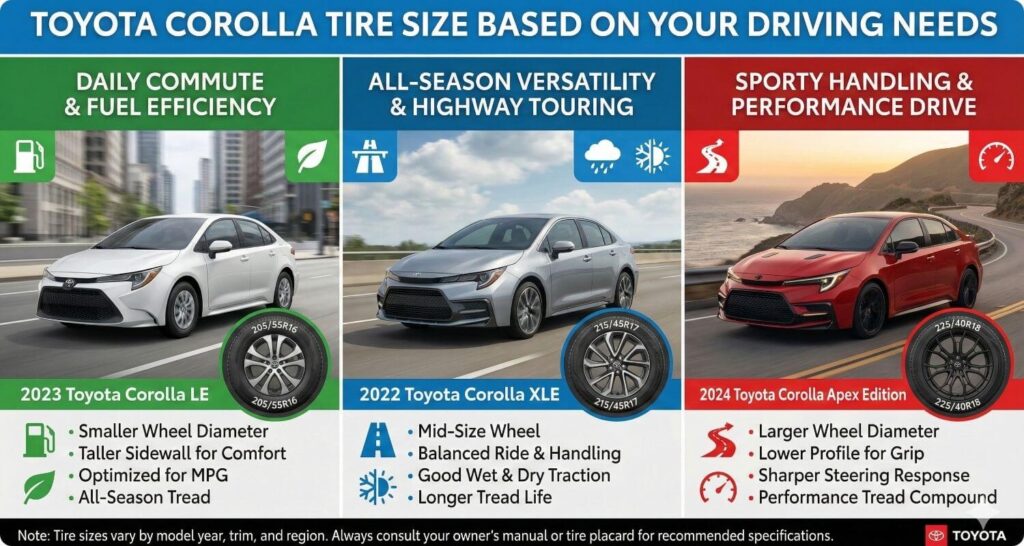
Choosing the right tire for your Corolla isn’t just about matching numbers on a sticker—it’s about how you drive and what you want from your car. Let’s explore different driving needs and what tire sizes work best for each.
1. Daily Commuting
If you drive to work, run errands, or take your Corolla on city streets most of the time, comfort and reliability are key.
- Stick with the factory-recommended tire size for your trim.
- Typically, this is 195/65R15 for LE models or 205/55R16 for SE trims.
- Why it works: OEM tires balance comfort, durability, and fuel efficiency. You’ll get a smooth ride without surprises.
2. Fuel Efficiency
If saving gas is your top priority, narrower tires with taller sidewalls are a good choice.
- Narrower tires roll easier, so your engine doesn’t work as hard.
- Taller sidewalls make the ride softer and help with fuel savings.
- Best fit: Usually the OEM tires on LE or hybrid models. Avoid upsizing unless necessary.
3. Comfort-Focused Driving
Some people just want a soft, smooth ride, especially on bumpy roads.
- Choose tires with taller sidewalls (higher aspect ratio).
- Smaller wheels with taller tires absorb bumps better.
- Good example: LE trims with 195/65R15 tires feel cushioned and quiet.
4. Sporty Handling
If you love a car that feels sharp around corners, handling is the focus.
- Wider, lower-profile tires give more grip and sharper steering.
- Shorter sidewalls flex less, so the car responds faster when you turn.
- Typical choice: SE or XSE trims with 205/55R16 or 225/40R18.
- Trade-off: The ride is firmer and bumps feel stronger.
5. Winter Driving
Winter driving needs traction and safety, not style.
- Slightly narrower tires can cut through snow better.
- Keep the same overall diameter as OEM tires to avoid clearance or speedometer issues.
- Use dedicated winter tires on steel or OEM wheels if possible.
6. All-Season vs Winter Tire Considerations
- All-season tires: Good year-round, balance between grip, comfort, and durability.
- Winter tires: Best in snow and ice, even if you drive the same wheel size as all-season tires.
- Rule: Don’t mix all-season and winter tires on the same axle. Always use a full set if switching for winter.
Read More: Best Tires for Toyota Camry
Where to Find Your Toyota Corolla’s Tire Size
Before buying new tires, you need to know the exact size for your specific Corolla. Even the same model year can have different tires depending on the trim, so checking your car directly is the safest way.
1. Check the Driver-Side Door Jamb Sticker
- Open the driver’s side door and look at the door frame (the part the door closes against).
- You’ll find a sticker with information like tire size, recommended tire pressure, and load ratings.
- This is the most reliable source for your car’s OEM (original) tire size.
2. Look in the Owner’s Manual
- Your Corolla’s owner’s manual lists the factory tire size for each trim and model year.
- It also tells you the correct tire pressure and the load/speed ratings.
3. Check the Sidewall of Your Current Tires
- Tires have their size printed on the sidewall, for example: 195/65R15 91H.
- This is useful if you want to match your current tires or confirm what’s already on your car.
Why Checking Your Specific Vehicle Matters
- Different trims (LE, SE, XSE, Hybrid) may have different tires.
- Some cars have optional packages with larger wheels.
- Buying the wrong size can cause safety issues, ride problems, or speedometer errors.
What to Do If the Sticker Is Missing
- Check the owner’s manual first.
- Look at the existing tires’ sidewalls.
- If you’re still unsure, ask a Toyota dealership or trusted tire shop.
- Never guess or buy tires based only on the model year—they may not fit your exact car.
Quick Tip: Always write down the exact tire size, load index, and speed rating before shopping. It makes buying the right tires faster, safer, and easier.
Read More: Best Tires for Toyota 4Runner
Common Mistakes Corolla Owners Make When Choosing Tire Sizes
Buying new tires for your Corolla might seem simple, but many drivers make avoidable mistakes. Let’s look at some real-world examples so you don’t fall into the same traps.
1. Assuming All Corollas Use the Same Tire Size
Sarah bought a tire online thinking all 2018 Corollas use the same tires. When she got home, she realized her SE trim actually needed wider tires than the standard LE model. Lesson: trim and model matter—never assume one size fits all Corollas.
2. Ignoring Trim Level Differences
Jake wanted a sportier look and chose tires for the SE trim, but his Corolla was an LE. The tires were slightly too wide and rubbed the wheel well. Always check your trim level, because LE, SE, XSE, and Hybrid trims can have different OEM sizes.
3. Buying Tires Based on Price Alone
Maria found a cheap set of tires online and didn’t check the ratings. They were the right size but had a lower load and speed rating than recommended. Her car handled differently, and she had to replace them sooner than expected. Price matters, but safety comes first.
4. Forgetting Load Index and Speed Rating
Tom swapped tires with a friend without checking the load index. His Corolla was slightly heavier than the replacement tires could handle. This mistake can lead to uneven wear or even unsafe driving conditions. Always match or exceed the factory load index and speed rating.
5. Mixing Tire Sizes Incorrectly
Emily replaced only the front tires with a larger size and left the rear tires as they were. Her Corolla felt unstable on turns, especially in the rain. All four tires should match the recommended size, or at least the front and rear pairs should match for AWD/2WD cars.
Expert Tips for Buying Replacement Tires
Buying new tires for your Toyota Corolla doesn’t have to be confusing. Here are some expert tips to help you make the right choice and keep your car safe.
1. When to Replace Tires Based on Tread Depth
- Tires wear down over time, and the tread helps your car grip the road.
- Check your tread depth regularly using a tread gauge or the penny test: insert a penny into the grooves; if you can see the top of Lincoln’s head, it’s time to replace the tire.
- Worn tires increase the risk of slipping in rain or snow, and they reduce braking performance.
2. Importance of Alignment and Rotation
- Alignment makes sure your tires sit at the correct angles. Misaligned tires wear unevenly and can make your car pull to one side.
- Rotation means moving your tires from front to back (or side to side) every 5,000–7,500 miles. This helps them wear evenly and last longer.
- Always consider alignment and rotation when installing new tires.
3. Matching Tires in Pairs vs All Four
- Ideally, replace all four tires at the same time for balanced handling and safety.
- If you only replace two, make sure the new tires go on the rear axle to reduce the risk of skidding.
- Mixing old and new tires can affect traction and braking, especially in wet conditions.
4. Why OEM Specs Should Be Your Starting Point
- The factory-recommended tire size, load index, and speed rating are designed for your Corolla’s safety, handling, and performance.
- Start with these specs when shopping for replacement tires. Only consider alternatives if a professional confirms they’re safe.
5. When to Consult a Professional
- Unsure about tire size, load, or speed ratings?
- Planning to upsize or downsize your tires?
- Dealing with unusual wear patterns or alignment issues?
Tip: A tire shop or Toyota dealership can check your car and recommend the best tires for your exact year, trim, and driving needs.
Frequently Asked Questions (FAQ)
1. What tire size fits a Toyota Corolla LE?
Most LE models use 195/65R15 tires. Always check your owner’s manual or the door jamb sticker to confirm the exact size for your year and trim.
2. Can I put bigger tires on my Corolla?
Yes, but only within safe limits. Bigger tires can affect speedometer accuracy, handling, and clearance. Keep the overall tire diameter within about ±3% of the original size and make sure the load index and speed rating meet or exceed the factory recommendation.
3. Do front and rear tires need to be the same size?
Yes. For safety and proper handling, your Corolla’s front and rear tires should match. If you replace only two tires, put the new ones on the rear axle to maintain stability, especially in wet conditions.
4. What tire size is best for winter?
Winter driving works best with tires that:
- Fit the same wheel diameter as OEM tires
- Are slightly narrower for better traction in snow
- Have the right load index and speed rating
Always use a full set of winter tires rather than mixing them with all-season tires.
5. How often should Corolla tires be replaced?
Most tires last 40,000–60,000 miles, depending on driving conditions. Replace them sooner if:
- The tread is worn down (check with a penny or tread gauge)
- You notice cracks, bulges, or uneven wear
- Handling or braking feels different
Final Thoughts: Choosing the Right Tire Size for Your Corolla
Choosing the right tires for your Toyota Corolla is about more than just fit—it affects safety, handling, and overall performance. Here are the key takeaways:
- Check your OEM specifications: Your Corolla’s recommended tire size, load index, and speed rating are designed for optimal safety and performance.
- Trim and year matter: Different trims (LE, SE, XSE, Hybrid) may require different tire sizes. Always verify your specific vehicle.
- Replace worn tires on time: Proper tread depth ensures good grip, shorter stopping distances, and safer driving.
- Avoid guessing or price-only decisions: Safety and correct fit are more important than saving a few dollars.
- Double-check before buying: Look at your door jamb sticker, owner’s manual, or tire sidewall to confirm the correct size.
By taking these steps, you’ll not only improve safety and handling but also help your tires last longer and maintain your Corolla’s performance. Choosing the right tire size is a small step that makes a big difference on the road.
