Toyota Tacoma Tire Pressure: Recommended PSI by Year, Trim & Tire Size
Finding the right Toyota Tacoma tire pressure sounds simple until you compare different model years. A Tacoma’s recommended PSI can change with the tire size, cab configuration, drivetrain, and factory equipment.
That matters because using a generic PSI from another Tacoma—or simply following the maximum PSI printed on the tire sidewall—can result in the wrong inflation pressure. The difference may affect ride comfort, handling, tire wear, and load-carrying performance.
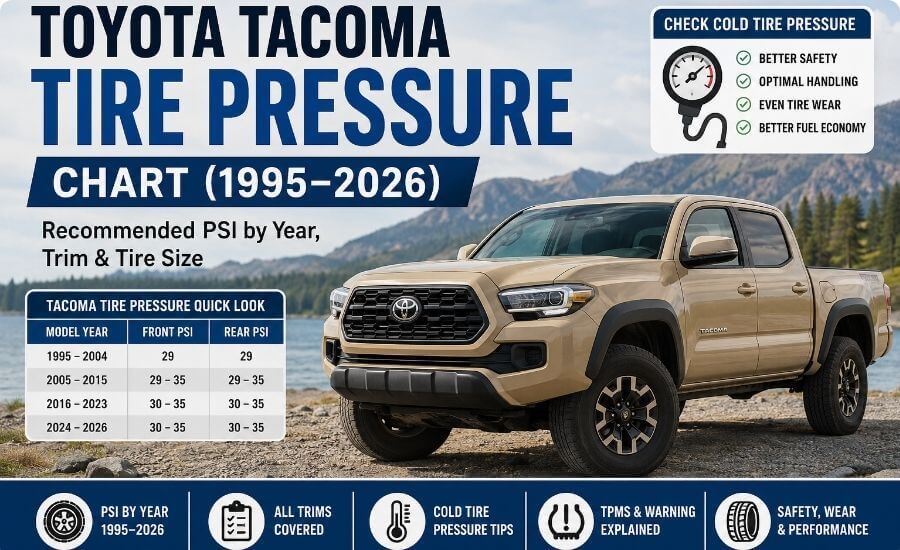
This guide covers Toyota Tacoma tire pressure from 1995 through 2026, using factory tire sizes and pressure specifications to show how the recommendations changed over the years.
The goal is simple: help you identify the pressure that matches your Tacoma instead of guessing from a generic number. For any individual truck, however, the driver-side door-jamb tire-information label remains the final reference, especially if the tires or wheels have been changed from the original factory setup.
Quick Answer: What Tire Pressure Does a Toyota Tacoma Need?
The correct Toyota Tacoma tire pressure depends on the model year, tire size, and factory configuration. There is no single PSI number that applies to every Tacoma from 1995 through 2026.
For example, many third-generation Tacomas use 29–32 PSI, while some 2024–2026 models use 30–35 PSI, depending on the factory tire size. Older Tacomas can have different front and rear pressures, so using a generic number can be misleading.
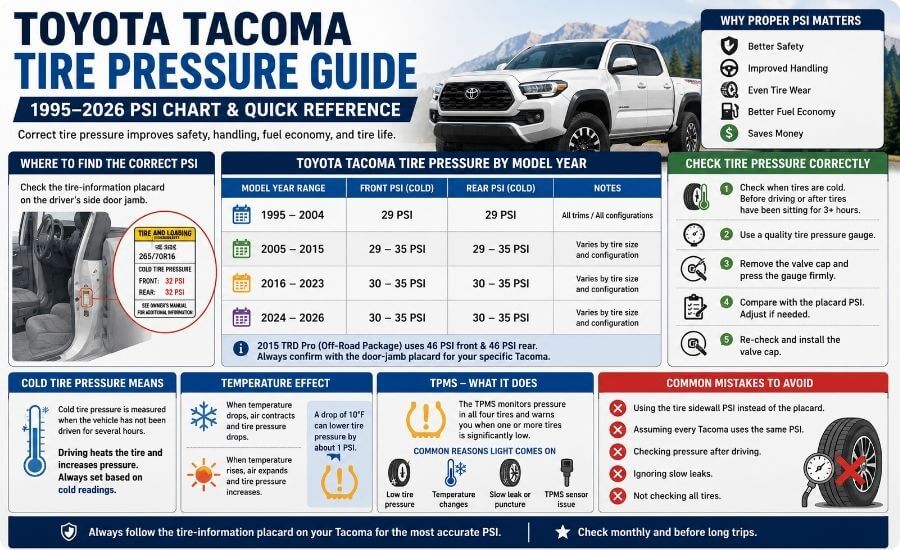
The most reliable starting point is the tire-information label on the driver’s-side door jamb. It shows the recommended cold tire pressure for that specific Tacoma and its original tire configuration.
If you are looking for the factory pressure for a particular model year, use the year-by-year chart below. It lists the trim/configuration, factory tire size, front PSI, and rear PSI so you can find the appropriate pressure without relying on a one-size-fits-all recommendation.
Always check tire pressure when the tires are cold, preferably before driving or after the truck has been parked for several hours. The PSI printed on the tire sidewall is the tire’s maximum pressure information, not necessarily the recommended pressure for your Tacoma.
Final Toyota Tacoma Tire Pressure Chart: 1995–2026
Important: These are recommended cold tire inflation pressures for the listed factory tire configurations. For an individual truck, the driver’s-side door-jamb tire-information label should be treated as the final vehicle-specific reference.
1995 Toyota Tacoma Tire Pressure
| Trim / Configuration | Tire Size | Front PSI | Rear PSI |
| Base / DLX | P195/75R14 | 29 | 35 |
| DLX XtraCab / applicable | P205/75R14 | 29 | 35 |
| SR5 | P205/75R14 | 29 | 35 |
| SR5 | P215/65R15 | 29 | 35 |
| Base / DLX / SR5 / applicable 4WD | P225/75R15 | 29 | 32 |
| SR5 / applicable 4WD | 31×10.50R15LT | 29 | 32 |
1996 Toyota Tacoma Tire Pressure
| Trim / Configuration | Tire Size | Front PSI | Rear PSI |
| Regular Cab | P195/75R14 | 29 | 35 |
| Regular Cab / XtraCab | P215/70R14 | 29 | 29 |
| 4WD / applicable | P225/75R15 | 26 | 29 |
| 4WD / applicable | 31×10.5R15LT | 26 | 29 |
1997 Toyota Tacoma Tire Pressure
| Trim / Configuration | Tire Size | Front PSI | Rear PSI |
| Base / Regular Cab | P195/75R14 | 29 | 35 |
| Base / XtraCab | P215/70R14 | 29 | 29 |
| 4WD / applicable | P225/75R15 | 26 | 29 |
| 4WD / applicable | 31×10.5R15LT | 26 | 29 |
| 4WD / applicable | P265/75R15 | 26 | 26 |
1998 Toyota Tacoma Tire Pressure
| Trim / Configuration | Tire Size | Front PSI | Rear PSI |
| Base / Limited / SR5 / PreRunner | P195/75R14 | 29 | 35 |
| Base / Limited / SR5 / PreRunner | P215/70R14 | 29 | 29 |
| 4WD / PreRunner / applicable | P225/75R15 | 26 | 29 |
| 4WD / applicable | P265/75R15 | 26 | 26 |
| 4WD / applicable | 31×10.5R15LT | 26 | 29 |
1999 Toyota Tacoma Tire Pressure
| Trim / Configuration | Tire Size | Front PSI | Rear PSI |
| Base / Limited / SR5 / PreRunner 2WD | P195/75R14 | 29 | 35 |
| Base / Limited / SR5 / PreRunner 2WD | P215/70R14 | 29 | 35 |
| Base / Limited / SR5 / PreRunner 4WD | P225/75R15 | 26 | 29 |
| Base / Limited / SR5 / PreRunner 4WD | P265/75R15 | 26 | 26 |
| Base / Limited / SR5 / PreRunner 4WD | 31×10.50R15LT | 26 | 29 |
2000 Toyota Tacoma Tire Pressure
| Trim / Configuration | Tire Size | Front PSI | Rear PSI |
| Regular Cab / applicable 2WD | P195/75R14 | 29 | 35 |
| 2WD / applicable | P215/70R14 | 29 | 35 |
| PreRunner / 4WD / applicable | P225/75R15 | 26 | 29 |
| 4WD / applicable | 31×10.5R15LT | 26 | 29 |
| 4WD / applicable | P265/75R15 | 26 | 26 |
2001 Toyota Tacoma Tire Pressure
| Trim / Configuration | Tire Size | Front PSI | Rear PSI |
| Regular Cab / XtraCab | P205/75R15 | 29 | 29 |
| Regular Cab / XtraCab | P225/75R15 | 26 | 29 |
| S-Runner / applicable | P235/55R16 | 29 | 32 |
| Double Cab / applicable | P265/70R16 | 26 | 26 |
| XtraCab Off-Road Package | P265/70R16 | 26 | 29 |
| Other applicable P265/70R16 configuration | P265/70R16 | 26 | 26 |
2002 Toyota Tacoma Tire Pressure
| Trim / Configuration | Tire Size | Front PSI | Rear PSI |
| Regular Cab / XtraCab | P205/75R15 | 29 | 29 |
| Regular Cab / XtraCab | P225/75R15 | 26 | 29 |
| S-Runner / applicable | P235/55R16 | 29 | 32 |
| Double Cab | P265/70R16 111S | 26 | 26 |
| Regular Cab / XtraCab | P265/70R16 111T | 26 | 29 |
| Double Cab | P265/70R16 111T | 26 | 26 |
2003 Toyota Tacoma Tire Pressure
| Trim / Configuration | Tire Size | Front PSI | Rear PSI |
| Regular Cab / XtraCab | P205/75R15 | 29 | 29 |
| Regular Cab / XtraCab | P225/75R15 | 26 | 29 |
| S-Runner / applicable | P235/55R16 | 29 | 32 |
| Double Cab | P265/70R16 111S | 26 | 26 |
| Regular Cab / XtraCab | P265/70R16 111T | 26 | 29 |
| Double Cab | P265/70R16 111T | 26 | 26 |
2004 Toyota Tacoma Tire Pressure
| Trim / Configuration | Tire Size | Front PSI | Rear PSI |
| Regular Cab / applicable | P205/75R15 | 29 | 29 |
| Regular Cab / XtraCab / applicable | P225/75R15 | 26 | 29 |
| S-Runner | P235/55R16 | 29 | 32 |
| Double Cab | P265/70R16 111S | 26 | 26 |
| Regular Cab / XtraCab | P265/70R16 111S | 26 | 29 |
| Double Cab | P265/70R16 111T | 26 | 26 |
| Regular Cab / XtraCab | P265/70R16 111T | 26 | 29 |
2005 Toyota Tacoma Tire Pressure
| Trim / Configuration | Tire Size | Front PSI | Rear PSI |
| Base / applicable | P215/70R15 | 29 | 32 |
| Base / PreRunner / applicable | P245/75R16 | 29 | 29 |
| Base / PreRunner / applicable | P265/70R16 | 29 | 32 |
| Base / PreRunner / applicable | P265/65R17 | 29 | 29 |
| X-Runner | P255/45R18 | 35 | 35 |
2006 Toyota Tacoma Tire Pressure
| Trim / Configuration | Tire Size | Front PSI | Rear PSI |
| Base / Access Cab / applicable | P215/70R15 | 29 | 32 |
| Base / PreRunner / applicable | P245/75R16 | 29 | 29 |
| Base / PreRunner / applicable | P265/70R16 | 29 | 32 |
| Base / PreRunner / applicable | P265/65R17 | 29 | 29 |
| X-Runner | P255/45R18 | 35 | 35 |
2007 Toyota Tacoma Tire Pressure
| Trim / Configuration | Tire Size | Front PSI | Rear PSI |
| Base / Access Cab / applicable | P215/70R15 | 29 | 32 |
| Base / PreRunner / applicable | P245/75R16 | 29 | 29 |
| Base / PreRunner / applicable | P265/70R16 | 29 | 32 |
| Base / PreRunner / applicable | P265/65R17 | 29 | 29 |
| X-Runner | P255/45R18 | 35 | 35 |
2008 Toyota Tacoma Tire Pressure
| Trim / Configuration | Tire Size | Front PSI | Rear PSI |
| Base / Access Cab / applicable | P215/70R15 | 29 | 32 |
| Base / PreRunner / applicable | P245/75R16 | 29 | 29 |
| Base / PreRunner / applicable | P265/70R16 | 29 | 32 |
| Base / PreRunner / applicable | P265/65R17 | 29 | 29 |
| X-Runner | P255/45R18 | 35 | 35 |
2009 Toyota Tacoma Tire Pressure
| Trim / Configuration | Tire Size | Front PSI | Rear PSI |
| Regular Cab / applicable | P215/70R15 | 29 | 32 |
| Regular Cab / PreRunner / 4WD | P245/75R16 | 29 | 29 |
| Applicable configurations | P265/70R16 | 29 | 32 |
| Double Cab / applicable | P265/65R17 | 29 | 29 |
| X-Runner | P255/45R18 | 35 | 35 |
2010 Toyota Tacoma Tire Pressure
| Trim / Configuration | Tire Size | Front PSI | Rear PSI |
| Regular Cab / applicable | P215/70R15 | 29 | 32 |
| Base / PreRunner / applicable | P245/75R16 | 29 | 29 |
| Applicable configurations | P265/70R16 | 29 | 32 |
| Double Cab / applicable | P265/65R17 | 29 | 29 |
| X-Runner | P255/45R18 | 35 | 35 |
2011 Toyota Tacoma Tire Pressure
| Trim / Configuration | Tire Size | Front PSI | Rear PSI |
| Regular Cab / applicable | P215/70R15 | 30 | 33 |
| PreRunner / applicable | P245/75R16 | 30 | 30 |
| Applicable | P265/70R16 | 29 | 32 |
| Double Cab / applicable | P265/65R17 | 29 | 29 |
| X-Runner | P255/45R18 | 35 | 35 |
2012 Toyota Tacoma Tire Pressure
| Trim / Configuration | Tire Size | Front PSI | Rear PSI |
| Regular Cab / applicable | P215/70R15 | 30 | 33 |
| PreRunner / applicable | P245/75R16 | 30 | 30 |
| Applicable | P265/70R16 | 29 | 32 |
| Double Cab / applicable | P265/65R17 | 29 | 29 |
| PreRunner Double Cab / applicable | P265/60R18 | 30 | 30 |
| X-Runner | P255/45R18 | 35 | 35 |
2013 Toyota Tacoma Tire Pressure
| Trim / Configuration | Tire Size | Front PSI | Rear PSI |
| Regular Cab / applicable 2WD | P215/70R15 | 30 | 33 |
| PreRunner / 4WD / applicable | P245/75R16 | 30 | 30 |
| PreRunner / 4WD / applicable | P265/70R16 | 29 | 32 |
| PreRunner / 4WD / applicable | P265/65R17 | 29 | 29 |
| PreRunner / Limited Package | P265/60R18 | 30 | 30 |
| X-Runner | P255/45R18 | 35 | 35 |
2014 Toyota Tacoma Tire Pressure
| Trim / Configuration | Tire Size | Front PSI | Rear PSI |
| Regular Cab / applicable 2WD | P215/70R15 | 30 | 33 |
| PreRunner / 4WD / applicable | P245/75R16 | 30 | 30 |
| PreRunner / 4WD / applicable | P265/70R16 | 29 | 32 |
| PreRunner / 4WD / applicable | P265/65R17 | 29 | 29 |
| Double Cab Limited Package | P265/60R18 | 30 | 30 |
| X-Runner | P255/45R18 | 35 | 35 |
2015 Toyota Tacoma Tire Pressure
| Trim / Configuration | Tire Size | Front PSI | Rear PSI |
| 2WD / applicable | P215/70R15 | 30 | 33 |
| PreRunner / 4WD / applicable | P245/75R16 | 30 | 30 |
| PreRunner / 4WD / applicable | P265/70R16 | 29 | 32 |
| PreRunner / 4WD / applicable | P265/65R17 | 29 | 29 |
| Double Cab / Limited Package | P265/60R18 | 29 | 29 |
| X-Runner | P255/45R18 | 35 | 35 |
| TRD Pro | LT265/70R16/D | 46 | 46 |
2016 Toyota Tacoma Tire Pressure
| Trim / Configuration | Tire Size | Front PSI | Rear PSI |
| SR / applicable | P245/75R16 | 32 | 32 |
| SR5 / TRD Off-Road / applicable | 265/70R16 | 30 | 30 |
| TRD Sport / applicable | P265/65R17 | 29 | 29 |
| Limited | P265/60R18 | 29 | 29 |
2017 Toyota Tacoma Tire Pressure
| Trim / Configuration | Tire Size | Front PSI | Rear PSI |
| SR / applicable | P245/75R16 | 32 | 32 |
| SR5 / TRD Off-Road / applicable | 265/70R16 | 30 | 30 |
| TRD Sport / applicable | P265/65R17 | 29 | 29 |
| Limited | P265/60R18 | 29 | 29 |
2018 Toyota Tacoma Tire Pressure
| Trim / Configuration | Tire Size | Front PSI | Rear PSI |
| SR / applicable | P245/75R16 | 32 | 32 |
| SR5 / TRD Off-Road / applicable | 265/70R16 | 30 | 30 |
| TRD Sport / applicable | P265/65R17 | 29 | 29 |
| Limited | P265/60R18 | 29 | 29 |
2019 Toyota Tacoma Tire Pressure
| Trim / Configuration | Tire Size | Front PSI | Rear PSI |
| SR / applicable | P245/75R16 | 32 | 32 |
| SR5 / TRD Off-Road / applicable | 265/70R16 | 30 | 30 |
| TRD Sport / applicable | P265/65R17 | 29 | 29 |
| Limited | P265/60R18 | 29 | 29 |
2020 Toyota Tacoma Tire Pressure
| Trim / Configuration | Tire Size | Front PSI | Rear PSI |
| SR / applicable | P245/75R16 | 32 | 32 |
| SR5 / TRD Off-Road / applicable | 265/70R16 | 30 | 30 |
| TRD Sport / applicable | P265/65R17 | 29 | 29 |
| Limited | P265/60R18 | 29 | 29 |
2021 Toyota Tacoma Tire Pressure
| Trim / Configuration | Tire Size | Front PSI | Rear PSI |
| SR / SR5 / applicable | P245/75R16 | 32 | 32 |
| TRD Off-Road / TRD Pro / applicable | 265/70R16 | 30 | 30 |
| TRD Sport / applicable | P265/65R17 | 29 | 29 |
| Limited | P265/60R18 | 29 | 29 |
2022 Toyota Tacoma Tire Pressure
| Trim / Configuration | Tire Size | Front PSI | Rear PSI |
| SR / SR5 / applicable | P245/75R16 | 32 | 32 |
| TRD Off-Road / TRD Pro / applicable | 265/70R16 | 30 | 30 |
| TRD Sport / applicable | P265/65R17 | 29 | 29 |
| Limited / applicable | P265/60R18 | 29 | 29 |
2023 Toyota Tacoma Tire Pressure
| Trim / Configuration | Tire Size | Front PSI | Rear PSI |
| SR / SR5 / applicable | P245/75R16 | 32 | 32 |
| TRD Off-Road / TRD Pro / applicable | 265/70R16 | 30 | 30 |
| TRD Sport / applicable | P265/65R17 | 29 | 29 |
| Limited / applicable | P265/60R18 | 29 | 29 |
2024 Toyota Tacoma Tire Pressure
| Trim / Configuration | Tire Size | Front PSI | Rear PSI |
| SR / SR5 / applicable | 245/70R17 | 35 | 35 |
| TRD Off-Road / TRD PreRunner | 265/70R17 | 30 | 30 |
| TRD Sport / Limited | 265/65R18 | 32 | 32 |
| TRD Pro / Trailhunter | 265/70R18 | 30 | 30 |
2025 Toyota Tacoma Tire Pressure
| Trim / Configuration | Tire Size | Front PSI | Rear PSI |
| SR / SR with Steel Wheels / SR5 | 245/70R17 | 35 | 35 |
| TRD Off-Road Gas / TRD PreRunner | 265/70R17 | 30 | 30 |
| TRD Sport / Limited | 265/65R18 | 32 | 32 |
| TRD Off-Road i-FORCE MAX / TRD Pro / Trailhunter | 265/70R18 | 30 | 30 |
2026 Toyota Tacoma Tire Pressure
| Trim / Configuration | Tire Size | Front PSI | Rear PSI |
| SR / SR with Steel Wheels / SR5 | 245/70R17 | 35 | 35 |
| TRD Off-Road Gas / TRD PreRunner | 265/70R17 | 30 | 30 |
| Limited / Limited i-FORCE MAX / TRD Sport / applicable | 265/65R18 | 32 | 32 |
| TRD Off-Road i-FORCE MAX / TRD Pro / Trailhunter | 265/70R18 | 30 | 30 |
Why Tacoma Tire Pressure Can Differ
Toyota Tacoma tire pressure is not determined by the model year alone. Toyota can specify different pressures for the same year depending on how the truck is equipped and the tires fitted from the factory.
Model year: Toyota can change tire sizes, suspension setups, or recommended pressures between generations and even between individual model years. That is why a PSI value from an older Tacoma should not automatically be used on a newer one.
Trim and vehicle configuration: Regular Cab, Access Cab, Double Cab, PreRunner, 2WD, and 4WD configurations can have different factory specifications. The truck’s weight distribution and intended use can affect the recommended pressure.
Factory tire size: Tire dimensions and construction influence how much air is needed to support the vehicle properly. A Tacoma equipped with a different factory tire size may therefore have a different recommended PSI.
Load rating: Tires designed to carry different loads may require different inflation pressures. This becomes particularly important on Tacoma models equipped with LT-rated or higher-load-capacity tires.
The key point is that PSI should be matched to the specific tire and vehicle configuration, not simply the Tacoma name. When there is any conflict between a general chart and your truck’s door-jamb label, follow the label for that vehicle.
How to Find the Correct Tire Pressure for Your Toyota Tacoma
The quickest way to confirm the correct tire pressure for your Tacoma is to check the tire and loading information label on the driver’s-side door jamb. Toyota uses this label to identify the recommended cold inflation pressure for that specific vehicle.
Start by matching the tire size on your Tacoma with the size shown on the label. If they match, use the PSI listed on the label rather than a generic recommendation found online.
This becomes especially important if your Tacoma has different wheels or tires from the factory setup. A tire-pressure chart can help identify the original specification, but it cannot replace the vehicle-specific label when the truck has been modified.
Also, don’t use the number molded into the tire sidewall as your normal inflation target. That number is generally the tire’s maximum permissible inflation pressure, not Toyota’s recommended operating pressure for the truck.
If the door-jamb label is missing or unreadable, the owner’s manual is the next place to check. When the manual, an online chart, and the vehicle label appear to disagree, give priority to the vehicle-specific label, provided the truck is still using the tire size and configuration for which that label was issued.
What “Cold Tire Pressure” Means
Cold tire pressure is the air pressure inside a tire before it has been significantly warmed by driving. The PSI shown on your Tacoma’s tire-information label is intended to be checked at this cold condition.
As you drive, the tire flexes against the road and generates heat. That heat raises the air pressure inside the tire, so a reading taken after driving can be higher than the actual cold pressure.
For the most accurate reading, check your Tacoma before driving for the day or after the truck has been parked long enough for the tires to return close to ambient temperature. This is why adding or removing air from hot tires based only on that temporary reading can lead to an incorrect cold pressure later.
Temperature outside also matters. Tire pressure naturally changes as ambient temperature changes, even when the tire has no leak. That makes regular cold-pressure checks more useful than judging pressure by appearance alone.
How to Check Toyota Tacoma Tire Pressure Correctly
Check your Tacoma’s tire pressure when the tires are cold. Ideally, measure them before driving or after the truck has been parked for several hours. Driving heats the tires and temporarily increases the pressure, which can give you a misleading reading.
Remove the valve-stem cap and press a reliable tire-pressure gauge firmly onto the valve stem. Check all four tires, even if the TPMS warning light is not on. A small difference between tires can be easy to miss from the driver’s seat.
If a tire is below the recommended pressure, add air gradually and recheck it with the same gauge. If it is too high, release a small amount of air and measure again rather than trying to estimate the pressure.
After adjusting the tires, replace the valve caps and check for slow leaks if one tire repeatedly loses pressure. A recurring pressure loss is usually a reason to inspect the tire, valve stem, or wheel rather than simply adding air every few days.
For the most consistent results, use the same gauge when checking your Tacoma over time. Different gauges can vary slightly, so consistency makes it easier to spot a genuine pressure change.
What Happens If Tire Pressure Is Too Low or Too High?
Tire pressure affects more than the number shown on a gauge. On a Tacoma, running noticeably above or below the recommended pressure can change how the truck rides, handles, and wears its tires.
If Tire Pressure Is Too Low
Underinflated tires flex more as they roll, creating additional heat inside the tire. Over time, that extra heat can increase the risk of tire damage and shorten tread life.
Low pressure can also make the Tacoma feel less precise in corners or during quick steering inputs. The tread may wear faster along the outer portions, and increased rolling resistance can reduce fuel economy.
If Tire Pressure Is Too High
Overinflation reduces the amount of tread that naturally conforms to the road. The truck may feel firmer over bumps, with more road harshness reaching the cabin.
Excessively high pressure can also change the truck’s handling response and contribute to uneven tread wear, particularly toward the center of the tread.
The goal is not to run the highest or lowest pressure that seems acceptable. The right pressure is the manufacturer’s recommended cold PSI for the specific Tacoma configuration and tire size.
Tacoma TPMS and the Warning Light
Tacoma’s TPMS is there to alert you when one or more tires may be significantly underinflated. It is a warning system, not a replacement for a manual pressure check.
A TPMS light can come on for a few ordinary reasons. The most common is a real pressure drop, often after a cold-weather change. A slow leak, a puncture, or a tire that was filled incorrectly after service can also trigger it.
When the light comes on, start by checking all four tires with a gauge. If one tire is low, bring it back to the correct cold PSI and watch whether the light clears after driving a short distance. If the light returns, the problem is usually not just normal pressure loss.
If all four tires are at the correct pressure and the light stays on, the issue may be a sensor, a damaged valve stem, or another tire-system problem. At that point, the truck needs a closer inspection rather than another guess with the air hose.
Temperature and Tire Pressure
Tire pressure naturally changes with temperature. When the weather gets colder, the air inside the tire contracts and the measured PSI drops. The tire has not necessarily developed a leak; the pressure has simply changed with the temperature.
This is why a Tacoma that was correctly inflated during warmer weather may show a lower reading when temperatures fall. A sudden cold snap can also push the pressure low enough to trigger the TPMS warning light.
Seasonal changes are a good reminder to check all four tires with a gauge and adjust them to the recommended cold PSI. Don’t compensate for cold weather by intentionally overinflating the tires; use the vehicle’s specified pressure instead.
Common Mistakes Tacoma Owners Make
Even a simple tire-pressure check can go wrong when the wrong reference point or timing is used. These are some of the mistakes most likely to cause inaccurate readings or unnecessary tire-pressure adjustments:
- Using the tire sidewall PSI instead of the door-jamb placard: The number on the tire is generally the tire’s maximum pressure information, not the pressure Toyota recommends for your Tacoma.
- Assuming every Tacoma uses the same PSI: Tacoma pressure specifications vary by model year, tire size, and factory configuration. A PSI that is correct for one Tacoma may not be correct for another.
- Checking pressure after driving: Heat from driving temporarily raises tire pressure. Checking hot tires can make you think they have more air than they actually have when cold.
- Ignoring a slow leak: If one tire repeatedly loses pressure, simply adding air is treating the symptom. A puncture, valve-stem issue, or wheel problem may need to be found.
- Not checking all four tires: One tire can lose air while the other three remain properly inflated. Checking only the tire that looks low—or relying solely on how the truck feels—can miss a developing problem.
FAQs
What is the correct tire pressure for a Toyota Tacoma?
There is no single PSI for every Tacoma. The correct pressure depends on the model year, tire size, and factory configuration. Check the chart above, then confirm the pressure on your Tacoma’s driver’s-side door-jamb label.
Is 35 PSI good for a Tacoma?
It can be correct for some Tacoma configurations, but not all. For example, some 2024–2026 Tacoma configurations specify 35 PSI, while others use 30 or 32 PSI. Always match the pressure to your specific tire and vehicle configuration.
Should Tacoma tires be inflated to the PSI on the sidewall?
No. The PSI printed on the tire sidewall is generally the tire’s maximum inflation-pressure information, not Toyota’s recommended pressure for your Tacoma. Use the vehicle’s recommended cold PSI instead.
Should tire pressure be checked hot or cold?
Check it cold, ideally before driving or after the tires have cooled. A hot tire normally shows a higher pressure because driving generates heat.
Why does the TPMS light keep coming on?
A recurring TPMS warning can indicate a slow tire leak, puncture, valve-stem problem, temperature-related pressure loss, or a TPMS sensor issue. Check all four tires with a gauge; if the pressure is correct but the warning continues, have the system inspected.
Final Takeaway
The safest way to confirm your Tacoma’s tire pressure is to start with the tire-information placard on the driver’s-side door jamb. It is specific to your vehicle and should take priority over a generic online recommendation.
As the 1995–2026 charts show, Tacoma tire pressure is not the same across every model. Tire size, configuration, and model year can change the recommended PSI.
When checking or adjusting pressure, use the cold tire pressure specification. A correct cold reading gives you a reliable baseline and helps maintain the handling, tire wear, and ride quality Toyota designed for your Tacoma.
