H Speed Rating: Meaning, Maximum Speed & Tire Replacement
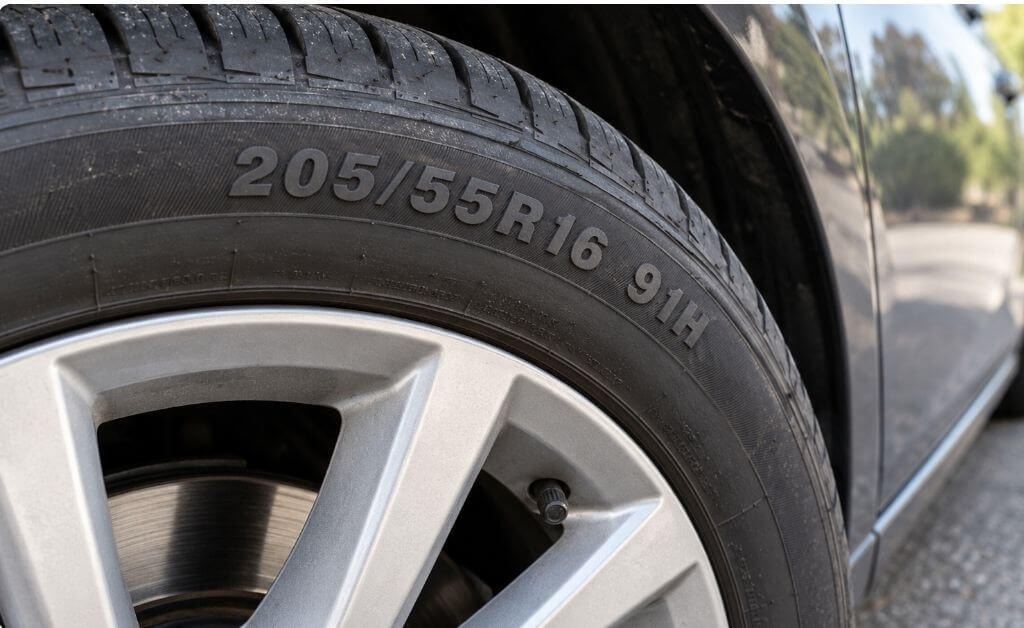
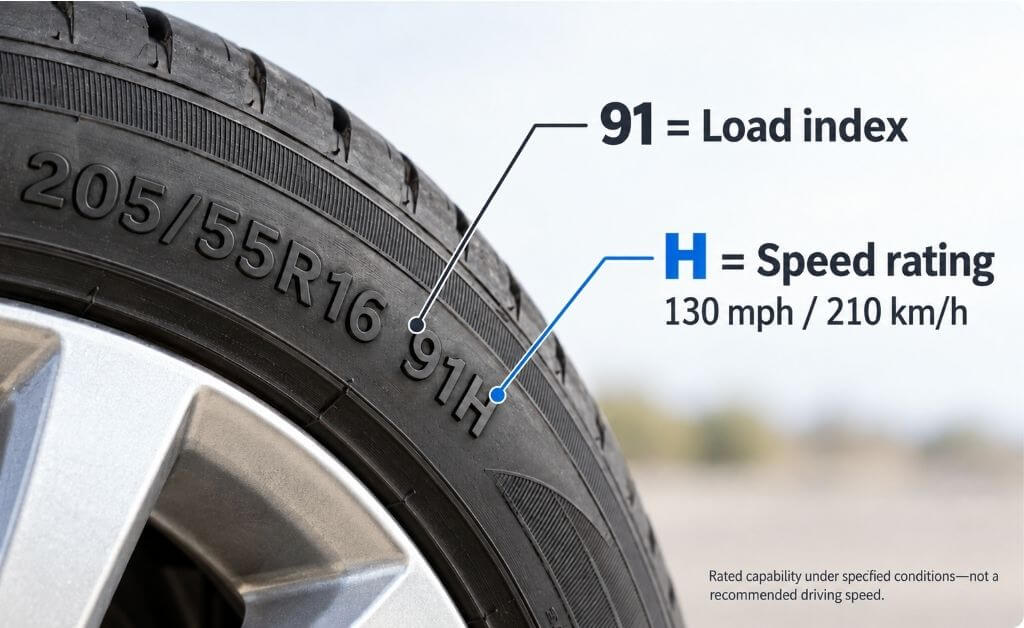
An H speed rating means a tire has a rated speed capability of 130 mph (210 km/h) under specified test conditions. You will usually find H after the load-index number on the sidewall, as in 205/55R16 91H.
If you are buying replacement tires, the important question is whether H meets your vehicle’s requirements. Check that first, then compare suitable tires for comfort, grip, noise, and wear.
Quick Answer: H-rated tires are rated for 130 mph (210 km/h) under specified load, inflation, and laboratory test conditions. The rating is not a recommended driving speed. Choose replacements that meet or exceed the vehicle manufacturer’s required speed rating, subject to applicable winter-tire guidance.
What Does H Speed Rating Mean?
H is the speed symbol in a tire’s service description, which combines the load-index number and speed-rating letter after the size.
The H category corresponds to 210 km/h, commonly published as 130 mph. Speed ratings come from laboratory testing at specified speeds and loads. They describe capability under controlled conditions, rather than a guarantee of performance in every road situation.
Bridgestone explains that inflation, wear, vehicle condition, driving conditions, and the duration of speed can affect actual capability. The rating assumes the applicable test conditions; it is not a guarantee for an underinflated, overloaded, or damaged tire.
H does not mean you should drive at 130 mph. Follow posted limits and adjust your speed for traffic, visibility, weather, and road conditions.
Where Is the H Rating on a Tire?
Look for H immediately after the load-index number in the service description on the sidewall.
Consider this illustrative example:
205/55R16 91H
| Marking | Meaning |
|---|---|
| 205 | Nominal section width in millimeters |
| 55 | Aspect ratio: nominal sidewall height is 55% of section width |
| R | Radial construction |
| 16 | Wheel diameter in inches |
| 91 | Load index |
| H | Speed rating: 130 mph (210 km/h) |
The number 91 is not a speed rating, and H is not a load rating. Both parts matter when checking a replacement.
For the other markings, see our guide to how to read tire size.
The sidewall tells you the specification of the tire currently installed. It may reflect a previous replacement rather than the vehicle’s original requirement. Confirm the required rating through the owner’s manual or vehicle manufacturer’s fitment information.
H vs T vs V Speed Rating
H has a higher rated speed than T and U, but a lower rated speed than V. The sequence is not entirely alphabetical.
| Speed rating | Rated speed, mph | Rated speed, km/h |
|---|---|---|
| T | 118 | 190 |
| U | 124 | 200 |
| H | 130 | 210 |
| V | 149 | 240 |
The mph figures are commonly published rounded equivalents of the rated km/h values.
If your vehicle requires H, T falls below that speed requirement. If it requires T, an H-rated replacement can meet the speed requirement, provided its other specifications are appropriate.
V exceeds H’s rated speed capability. However, the letter alone does not prove better wet braking, lower noise, or longer tread life. Compare the exact tire models and sizes for those characteristics.
For the other symbols, use our complete tire speed rating chart.
Can H-Rated Tires Replace V-Rated Tires?
If your vehicle requires V, an ordinary H-rated replacement falls below that requirement and is generally not recommended.
H is rated at 130 mph; V is rated at 149 mph. Driving below both values does not, by itself, establish that downgrading is appropriate. A lower-rated replacement can reduce the vehicle’s tire-related speed capability and affect handling.
First confirm whether V is actually required. A V on the currently installed tire does not necessarily establish the vehicle’s minimum specification.
Can You Use V-Rated Tires Instead of H?
A V-rated tire can generally replace an H-rated tire because it exceeds the H speed requirement. The size, load capacity, construction, and other fitment requirements must still be suitable.
A higher speed rating cannot compensate for insufficient load capacity or an unsuitable size. It also does not automatically make a tire better for your priorities.
For example, if the approved specification is 205/55R16 91H, a 205/55R16 91V replacement satisfies the speed-rating comparison and matches the listed size and load index. That does not confirm every fitment requirement: check the exact tire’s construction, application, and any vehicle-specific restrictions before buying.
Replacement Decisions at a Glance
| Vehicle requirement | Proposed replacement | Decision |
|---|---|---|
| H | H | Meets the speed requirement; verify the other specifications |
| H | V | Generally acceptable; verify complete fitment |
| V | H, ordinary replacement | Below the required rating; generally not recommended |
| V | H, winter-capable replacement | May be permitted under applicable manufacturer guidance |
| Unknown | H or V | Confirm the vehicle requirement before buying |
Winter replacements require separate consideration, as explained below.
Are H-Rated Tires Suitable for Highway Driving?
H-rated tires can be suitable for highway driving when they meet your vehicle’s specifications and suit the conditions. Highway use alone does not determine the required rating.
For a vehicle requiring H, there is no need to choose V simply because you regularly use highways. For a vehicle requiring V, normal highway speeds do not make an ordinary H-rated replacement equivalent.
Before a trip, check cold inflation pressure against the vehicle’s recommendation and inspect for wear or damage. Keep the load within the vehicle and tire limits. The H marking does not compensate for poor condition, underinflation, or overloading.
Do H-Rated Tires Ride Better or Last Longer?
H does not guarantee a softer ride, quieter operation, or longer tread life than V.
Speed ratings can be associated with design trade-offs, but those tendencies are not a reliable comparison of every H-rated tire against every V-rated tire. Compound, tread pattern, construction, size, and intended category all matter.
| Priority | Evidence to compare |
|---|---|
| Ride comfort and noise | Relevant ride and noise evaluations |
| Wet grip | Comparable wet-braking and handling tests |
| Tread life | Wear evidence, mileage warranty, and warranty conditions |
| Snow performance | Winter qualification and snow-traction testing |
Do not assume that H has softer sidewalls or that V always stops sooner in rain. Choose tires meeting the vehicle’s requirements, then assess model-specific evidence.
Can You Mix H- and V-Rated Tires?
A matching, manufacturer-approved tire set is the preferred choice. Mixing H and V requires checking more than wheel fit or rated speed.
If the vehicle requires V, H falls below the ordinary replacement requirement. If it requires H, both symbols can satisfy the speed minimum, but that alone does not establish a suitable mixed setup.
Manufacturer guidance may permit certain mixed arrangements when the tires meet the vehicle’s minimum requirements. Tire type, model, construction, load capacity, tread characteristics, and axle placement still need consideration.
Do not decide placement from the speed letters alone. When replacing only two tires, tread depth and available grip also matter. Have a qualified tire professional check the proposed combination and axle placement against the vehicle and tire manufacturers’ instructions.
With H and V installed, H is the lower speed category. The vehicle does not retain V-rated tire speed capability. Observing that lower limitation does not, by itself, make the combination appropriate.
Can Winter Tires Have a Lower Speed Rating?
A lower rating may be permitted for winter use under applicable manufacturer guidance.
Michelin’s load- and speed-rating guidance identifies an exception for winter-capable tires carrying the Three-Peak Mountain Snowflake (3PMSF) symbol, including qualifying all-season tires.
This is not permission to downgrade every all-season tire. Confirm the exact tire and vehicle application, follow any seasonal-use instructions, and observe the lower rated-speed limitation.
H and 3PMSF describe different characteristics:
- H: Rated speed capability.
- 3PMSF: Severe-snow-service qualification.
A tire carrying both remains H-rated. Snow qualification does not raise the speed rating or guarantee ice performance.
How to Choose the Correct Replacement Tire
Use this order when shopping:
- Confirm the required speed rating. Consult the owner’s manual or vehicle manufacturer’s approved fitment information.
- Check the approved size. Use the specified size or an approved alternative.
- Verify load capacity. Read the load index separately from the speed symbol.
- Check tire type and special requirements. Consider climate, construction, and any vehicle-specific restrictions.
- Verify the exact model and size listing. Do not rely on the product name alone.
- Compare performance and price. Assess suitable options for your driving needs after confirming compatibility.
If the required rating is unclear, resolve it before ordering. Your usual driving speed and the current tire’s marking are not substitutes for the vehicle’s specification.
Frequently Asked Questions
Why Is H Between U and V?
H is a historical exception to the usual alphabetical sequence. Today, U corresponds to 124 mph, H to 130 mph, and V to 149 mph. Read the rated values rather than assuming alphabetical order.
Does H Identify a Tire’s Load Capacity?
No. H identifies the speed category. The accompanying load-index number identifies the load-capacity category.
Is H a Winter-Performance Rating?
No. Check winter qualification and relevant snow or ice test evidence separately.
Does a Higher Speed Rating Mean You Should Drive Faster?
No. It does not override speed limits or the need to adjust speed for conditions.
Conclusion
An H speed rating identifies a rated capability of 130 mph (210 km/h) under specified conditions. It does not establish overall tire quality or a recommended driving speed.
Confirm that H meets your vehicle’s requirements, then check size, load capacity, tire type, and complete fitment. Compare suitable models for the performance you need.
