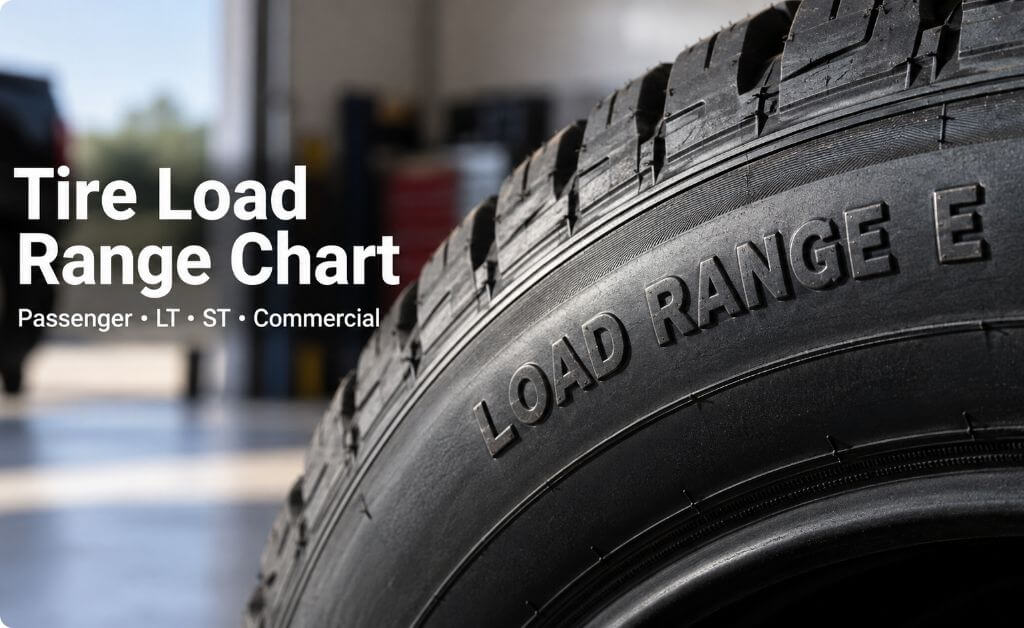
Tire Load Range Chart: Passenger, LT, ST & Commercial
This tire load range chart explains letter ratings from A through N, their historical ply-rating equivalents, and passenger tire designations such as SL and XL. Use it to identify your tire’s classification, then check its exact load capacity and inflation requirements.
A load-range letter alone does not tell you how many pounds a tire can carry or which pressure your vehicle needs. Those details depend on the tire’s size, type, specification, and applicable load–inflation data.
This guide covers passenger, light-truck, special-trailer, and commercial road tires. Their markings are related, but they should not be treated as one interchangeable rating system.
Quick Answer: Load Range C corresponds to a 6-ply rating, D to an 8-ply rating, and E to a 10-ply rating. These are historical rating equivalents—not necessarily the tire’s actual number of plies. Passenger tires use designations such as Standard Load (SL) and Extra Load (XL). Check the complete specification: a load-range letter does not provide one universal capacity or PSI value.
Tire Load Range Chart and Ply-Rating Equivalents
The chart below shows the verified letter-to-ply-rating reference sequence. It is a classification lookup, not a replacement-tire selection chart.
Not every tire size or application is available in every load range.
| Load range | Historical ply-rating equivalent |
| A | 2-ply rated |
| B | 4-ply rated |
| C | 6-ply rated |
| D | 8-ply rated |
| E | 10-ply rated |
| F | 12-ply rated |
| G | 14-ply rated |
| H | 16-ply rated |
| J | 18-ply rated |
| L | 20-ply rated |
| M | 22-ply rated |
| N | 24-ply rated |
Chart note: Ply rating does not necessarily equal physical ply count. Confirm load capacity and inflation requirements for the exact tire size, specification, and service conditions.
What the Letters Tell You
Load range identifies a tire’s load and inflation classification. Letter ratings appear on applicable light-truck, special-trailer, and commercial tires.
For the same size and tire system, compare the manufacturer’s listed capacities and associated pressures. A higher range does not necessarily provide additional capacity at the pressure you use.
Across different sizes, the letter is even less useful as a standalone capacity comparison. A larger D-rated tire can have a higher maximum capacity than a smaller E-rated tire.
Why There Is No Universal Pounds or PSI Column
There is no single pounds-per-tire capacity for C, D, E, or another letter. Capacity varies with the tire’s dimensions and specification.
Pressure references can also differ within the same load range. For that reason, this chart does not assign one universal PSI value to each letter.
Use the tire’s complete markings and applicable manufacturer load–inflation table. The pressure section below explains how to distinguish rated-load pressure from your vehicle’s recommended setting.
Passenger Tire Load Designations: SL, XL, LL and HL
Passenger tires use load designations that should be interpreted separately from the letter-to-ply chart. Do not treat SL, XL, and LT load-range letters as one interchangeable scale.
| Designation | Meaning or identification | What to check |
| SL | Standard Load | Required load index and capacity at the recommended cold pressure |
| XL | Extra Load | Whether XL is required and whether capacity is sufficient at the specified pressure |
| Reinforced | Reinforced passenger-tire designation, used in connection with Extra Load tires | Manufacturer terminology and complete specification |
| LL | Lower-load designation identified as “Low Load” in Toyo’s US specification legend | Exact manufacturer definition and approved fitment |
| HL | High Load designation appearing before the tire size; it can coexist with XL | Complete HL specification, load index, and vehicle requirements |
Passenger chart note: These designations do not establish a universal physical ply count or fixed maximum pressure. HL is a size-prefix designation, rather than another letter in the load-range chart.
Standard Load vs. Extra Load
Standard Load tires provide the capacity specified for their size and load index under the applicable conditions. Extra Load tires are designed to provide greater load capacity than corresponding Standard Load specifications of the same size.
The additional capacity depends on the applicable inflation requirements. An XL tire does not provide its full rated capacity at every pressure.
If your vehicle requires XL tires, retain that requirement unless the vehicle manufacturer approves an alternative. For an approved XL replacement on a vehicle originally fitted with SL tires, confirm the complete fitment and pressure requirements.
Is Standard Load the Same as Load Range B?
Do not use SL and B as interchangeable replacement specifications. SL identifies a passenger-tire load designation; B belongs to the letter load-range reference system.
A historical comparison does not establish equal capacity at a particular pressure. Tire size, type, load index, and applicable load–inflation data remain necessary.
What Does HL Mean?
HL identifies a higher-load passenger-tire specification and appears before the size. It can appear alongside XL:
HL 245/40 R 19 101 Y XL
Continental’s published example compares load specifications for this nominal size: 670 kg for SL, 750 kg for XL, and 825 kg for HL, per tire.
These figures describe that example. They are not universal capacities or percentage increases for every SL, XL, and HL tire, nor should they be presented as a same-model comparison without further evidence.
Select HL tires according to the vehicle’s requirements and approved fitment information.
How Load Ranges Apply to LT, Trailer and Commercial Tires
Light-truck, special-trailer, and commercial tires can use the same load-range letters. A shared letter does not make their capacities, pressures, or approved applications interchangeable.
Identify the tire type first, then check its exact size and manufacturer specifications.
LT-Metric and Flotation Tires
Light-truck tires commonly identify their type with LT before or after the size:
| Size format | Example | Tire-type identification |
| LT-metric | LT265/75R16 | LT appears before the width |
| Flotation | 31×10.50R15LT | LT appears after the wheel diameter |
| Numeric LT | 7.50-16LT | LT appears after the size |
The load range is separate information. LT265/75R16 Load Range E, for example, identifies an LT-metric tire with a 10-ply-rating equivalent.
Do not assume every LT tire starts at C. Manufacturer reference tables also include B-rated flotation specifications. Available ranges depend on the exact size and product.
LT-metric and flotation specifications can have different pressure references. Exceptions also occur within a format, so the size notation alone cannot establish the correct pressure.
For truck-specific tables and fitment examples, see our truck tire load range chart.
ST Trailer Tires
ST means Special Trailer. In ST225/75R15 Load Range D, ST identifies the tire application, while D identifies the load-range classification.
A D-rated ST tire is not automatically equivalent to a D-rated LT tire. Their specifications and application requirements must be checked separately.
Confirm the trailer manufacturer’s required size, tire type, capacity, and cold pressure. Also check wheel ratings and clearance before changing specifications.
Do not select a range from trailer weight alone. Weight distribution, tire count, axle limits, and the exact tire’s capacity all matter.
For application-specific examples, see our trailer tire load range chart.
Commercial Truck and Bus Tires
Commercial tires may carry classifications including F, G, H, J, L, M, and N. Availability depends on the size and model.
Consider this commercial example:
295/75R22.5 144/141L Load Range G
| Marking | What it identifies |
| 295/75R22.5 | Tire size and radial construction |
| 144/141 | Load indices for single and dual applications |
| L | Speed symbol |
| Load Range G | Load-range classification; 14-ply-rating equivalent |
For an approved dual installation, use the applicable dual capacity for each tire. The range letter does not replace single/dual information.
Commercial pressures must follow applicable manufacturer guidance for the actual loads. Motorhome owners can consult our RV tire load range chart for application-specific considerations.
How to Find the Load Range on a Tire
Look around the sidewall for wording such as “Load Range E.” It may appear separately from the main size marking.
Passenger tires may show Extra Load, XL, or Reinforced instead. An SL tire may lack an explicit SL marking; confirm an unclear designation through the manufacturer.
Read the Complete Marking
This example separates the information:
LT235/85R16 120/116Q — Load Range E
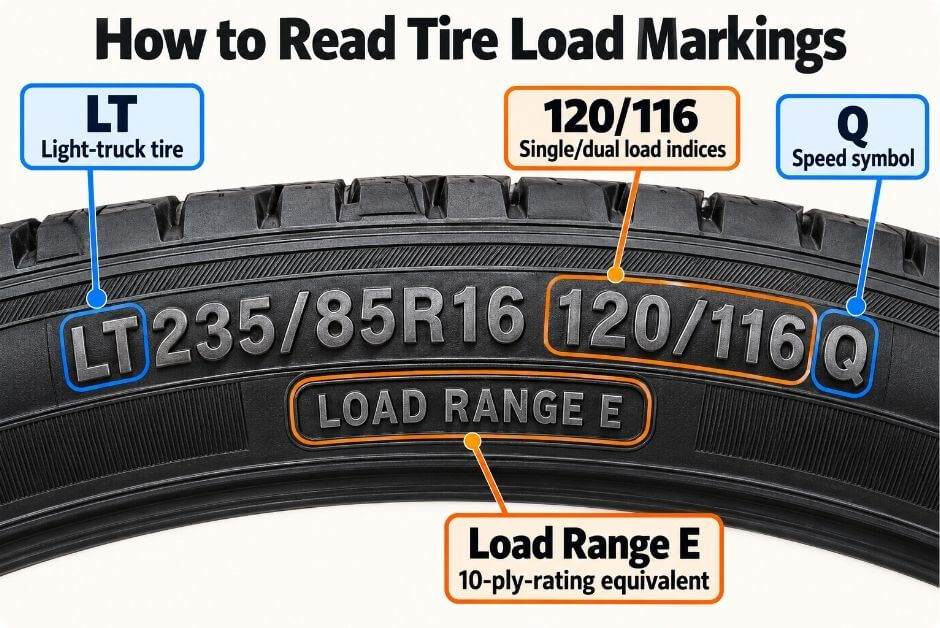
| Marking | Meaning |
| LT | Light-truck tire designation |
| 235 | Nominal section width in millimeters |
| 85 | Aspect ratio |
| R | Radial construction |
| 16 | Wheel diameter in inches |
| 120/116 | Single/dual load indices |
| Q | Speed symbol |
| Load Range E | Load-range classification |
Read the separate maximum-load and cold-pressure statements as well. If the tire is approved for single and dual service, check the values for its actual installation.
Does the C After the Tire Size Mean Load Range C?
Not necessarily. In 225/70R15C 112/110R, the C immediately after the wheel diameter identifies a European commercial tire type.
| Position of C | Interpretation |
| In “Load Range C” | Load-range classification |
| After the wheel diameter in a C-type size | European commercial tire designation |
If markings are unreadable, identify the exact model, size, and product specification through the manufacturer. Avoid assigning a range from tread appearance or an incomplete sales listing.
Load Range vs. Load Index vs. Actual Ply Count
These markings answer different questions:
| Specification | Example | What it tells you |
| Load range | E | Load and inflation classification |
| Load index | 120/116 | Numeric capacity references for single and dual service |
| Actual ply composition | Separate tread and sidewall markings | Physical layers and materials in the specified areas |
There is no fixed conversion from Load Range E to one load-index number. For numeric capacities, use our tire load rating chart.
Does “10-Ply Rated” Mean Ten Actual Plies?
No. Modern materials and construction can achieve a ply-rating equivalent with fewer physical plies.
Read the separate tread and sidewall composition markings for construction details. A 10-ply rating alone does not establish puncture resistance, grip, or tread life.
Why Load Range Does Not Give One Universal PSI
The pressure associated with a load-range specification can vary by size and tire system. First, distinguish three figures:
| Pressure figure | Meaning | How to use it |
| Vehicle-recommended cold pressure | Setting for the approved setup and operating conditions | Follow the placard and owner’s manual |
| Pressure associated with maximum rated load | Pressure corresponding to maximum capacity in the applicable specification | Consult manufacturer load–inflation data |
| Maximum cold inflation pressure | Maximum cold pressure permitted for the tire | Observe it alongside applicable wheel limits |
These figures are not always identical. Some passenger tires permit a higher pressure than the pressure at which they reach maximum rated load. That allowance does not automatically increase capacity.
Same Letter, Different Pressure References
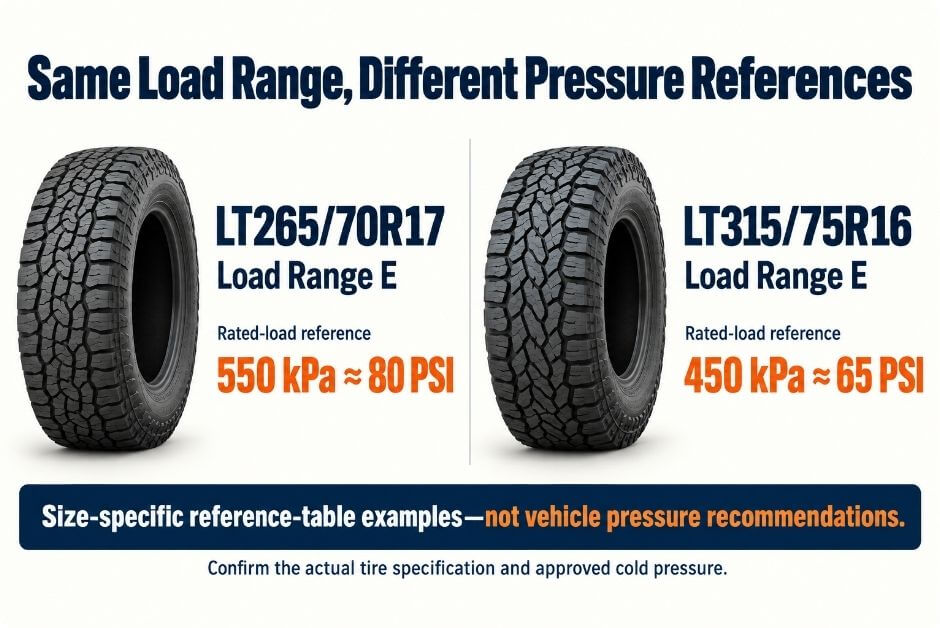
Toyo’s TRA-based reference table illustrates why size matters:
| Reference specification | Load range | Pressure associated with the listed rated load |
| LT265/70R17 | E | 550 kPa—approximately 80 PSI |
| LT315/75R16 | E | 450 kPa—approximately 65 PSI |
Example note: These are size-specific reference-table values, not vehicle operating-pressure recommendations. Confirm the actual tire’s specification before applying either value.
Use the Applicable Load–Inflation Table
A tire does not necessarily provide its maximum rated capacity at a lower pressure. Check its capacity at the intended pressure using the applicable manufacturer table.
Do not assume that reducing pressure by a percentage reduces capacity by the same percentage. Adding pressure above the rated-load reference also does not authorize exceeding the tire’s rated maximum.
Select the correct size, specification, and single or dual application.
Which Pressure Should You Use?
For an original or approved equivalent setup, follow the vehicle manufacturer’s cold-pressure guidance, including any specified adjustments for load or operating conditions.
When changing size, tire type, or load specification, confirm the replacement’s pressure requirements. Do not automatically retain the old pressure or use the sidewall maximum.
For commercial and RV applications, follow applicable manufacturer guidance for measured loads. Check pressures cold, and do not release air from warm tires simply to match a cold setting.
Load Range C vs. D vs. E
The basic rating comparison is straightforward:
| Load range | Historical ply-rating equivalent |
| C | 6-ply rated |
| D | 8-ply rated |
| E | 10-ply rated |
Does E Carry More Than D or C?
For the same size and tire system, a higher-range specification may have a higher maximum capacity at its associated pressure. Confirm the difference in manufacturer data.
At a shared pressure, additional capacity is not guaranteed. Specifications following the same applicable load–inflation schedule can have equal capacities within their overlapping pressure range.
Across sizes, a larger C- or D-rated tire can carry more than a smaller E-rated tire.
Which Range Should You Choose?
Choose the specification that meets vehicle requirements and supplies sufficient capacity at the appropriate pressure.
A half-ton or three-quarter-ton description does not establish the required range. Requirements vary by model, equipment, size, and application.
Occasional towing does not automatically justify moving up one range. Check the vehicle’s instructions and loaded axle weights first.
What Tire Load Range Do You Need?
Start with the vehicle manufacturer’s requirements. The placard usually lists original sizes and cold pressures; use the owner’s manual and approved fitment information for additional specifications.
Replacement Tire Checklist
| Check | What to confirm |
| Vehicle requirements | Approved size, tire type, load specification, and speed requirements |
| Replacement specification | Exact model, size, range or passenger designation, and load index |
| Capacity at intended pressure | Sufficient capacity using applicable manufacturer data |
| Wheel compatibility | Approved dimensions and adequate load and pressure ratings |
| Loaded vehicle limits | Compliance with GVWR, axle ratings, and towing limits |
| Installation requirements | Correct single/dual application and matching requirements |
Changing Tire Size or Type
Have capacity and pressure requirements checked when changing specifications. An LT tire can require a different pressure to support a load previously carried by a passenger tire.
Passenger tires installed in applicable light-truck service require a capacity adjustment. Relevant guidance specifies dividing passenger-tire capacity by 1.10; this is not a universal adjustment for all tire types.
Heavy Loads and Towing
Assess the vehicle in its loaded operating condition. Trailer tongue or pin weight adds load to the tow vehicle and affects axle loading.
Dividing measured axle weight by tire count gives an average, not each tire’s actual load. Where unequal loading matters, obtain individual wheel-position weights and follow manufacturer guidance.
Is a Higher Load Range Better?
A higher range is useful when its complete specification meets a capacity or fitment requirement. The letter alone is not a performance upgrade.
Ride Comfort Depends on the Complete Setup
Construction, dimensions, tire model, suspension, and pressure affect ride comfort. Load range alone cannot predict the change.
Do not use maximum sidewall pressure merely because the replacement has a higher range. Use the setting established for the approved fitment and conditions.
Higher Range Does Not Guarantee Better Performance
Load range does not independently establish better wet grip, quieter operation, longer tread life, or greater puncture resistance. Evaluate those qualities using evidence for the specific tire.
Vehicle Limits Still Apply
Higher-capacity tires do not increase GVWR, GAWR, payload allowance, or towing limits.
If required capacity cannot be achieved within tire, wheel, and approved fitment limits, reassess the setup. More pressure or a higher letter alone does not resolve it.
Common Tire Load-Range Mistakes
| Mistake | Better check |
| Assuming E always carries more than D | Compare exact specifications at the intended pressure |
| Reading ply rating as physical ply count | Check construction markings |
| Assigning universal PSI by letter | Use applicable manufacturer data |
| Treating XL and E as interchangeable | Identify the tire system |
| Reading a size suffix C as Load Range C | Check its position and context |
| Using sidewall maximum as the everyday setting | Follow approved cold-pressure guidance |
| Using single capacity for dual tires | Use dual capacity for each tire |
| Assuming higher range increases towing capacity | Respect vehicle limits |
Frequently Asked Questions
What Does Load Range E Mean?
E identifies a load and inflation classification corresponding to a 10-ply-rating equivalent. It does not give one universal capacity or pressure.
Is Load Range E the Same as 10-Ply?
It means 10-ply rated, not necessarily ten physical plies. Actual construction is listed separately.
Is XL the Same as Load Range E?
No. XL is an Extra Load passenger designation. E belongs to the letter load-range system; compare complete specifications before replacing either.
Does E Always Carry More Than D?
No. Size, specification, and operating pressure determine the comparison. A larger D-rated tire can have more capacity.
Do E-Rated Tires Always Need 80 PSI?
No. Rated-load references vary, and they are not automatic vehicle operating settings.
Can I Use a Higher Load Range?
It may be suitable when the complete specification meets vehicle requirements. Confirm capacity, pressure, fitment, and wheel compatibility.
Why Are Some Letters Missing?
The verified sequence is A, B, C, D, E, F, G, H, J, L, M, and N. Do not insert missing letters or estimate unlisted classifications.
Sources and Chart Method
The letter-to-ply mapping and size-specific pressure examples follow Toyo Tires’ technical load–inflation reference.
Commercial markings, ply-rating qualifications, and single/dual interpretation follow the USTMA commercial truck and bus tire guide. Passenger and replacement guidance was also checked against USTMA’s passenger/light-truck guide and Toyo and Continental information.
This guide covers the stated road-tire systems, not bicycle, agricultural, or earthmover classifications. The reference table does not establish range availability for every application.
Pressure examples retain source kPa values; approximate PSI equivalents are rounded to whole numbers. This guide does not calculate pressure-specific capacity or approve a fitment.
Conclusion
Use the tire load range chart to identify the classification, then verify the complete specification and capacity at the appropriate cold pressure.
Choose replacements that meet vehicle requirements and respect tire, wheel, axle, and vehicle limits. A higher letter alone does not establish a better fitment or increase payload and towing capacity.
