Truck Tire Load Range Chart: LT and Commercial Tires
A truck tire load range chart connects a tire’s letter rating with its historical ply-rating equivalent. For light-truck (LT) tires, it can also show reference pressures associated with maximum load. The letter alone does not tell you how many pounds a tire can carry or what pressure your truck needs.
Use the chart that matches your tire: light-truck or commercial truck. Then verify its exact size, sidewall markings, and the specifications for your vehicle or application.
Quick Answer: On LT tires, Load Ranges C, D, E, and F correspond to historical 6-, 8-, 10-, and 12-ply ratings. Those numbers do not necessarily describe the tire’s actual physical plies. Load range alone cannot establish a tire’s exact load capacity or the pressure to use on your truck.
Light-Truck Tire Load Range Chart
This chart covers LT-metric and flotation light-truck tires. Its pressure figures are reference pressures associated with maximum-load ratings, not recommended inflation pressures for every pickup. The width categories and pressures follow Tire Rack’s LT tire reference.
| Load range | Historical ply rating | Tire section width ≤295 mm / 11.5 in | Tire section width >295 mm / 11.5 in |
| B | 4-ply rated | 35 PSI | No value listed in this reference |
| C | 6-ply rated | 50 PSI | 35 PSI |
| D | 8-ply rated | 65 PSI | 50 PSI |
| E | 10-ply rated | 80 PSI | 65 PSI |
| F | 12-ply rated | 95 PSI | 80 PSI |
Chart note: Some LT sizes have modified maximum-load pressures. Check the pressure and maximum load marked on the specific tire’s sidewall; do not use this chart as an instruction to inflate a vehicle’s tires. For the vehicle’s recommended front and rear cold pressures, check its tire placard or owner’s manual. If changing tire specifications, confirm the replacement’s capacity at the intended pressure using the tire manufacturer’s information.
C vs. D vs. E vs. F: The letters identify different load-range categories, but a higher letter alone does not establish that a tire fits your pickup. Compare the complete tire specification and its load capacity at the required pressure.
Commercial Truck Tire Load Range Chart
The U.S. Tire Manufacturers Association (USTMA) commercial truck and bus tire guide lists these load-range and historical ply-rating equivalents for its covered tires:
| Load range | Historical ply rating |
| F | 12-ply rated |
| G | 14-ply rated |
| H | 16-ply rated |
| J | 18-ply rated |
| L | 20-ply rated |
| M | 22-ply rated |
| N | 24-ply rated |
Chart note: This table does not assign a universal PSI or pounds-per-tire value to any load range. Match the exact tire size and service description to the manufacturer’s load and inflation table. For a tire used in a dual-wheel assembly, use its dual rating rather than its single rating. A historical ply rating is not necessarily the number of physical plies in a modern tire.
How to Read a Truck Tire’s Load Rating
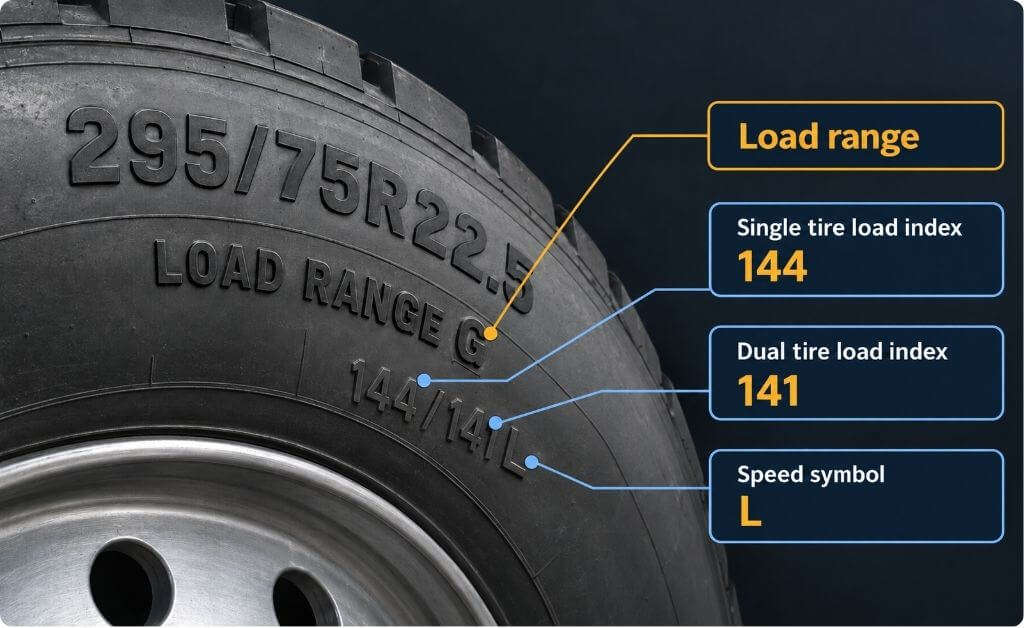
Look for the complete marking on the tire sidewall. These details answer different questions:
| Marking | What it tells you |
| Tire size | Which size-specific specification and load/inflation table to consult |
| Load range | The tire’s load and inflation category |
| Load index | A numerical code associated with maximum rated load under specified conditions |
| Maximum load and cold pressure | The maximum load marked for that tire and its corresponding cold pressure |
| Single/dual ratings, if present | Separate load ratings for a single tire or each tire in a dual assembly |
Load range and load index are not interchangeable. Two tires bearing the same load-range letter can have different capacities. A load index is also not enough on its own to establish capacity at every operating pressure: use the tire manufacturer’s applicable load/inflation data.
On a commercial tire marked 144/141L, 144 is the single-use load index, 141 is the dual-use load index, and L is the speed symbol. The first number is not the rating to apply to each tire of a dual assembly. The USTMA commercial guide explains these markings and shows maximum load and cold pressure on a truck tire’s sidewall.
Two Worked Examples
Example 1: An LT Tire Can Have Different Front and Rear Pressures
A Michelin fitment listing for a GMC Sierra 2500 shows LT245/75R16/E with 65 PSI front and 80 PSI rear. Both positions use a Load Range E tire, yet the listed pressures differ.
This is an example from that fitment listing, not a pressure recommendation for every Sierra 2500 or every E-rated tire. Check the tire placard and owner’s manual for your exact vehicle. If a different tire size or specification is fitted, verify the required load capacity and pressure for that replacement.
Example 2: Single and Dual Loads on a Commercial Tire
USTMA illustrates a 295/75R22.5 Load Range G tire with the service description 144/141L:
| Configuration | Maximum load for each tire | Corresponding cold pressure |
| Single tire | 6,175 lb | 110 PSI |
| Each tire in a dual assembly | 5,675 lb | 110 PSI |
These are the values for USTMA’s specific example, not ratings shared by all Load Range G tires. At another pressure, use the relevant manufacturer’s load/inflation table. Do not use the single rating for tires mounted in duals.
How to Choose the Correct Tire and Pressure
1. Start with the vehicle specification. Read the tire placard and owner’s manual for the original tire size, front and rear cold pressures, and vehicle load limits. Do not assume the same pressure applies to both axles.
2. Check the complete replacement tire. Confirm its size, load index or sidewall maximum load, load range, and speed rating against the vehicle manufacturer’s requirements. A higher load-range letter—or an equal or higher load index by itself—does not prove adequate capacity at every pressure.
3. Verify capacity at the pressure required for the application. If the replacement differs from the original specification, use the tire manufacturer’s load/inflation information to confirm adequate capacity. USTMA says replacement tires must provide at least the original equipment tire’s load capacity at the specified vehicle placard pressure. A properly specified alternative may require a verified pressure change.
4. Check tire, wheel, and vehicle limits. Do not exceed the maximum inflation pressure on the tire sidewall or the wheel’s limits. Check approved rim width, and never exceed the vehicle’s axle or gross weight ratings. A higher load range does not increase those vehicle ratings.
For an unfamiliar replacement size, a switch from passenger to LT tires, or a dual-wheel fitment, consult the vehicle or tire manufacturer or a qualified tire professional. See USTMA’s passenger and light-truck tire guide for replacement, pressure, and wheel-fitment guidance.
Common Questions About Truck Tire Load Ranges
Is Load Range F better than Load Range E?
Not automatically. F is a higher load-range category, but the right replacement must supply the required capacity at the appropriate pressure and fit the vehicle and wheel. Compare the specific tire specifications, not just the letters.
Does a 10-ply-rated tire contain 10 plies?
Not necessarily. “10-ply rated” is the historical equivalent associated with Load Range E. Modern tire construction can use fewer physical plies.
Is every Load Range G truck tire rated for 110 PSI?
No. The 110 PSI figure in the worked example applies to the particular tire specification illustrated by USTMA. Check your tire’s sidewall and the manufacturer’s load/inflation table instead of assigning one pressure to every G-rated tire.
What does a dual load index such as 144/141 mean?
The first number, 144, is for single-tire use. The second, 141, is for each tire when used in a dual assembly. Apply the rating and load/inflation information for the actual mounting arrangement.
Should I inflate my pickup’s Load Range E tires to 80 PSI?
Not based on the letter alone. 80 PSI is a reference maximum-load pressure for certain LT sizes; some wider or modified sizes differ. Follow the pressure specification for your vehicle and verify any alternative tire fitment using its load/inflation data.
