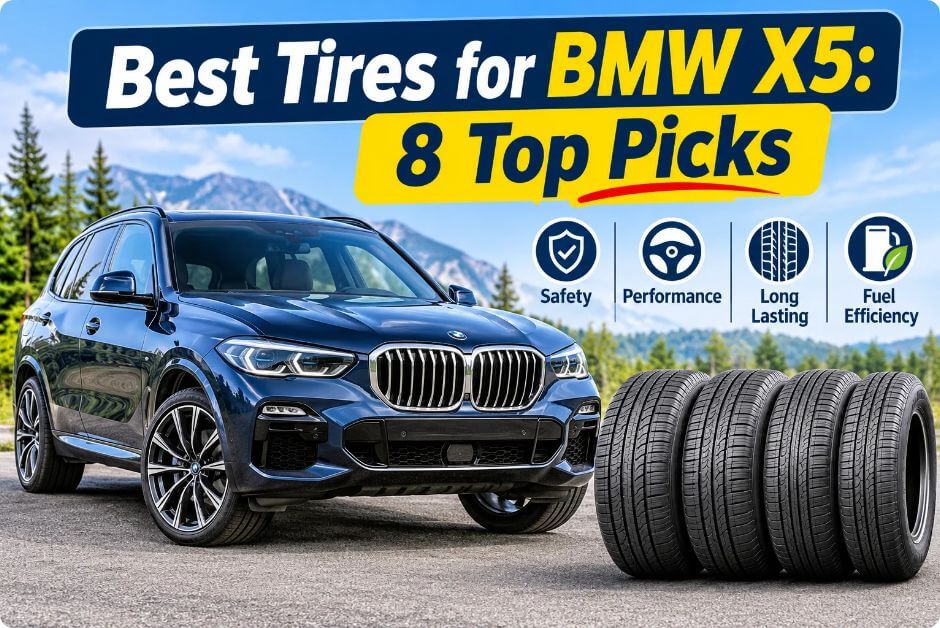
Best Tires for BMW X5: 8 Picks for Every Driving Style
Choosing the best tires for BMW X5 depends on more than brand reputation or price. Different model years, trims, and wheel packages use different tire sizes, load ratings, and front-to-rear configurations. Some X5 models have square setups with identical tire sizes on all four wheels, while others use staggered fitments with wider rear tires.
For drivers who prioritize year-round versatility, the Goodyear Assurance WeatherReady 2 and Michelin CrossClimate2 are strong all-weather options. The Pirelli Scorpion AS 4 is worth considering for its long treadwear warranty, while the Continental ExtremeContact DWS 06 Plus and Michelin Pilot Sport All-Season 4 offer performance-oriented alternatives for compatible configurations.
For summer driving, the Pirelli P Zero PZ4 provides a BMW Star-marked run-flat option for specific G05 staggered setups. Drivers with an X5 M Competition can consider the Michelin Pilot Sport 4 S, while the Pirelli Scorpion Winter offers a dedicated winter option for compatible X5 models.
Below, we compare eight tires based on independent testing, manufacturer specifications, available BMW fitments, warranty coverage, and intended driving conditions. We also explain how to choose the right tire size, load rating, and construction for your particular X5.
Best Tires for BMW X5 — Quick Comparison
| Tire | Best For | Representative BMW X5 Fitment | Main Advantage |
|---|---|---|---|
| Goodyear Assurance WeatherReady 2 | Balanced all-weather driving | 275/45R20 110V XL, square | Strong wet-road performance, 60K warranty |
| Michelin CrossClimate2 | Snow and ice braking | 275/45R20 110V XL, square | Strong snow braking, 3PMSF |
| Pirelli Scorpion AS 4 | Long-warranty touring | 275/45R20 110V XL, square | 70K limited warranty |
| Continental ExtremeContact DWS 06 Plus | Balanced performance all-season | 275/40ZR20 front, 315/35ZR20 rear | Strong wet braking |
| Michelin Pilot Sport All-Season 4 | Grip-focused performance all-season | 275/40ZR21 front, 315/35ZR21 rear | Strong dry grip and braking |
| Pirelli P Zero PZ4 | BMW OE summer run-flat | 275/45R20 front, 305/40R20 rear | BMW Star marking and RFT |
| Pirelli Scorpion Winter | BMW OE winter run-flat | 275/45R20 110H XL | BMW Star marking and 3PMSF |
| Michelin Pilot Sport 4 S | X5 M Competition summer performance | 295/35ZR21 front, 315/30ZR22 rear | BMW original-equipment fitment |
Important fitment note: These are representative product-size examples, not universal approvals for every BMW X5. Always confirm the original tire specification, load index, speed rating, run-flat requirement, and wheel configuration using your vehicle’s door-jamb label and owner’s manual.
How We Selected the Best Tires for BMW X5
Selecting replacement tires for a BMW X5 requires more than comparing popular brands or customer ratings. We evaluated each candidate according to its intended driving purpose, US-market specifications, available front-and-rear combinations, and compatibility with applicable X5 configurations.
First, we reviewed BMW factory tire specifications and manufacturer vehicle-fitment information. We considered tire dimensions, load capacity, speed rating, Extra Load construction, run-flat availability, and BMW-specific original-equipment markings.
Next, we examined independent tire tests covering dry and wet braking, handling, snow traction, ride comfort, noise, and rolling resistance. We also reviewed manufacturer treadwear warranties and available owner feedback as supporting evidence.
We did not conduct our own physical road tests on a BMW X5. When an independent test used another vehicle or tire size, we treated its findings as comparative evidence rather than direct BMW X5 test results. Different sizes, vehicles, and OE-specific versions can produce different results, so testing data should be interpreted in context.
We also considered each tire’s limitations. Our recommendations reflect where a product performs well and where another tire category may be more suitable.
Our goal is to help BMW X5 owners choose tires that match their approved fitment, driving conditions, and performance priorities.
8 Best Tires for BMW X5 — Detailed Reviews
1. Goodyear Assurance WeatherReady 2 — Best for Balanced All-Weather Driving
Key Features
- Category: Grand Touring All-Weather.
- Example X5-related size: 275/45R20 110V XL.
- Treadwear warranty: 60,000-mile limited warranty.
- Winter certification: Three-Peak Mountain Snowflake (3PMSF).
- UTQG: 700 A A.
- Technology: AquaTred Technology and Evolving Traction Grooves.
- Best for: Wet-road confidence and year-round driving in moderate winter conditions.

Performance Explained
The Goodyear Assurance WeatherReady 2 is designed to balance everyday comfort, wet-road grip, and winter traction. Its AquaTred tread design and water-evacuation grooves are intended to maintain traction on wet roads, while its all-weather compound supports performance across changing temperatures.
Independent testing has produced encouraging overall results. In Tire Rack’s 2025 comparisons, it achieved first-place finishes in two group tests, with particularly strong wet braking, wet handling, and subjective steering response.
However, its results are not uniformly class-leading. A later 2026/27 all-weather comparison placed it joint fourth among eight tires. The tire remained highly regarded for wet-road handling, but deep-winter traction, curved aquaplaning resistance, and rolling resistance were identified as weaknesses.
Its 60,000-mile limited warranty and 3PMSF certification make it a useful choice for drivers who encounter occasional snow without needing a dedicated winter tire.
For eligible G05 square 20-inch configurations, the 275/45R20 110V XL version is worth considering. It is not a verified complete replacement for the staggered 275/45R20 front and 305/40R20 rear arrangement.
Pros
- Strong wet-road braking and handling evidence.
- 3PMSF-certified for severe-snow service.
- Responsive steering and composed road manners.
- 60,000-mile limited treadwear warranty.
- Touring-oriented ride comfort.
Cons
- Snow performance is not consistently class-leading.
- Weak curved-aquaplaning results in one comparison.
- Higher rolling resistance can affect efficiency.
- Not a dedicated winter tire.
- No verified complete G05 staggered 20-inch matched pair.
2. Michelin CrossClimate2 — Best for Snow and Ice Braking
Key Features
- Category: Grand Touring All-Season.
- Example X5-related size: 275/45R20 110V XL.
- Treadwear warranty: 60,000-mile limited warranty.
- Winter certification: 3PMSF.
- UTQG: 640 B A in the reviewed size.
- Initial tread depth: Approximately 10/32 inch.
- Technology: Thermal Adaptive compound and directional V-Formation tread.
- Best for: Drivers who prioritize snow traction and braking.

Performance Explained
The Michelin CrossClimate2 is particularly attractive for drivers who regularly encounter snowfall but want one tire set for eligible year-round applications.
Its directional V-Formation tread pattern and Thermal Adaptive compound are designed to maintain grip as temperatures change. Independent testing supports its winter-oriented design.
In Tire Rack’s 11-tire 2024 all-season and all-weather comparison using 215/55R17 tires, it achieved the shortest snow-braking distance, stopping from 25 mph in 17.01 meters. It also finished second in snow traction, snow handling, and ice braking.
A separate premium-CUV comparison used 235/55R19 tires on a 2023 Alfa Romeo Stelvio Q4. That test also found strong winter performance, although the product was not tested on a BMW X5 or in the reviewed 275/45R20 size.
Wet performance is less impressive than its snow performance. In the 11-tire comparison, the CrossClimate2 finished third in wet braking but seventh in measured wet handling. It can feel less composed when pushed aggressively through wet corners.
Michelin’s 60,000-mile warranty is another advantage. The tire is comfortable in normal driving, although road noise can be noticeable on some surfaces.
The 275/45R20 110V XL version is a potential choice for eligible G05 square 20-inch configurations. It is not a confirmed complete replacement for the G05 20-inch staggered setup because a matching 305/40R20 rear version has not been established.
Pros
- Excellent independent snow-braking results.
- Strong snow traction and ice-braking performance.
- 3PMSF severe-snow certification.
- Competitive dry braking.
- 60,000-mile limited treadwear warranty.
- Comfortable everyday road manners.
Cons
- Wet handling is less impressive than snow performance.
- Can understeer during aggressive cornering.
- Not a dedicated winter tire for extreme conditions.
- Road noise can be noticeable.
- No verified matching 305/40R20 rear size.
- Reviewed variant is not run-flat.
3. Pirelli Scorpion AS 4 — Best Long-Warranty Touring Candidate
Key Features
- Category: Crossover/SUV Touring All-Season.
- Example X5-related size: 275/45R20 110V XL.
- Treadwear warranty: 70,000-mile limited warranty.
- Trial program: 60-day trial for eligible purchases.
- UTQG: 800 A A.
- Initial tread depth: Approximately 11/32 inch.
- Technology: Symmetrical tread pattern and updated tread polymers.
- Best for: Highway touring, everyday comfort, and long-warranty value.

Performance Explained
The Pirelli Scorpion AS 4 is a newer touring all-season tire designed for crossovers, SUVs, and pickups. Its development emphasizes wet-road confidence, comfortable driving, and long treadwear.
Pirelli uses an updated resin package, four circumferential grooves, and tailor-made tread polymers. These features are intended to improve wet grip, water evacuation, tread durability, and noise comfort.
However, the Scorpion AS 4 is relatively new, and sufficient independent comparative testing is not yet available to establish its real-world braking, handling, or treadwear position against established competitors.
Its main advantage is the 70,000-mile limited treadwear warranty. The reviewed 275/45R20 110V XL version also carries an 800 A A UTQG grade and approximately 11/32-inch initial tread depth.
The UTQG grade and mileage warranty should not be interpreted as proof that the tire will actually last 70,000 miles. Actual wear depends on vehicle weight, alignment, inflation pressure, road conditions, and driving habits.
The tire does not carry the 3PMSF severe-snow designation. It is better suited to ordinary all-season driving than regions with frequent heavy snowfall.
For eligible G05 square configurations, the 275/45R20 version is worth considering. It is not a verified BMW Star-marked or run-flat replacement, and a matching 305/40R20 rear size has not been established.
Pros
- 70,000-mile limited treadwear warranty.
- 800 A A UTQG rating in the reviewed size.
- Touring-focused tread design.
- Manufacturer-developed wet-grip improvements.
- Comfort-oriented noise and pitch optimization.
- Eligible 60-day trial program.
Cons
- Limited independent comparative test evidence.
- No 3PMSF severe-snow certification.
- Actual wet braking and handling remain independently unverified.
- No established BMW Star-marked or run-flat version in the reviewed size.
- No verified G05 staggered 20-inch rear size.
4. Continental ExtremeContact DWS 06 Plus — Best Balanced Performance All-Season for Selected Older X5 Fitments
Key Features
- Category: Ultra-High-Performance All-Season.
- Example X5 staggered fitment: 275/40ZR20 106Y XL front and 315/35ZR20 110Y XL rear.
- Treadwear warranty: 50,000-mile limited warranty.
- UTQG: 560 A A.
- Initial tread depth: Approximately 10/32 inch.
- Technology: SportPlus Technology and QuickView DWS Indicators.
- Best for: Performance-oriented older X5 staggered configurations.

Performance Explained
The Continental ExtremeContact DWS 06 Plus is designed for drivers who want sporty steering response and wet-road control without switching to a summer-only tire.
In Tire Rack’s 2026 Ultra-High-Performance All-Season comparison, using a 2024 BMW 330i xDrive with 235/40R19 tires, it finished second among the four ranked replacement-tire contenders.
Its strongest result was wet braking, where it stopped from 97 km/h in 39.72 meters, the shortest distance in that comparison. It also finished second in wet handling. Dry braking and comfort were competitive.
The Michelin Pilot Sport All-Season 4 delivered stronger outright braking and handling measurements in certain disciplines, while the Continental offered a more balanced combination of wet braking, comfort, and road manners.
The DWS 06 Plus carries a 50,000-mile limited treadwear warranty. Its QuickView system uses DWS tread indicators to help drivers monitor changes in the tire’s intended dry, wet, and snow performance as the tread wears.
Despite the Snow indicator, the reviewed variants do not carry 3PMSF severe-snow certification. They should not be treated as dedicated winter tires.
A complete 275/40ZR20 106Y XL front and 315/35ZR20 110Y XL rear combination is listed for selected older X5 configurations, including certain E70 applications. This is not the correct size pair for the G05 20-inch staggered setup.
Pros
- Excellent independent wet-braking result.
- Strong wet handling and steering feedback.
- Balanced dry-road performance.
- 50,000-mile limited treadwear warranty.
- Useful QuickView DWS wear indicators.
- Complete matched 20-inch staggered sizes available for selected older X5 models.
Cons
- Not 3PMSF-certified for severe snow.
- Snow performance is not consistently class-leading.
- Staggered applications can receive reduced rear warranty coverage.
- Not a confirmed G05 20-inch staggered replacement.
- Not intended for regular deep-snow or icy-road driving.
5. Michelin Pilot Sport All-Season 4 — Best Grip-Focused Performance All-Season
Key Features
- Category: Ultra-High-Performance All-Season.
- Example G05 21-inch fitment: 275/40ZR21 107Y XL front and 315/35ZR21 111Y XL rear.
- Warranty: Up to 45,000 miles, depending on size and applicable terms.
- UTQG: 540 AA A in the reviewed 21-inch variants.
- Technology: Dynamic Response Technology.
- Winter classification: M+S; not 3PMSF-certified in the reviewed sizes.
- Best for: Drivers prioritizing grip, braking, and sporty handling.

Performance Explained
The Michelin Pilot Sport All-Season 4 is designed for drivers who want sporty handling without switching to summer-only tires.
Its Dynamic Response Technology is intended to improve steering precision, while the performance-oriented tread compound supports dry and wet grip.
In Tire Rack’s 2026 UHP all-season comparison on a 2024 BMW 330i xDrive with 235/40R19 tires, the Michelin finished third overall among the four ranked replacement tires.
It achieved the shortest dry-braking distance at 33.955 meters and the fastest wet-handling lap at 31.55 seconds. However, it was the noisiest tire in the comparison and received the lowest subjective road-feel score.
These results show that the Pilot Sport All-Season 4 is particularly appealing for drivers who prioritize measurable performance over maximum ride refinement.
It is not a 3PMSF-certified severe-winter tire. Its M+S all-season classification should not be confused with dedicated winter capability.
Michelin’s warranty varies by size, with 30,000- and 45,000-mile coverage options. Some staggered applications have separate front and rear warranty conditions.
Michelin’s vehicle selector identifies matched configurations for selected E70/F15 and G05 models. The 275/40ZR21 front and 315/35ZR21 rear combination is a relevant example for certain G05 21-inch staggered setups.
Pros
- Excellent dry-road braking and grip.
- Fast wet-handling results in independent testing.
- Precise steering response.
- Available in several matched BMW X5 staggered sizes.
- Up to 45,000-mile warranty, depending on size.
Cons
- Not 3PMSF-certified for severe snow.
- Noticeable road noise in comparative testing.
- Can understeer when pushed hard.
- Less refined than some balanced UHP all-season alternatives.
- Warranty coverage varies by size and split fitment.
6. Pirelli P Zero PZ4 — Best BMW OE Summer Run-Flat for Eligible G05 Staggered Fitments
Key Features
- Category: Max Performance Summer.
- Front: 275/45R20 110Y XL BMW* Run Flat.
- Rear: 305/40R20 112Y XL BMW* Run Flat.
- Construction: Extra Load and Run-Flat Technology.
- Technology: Customized inner and outer tread design with high-silica compound.
- Winter certification: No 3PMSF.
- Mileage warranty: No mileage-based treadwear warranty established for the reviewed replacement variants.
- Best for: Eligible G05 owners retaining BMW-marked run-flat summer tires.

Performance Explained
The Pirelli P Zero PZ4 is designed for high-performance vehicles that require responsive steering, strong cornering grip, and controlled handling at speed.
Its inner tread uses a high-silica compound designed to support wet grip, while the customized outer tread and optimized pitch sequence aim to balance steering response, noise, and rolling resistance.
Independent summer-tire tests have produced strong results for dry handling and wet cornering, but braking consistency and treadwear vary by size and vehicle-specific homologation. Results from a non-BMW PZ4 version should not automatically be transferred to the BMW Star-marked run-flat product.
Its biggest advantage for the G05 is fitment availability. Pirelli lists both the 275/45R20 110Y XL BMW Star run-flat front and 305/40R20 112Y XL BMW Star run-flat rear.
This provides a valuable replacement pathway for eligible owners who want to retain the original summer run-flat arrangement.
The PZ4 is a summer tire, not an all-season or winter option. It does not carry the 3PMSF symbol, and its performance-oriented construction is not focused on long treadwear.
Pros
- Exact BMW-marked 20-inch staggered pair available.
- Run-flat construction in both reviewed variants.
- Strong dry handling in several independent comparisons.
- High-silica tread compound designed for wet performance.
- OE-style replacement option for eligible G05 configurations.
Cons
- Summer-only construction.
- No 3PMSF severe-snow capability.
- Wet braking and aquaplaning results vary.
- No mileage-based treadwear warranty for the reviewed variants.
- Run-flat construction may provide a firmer ride.
7. Pirelli Scorpion Winter — Best BMW OE Winter Run-Flat for Compatible Square Fitments
Key Features
- Category: Premium SUV Performance Winter.
- Reviewed size: 275/45R20 110V XL.
- BMW OE marking: BMW*.
- Construction: Run Flat (RSC).
- Winter certification: 3PMSF.
- UTQG: Not assigned.
- Treadwear warranty: No mileage-based warranty for the reviewed size.
- Best for: Compatible X5 owners requiring a BMW-marked 20-inch winter run-flat.

Performance Explained
The Pirelli Scorpion Winter is designed for premium SUVs that need traction and stability in cold weather, snow, and slush.
Its winter-focused tread blocks, grooves, and biting edges are intended to improve acceleration, braking, and lateral grip on snow-covered roads. The 3PMSF marking confirms that it meets the applicable severe-snow traction requirement.
However, certification does not establish that it leads every winter-tire comparison. Independent test results for the original Scorpion Winter have been mixed across wet braking, aquaplaning, and snow performance. Its suitability as a BMW replacement is strengthened by the availability of a BMW Star-marked run-flat variant.
Pirelli lists the 275/45R20 110V XL version with BMW approval, RSC run-flat construction, and 3PMSF certification. A 110H variant is also listed, but buyers must choose the speed specification that is approved for their particular vehicle and winter setup.
This tire is a useful option for compatible G05 20-inch square configurations that require winter traction while retaining run-flat technology.
For staggered configurations, do not assume that the same model is automatically available as a BMW-approved matching front/rear pair. Verify the exact rear SKU, load and speed rating, OE marking, and run-flat construction before ordering.
Pros
- BMW Star-marked version available in 275/45R20.
- Run-flat construction.
- 3PMSF severe-snow certification.
- SUV-specific winter tread design.
- Suitable for compatible BMW X5 winter wheel packages.
Cons
- No mileage-based treadwear warranty.
- Independent wet and snow results are not consistently class-leading.
- Limited comparable ice-test evidence.
- Staggered rear fitment requires separate verification.
- Winter construction is not intended for warm-weather year-round use.
8. Michelin Pilot Sport 4 S — Best Summer Performance Tire for BMW X5 M Competition
Key Features
- Category: Max Performance Summer.
- Front: 295/35ZR21 XL 107(Y) BMW*.
- Rear: 315/30ZR22 XL 107(Y) BMW*.
- Michelin product numbers: MSPN 20820 front / MSPN 38261 rear.
- Original Equipment marking: BMW Star.
- UTQG: 300 AA A in the reviewed OE variants.
- Technology: Multi-Compound Technology and Dynamic Response Technology.
- Winter certification: No 3PMSF.
- Best for: Selected X5 M Competition 21/22-inch staggered packages.
Performance Explained
The Michelin Pilot Sport 4 S is developed for high-performance vehicles that require precise steering, strong dry traction, and controlled cornering.
Its Multi-Compound Technology uses different tread compounds to balance dry grip and wet traction. Dynamic Response Technology is designed to transmit steering inputs accurately through its hybrid aramid-and-nylon belt construction.
Independent testing supports its dry-road performance. Across a broad history of comparative summer-tire tests, it has achieved numerous podium finishes and test wins. In the 2025 Auto Bild Sports Cars UUHP comparison, it finished second overall and delivered the strongest dry-handling result.
Wet performance is also competitive, although its results vary in braking and aquaplaning. It should not be considered a universal wet-weather leader.
The Pilot Sport 4 S is a summer-only tire. It does not carry 3PMSF certification and should not be used as a dedicated winter replacement.
Its key BMW advantage is the availability of a factory-approved staggered pair. Michelin USA identifies 295/35ZR21 107(Y) XL BMW* front and 315/30ZR22 107(Y) XL BMW* rear variants as Original Equipment for selected X5 M Competition models.
Michelin excludes Original Equipment tires on model-year 2018 and newer vehicles from its standard replacement-tire mileage treadwear warranty. Buyers should therefore check the applicable OE warranty rather than assume the replacement-tire mileage coverage applies.
Pros
- BMW Star-marked Original Equipment versions available.
- Exact X5 M Competition front/rear size pairing.
- Excellent dry-road grip and cornering performance.
- Precise steering response and high-speed stability.
- Strong dry-braking results in independent testing.
Cons
- Summer-only tire without severe-snow capability.
- Wet braking and aquaplaning are not consistently class-leading.
- Less comfortable than touring-focused alternatives.
- Premium replacement cost.
- Standard mileage treadwear warranty does not apply to the reviewed newer BMW OE tires.
BMW X5 Tire Sizes and Fitment by Generation
BMW X5 tire sizes vary by model year, trim, engine, and factory wheel package. The following table provides representative configurations to help identify the appropriate tire category.
| Generation | Square Fitment Examples | Staggered Fitment Examples |
|---|---|---|
| E53 (2000–2006) | 235/65R17; 255/55R18 | 255/50R19 + 285/45R19; 275/40R20 + 315/35R20 |
| E70 (2007–2013) | 255/55R18 | 275/40R20 + 315/35R20; 285/35R21 + 325/30R21 |
| F15 (2014–2018) | 255/50R19 | 275/40R20 + 315/35R20; 285/35R21 + 325/30R21 |
| G05 (2019–2026) | 265/50R19; 275/45R20 | 275/45R20 + 305/40R20; 275/40R21 + 315/35R21; 275/35R22 + 315/30R22 |
These examples do not represent every factory option. Some combinations are limited to specific engines, trims, or performance packages.
First Generation BMW X5 (E53)
The E53 uses square 17- and 18-inch setups, with optional staggered 19- and 20-inch configurations on applicable models. The 20-inch staggered option is particularly relevant to performance-oriented versions such as the 4.6is.
Second Generation BMW X5 (E70)
The E70 introduced additional performance wheel packages, including 20- and 21-inch staggered combinations. The X5 M has separate requirements, so standard E70 fitment should not be used automatically for an X5 M.
Third Generation BMW X5 (F15)
The F15 offers different wheel packages, including 20- and 21-inch staggered combinations. The Continental DWS 06 Plus and Michelin Pilot Sport All-Season 4 are relevant candidates for selected 20-inch staggered configurations.
The F85 X5 M has separate performance fitments that should be checked independently.
Fourth Generation BMW X5 (G05)
The G05 offers square 19- and 20-inch options and staggered 20-, 21-, and 22-inch configurations.
The 20-inch distinction is particularly important:
- Square: 275/45R20 on all four wheels for eligible configurations.
- Staggered: 275/45R20 front and 305/40R20 rear for applicable summer packages.
The 21- and 22-inch setups also use different front and rear sizes. M60i and other performance packages can have separate combinations.
BMW X5 M and M Competition
The F85 and F95 X5 M models must be considered separately from standard X5 versions.
For example, selected X5 M Competition packages use 295/35ZR21 front and 315/30ZR22 rear tires. The Michelin Pilot Sport 4 S is a verified BMW OE candidate for this combination.
Always check the model year and factory wheel package before applying an X5 M recommendation.
How to Choose the Right Tires for Your BMW X5
Choosing a suitable replacement requires matching the tire to your vehicle’s factory specification and driving conditions.
1. All-Season vs. All-Weather Tires
Conventional all-season tires balance dry traction, wet-road handling, comfort, and tread life. Their snow performance varies, and many do not carry the 3PMSF symbol.
All-weather tires are designed to provide stronger winter traction while remaining suitable for year-round use. Look for the Three-Peak Mountain Snowflake symbol if you need a tire certified for severe-snow service.
The M+S marking alone does not provide the same certification.
For occasional snowfall, a 3PMSF-rated tire such as the Goodyear Assurance WeatherReady 2 or Michelin CrossClimate2 is worth considering. For frequent deep snow or icy roads, a dedicated winter tire is generally more appropriate.
2. Summer vs. Winter Tires
Summer tires prioritize warm-weather dry and wet grip, steering response, and cornering performance. The Pirelli P Zero PZ4 and Michelin Pilot Sport 4 S are examples for eligible performance-oriented X5 configurations.
Winter tires use compounds and tread designs developed for colder temperatures, snow, and slush. Their specialized grooves and biting edges help maintain traction when ordinary summer tires are unsuitable.
The Pirelli Scorpion Winter is a dedicated winter option for compatible X5 configurations.
Do not use summer-only tires as a year-round replacement in areas with regular snow and ice.
3. Run-Flat vs. Non-Run-Flat Tires
Some BMW X5 models are factory-equipped with run-flat tires, while others use conventional tires.
Run-flat tires have reinforced sidewalls designed to support the vehicle temporarily after a loss of pressure. They do not allow unlimited driving after a puncture; the manufacturer’s speed and distance restrictions must be followed.
The RSC marking identifies BMW Runflat System Component technology.
If your X5 is equipped with run-flat tires, confirm that the replacement is an approved run-flat version before purchasing.
Converting from run-flat to standard tires requires additional consideration. BMW’s owner’s manual instructs owners to provide an appropriate emergency wheel or tire mobility kit when making this change.
4. BMW Star-Marked Tires — Are They Necessary?
The BMW Star symbol identifies a tire specially developed and approved for a particular BMW application.
BMW recommends using Star-marked tires again when replacing the original wheels and tires. It also recommends using tires of the same make and tread design.
However, Star marking does not mean a tire is automatically run-flat. The BMW Star and RSC designations identify different characteristics.
For example, specific Pirelli P Zero PZ4 variants carry both BMW approval and run-flat construction, while selected Michelin Pilot Sport 4 S variants carry BMW OE marking without a confirmed run-flat designation.
Always check the exact tire variant.
5. Understanding Load Index, Speed Rating, and XL Construction
The load index indicates the weight a tire can support under its specified conditions. The speed symbol identifies the tire’s maximum rated speed under applicable test conditions.
XL means Extra Load, indicating a reinforced tire construction designed for higher load capacity at the specified inflation pressure.
BMW X5 front and rear requirements can differ, especially with staggered wheels.
For example, a documented G05 20-inch staggered fitment uses:
- Front: 275/45R20 110Y XL.
- Rear: 305/40R20 112Y XL.
Do not choose a tire with insufficient load capacity or speed rating merely because its dimensions match.
Winter tires sometimes have lower speed ratings than summer tires. Any lower-rated winter replacement must be permitted by the vehicle and tire manufacturers, and the applicable winter speed restriction must be observed.
6. Square vs. Staggered Tire Setup
A square setup uses identical tire dimensions on all four wheels. A staggered setup uses different front and rear tire sizes, usually with wider rear tires.
For example:
Square 20-inch setup
- Front: 275/45R20.
- Rear: 275/45R20.
Staggered 20-inch setup
- Front: 275/45R20.
- Rear: 305/40R20.
This distinction matters when buying tires. A product available in the front size is not automatically suitable for the rear axle.
Complete front-and-rear product specifications must be confirmed before purchasing a staggered set.
7. Replacing One Tire vs. All Four Tires
BMW X5 xDrive models use an all-wheel-drive system that depends on appropriate tire rolling characteristics.
Tires with significantly different tread depths, rolling circumferences, or construction characteristics can affect drivetrain operation and vehicle behavior.
Before replacing one tire, have a qualified tire professional compare its condition and tread depth with the other three tires.
The replacement must meet the required size, load capacity, speed rating, construction, and applicable OE requirements.
Do not assume that replacing one tire is always acceptable or that every situation automatically requires four new tires. Follow BMW’s vehicle-specific requirements and obtain professional guidance when tread differences are significant.
8. Can You Rotate BMW X5 Tires?
Square setups may allow tire rotation, depending on tread direction, tire construction, and wheel specifications.
Staggered setups generally do not allow conventional front-to-rear rotation because the front and rear tires have different dimensions.
BMW warns against swapping different-size wheels and tires between axles. Follow the vehicle manufacturer’s instructions for any permitted side-to-side rotation.
9. Check Tire Pressure After Replacement
Correct inflation pressure helps maintain the X5’s handling, braking, load capacity, and tire wear.
Use the cold inflation pressures shown on the driver’s door-jamb label or in the applicable owner’s manual. Do not use the maximum inflation pressure molded on the sidewall as your vehicle’s recommended operating pressure.
After installation, verify the tire specifications, adjust the pressures, and reset the Tire Pressure Monitor as instructed.
For model-year-specific pressure information, see our BMW X5 Tire Pressure Guide.
Frequently Asked Questions About BMW X5 Tires
What Size Tires Does a BMW X5 Use?
BMW X5 tire sizes depend on the generation, trim, and wheel package. Representative sizes include 235/65R17 and 255/55R18 on older models, 275/40R20 and 315/35R20 on selected staggered setups, and 265/50R19 or 275/45R20 on applicable G05 square configurations.
Newer G05 models can also use staggered 21- and 22-inch combinations. Always verify the exact sizes on your vehicle’s door-jamb label.
Does the BMW X5 Require Run-Flat Tires?
Not every BMW X5 requires run-flat tires. Some factory configurations use run-flat tires, while others use conventional tires.
If your vehicle requires run-flat replacements, choose the appropriate RSC/RFT specification. If you want to switch to conventional tires, check BMW’s instructions and provide an appropriate emergency mobility solution.
Are BMW Star-Marked Tires Better?
BMW Star-marked tires are specially developed and approved for particular BMW applications. They can provide vehicle-specific tuning for handling, comfort, and other performance characteristics.
BMW recommends using Star-marked tires again when replacing original equipment. However, a Star-marked tire is not automatically a run-flat tire, and the exact size and construction still need to match the vehicle.
Can I Mix Tire Brands on a BMW X5?
Using different tire brands or tread designs is generally not recommended, particularly on xDrive models.
BMW recommends tires of the same make and tread design. Mixing different models can create differences in grip, rolling circumference, and handling.
For the best compatibility, use a matching set of approved tires and check BMW’s guidance before fitting a different product.
Are All-Weather Tires Better Than All-Season Tires for the BMW X5?
All-weather tires are generally a better choice for drivers who regularly encounter snow and colder winter conditions because qualifying models carry the 3PMSF severe-snow symbol.
Conventional all-season tires may be more suitable for drivers in warmer climates who prioritize everyday comfort, handling, and tread life.
The right option depends on local weather and driving priorities.
What Are the Best BMW X5 Tires for Snow?
For compatible square 20-inch G05 configurations, the Goodyear Assurance WeatherReady 2 and Michelin CrossClimate2 are strong all-weather candidates.
For dedicated winter use, the Pirelli Scorpion Winter is worth considering where its exact size, BMW marking, speed rating, and run-flat construction match the vehicle.
Drivers facing frequent deep snow or ice should prioritize dedicated winter capability over sporty summer handling.
How Long Do BMW X5 Tires Last?
BMW X5 tire life depends on the tire model, vehicle weight, alignment, inflation pressure, driving habits, and maintenance.
Premium replacement tires may carry warranties ranging from approximately 45,000 to 70,000 miles, but those figures represent conditional manufacturer coverage, not guaranteed tire life.
Regular inspections, pressure checks, and alignment maintenance help preserve tread life.
Can Staggered BMW X5 Tires Be Rotated?
Conventional front-to-rear rotation is generally not possible with staggered setups because the front and rear tire sizes differ.
Some square setups may allow rotation, depending on directional tread and wheel design. Always follow BMW’s rotation instructions for the specific vehicle.
Should All Four BMW X5 Tires Match?
BMW recommends using tires of the same make and tread design. This is particularly important on xDrive models because substantial differences in rolling circumference and tread condition can affect drivetrain behavior.
Before replacing only one tire, have a professional inspect and compare the remaining tires and check BMW’s requirements for the exact vehicle.
Final Verdict — Which Tires Should You Buy?
There is no single tire that is best for every BMW X5. The right choice depends on your model year, wheel configuration, climate, and driving priorities.
For eligible square-fitment owners who want wet-road confidence and year-round versatility, the Goodyear Assurance WeatherReady 2 is worth considering. Choose the Michelin CrossClimate2 if snow braking is a higher priority, or the Pirelli Scorpion AS 4 if you value a longer advertised treadwear warranty.
For sporty older staggered setups, the Continental ExtremeContact DWS 06 Plus and Michelin Pilot Sport All-Season 4 offer different performance tradeoffs. For eligible G05 staggered summer applications, the Pirelli P Zero PZ4 provides a BMW-marked run-flat option. Owners of the X5 M Competition can consider the Michelin Pilot Sport 4 S as a factory-matched summer performance tire.
Before purchasing, verify the complete front-and-rear tire specification against your BMW’s original equipment requirements. Correct fitment, load capacity, speed rating, and construction should always take priority over brand popularity or a high warranty figure.
