Bike Wheel Size Chart: Complete Guide to Bicycle Wheel Sizes
Choosing the right bike wheel size can feel confusing at first. Some bikes are listed in inches, some use ISO numbers, and some sizes look almost the same even though they are not. That is why a clear bike wheel size chart is so useful.
This guide will help you understand common bicycle wheel sizes, what they mean, and how to choose the right one for your bike. Whether you are buying a new bike, replacing tires, or trying to check compatibility, this post will make the process much easier.
What Is a Bike Wheel Size?
A bike wheel size tells you the diameter of the wheel, but the number on the tire or bike label does not always tell the full story. For example, two wheel sizes may both seem similar in name, but they can still use different standards.
That is why bike wheels are often described in more than one way:
- Inches: common in casual bike sizing, especially for kids’ bikes and older mountain bikes
- ISO / ETRTO: the most accurate way to identify wheel and tire compatibility
- Centimeters: sometimes used for easier comparison
The most important thing to remember is this: the wheel size must match the tire and rim standard. A simple size label is not always enough.
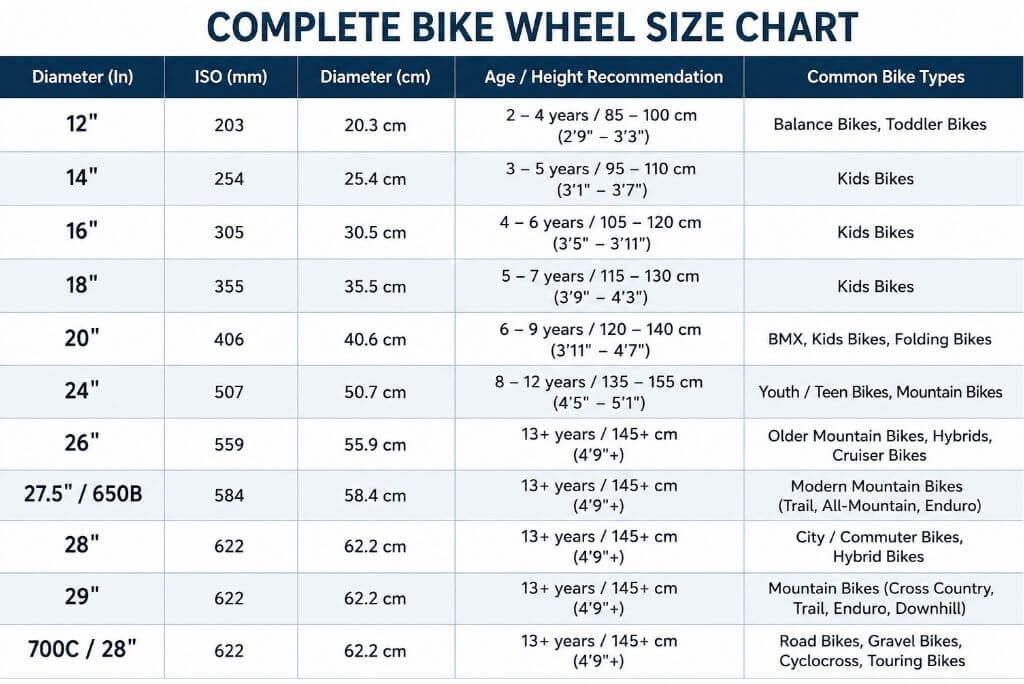
Bike Wheel Size Chart
Use this bike wheel size chart to compare common bicycle wheel diameters, ISO measurements, rider height recommendations, and the bike types each wheel size is commonly used for.
| Diameter (In) | ISO (mm) | Diameter (cm) | Age / Height Recommendation | Common Bike Types |
|---|---|---|---|---|
| 12" | 203 mm | 30.5 cm | Ages 2–4 / Under 36 in (91 cm) | Balance bikes, first pedal bikes |
| 14" | 254 mm | 35.6 cm | Ages 3–5 / 36–40 in (91–102 cm) | Kids bikes |
| 16" | 305 mm | 40.6 cm | Ages 4–6 / 40–46 in (102–117 cm) | Kids bikes, beginner BMX |
| 18" | 355 mm | 45.7 cm | Ages 5–7 / 42–48 in (107–122 cm) | Kids bikes |
| 20" | 406 mm | 50.8 cm | Ages 6+ / 45–54 in (114–137 cm) | BMX, kids bikes, folding bikes |
| 24" | 507 mm | 61.0 cm | Ages 8+ / 50–60 in (127–152 cm) | Youth mountain bikes, junior bikes |
| 26" | 559 mm | 66.0 cm | Teens and adults / 55+ in (140+ cm) | Older mountain bikes, cruisers, hybrids |
| 27.5" | 584 mm | 69.9 cm | Teens and adults / 5'2"+ (157 cm+) | Mountain bikes, trail bikes |
| 28" | 622 mm | 71.1 cm | Teens and adults / 5'4"+ (163 cm+) | Hybrid bikes, city bikes, touring bikes |
| 29" | 622 mm | 73.7 cm | Teens and adults / 5'5"+ (165 cm+) | Mountain bikes, XC bikes, trail bikes |
| 650B | 584 mm | 66.0 cm | Teens and adults / 5'2"+ (157 cm+) | Gravel bikes, some touring bikes, MTBs |
| 700C | 622 mm | 71.1 cm | Teens and adults / 5'4"+ (163 cm+) | Road bikes, gravel bikes, hybrid bikes |
This chart gives you a quick starting point, but it is still smart to check the exact tire and rim markings on your bike before buying anything.
Understanding ETRTO Measurements
If you want the most reliable way to identify wheel size, use the ETRTO system. ETRTO stands for the European Tyre and Rim Technical Organisation. In simple terms, it helps match the tire to the rim more accurately than inches alone.
The key number to know is the bead seat diameter (BSD). This number tells you the exact rim diameter where the tire sits.
For example:
- 26″ wheel = 559 mm
- 27.5″ / 650B wheel = 584 mm
- 29″ / 700C wheel = 622 mm
This is one reason people often get confused. Two wheel sizes may look similar in name, but the ISO number tells the real story.
If you are checking compatibility, always look for the ISO or ETRTO number on the tire sidewall or rim. That number is much more dependable than the inch label.
Common Bike Wheel Sizes Explained
12 Inch Wheels (ISO 203 mm)
12-inch wheels are the smallest common bike wheels you’ll see. They are usually used on balance bikes or very small kids’ bikes.
These wheels are designed to help young children learn balance and basic riding skills. They keep the bike low to the ground, which makes it easier and safer to control.
Because the wheel is small, it doesn’t roll smoothly over bumps or rough roads. It’s not meant for speed or long rides—just learning and short playtime riding.
In simple terms, this size is only for very young riders who are just starting out, not for regular cycling use.
14 Inch Wheels: ISO 254 mm
14-inch wheels are slightly bigger than the smallest kids’ bikes and are often used for children who are just getting more balance and control while riding. They are still very beginner-friendly but give a bit more stability than 12-inch wheels.
These wheels feel a little smoother on short outdoor rides, like in parks or quiet streets. They help kids build confidence before moving to larger bikes.
The only limitation is that they are still too small for longer rides or uneven roads. They are mainly a short transition stage before moving up to 16-inch wheels.
16 Inch Wheels: ISO 305 mm
16-inch wheels are a common choice for kids who already know the basics of balancing and pedaling. At this stage, children usually feel more confident and start riding more on their own.
These wheels roll a bit smoother than 12″ and 14″, so rides feel less shaky on small bumps or uneven paths. They are often used on first real “independent” bikes without training wheels.
One small drawback is that they can still feel limiting as the child grows quickly. After a while, most riders will need to move up to a 20-inch bike for better comfort and longer rides.
20 Inch Wheels: ISO 406 mm
20-inch wheels are a big step up from small kids’ bikes. You’ll often see them on BMX bikes, folding bikes, and bikes for older kids who ride more often.
At this size, the bike feels faster and more responsive. It can handle short jumps, curbs, and basic rough paths much better than smaller wheels. That’s why many beginner BMX riders start here.
The only downside is that the ride can feel a bit bumpy on longer trips, especially compared to larger wheels. But for tricks, city riding, or school use, it works very well.
24 Inch Wheels: ISO 507 mm
24-inch wheels are often used on youth bikes. They are a good middle step for kids who have outgrown smaller bikes but are not ready for full-size wheels yet.
They give a more stable ride and feel better on longer trips, school rides, or light trails. Compared with smaller wheels, they usually feel less cramped and easier to keep balanced.
The trade-off is that they can be outgrown fairly quickly. For many riders, 24-inch wheels are a short stage before moving to 26-inch or larger bikes.
26 Inch Wheels: ISO 559 mm
26-inch wheels were once the most common size for mountain bikes, and you still see them on many older or budget-friendly bikes today. They are a familiar choice for many riders.
These wheels feel easy to control and are good for everyday riding like city streets, casual trails, and light off-road use. They also tend to feel quick when starting from a stop.
The downside is that newer bikes often use 27.5″ or 29″ wheels because they roll over bumps more easily. So 26-inch wheels are now seen more as a traditional option than the latest standard.
27.5 Inch (650B) Wheels: ISO 584 mm
27.5-inch wheels, also called 650B, are very popular on modern mountain bikes. They are designed to give a good balance between control and speed.
These wheels feel smoother than 26-inch wheels when riding over rocks, roots, or uneven paths. At the same time, they still feel fairly quick and easy to handle on tight trails.
The small drawback is that they are not the fastest on flat roads compared to larger 29-inch wheels. But for most trail riders, they offer a very comfortable and balanced ride.
29 Inch Wheels: ISO 622 mm
29-inch wheels are commonly used on modern mountain bikes, especially for riders who go on longer rides or rough trails. They are built for efficiency and smooth rolling.
These wheels handle bumps and obstacles better than smaller sizes. Once they start moving, they keep rolling easily, which helps on climbs and longer distances.
The downside is that they can feel a bit slower to start and less quick in tight turns compared to smaller wheels. But for open trails and steady riding, they perform very well.
28 Inch Wheels: ISO 622 mm
28-inch wheels are often found on hybrid, city, and touring bikes. They are very close in size to 29-inch and 700C wheels, which is why they can feel quite similar in real use.
These wheels are made for smooth and steady riding. They roll well on roads and light paths, making them a good choice for daily commuting or relaxed cycling.
The downside is that “28-inch” is not always used the same way by every brand, which can cause confusion. So it’s always better to double-check the ISO (622 mm) before buying replacement parts.
700C Wheels: ISO 622 mm
700C wheels are one of the most common sizes for road bikes and gravel bikes. They are built for speed and smooth rolling on paved roads.
These wheels feel light and efficient when you ride on good surfaces. They help you maintain speed with less effort, which is why they are widely used for commuting, fitness rides, and long-distance cycling.
The drawback is that they are not as comfortable on rough or rocky trails compared to smaller mountain bike wheels. But on roads and smooth paths, they perform very well and feel steady even on longer rides.
How to Find Your Bike Wheel Size
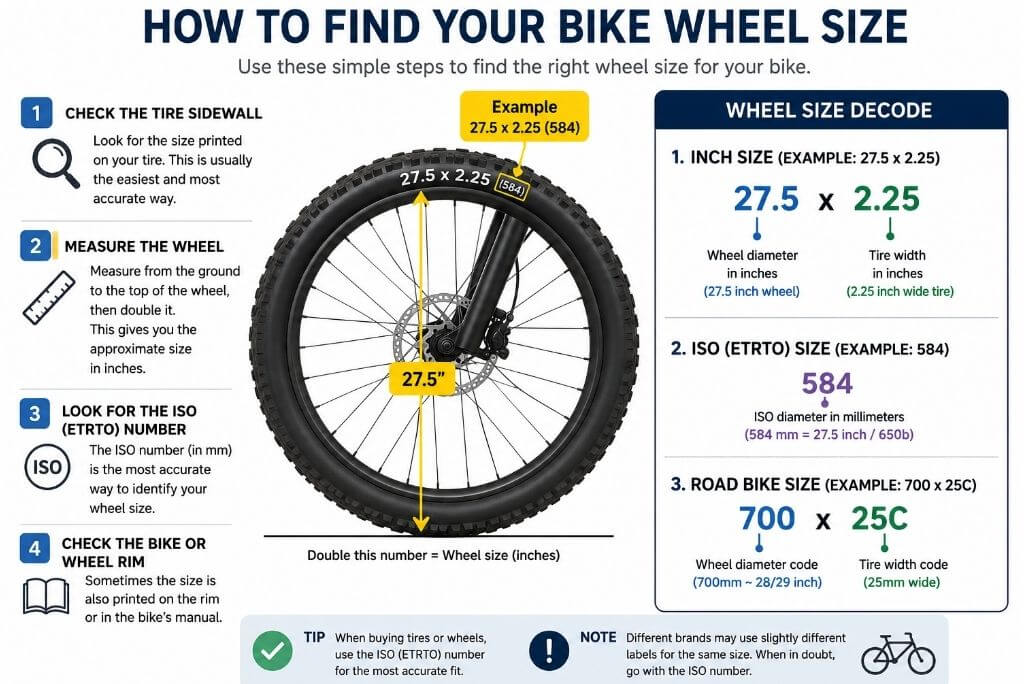
The easiest way to find your bike wheel size is to check the side of your tire. Most tires have the size printed there in inches or ISO numbers. You might see something like “26 x 2.0” or “700 x 25C”.
Sometimes the numbers are small or a bit worn out, so you may need to look closely. If you can’t read it clearly, don’t worry — there are other simple ways.
Another reliable method is to measure the wheel directly. Measure from the ground to the top of the wheel, then double it. This gives you an approximate size, but it may not be perfectly exact.
The most accurate way is to look for the ISO (ETRTO) number, like 559 mm or 622 mm. This number gives the true fitting size, and it helps you avoid buying the wrong tire or wheel.
Can You Change Wheel Sizes?
Sometimes yes, but not always. Changing wheel size is possible only if your frame, fork, brakes, and tire clearance allow it.
Before changing wheel size, check these things:
- Will the new wheel fit inside the frame and fork?
- Will the brakes line up properly?
- Is there enough room for the tire?
- Will the bottom bracket height or ride feel change too much?
For example, switching from 26-inch to 29-inch wheels is usually not a simple swap. In many bikes, the larger wheel will not fit. On the other hand, some bikes are built to accept both 700C and 650B wheels, depending on the frame design.
If you are not sure, check the bike manufacturer’s specs or ask a bike mechanic before buying new wheels.
Which Bike Wheel Size Is Best?
There is no single wheel size that is best for everyone. The right choice depends on your bike type, your height, and how you ride.
In general:
- Smaller wheels feel quicker to accelerate and easier to maneuver
- Larger wheels roll over bumps more smoothly and keep momentum better
- Mid-size wheels often offer a balance of comfort and control
For many riders:
- Kids usually need 12″ to 24″ wheels
- Casual riders often use 26″, 27.5″, 28″, or 700C
- Mountain bikers may prefer 27.5″ or 29″
- Road and gravel riders often choose 700C or 650B
Your riding style matters more than the number alone. A wheel size that works well for one rider may not be ideal for another.
Common Wheel Size Mistakes
Many riders make the same mistakes when shopping for bike wheels or tires. Avoiding these can save time and money.
One common mistake is confusing wheel size with tire width. For example, a tire marked 700 x 35C is not the same as 700 x 25C, even though both fit 700C wheels.
Another mistake is trusting the inch number without checking the ISO number. Two tires can sound similar but still be incompatible.
A third mistake is ignoring frame clearance. Even if the wheel fits the rim size, the tire may be too wide for the frame.
It is also easy to assume all 29-inch or all 700C wheels are the same. They share the same BSD, but the complete tire and bike setup still needs to match.
FAQs
Is 29-inch the same as 700C?
They use the same 622 mm BSD, but they are usually used on different bike types. A 29-inch wheel is common on mountain bikes, while 700C is common on road and gravel bikes.
Can I replace 26-inch wheels with 27.5-inch wheels?
Sometimes, but not on every bike. You need enough frame and fork clearance, and the brakes must work with the new wheel size.
What does ETRTO mean?
ETRTO is the standard system used to measure tire and rim compatibility. It helps you match the correct tire to the correct wheel.
Why do some wheel sizes have two names?
Because the bike industry uses both old-style inch labels and ISO/ETRTO numbers. That is why 27.5″ and 650B, or 29″ and 700C, can refer to the same BSD size.
Conclusion
A bike wheel size chart makes it much easier to understand bicycle sizing and choose the right wheel or tire. The inch label gives you a quick idea, but the ISO number tells you the exact fit. That is why checking both is always the safest choice.
If you are buying a new bike, replacing tires, or comparing wheel sizes, focus on compatibility first and ride style second. The best wheel size is the one that fits your bike, supports your riding needs, and gives you confidence on the road or trail.
With the right chart and a little attention to detail, choosing bike wheels becomes much simpler.
