What Is Tire Speed Rating S?
If you have ever looked at a tire sidewall and noticed a letter at the end of the tire size code, you may have wondered what it means. One of the most common questions is: what is tire speed rating S?
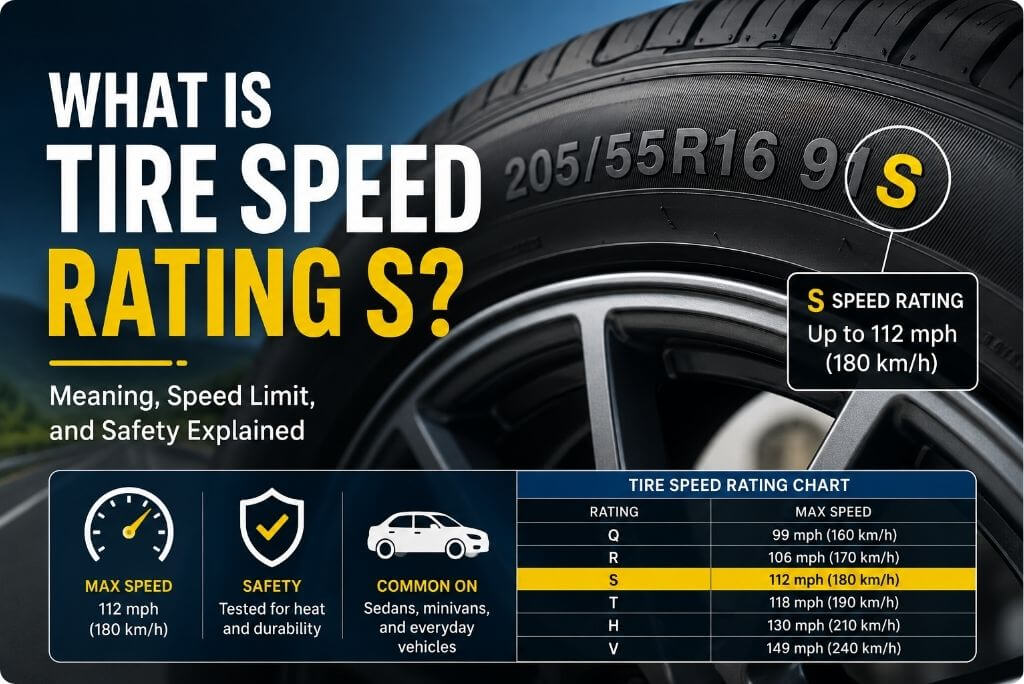
The short answer is that S is a speed rating that means the tire is designed to safely handle speeds up to 112 mph (180 km/h) under controlled test conditions. That does not mean you should drive that fast. It simply tells you the tire has been built and tested to perform up to that limit.
Understanding this matters because the speed rating is part of choosing the right tire for your vehicle. It affects safety, handling, and whether the tire matches the way your car was designed to be driven. In this guide, we will break down what the S rating means, how it compares with other ratings, and how to decide whether it is right for your vehicle.
What Does the S Tire Speed Rating Mean?
The S tire speed rating tells you the highest speed a tire is designed to handle safely under specific test conditions. For an S-rated tire, that maximum speed is 112 mph (180 km/h).
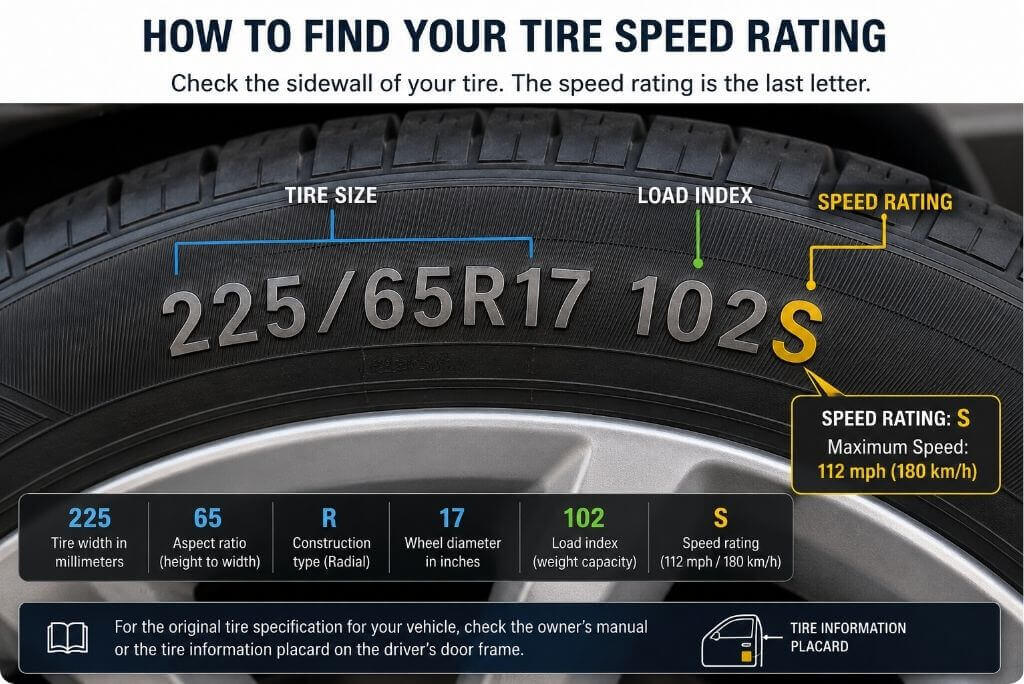
You’ll usually find this rating at the end of the tire’s sidewall code. For example, in a tire marked 225/65R17 102S, the “S” is the speed rating.
It’s important to understand that this number is not a recommended driving speed. It simply shows the tire’s tested capability under controlled conditions. Real-world factors such as road conditions, tire wear, vehicle load, weather, and tire pressure can all affect performance.
The speed rating is also just one part of choosing the right tire. A tire should match your vehicle’s recommended size, load index (how much weight it can carry), and overall fitment requirements. Even if a tire has the correct speed rating, it may not be suitable if the other specifications don’t match your vehicle.
For most everyday drivers, an S-rated tire provides more than enough speed capability for normal city and highway driving.
What a Tire Speed Rating Actually Measures
A tire speed rating shows the maximum speed a tire can safely maintain during standardized testing. These tests are performed under controlled conditions to see how well a tire handles sustained speed without failing.
The rating isn’t based only on speed. It also reflects how well the tire manages heat, since tires generate more heat as speed increases. A tire must be built to withstand that heat while maintaining its strength and stability.
In general, tires with higher speed ratings are made for more demanding driving conditions. They often use different materials and construction methods to improve performance at higher speeds.
However, a speed rating does not tell you everything about a tire. It doesn’t indicate how long the tread will last, how much weight the tire can carry, or how much grip it provides on wet or dry roads.
Think of the speed rating as just one piece of the puzzle. It’s useful, but it should be considered alongside other tire specifications when choosing the right tire for your vehicle.
How the S Rating Fits Into the Tire Speed Rating System
Tire speed ratings use letters to show the maximum speed a tire is designed to handle. As you move up the rating scale, each letter represents a higher speed capability.
The S rating sits near the middle of several common speed ratings. It offers more speed capability than lower-rated tires, while staying well within the needs of most everyday drivers.
| Speed Rating | Maximum Speed |
| Q | 99 mph (160 km/h) |
| S | 112 mph (180 km/h) |
| T | 118 mph (190 km/h) |
| H | 130 mph (210 km/h) |
| V | 149 mph (240 km/h) |
Looking at the chart, you can see that the differences between ratings are not always huge. For example, a T-rated tire is only rated for 6 mph more than an S-rated tire.
For many sedans, minivans, crossovers, and SUVs, the S rating provides a practical balance. It offers enough speed capability for normal driving without the higher-performance focus that comes with ratings such as H or V.
That said, the best rating is the one recommended for your vehicle. A higher rating isn’t necessarily better if your vehicle doesn’t require it.
Which Vehicles Commonly Use S-Rated Tires?
S-rated tires are commonly found on vehicles designed for regular daily driving rather than high-performance use. They are often used on some sedans, minivans, crossovers, and light-duty vehicles where a balance of comfort, reliability, and everyday performance is important.
Many family vehicles and commuter cars may come with S-rated tires from the factory. These vehicles usually do not need the higher speed capability of performance-focused tires because they are built mainly for normal road use.
However, there is no single rule for which vehicles use S-rated tires. Tire choices can vary depending on the vehicle model, engine type, trim level, and the manufacturer’s design requirements.
Before replacing your tires, always check the tire information label on the driver’s door frame or your owner’s manual. These sources show the recommended tire size, load rating, and speed rating your vehicle was designed to use.
Is an S Speed Rating Safe?
Yes, an S speed rating is safe when the tire is used within its limits and matches your vehicle’s requirements. An S-rated tire is designed to handle speeds up to its rated limit when properly maintained and used in the right conditions.
The most important thing is to follow the tire specifications recommended by your vehicle manufacturer. The correct tire size, load rating, and speed rating work together to ensure the tire performs as intended.
Driving beyond the tire’s speed rating can create extra heat inside the tire. Too much heat can weaken the tire structure and increase the risk of damage or failure.
Safety also depends on more than the speed rating. Tire pressure, tire age, vehicle load, road conditions, and overall tire condition all play a role in how safely a tire performs.
A properly matched and well-maintained S-rated tire is suitable for many everyday driving situations.
Can You Use S-Rated Tires on a Vehicle That Originally Came With a Higher Rating?
It is usually not recommended to replace a tire with a lower speed rating than the one originally specified for your vehicle. A vehicle designed for a higher-rated tire may rely on that tire’s construction for proper handling and stability.
In some cases, a lower rating may be acceptable if the vehicle manufacturer allows it or if the replacement tire meets all required specifications. However, this should be confirmed before making the change.
Using a lower-rated tire can affect how the vehicle feels on the road, especially during higher-speed driving, sudden braking, or quick turns. The tire may not provide the same level of stability and response as the original specification.
Before replacing your tires, check your owner’s manual or the tire information label on your vehicle. Matching the recommended tire size, load rating, and speed rating helps ensure your tires perform as intended.
S vs. Other Common Speed Ratings
The best way to understand S is to compare it with nearby ratings.
S is faster-rated than Q and R, but below T, H and V. In practical terms, it sits in a comfortable middle zone for regular driving. It is not meant for sporty or aggressive driving, but it is more than enough for most drivers on public roads.
Here is the simple difference:
- S: good for normal everyday driving and highway use
- T: a little higher speed capability
- H: more performance-oriented
- V: even more performance-focused
A higher speed rating is not automatically better. A tire with a higher rating may be designed differently, and that can affect ride comfort, price, tread life, and noise. The best tire is the one that fits your vehicle and driving habits.
How to Check Your Tire’s Speed Rating
You can find your tire’s speed rating on the tire sidewall. It appears at the end of the tire code, after the numbers that show the tire’s load rating.
For example, a tire marked 225/65R17 102S has:
- 225/65R17 = tire size information
- 102 = load index (how much weight the tire can carry)
- S = speed rating
The last letter in the service description is the part that tells you the tire’s speed rating. In this example, the tire is S-rated.
Before buying replacement tires, don’t rely only on the sidewall marking. Check your vehicle’s owner’s manual or the tire information label on the driver’s door frame to confirm the correct tire size, load index, and speed rating recommended for your vehicle.
How to Choose the Right Tire Speed Rating for Your Needs
The best tire speed rating depends on how you actually drive. If you mostly commute, run errands, and drive normal highway speeds, an S-rated tire is often enough.
If you spend a lot of time on the highway, carry heavy loads, tow regularly, or drive a vehicle built for stronger performance, a higher rating may make more sense. In those cases, the tire may need more heat resistance and stability than an S-rated tire provides.
S is a practical choice for many drivers because it covers everyday use without adding extra cost or stiffness you may not need. But it is not the right fit for every vehicle, especially if your owner’s manual recommends a higher rating.
The safest choice is the one that matches your driving habits and your vehicle’s original specifications.
Common Misunderstandings About S-Rated Tires
- “Higher speed rating always means better tires.”
Not always. A higher rating can be useful for some drivers, but it is not automatically the best choice for everyday use. The right tire is the one that matches your vehicle and driving needs. - “S-rated means the tire is only for slow driving.”
That is not true. S-rated tires are designed for speeds up to 112 mph under test conditions, which is more than enough for normal city and highway driving. - “Speed rating is the only safety factor.”
It is only one part of the picture. Tire pressure, load, age, and overall condition also affect safety. - “All tires with the same speed rating perform the same.”
They do not. Tires can share the same rating but still differ in ride comfort, wet grip, tread life, and handling.
FAQs
Is an S-rated tire good for highway driving?
Yes, for normal highway driving, an S-rated tire is suitable for many vehicles. It is designed for everyday road use, not high-performance driving.
Is S better than T?
Not necessarily. T has a higher speed rating than S, but that does not automatically make it the better tire for every driver. The right choice depends on your vehicle and driving needs.
Can I replace H-rated tires with S-rated tires?
Usually not without checking the manufacturer’s recommendation. Lowering the speed rating can affect handling and may not be appropriate for the vehicle.
Does speed rating affect tire life?
It can. Tires built for higher speed ratings are often constructed differently, which may influence tread life, comfort, and performance. But tire life depends on many factors, including driving habits and maintenance.
Do I need a higher speed rating if I never drive fast?
Not always. The best rating is the one that matches your vehicle and your usual driving conditions. More is not always better.
Conclusion
So, what is tire speed rating S? It means the tire is designed to safely handle speeds up to 112 mph (180 km/h) under standardized test conditions. For many drivers, that is more than enough for normal road and highway use.
The most important thing is to choose a tire that matches your vehicle’s recommendation and your real driving needs. Do that, and you will get a better balance of safety, comfort, and value.
If you are replacing tires, remember this simple rule: check the size, load index, and speed rating together before you buy. That small step can help you make a safer and smarter choice.
